
Why psoriasis involves extensor surface
Reading File
Finding Sources
Finding Sources
Searching the Web
why psoriasis affects extensor surfaces Koebner phenomenon pathophysiology
Reading File
Reading File
Loading Image
Excellent - I now have all the information needed for a thorough answer. Here is the full explanation:
Why Psoriasis Involves the Extensor Surface
The predilection of psoriasis for extensor surfaces (elbows, knees, shins, knuckles) is fundamentally explained by the Koebner (isomorphic) phenomenon - the most important concept linking trauma to plaque localization.
1. The Koebner Phenomenon - The Core Explanation
The Koebner phenomenon is the traumatic induction of psoriatic lesions on previously unlesional skin. Extensor surfaces are targeted because they are the areas of the body that receive the most mechanical trauma, friction, and pressure during daily activities - elbows bump against surfaces, knees contact the ground, shins get bumped. This is not coincidental; it is a direct cause-and-effect relationship.
Key facts:
- Observed in 25-75% of psoriasis patients at some point in their disease
- The Koebner reaction appears 7-14 days after injury (lag time of 2-6 weeks cited in some sources)
- It is an all-or-none phenomenon - if psoriasis occurs at one site of injury, it will occur at all sites of injury simultaneously
- A patient may be "Koebner-negative" at one time and become "Koebner-positive" later
(Fitzpatrick's Dermatology, p. 488; Dermatology 2-Volume Set 5e)
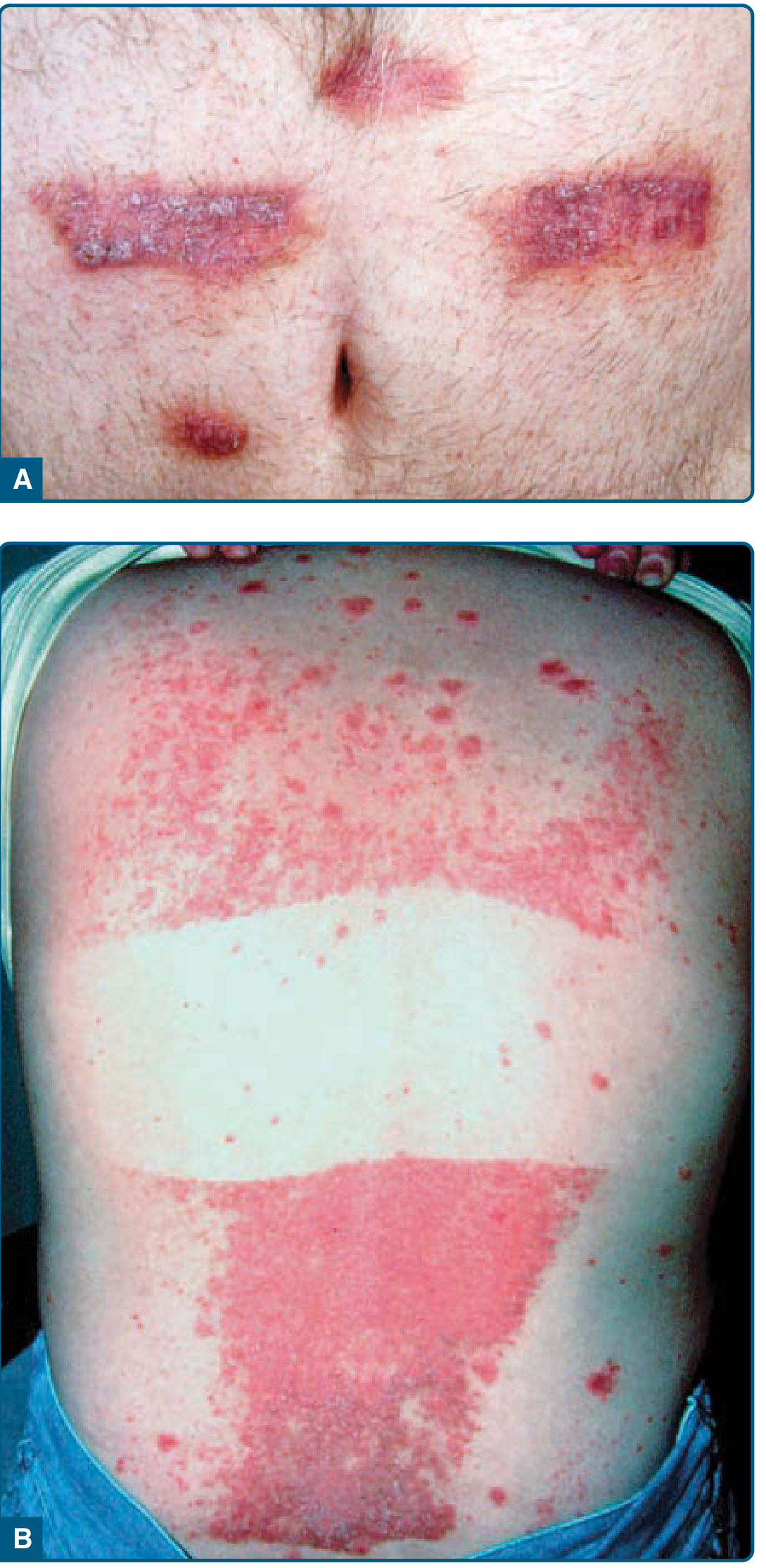
2. Why Extensor Surfaces Specifically?
| Factor | Extensor Surface | Flexor Surface |
|---|---|---|
| Mechanical trauma/friction | High (elbows, knees knocked daily) | Low (protected, shielded) |
| Skin thickness/tension | Greater, skin stretched over bony prominences | Skin is loose, redundant |
| Vascular response to trauma | Abnormal microvasculature response in psoriatics | Less traumatized, less activated |
| Sun exposure | More exposed | Less exposed |
The bony prominences at extensor sites (olecranon at the elbow, patella at the knee) mean the overlying skin is under constant mechanical stress - stretched, rubbed, and frequently bumped. This chronic low-grade trauma is the perpetual trigger for Koebner responses in predisposed individuals.
3. Pathophysiology: How Trauma Triggers a Plaque
The exact mechanism is incompletely understood, but current evidence points to:
-
Keratinocyte injury releases cytokines: basic fibroblast growth factor (bFGF) and nerve growth factor (NGF), which stimulate keratinocyte proliferation - the hallmark of psoriasis.
-
T-cell activation: Traumatized skin recruits T-cells; in psoriasis-susceptible individuals, these T-cells (particularly Th17 and Th1 cells) launch an exaggerated, autoimmune-like response releasing IL-17, IL-23, and TNF.
-
Tissue-Resident Memory T cells (TRM): These cells persist in the skin after previous lesions resolve, and skin injury reactivates them - explaining both Koebnerization and why psoriasis relapses at previously affected sites ("disease memory").
-
Abnormal microvasculature: Psoriatic skin shows an abnormal vascular response to trauma, with exaggerated angiogenesis and dermal papillary involvement being required to trigger a full Koebner response.
-
Aberrant innate immunity: Keratinocytes at sites of injury upregulate antimicrobial peptides like LL-37 and hBD2, which activate plasmacytoid dendritic cells (pDCs) and initiate the inflammatory cascade.
(Dermatology 2-Volume Set 5e, Triggering Factors / Innate immunity sections; StatPearls - Koebner Phenomenon)
4. Classic Sites of Predilection (Summary)
- Elbows (most common) - constant bumping and friction
- Knees - kneeling, contact with hard surfaces
- Shins / lower extremities - bumps and pressure
- Scalp - scratching and combing (microtrauma)
- Lumbosacral / buttocks - pressure from sitting
- Umbilicus and intergluteal cleft - friction and maceration
5. Contrast with Atopic Dermatitis
This extensor predominance is the opposite of atopic dermatitis (eczema), which favors flexor surfaces (antecubital fossa, popliteal fossa). This distinction is a classic teaching point:
| Condition | Preferred Surface | Reason |
|---|---|---|
| Psoriasis | Extensor | Koebner phenomenon (trauma-driven) |
| Atopic dermatitis | Flexor | Moisture, occlusion, scratch-itch cycle |
In summary: Extensor surfaces receive the most mechanical trauma and friction in daily life. In genetically predisposed individuals with psoriasis, this trauma consistently triggers the Koebner (isomorphic) phenomenon - the immune-mediated induction of new plaques at sites of skin injury. The result is the characteristic distribution of psoriatic plaques over elbows, knees, and shins.
This is a shared conversation. Sign in to Orris to start your own chat.