
What are the chances of getting pregnant if you had sex in seventh day and your cycle is of 24 days?
pregnancy chances day 7 of 24 day menstrual cycle ovulation fertility
Pregnancy Chances: Sex on Day 7 of a 24-Day Cycle
Step 1 - When Does Ovulation Happen?
Estimated ovulation day = 24 - 14 = Day 10
Step 2 - The Fertile Window
- Sperm can survive up to 5-6 days in well-estrogenized cervical mucus
- A released egg is only fertilizable for less than 24 hours
Step 3 - Estimated Probability
| Days Before Ovulation | Approx. Pregnancy Probability |
|---|---|
| 5 days before (Day 5 of 24-day cycle) | ~10% |
| 4 days before | ~16% |
| 3 days before (Day 7 of 24-day cycle) | ~14-27% |
| 2 days before | ~27-33% |
| 1 day before | ~31% |
| Day of ovulation (Day 10) | ~20% |
| 1 day after ovulation | very low (~0-10%) |
Key Takeaways
- The chances are real and significant. Day 7 of a 24-day cycle is within the fertile window, not a "safe" time.
- Variability matters. If ovulation shifts even 1-2 days earlier (to day 8 or 9, which is possible), day 7 becomes even more likely to result in conception.
- The ACOG recommends that couples trying to conceive have sex between days 7-20 of a standard cycle - day 7 of a short 24-day cycle is explicitly in the recommended window.
- On every day between days 6 and 21 of the menstrual cycle, at least 10% of women are in their fertile window at any given time, per the Wilcox BMJ 2000 study.
Note: This is general information based on average cycle patterns. Individual variation in ovulation timing, cycle length, and fertility can change these numbers significantly. Consult a healthcare provider for personalized advice.
Create a fertility calendar chart for different cycle lengths
A clean, professional fertility calendar chart showing fertile windows for different menstrual cycle lengths. The chart is a horizontal bar/grid table with cycle lengths listed on the left (21 days, 24 days, 26 days, 28 days, 30 days, 32 days, 35 days). The horizontal axis shows cycle days 1 through 35. Each row is color-coded with three zones: red zone for menstruation (days 1-5), green zone for the fertile window (6-day window ending on ovulation day), and yellow zone for the ovulation day marked with a star or egg icon. Safe/low-fertility days are shown in light gray. The legend clearly explains: Red = Menstruation, Green = Fertile Window, Yellow star = Ovulation Day, Gray = Low Fertility. Title at top reads "Fertility Calendar by Cycle Length". Clean medical infographic style with white background, easy to read labels on every cell, professional typography.
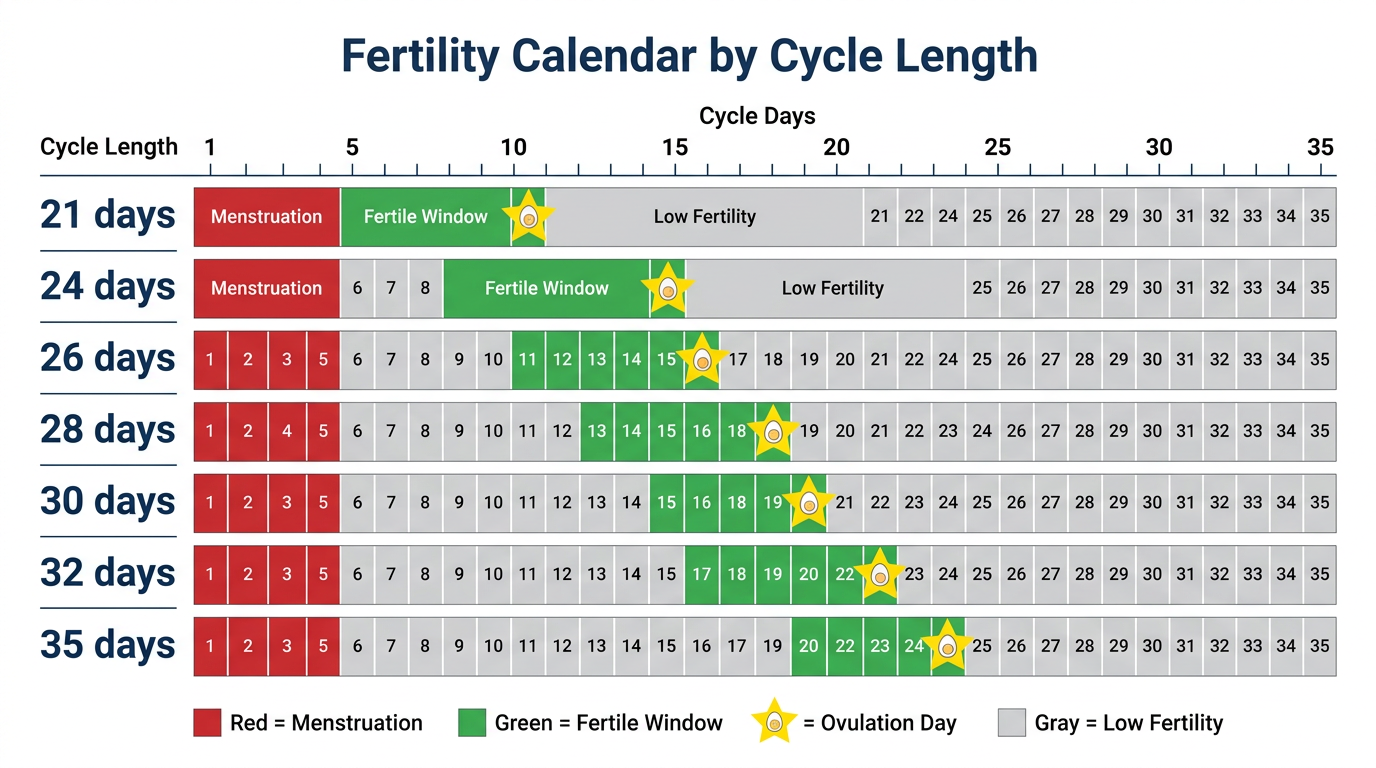
How to Read the Chart
| Color | Meaning |
|---|---|
| 🔴 Red | Menstruation (Days 1-5 approx.) |
| 🟢 Green | Fertile Window (6 days before ovulation) |
| 🌕 Yellow/Star | Ovulation Day |
| ⬜ Gray | Low fertility / relatively safe days |
Ovulation & Fertile Window by Cycle Length
| Cycle Length | Ovulation Day (approx.) | Fertile Window | Your Situation |
|---|---|---|---|
| 21 days | Day 7 | Days 1 - 7 | Very short - period overlaps fertile days |
| 24 days | Day 10 | Days 4 - 10 | Day 7 = HIGH fertility |
| 26 days | Day 12 | Days 6 - 12 | Day 7 = moderate-high |
| 28 days | Day 14 | Days 8 - 14 | Day 7 = moderate |
| 30 days | Day 16 | Days 10 - 16 | Day 7 = low-moderate |
| 32 days | Day 18 | Days 12 - 18 | Day 7 = low |
| 35 days | Day 21 | Days 15 - 21 | Day 7 = very low |
These are estimates based on the rule that ovulation occurs ~14 days before the next period. Actual ovulation varies. Tracking basal body temperature or using LH predictor kits gives more precise timing.
In past 1 year the females shortest cycle is 24 days and longest cycle is 33 days
- First fertile day = Shortest cycle - 18 = 24 - 18 = Day 6
- Last fertile day = Longest cycle - 11 = 33 - 11 = Day 22
A professional, clean medical fertility calendar infographic for a woman whose shortest cycle is 24 days and longest cycle is 33 days. Shows a horizontal calendar strip of days 1 through 33. Color-coded zones clearly labeled: Days 1-5 in red labeled "Menstruation", Days 6-22 in bright green labeled "Fertile Window (Days 6-22) - AVOID or USE PROTECTION", with a gold star on Day 10 labeled "Earliest Ovulation" and another gold star on Day 19 labeled "Latest Ovulation", Days 23-33 in light gray labeled "Lower Risk". A bold warning banner at the top in orange says "FERTILE WINDOW SPANS 17 DAYS". Below the calendar strip, a short legend and note: "Based on Rhythm Method: Shortest cycle (24 days) - 18 = Day 6 | Longest cycle (33 days) - 11 = Day 22". Title at top: "Personalized Fertility Window Calculator". Clean white background, medical infographic style, easy to read, professional typography, no clutter.
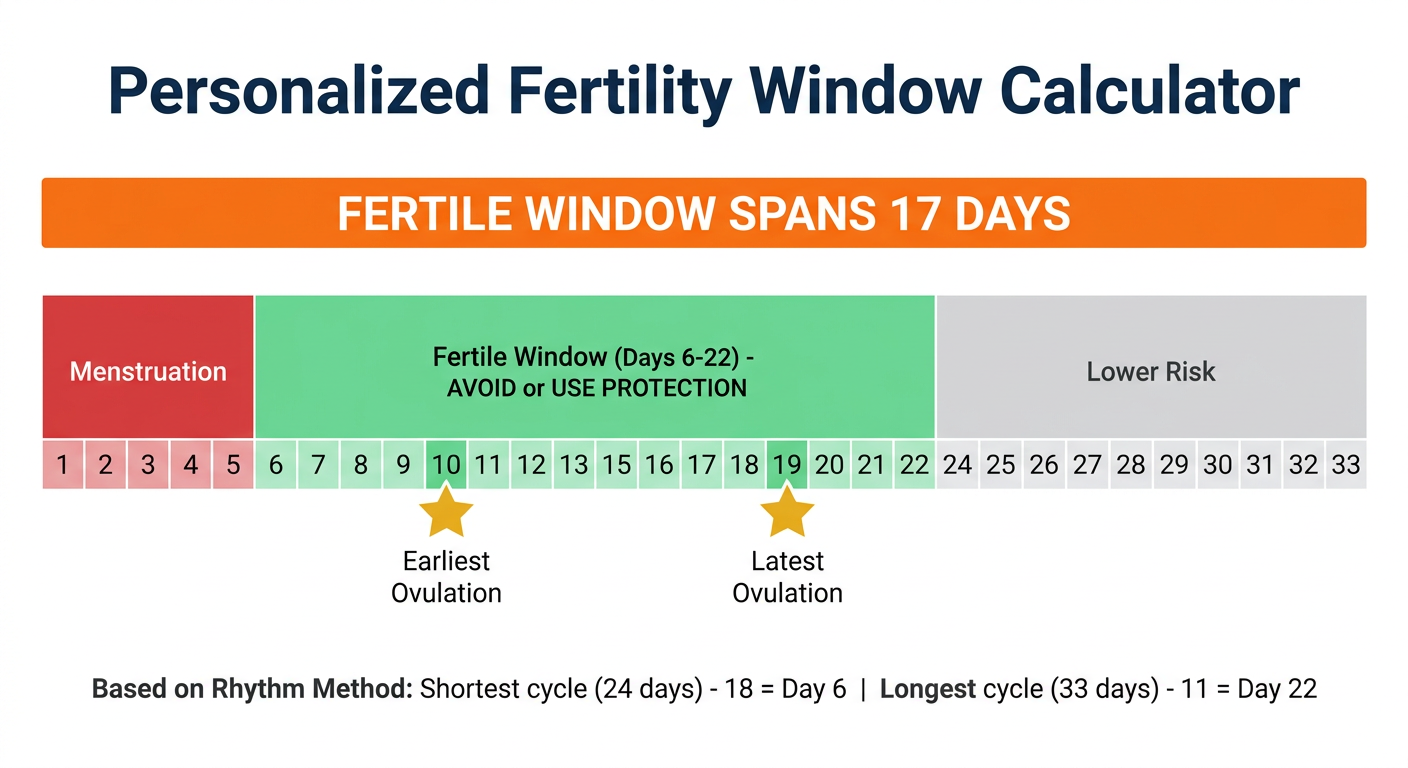
Personalized Fertility Window: 24-33 Day Cycle Range
The Formula (Ogino-Knaus Rhythm Method)
| Formula | Calculation | Result | |
|---|---|---|---|
| First fertile day | Shortest cycle - 18 | 24 - 18 | Day 6 |
| Last fertile day | Longest cycle - 11 | 33 - 11 | Day 22 |
Your Cycle at a Glance
| Days | Phase | Risk |
|---|---|---|
| Days 1 - 5 | Menstruation | Low (but not zero) |
| Days 6 - 22 | Fertile Window | HIGH - can get pregnant |
| Days 23 - 33 | Post-ovulation / Luteal phase | Low |
What This Means for Day 7
Important Points
-
The fertile window spans 17 days (days 6-22) - this is wide because cycles vary by 9 days across the year. The more irregular the cycle, the wider and less predictable the window.
-
Day 7 is never "safe" for this woman - it is inside the fertile window in every possible cycle length she has had.
-
The rhythm method alone has a ~9-24% typical-use failure rate per year. Given a 9-day cycle variability range, it is considered unreliable as a sole contraceptive method.
-
For conception - the best days to try are roughly Days 8-19, targeting 2-3 days before the estimated ovulation in any given cycle.
-
Ovulation can shift even within a known cycle range due to stress, illness, sleep changes, and other factors.
For reliable contraception, consult a healthcare provider about methods beyond the calendar/rhythm method. For trying to conceive, tracking basal body temperature or using LH ovulation predictor kits will give much more accurate day-specific timing than calendar calculations alone.