
/generatehandwrittenimages Explain the gibbs donnan effect and its role in determining the distribution of ions and water across capillary walls. How do changes in plasma protein concentration, capillary permeability and lymphatic drainage impact gibbs Donnan equilibrium and fluid balance in body - for md physiology 10 marks theory question. You can make many images and not just one for completing the answer
Handwritten medical physiology diagram on lined notebook paper showing the Gibbs-Donnan equilibrium concept. Show two compartments separated by a semipermeable membrane - left side labeled "Plasma (capillary)" with large negatively charged protein molecules (Pr-) that cannot cross, Na+ and Cl- ions. Right side labeled "Interstitial Fluid" with only Na+ and Cl-. Arrows showing redistribution: Na+ slightly higher in plasma, Cl- slightly higher in interstitium. Show the Donnan ratio formula: [Cl-]plasma/[Cl-]ISF = 0.95, [Na+]ISF/[Na+]plasma = 0.95. Add handwritten note: "Proteins impermeable → redistribute permeant ions → maintain electroneutrality". Include a small note: "r = Donnan ratio". Blue pen handwriting style with annotations, educational diagram format.
Handwritten medical physiology diagram on lined notebook paper showing Starling forces at the capillary wall for an MD physiology student. Draw a capillary tube with arterial end on left and venous end on right. Show four Starling forces with arrows: 1) Capillary hydrostatic pressure (Pc) pushing fluid out - arterial end 30 mmHg, venous end 10 mmHg. 2) Plasma colloid osmotic pressure (πc) pulling fluid in = 28 mmHg. 3) Interstitial fluid hydrostatic pressure (Pif) = -3 mmHg pushing out. 4) Interstitial fluid colloid osmotic pressure (πif) = 8 mmHg pushing out. At arterial end: Net filtration = 13 mmHg OUT. At venous end: Net reabsorption = 7 mmHg IN. Show Starling equation: Jv = Kf[(Pc - Pif) - σ(πc - πif)]. Handwritten blue pen style on notebook lined paper with box annotations.
Handwritten medical physiology notes on lined notebook paper showing a clear table and diagram of how plasma protein concentration affects fluid balance. Show a comparison table with three columns: Normal, Hypoproteinemia (e.g. nephrotic syndrome/cirrhosis/malnutrition), Hyperproteinemia. Rows showing: Plasma colloid osmotic pressure (πc), Direction of Starling forces, Net filtration/reabsorption, Clinical outcome (edema or dehydration). Draw a small diagram showing hypoalbuminemia: decreased πc → net outward force → fluid accumulates in interstitium → EDEMA. Include note: "Normal albumin 3.5-5.5 g/dL, πc ~25-28 mmHg. If albumin falls → πc falls → filtration exceeds reabsorption → pitting edema". Handwritten educational style blue pen on notebook paper.
Handwritten medical physiology diagram on lined notebook paper showing the role of lymphatic drainage in fluid balance. Draw a capillary, interstitial space, and lymphatic vessel. Show: 1) Normal: 90% of filtered fluid reabsorbed at venous end of capillary, 10% drained by lymphatics (labeled ~2-4 L/day). 2) Lymphatic obstruction scenario: blocked lymphatics → protein accumulates in interstitium → raised interstitial colloid osmotic pressure (πif) → more fluid drawn out → lymphedema. 3) Box showing "Safety factors against edema": i) Lymphatic flow can increase 10-50x, ii) Tissue compliance reduces rise in Pif, iii) Dilution of interstitial proteins reduces πif. Add note: "Lymphedema = high protein content edema (unlike cardiac/renal edema)". Draw with handwritten blue pen style on lined notebook paper.
Handwritten medical physiology notes on lined notebook paper showing capillary permeability and its effect on Gibbs-Donnan equilibrium and fluid balance. Draw a normal vs increased permeability capillary. Normal capillary: large proteins retained, Gibbs-Donnan effect intact, πc maintained at 28 mmHg. Increased permeability (e.g. inflammation, sepsis, burns, ARDS): proteins leak into interstitium → interstitial πif rises from 8 mmHg to higher values → both Gibbs-Donnan disrupted and Starling forces favor filtration → massive edema. Show table: Cause of increased permeability: histamine, cytokines, bradykinin, VEGF, burns. Effect: loss of Donnan effect, loss of oncotic gradient. Clinical: pulmonary edema, anasarca. Also note: "Reflection coefficient σ decreases → proteins cross → oncotic gradient lost". Handwritten blue/black pen educational style on lined notebook paper.
Handwritten medical physiology summary flowchart on lined notebook paper for MD exam. Title: "Gibbs-Donnan Effect & Fluid Balance - Summary". Show a master flowchart: Plasma proteins (Albumin Pr-) trapped in capillary → 1) Gibbs-Donnan equilibrium: Na+ slightly higher in plasma, Cl- slightly lower in plasma, creating osmotic gradient. 2) Oncotic pressure πc = 25-28 mmHg. 3) Starling equilibrium maintained: filtration at arterial end balanced by reabsorption at venous end + lymph drainage. Then show THREE disruptions with arrows: A) ↓ Plasma protein → ↓πc → ↑ net filtration → EDEMA (nephrotic, cirrhosis, malnutrition). B) ↑ Capillary permeability → proteins leak → ↑πif + ↓πc gradient → EDEMA (inflammation, ARDS, sepsis). C) Lymphatic obstruction → protein accumulation in ISF → ↑πif → LYMPHEDEMA (filariasis, malignancy). Final box: "Clinical: Treat underlying cause, albumin infusion, diuretics, treat infection". Handwritten neat educational flowchart, blue pen, lined notebook paper.
Error calling model 'gemini-3-pro-image' (RESOURCE_EXHAUSTED): 429 RESOURCE_EXHAUSTED. {'error': {'code': 429, 'message': 'Resource has been exhausted (e.g. check quota).', 'status': 'RESOURCE_EXHAUSTED'}}
We encountered an error while processing your request. Please try again or reach out to us for help.
/generatehandwrittenimages Explain the gibbs donnan effect and its role in determining the distribution of ions and water across capillary walls. How do changes in plasma protein concentration, capillary permeability and lymphatic drainage impact gibbs Donnan equilibrium and fluid balance in body - for md physiology 10 marks theory question. You can make many images and not just one for completing the answer
A handwritten medical physiology diagram on white lined notebook paper using blue ink pen, student exam notes style. Title at top in underlined handwriting: "GIBBS-DONNAN EQUILIBRIUM". Draw two rectangular compartments side by side separated by a vertical dashed line labeled "Semipermeable Capillary Wall". LEFT box labeled "PLASMA (Capillary)" contains: large oval shapes labeled "Pr⁻ (albumin, globulin) - CANNOT CROSS" and small ions: Na⁺ = 142 mEq/L (slightly higher), Cl⁻ = 103 mEq/L (slightly lower). RIGHT box labeled "INTERSTITIAL FLUID" contains: only small ions: Na⁺ = 145 mEq/L (slightly lower), Cl⁻ = 114 mEq/L (slightly higher). Small arrows showing Na⁺ slightly higher in plasma side, Cl⁻ slightly higher in ISF. Below the boxes, handwritten formula box: "Donnan Ratio r = [Na⁺]ISF / [Na⁺]plasma = [Cl⁻]plasma / [Cl⁻]ISF = 0.95". Below that, two key principles written in neat handwriting: "1. Electrical neutrality maintained in each compartment" and "2. Proteins (Pr⁻) attract Na⁺, repel Cl⁻ → unequal ion distribution". Bottom note: "Result: Plasma osmolality slightly > ISF osmolality → net osmotic force drawing H₂O into capillary". Small water drop arrows pointing inward toward plasma side. Clean student notebook aesthetic.
Handwritten medical physiology diagram on white lined notebook paper, blue ink pen, student notes style. Title underlined: "STARLING FORCES & FLUID EXCHANGE AT CAPILLARY WALL". Draw a horizontal cylindrical tube (capillary) in the center. Left end labeled "ARTERIAL END" with small arrow showing blood flow direction. Right end labeled "VENOUS END". Above the capillary, draw large upward arrows labeled with forces pushing fluid OUT: "Pc (capillary hydrostatic pressure) = 30 mmHg" at arterial end and "= 10 mmHg" at venous end. Draw small upward arrow: "Pif (negative interstitial pressure) = -3 mmHg (adds to outward force)". Draw small upward arrow: "πif (interstitial COP) = 8 mmHg". Below capillary, one large downward arrow: "πc (plasma COP / oncotic pressure) = 28 mmHg ← due to Gibbs-Donnan effect + proteins". Two calculation boxes: LEFT BOX "Arterial end: Outward = 30+3+8 = 41 mmHg, Inward = 28 mmHg, Net FILTRATION = 13 mmHg →→ fluid leaves". RIGHT BOX "Venous end: Outward = 10+3+8 = 21 mmHg, Inward = 28 mmHg, Net REABSORPTION = 7 mmHg →→ fluid enters". At bottom: Starling Equation in box: "Jv = Kf [(Pc - Pif) - σ(πc - πif)]". Note: "90% reabsorbed at venous end, 10% via lymphatics (~2 mL/min net filtration)". Neat handwriting style.
Handwritten medical physiology notes on white lined notebook paper, blue ink pen, MD exam notes style. Title underlined: "EFFECT OF PLASMA PROTEIN CONCENTRATION ON GIBBS-DONNAN & FLUID BALANCE". Draw three vertical columns side by side: COLUMN 1 "NORMAL": Albumin 3.5-5g/dL, πc = 25-28 mmHg, Donnan ratio intact, Filtration ≈ Reabsorption, No edema. COLUMN 2 "HYPOPROTEINEMIA" with down arrow: Causes listed: Nephrotic syndrome (↑ urinary loss), Cirrhosis (↓ synthesis), Malnutrition (kwashiorkor), Malabsorption. Mechanism: ↓ albumin → ↓ Gibbs-Donnan effect → ↓ πc → Net outward force dominant → Fluid accumulates in ISF → PITTING EDEMA (draw puffy leg). Critical level: "Edema when albumin < 2 g/dL or πc < 15 mmHg". COLUMN 3 "HYPERPROTEINEMIA" with up arrow: Dehydration → concentrated proteins → ↑ πc → Excessive fluid reabsorption. Between columns draw connecting arrows. Bottom section: Small diagram showing "Normal capillary" vs "Hypoalbuminemia capillary" with big arrow pointing out showing fluid leaking into interstitium. Neat handwriting, educational exam notes style.
Handwritten medical physiology diagram on white lined notebook paper, blue ink pen, MD exam study notes style. Title underlined at top: "CAPILLARY PERMEABILITY & LYMPHATIC DRAINAGE - Effects on Fluid Balance". Divide page into TWO SECTIONS with a horizontal line. TOP SECTION titled "A. INCREASED CAPILLARY PERMEABILITY": Draw a normal capillary on left with intact tight wall (proteins stay inside). Then a damaged/leaky capillary on right (draw small holes/gaps in wall) with proteins (Pr⁻) leaking out into ISF. Labels and arrows: "Normal: σ (reflection coefficient) = 1 for proteins → Gibbs-Donnan intact". "Increased permeability: σ → 0 → proteins cross → ↑πif, ↓πc gradient → Net filtration ↑↑ → EDEMA". Causes box: "Histamine, Cytokines (IL-1, TNF), Bradykinin, VEGF, Burns, Sepsis, ARDS". Result: "Oncotic gradient destroyed → massive edema, anasarca, pulmonary edema". BOTTOM SECTION titled "B. LYMPHATIC DRAINAGE - Safety Valve": Draw capillary, interstitial space, and lymphatic vessel (with one-way valve symbols). NORMAL: "Lymph drains 2-4 L/day, ~10% of filtered fluid, returns proteins to circulation → πif kept low". LYMPHATIC OBSTRUCTION: Show blocked lymph vessel with X mark → "Proteins accumulate in ISF → ↑ πif → MORE fluid drawn out → LYMPHEDEMA". Causes of obstruction: "Filariasis (elephantiasis), Malignancy, Post-surgical, Radiation". Key note: "Lymphedema fluid = HIGH protein content (unlike cardiac/renal edema = low protein)". Safety factors listed: "1. Lymph flow can ↑ 10-50x, 2. ISF compliance absorbs fluid, 3. ↓πif as ISF diluted". Neat handwriting.
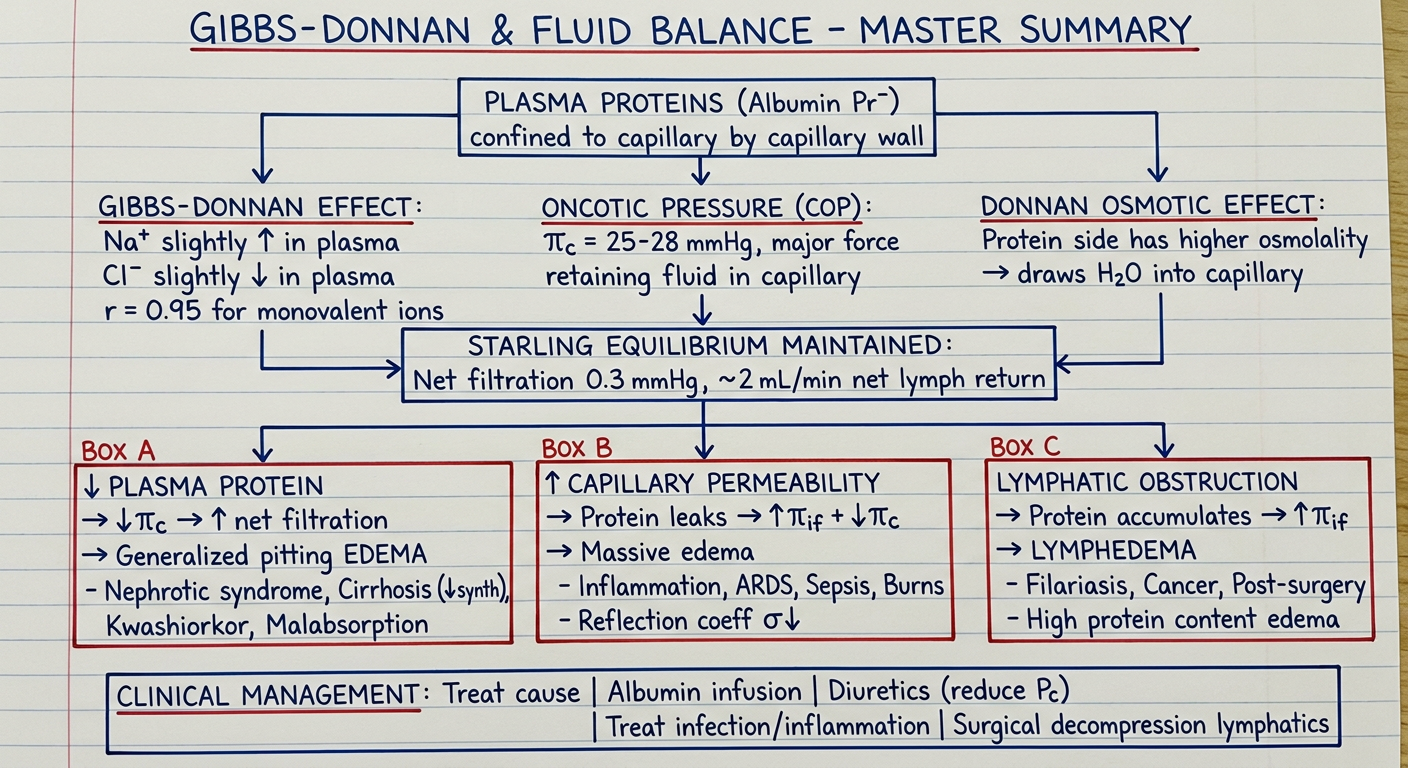
Handwritten medical physiology master summary flowchart on white lined notebook paper, blue ink with red underlines for headings, neat MD exam notes style. Title in large underlined handwriting: "GIBBS-DONNAN & FLUID BALANCE - MASTER SUMMARY". Central box at top: "PLASMA PROTEINS (Albumin Pr⁻) confined to capillary by capillary wall". Three downward arrows from central box: Arrow 1 → "GIBBS-DONNAN EFFECT: Na⁺ slightly ↑ in plasma, Cl⁻ slightly ↓ in plasma, r = 0.95 for monovalent ions". Arrow 2 → "ONCOTIC PRESSURE (COP): πc = 25-28 mmHg, major force retaining fluid in capillary". Arrow 3 → "DONNAN OSMOTIC EFFECT: Protein side has higher osmolality → draws H₂O into capillary". These three combine in a central box: "STARLING EQUILIBRIUM MAINTAINED: Net filtration 0.3 mmHg, ~2 mL/min net lymph return". Then THREE disruption pathways each in separate boxes with red outlines: BOX A "↓ PLASMA PROTEIN → ↓πc → ↑ net filtration → Generalized pitting EDEMA - Nephrotic syndrome, Cirrhosis (↓synthesis), Kwashiorkor, Malabsorption". BOX B "↑ CAPILLARY PERMEABILITY → Protein leaks → ↑πif + ↓πc → Massive edema - Inflammation, ARDS, Sepsis, Burns - Reflection coeff σ↓". BOX C "LYMPHATIC OBSTRUCTION → Protein accumulates → ↑πif → LYMPHEDEMA - Filariasis, Cancer, Post-surgery - High protein content edema". Bottom box: "CLINICAL MANAGEMENT: Treat cause | Albumin infusion | Diuretics (reduce Pc) | Treat infection/inflammation | Surgical decompression lymphatics". Neat organized flowchart with arrows connecting boxes.
Gibbs-Donnan Effect & Fluid Balance Across Capillary Walls
MD Physiology - 10 Mark Theory Answer
DIAGRAM 1 - Gibbs-Donnan Equilibrium Concept
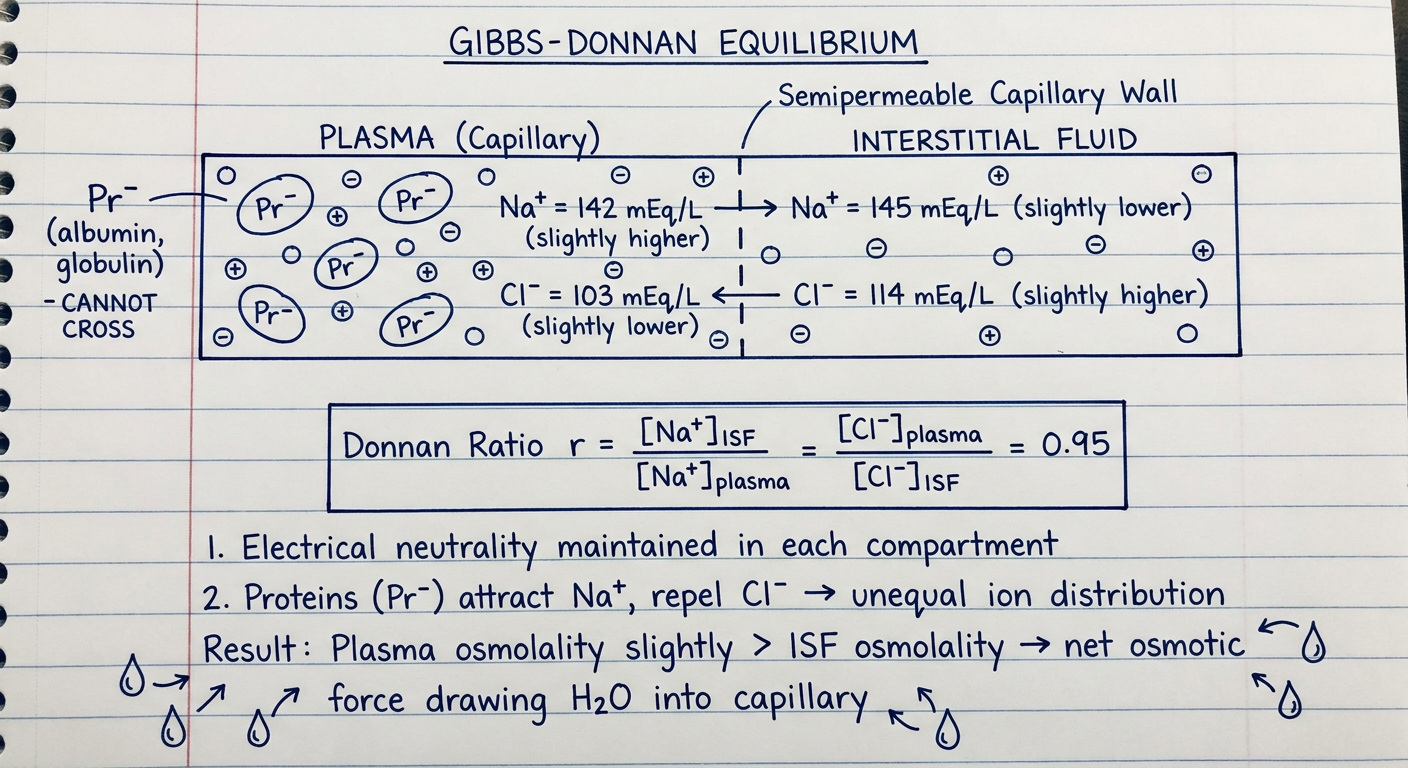
DIAGRAM 2 - Starling Forces at the Capillary Wall
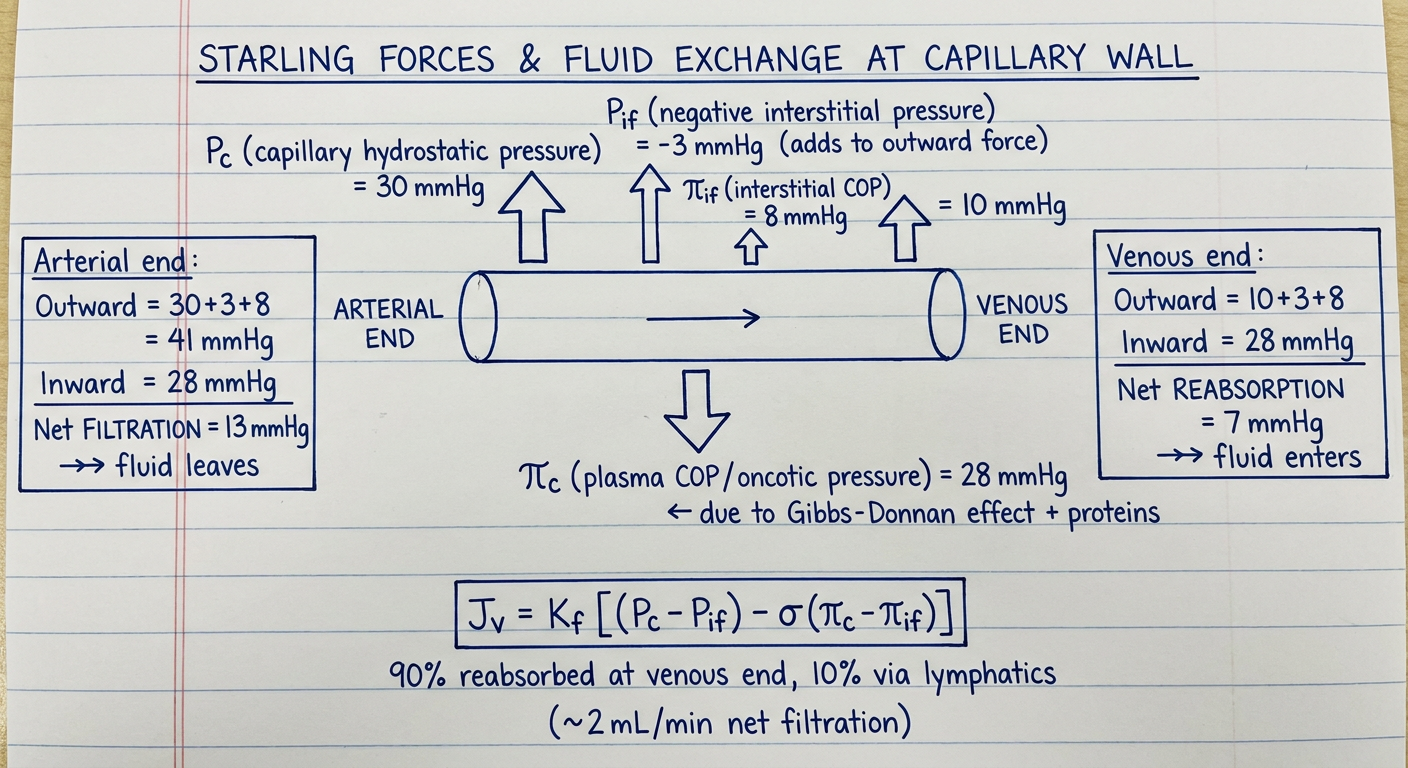
DIAGRAM 3 - Effect of Plasma Protein Concentration
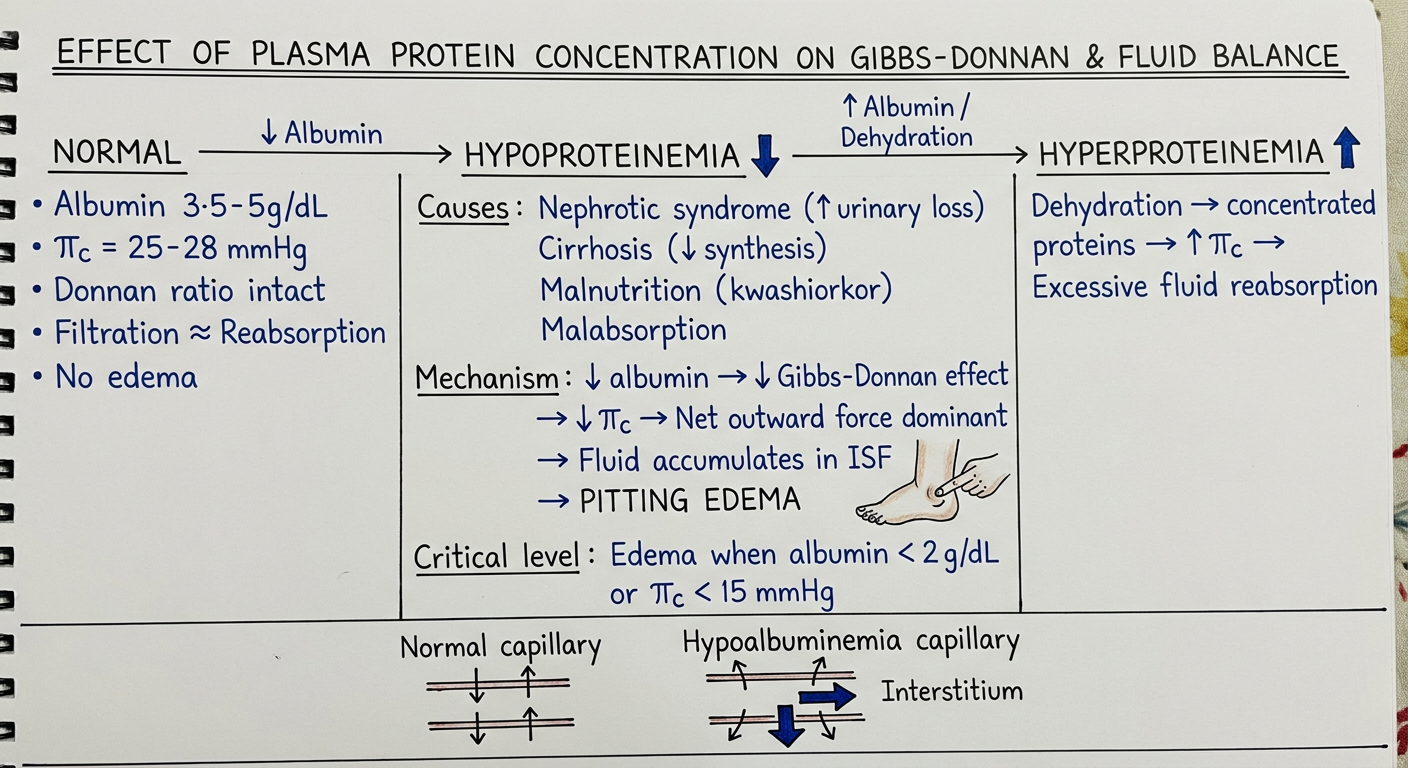
DIAGRAM 4 - Capillary Permeability & Lymphatic Drainage
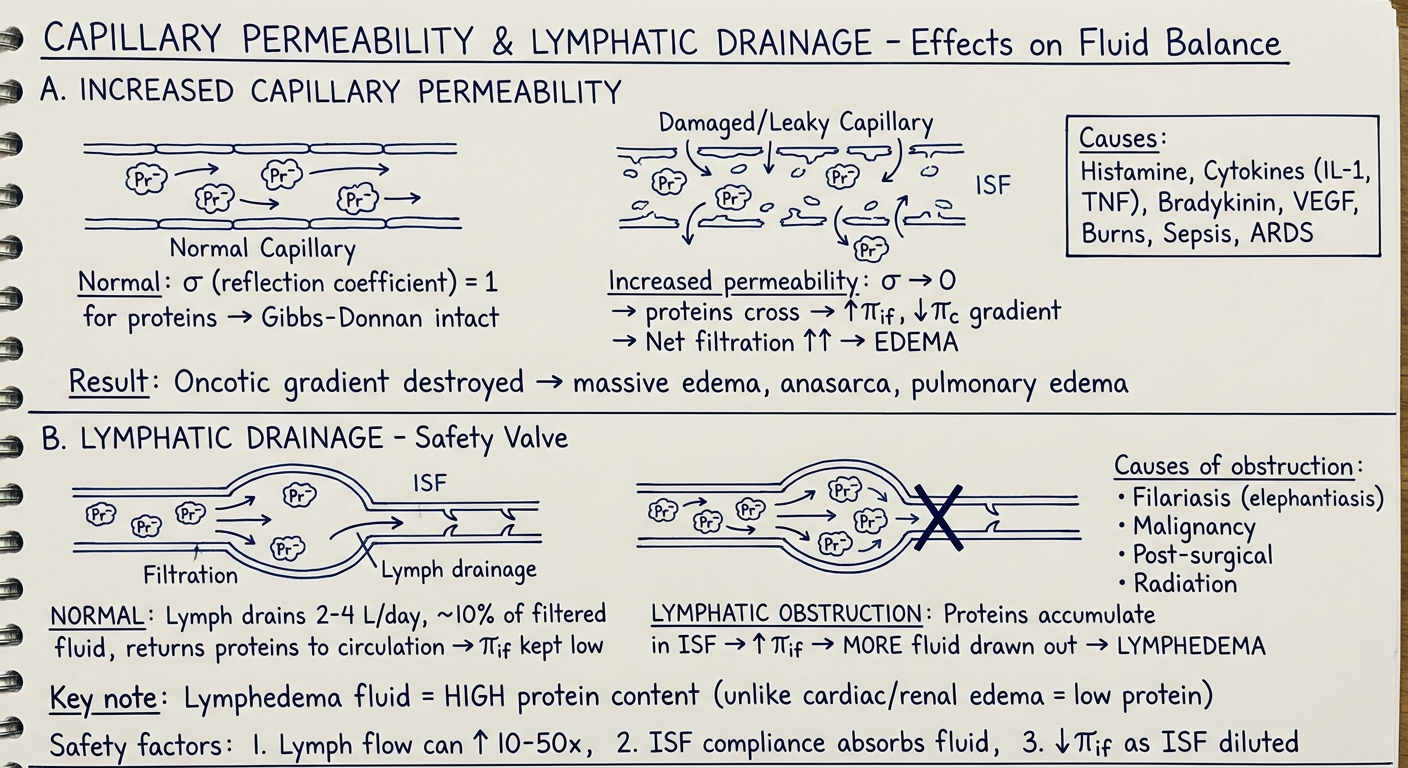
DIAGRAM 5 - Master Summary Flowchart
WRITTEN ANSWER
Introduction
I. The Gibbs-Donnan Effect - Mechanism
- Plasma proteins (Pr⁻) are confined to the capillary lumen - they cannot cross due to large molecular size
- These negatively charged proteins attract cations (Na⁺, K⁺) and repel anions (Cl⁻, HCO₃⁻)
- Result: unequal ion distribution described by the Donnan ratio:
Donnan ratio (r) = [Na⁺]ISF / [Na⁺]plasma = [Cl⁻]plasma / [Cl⁻]ISF = 0.95
- Na⁺ is slightly higher in plasma (142 mEq/L) than ISF (139 mEq/L)
- Cl⁻ is slightly lower in plasma (103 mEq/L) than ISF (108 mEq/L)
- Electrical neutrality must be maintained in each compartment at all times
- The product of diffusible ion concentrations is equal on both sides: [Na⁺]c × [Cl⁻]c = [Na⁺]if × [Cl⁻]if
II. Role in Starling Forces & Fluid Distribution
- Normal plasma protein = ~7 g/dL (albumin 3.5-5.5 g/dL; globulins 2-3.5 g/dL)
- πc = 25-28 mmHg (this exceeds the theoretical van't Hoff prediction due to the Donnan effect adding ~10% extra oncotic force - the Gibbs-Donnan "boost" to oncotic pressure)
- This is the major force retaining fluid within the capillary
| Force | Value (mmHg) | Direction |
|---|---|---|
| Capillary hydrostatic pressure - arterial end (Pc) | 30 | OUT |
| Interstitial fluid pressure (Pif) | -3 | OUT |
| Interstitial colloid osmotic pressure (πif) | 8 | OUT |
| Total outward force (arterial end) | 41 | |
| Plasma colloid osmotic pressure (πc) | 28 | IN |
| Net filtration at arterial end | +13 mmHg | OUT |
| Capillary hydrostatic pressure - venous end | 10 | OUT |
| Total outward force (venous end) | 21 | |
| Net reabsorption at venous end | -7 mmHg | IN |
III. Changes in Plasma Protein Concentration
A. Hypoproteinemia (↓ plasma proteins)
- ↓ Albumin → Gibbs-Donnan effect weakened → fewer proteins to attract cations and retain water
- ↓ πc (falls below 15 mmHg when albumin < 2 g/dL)
- Starling balance shifts: net outward force now greatly exceeds inward force
- Fluid accumulates in ISF → generalized pitting edema
- In severe cases: ascites, pleural effusion, anasarca
B. Hyperproteinemia (↑ plasma proteins)
- Seen in dehydration, multiple myeloma (paraproteinemia)
- ↑ πc → excessive fluid reabsorption → reduced ISF → haemoconcentration
- Can impair microcirculation
IV. Changes in Capillary Permeability
- σ approaches 0 → proteins leak into ISF
- Dual disruption of Gibbs-Donnan equilibrium:
- πc falls (less protein in plasma)
- πif rises (more protein in ISF)
- Net oncotic gradient (πc - πif) collapses
- Massive net filtration → inflammatory edema, pulmonary edema, anasarca
- This edema is protein-rich (exudate) - unlike cardiac edema (transudate)
V. Changes in Lymphatic Drainage
- Drain ~2-4 L/day of interstitial fluid (the 0.3 mmHg net excess)
- Return proteins that do leak from capillaries back to circulation
- Can increase flow 10-50 fold when ISF volume rises (safety factor)
- Keep interstitial protein concentration low → maintains low πif (~8 mmHg)
- Protein-rich fluid cannot be cleared from ISF
- Interstitial protein accumulates → ↑ πif
- Rising πif → more fluid drawn from capillaries into ISF (net filtration ↑)
- Result: Lymphedema - hallmark is high-protein content edema (distinguishes it from cardiac/renal edema which are low-protein transudates)
- Chronic lymphedema → fibrosis → non-pitting edema
- Lymph flow can increase up to 50-fold
- Interstitial compliance reduces rise in Pif
- ISF dilution of leaked proteins reduces πif ("protein washdown")
VI. Clinical Correlates Summary
| Mechanism | Example | Fluid type | Key finding |
|---|---|---|---|
| ↓ πc (low protein) | Nephrotic syndrome, Cirrhosis, Kwashiorkor | Transudate | Albumin < 2 g/dL |
| ↑ Permeability | ARDS, Sepsis, Burns, Anaphylaxis | Exudate | Protein-rich fluid |
| Lymphatic obstruction | Filariasis, Post-mastectomy | Lymphedema | Non-pitting, high protein |
| ↑ Pc (venous HTN) | Cardiac failure, DVT | Transudate | Pitting edema |