
Telomers and telomerase.. Explain woth flowchart
Reading File
Now let me search the medical library for telomeres and telomerase content in parallel:
Finding Sources
Finding Sources
Good results. Let me now read the key sections from Harper's Biochemistry, Thompson & Thompson Genetics, and Harrison's in parallel:
Reading File
Reading File
Reading File
Excellent - I have comprehensive content from Harrison's and Thompson & Thompson. Let me also read the Harper's Biochemistry telomere section for the molecular clock concept, and check for images:
Reading File
Finding Sources
I found a great diagram image. Let me fetch it and also read the Robbins section on telomere/aging:
Loading Image
Reading File
Finding Sources
Now let me fetch the Robbins diagram on telomere-senescence:
Loading Image
I now have all the content I need for a comprehensive, well-illustrated answer. Let me compose it with a text-based flowchart.
Telomeres and Telomerase
What Are Telomeres?
Telomeres are the physical termini of linear chromosomes - repetitive hexanucleotide sequences (TTAGGG)n on the leading strand and (CCCTAA)n on the lagging strand, tandemly repeated hundreds to thousands of times. At birth, human telomeres contain ~15 kb of these repeats.
Functions of telomeres:
- Protect chromosome ends from being recognized as double-strand DNA breaks by the DNA damage repair machinery
- Prevent end-to-end chromosome fusions
- Buffer the loss of genetic information during replication
- Serve as a "molecular clock" counting cell divisions
Shelterin proteins - a group of specialized proteins (TRF1, TRF2, POT1, TPP1, RAP1, TIN2) - directly bind telomeric repeats, organize the telomere tertiary structure, and suppress DNA damage response proteins.
Harrison's Principles of Internal Medicine 22E, 2025
The End-Replication Problem
DNA polymerase can only synthesize in the 3'→5' direction, and requires an RNA primer to begin. When the primer at the very 5' end is removed, that gap cannot be filled - so each round of replication leaves the new strand ~100 bp shorter than the template. This is the "end-replication problem."
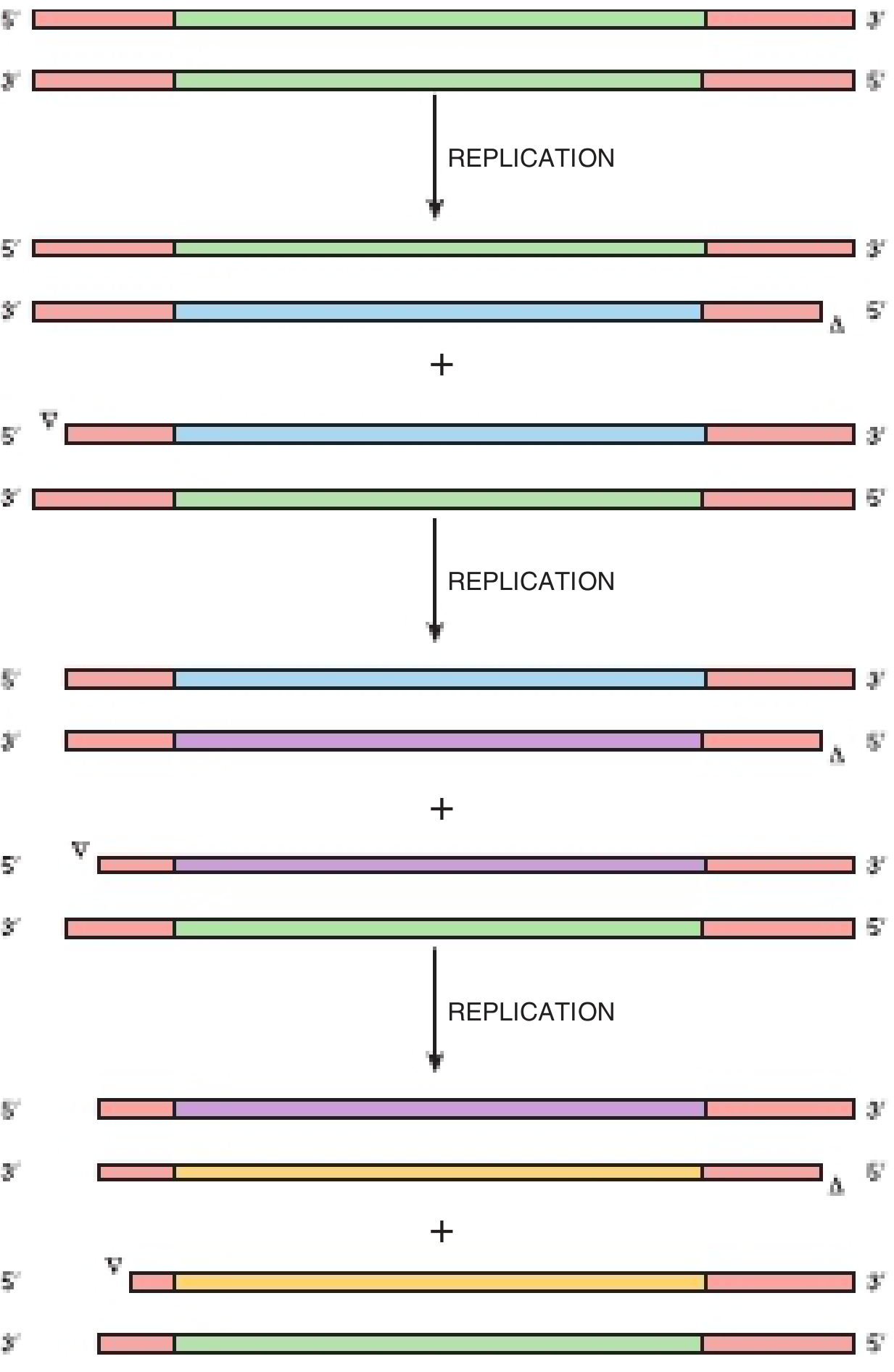
Each color represents a new generation of DNA. Note the progressive shortening of telomere ends (red caps).
Harper's Illustrated Biochemistry, 32nd Ed.
Telomere Shortening Flowchart
EACH CELL DIVISION
        │
        ▼
DNA polymerase replicates chromosome
        │
        ▼
5' end of new strand remains incomplete
(RNA primer removed, gap cannot be filled)
        │
        ▼
TELOMERE SHORTENS by ~50–100 bp per division
        │
        ├────────────────────────────────────────────┐
        ▼                                            ▼
  NORMAL SOMATIC CELLS              STEM CELLS / GERM CELLS
  (No telomerase)                   (Telomerase active)
        │                                            │
        ▼                                            ▼
Telomere shortens progressively         Telomere length maintained
        │
        ▼
After ~50–100 divisions (Hayflick limit)
CRITICALLY SHORT TELOMERES
        │
        ▼
p53 pathway activation
        │
        ├──────────────────┐
        ▼                  ▼
 PROLIFERATIVE        APOPTOSIS
    ARREST
  (G0 / Senescence)
        │
        ▼
Tissue dysfunction / Aging
What Is Telomerase?
Telomerase is a ribonucleoprotein reverse transcriptase (not a regular DNA polymerase) that counteracts telomere shortening.
Composition of the telomerase holoenzyme complex:
| Component | Gene | Role |
|---|---|---|
| Telomerase reverse transcriptase | TERT | Catalytic subunit - adds TTAGGG repeats |
| Telomerase RNA component | TERC | RNA template (contains the complementary sequence) |
| Dyskerin | DKC1 | Stabilizes the complex |
| TCAB1 | WRAP53 | Traffics telomerase to Cajal bodies for elongation |
Mechanism: TERC binds to the single-stranded 3' overhang of the telomere, and TERT uses it as a template to add GTTAGGG hexanucleotide repeats to the 5' end of the leading DNA strand. This restores the telomere cap.
Harrison's Principles of Internal Medicine 22E, 2025
Telomerase Action Flowchart
CELL REQUIRES TELOMERE MAINTENANCE
        │
        ▼
Telomerase holoenzyme recruited to chromosome end
(TERT + TERC + Dyskerin + TCAB1)
        │
        ▼
TERC RNA aligns with 3' overhang of telomere
(TERC template: 3'-AAUCCC-5' pairs with TTAGGG)
        │
        ▼
TERT (reverse transcriptase) synthesizes
new telomeric DNA: adds GTTAGGG repeats
        │
        ▼
Telomerase translocates along the overhang
(repeats the process multiple times)
        │
        ▼
Conventional DNA polymerase fills in
the complementary lagging strand
        │
        ▼
TELOMERE RESTORED TO FULL LENGTH
Regulation of Telomerase Expression
- Active in: embryonic/germ cells, stem cells (bone marrow, gut), most lymphocytes, most cancer cells
- Absent/silenced in: mature somatic cells
- Stimulated by: MYC oncogene, sex hormones, many growth factors
- Inhibited by: p53, RB (tumor suppressors)
The Complete Telomere Biology Flowchart
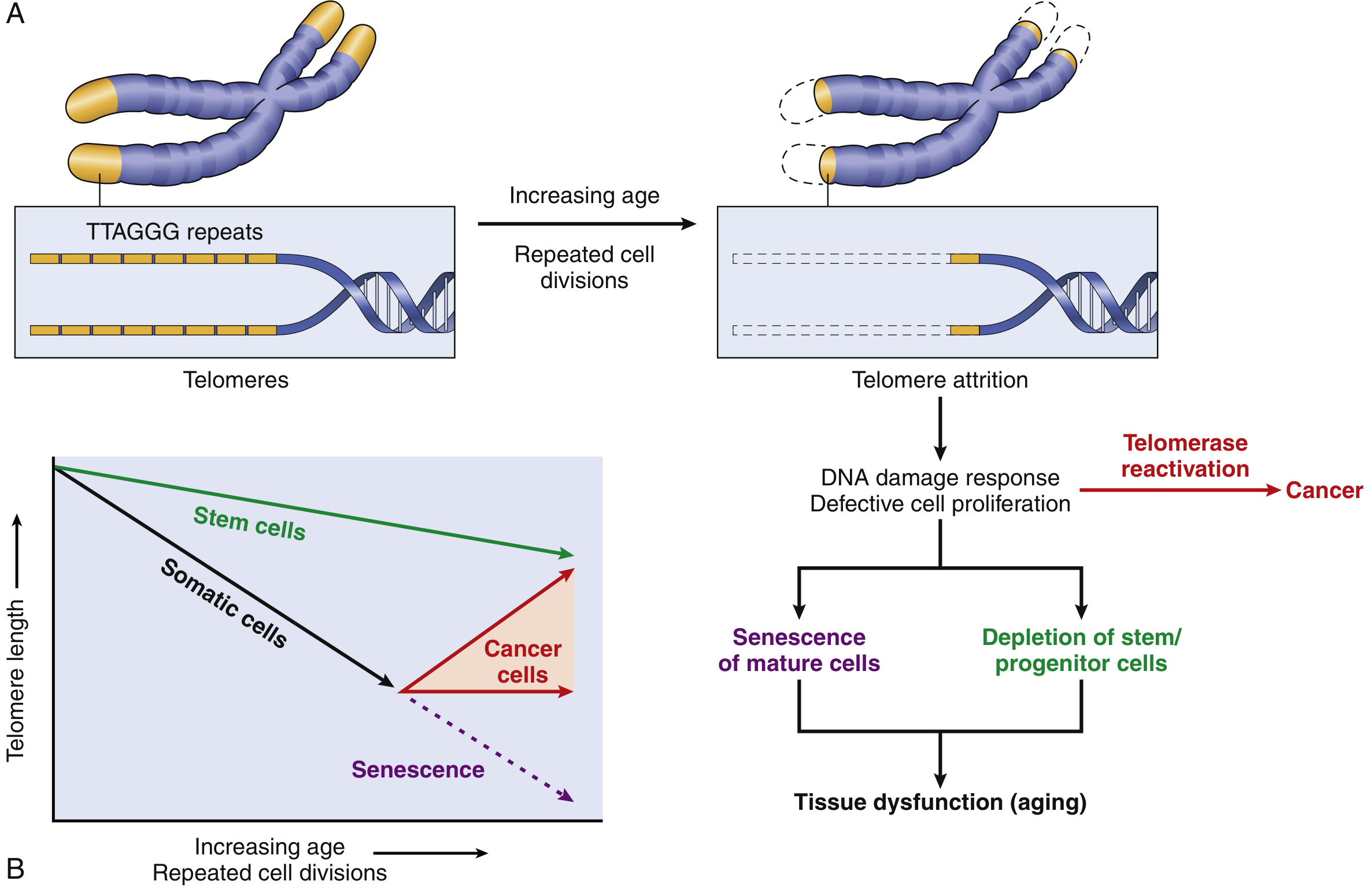
From Robbins Basic Pathology: (A) Telomere attrition with aging leads to DNA damage response, senescence, stem cell depletion, and tissue dysfunction. Cancer cells reactivate telomerase to escape senescence. (B) Telomere length over time in stem cells vs somatic cells vs cancer cells.
Robbins & Kumar Basic Pathology
Three Fates After Telomere Shortening
CRITICALLY SHORT TELOMERES
        │
        ├──────────────────────────────────────────┐
        │                                          │
        ▼                                          ▼
p53/RB pathway intact             p53/RB pathway MUTATED / bypassed
        │                                          │
        ▼                                          ▼
 SENESCENCE or APOPTOSIS         Chromosome instability
 (normal protective outcome)     (breaks, fusions, aneuploidy)
                                           │
                                           ▼
                              TELOMERASE REACTIVATED
                              (via TERT mutations, MYC amplification)
                                           │
                                           ▼
                              IMMORTALIZED CANCER CELL
                              (indefinite replication)
Clinical Significance
| Condition | Mechanism | Examples |
|---|---|---|
| Telomeropathies | Germline mutations in TERT/TERC/DKC1 → accelerated telomere loss | Dyskeratosis congenita, aplastic anemia, pulmonary fibrosis, liver cirrhosis |
| Aging | ~50 bp/year shortening in leukocytes; shorter telomeres correlate with increased mortality | Premature aging syndromes (ataxia-telangiectasia) |
| Cancer | Telomerase reactivated in ~85% of human cancers | Most carcinomas, lymphomas, leukemias |
| Long telomere syndromes | Rare mutations causing telomere elongation | Clonal hematopoiesis, predisposition to cancer |
Harrison's Principles of Internal Medicine 22E, 2025 | Robbins Basic Pathology | Thompson & Thompson Genetics 9th Ed.
Key Summary
TELOMERES
  = Repetitive TTAGGG caps at chromosome ends
  = Protected by shelterin proteins
  = Shorten ~50-100 bp per cell division (end-replication problem)
  = Hayflick limit: ~50-100 divisions → senescence

TELOMERASE
  = Ribonucleoprotein reverse transcriptase (TERT + TERC)
  = Adds TTAGGG repeats using RNA template
  = Active: stem cells, germ cells, cancer cells
  = Absent: mature somatic cells

CONSEQUENCES OF IMBALANCE:
  Too little telomerase → premature aging / telomeropathies
  Too much telomerase → cancer / immortalization
This is a shared conversation. Sign in to Orris to start your own chat.