

IMG_0347.png
Explain this in detail
This slide is about surgical needle types classified by their point/tip geometry. Here's a detailed breakdown of each type:
Reading File
Finding Sources
Searching the Web
surgical needle types cutting reverse cutting taper blunt tip differences
Finding Sources
Reading File
Reading File
Here is a detailed explanation of the slide:
Surgical Needle Types - Classified by Point/Tip Geometry
Suture needles are classified by the geometry of their points. The tip design determines how the needle penetrates tissue, how much trauma it causes, and whether a stitch is likely to tear through. There are five main types shown in this slide:
1. Cutting Needle
Shape: Triangle with the apex (cutting edge) on the inner curve - represented by the triangle with the dot at the top.
- Has three cutting edges running along its length, with the sharpest edge facing inward (toward the center of curvature).
- The inner edge cuts directly toward the wound when the needle is driven through tissue.
- Problem: Because the cutting edge faces the wound margin, if suture tension increases, the thread can tear through the wound edge toward the wound itself.
- Used for: Skin and other tough, dense tissues.
2. Reverse Cutting Needle
Shape: Inverted triangle with the cutting edge on the outer curve - represented by the downward-pointing triangle with the dot at the bottom tip.
- Same triangular cross-section as the cutting needle, but the sharpest edge faces outward (away from the center of curvature).
- This is the most important functional difference: if suture tension increases, any tearing tendency goes away from the wound edge, not toward it - making it significantly safer.
- Stronger than conventional cutting needles.
- Used for: Skin closure, tough tissues. This is the preferred needle for skin suturing.
- The "Reality Check" in the slide: The outer edge resisting pull-out is why this distinction actually matters in practice - it changes whether your stitch tears through.
3. Taper (Round) Needle
Shape: Circle - representing a round body that comes to a sharp point.
- Has no cutting edges. Instead of cutting, it pushes tissue fibers apart and lets them spring back around the suture, creating a tighter, more leak-proof closure.
- Because fibers are not cut, there is minimal tissue damage and the suture hole seals well.
- Requires more force to push through dense tissue, but causes far less collateral trauma.
- Used for: Bowel, blood vessels, soft tissue - anywhere you want to minimize trauma and avoid leakage.
- Biomechanically, taper needles require higher tear-through forces (~4 N) vs cutting designs, meaning they are less likely to accidentally tear through delicate tissue under tension.
4. Taper-Cut Needle
Shape: Triangle inside a circle - a hybrid design.
- Combines a round body (like a taper needle) with a short triangular cutting tip (like a cutting needle) at the very end.
- The cutting tip makes initial penetration easier through hard tissue, while the round body prevents further cutting along the needle's length.
- Used for: Tough or calcified tissue - e.g., tendons, ligaments, calcified vessels, dense fascia where a pure taper needle can't penetrate but you still don't want a full-length cutting edge tearing through.
5. Blunt Needle
Shape: Dashed circle with a small solid dot in the center - representing a rounded tip.
- Has a blunt, rounded tip rather than a sharp point. It does not cut through tissue; instead it must be pushed through with more force, separating (rather than slicing) tissue planes.
- The key safety advantage: in friable (easily crumbled/torn) tissue, a blunt needle pushes aside rather than slicing through fragile structures.
- Also used as a safety measure to reduce needlestick injuries to surgical staff.
- Used for: Friable liver, fascia, and situations where a sharp needle is unsafe (e.g., blunt needles for fascial closure reduce glove perforation rates significantly).
Key Conceptual Distinction Highlighted in the Slide
| Type | Inner/Outer Edge | Tear Direction | Clinical Implication |
|---|---|---|---|
| Cutting | Inner curve | Toward wound | Risk of stitch tearing through wound edge |
| Reverse Cutting | Outer curve | Away from wound | Safer - preferred for skin |
Bottom line: Regular cutting = inner edge cuts toward center of curvature, which can tear toward the wound. Reverse cutting = outer edge cuts away, so any tear goes away from the wound. This is why reverse cutting is the standard choice for skin closure.
Sources: Dermatology 2-Volume Set 5e, p. 2949-2950; Textbook of Family Medicine 9e, p. 3615
Search for clinical images of needle penetration through different tissues
Searching sources...
Finding Sources
Finding Sources
Searching the Web
clinical images surgical needle penetration tissue cutting taper reverse cutting histology diagram
Now let me fetch the most relevant clinical images and also search the textbook library for embedded diagrams:
Loading Image
Loading Image
Loading Image
Finding Sources
Loading Image
Reading File
Finding Sources
Excellent - found textbook diagrams. Let me fetch those now:
Loading Image
Loading Image
Here is a curated collection of clinical images showing needle geometry and tissue penetration, sourced from medical textbooks and clinical references:
Image 1 - Cross-sectional Point Geometry & Penetration Mechanics
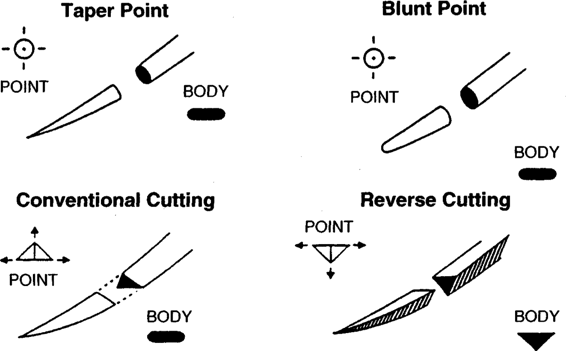
This diagram shows the cross-sectional profile of each needle type at its tip and along its body:
- Taper Point - Perfectly round cross-section. The point pierces tissue and the round body simply pushes fibers aside without slicing. The resulting tissue hole is small and seals tightly around the suture.
- Blunt Point - Round body with a blunted tip (not sharp at all). Dilates tissue rather than cutting through it.
- Conventional Cutting - Triangular cross-section, apex pointing inward (toward center of curvature). The inner edge acts like a blade slicing toward the wound edge.
- Reverse Cutting - Triangular cross-section, apex pointing outward (away from wound). The flat face presses against the wound edge - any tension pulls away from the incision, not through it.
Image 2 - 3D Needle Tip Geometry (RCEM Learning)

This shows 3D rendered views of the three most common needle tips side by side:
- Taper needle (top) - Smooth, conical tip that gradually narrows. Round body cross-section visible on the right. Creates a round, clean hole in tissue.
- Reverse cutting (middle) - Triangular tip with the apex facing downward/outward. The body has a triangular-to-flat profile. Note how the flat surface is on the inner curve.
- Conventional cutting (bottom) - Triangular tip with apex facing upward/inward. Sharper penetration through dense tissue but with higher cut-through risk.
Image 3 - Full Needle Anatomy with Cutting Types (from Dermatology 5e Textbook)
This is the textbook illustration showing complete needle structure and tip comparison:
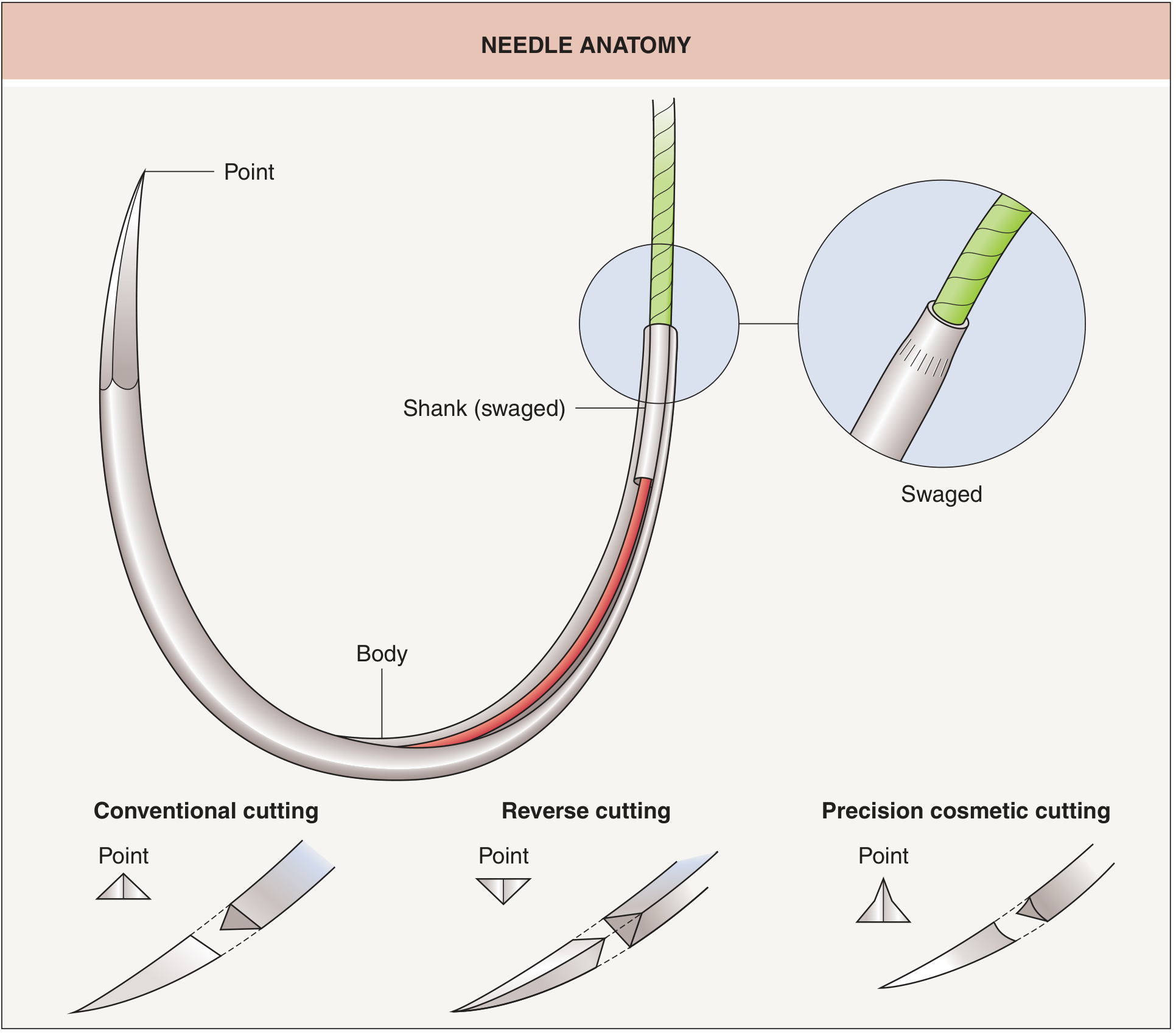
Key points visible in this diagram:
- The three parts of a surgical needle: Point (tip), Body, and Shank (the swaged end where suture attaches)
- Conventional cutting - triangle apex points toward center of the curve (inward)
- Reverse cutting - triangle apex inverted, points away from center (outward)
- Precision cosmetic cutting - a refined variant with a flatter body for better needle-holder grip and a sharper electropolished tip; used for delicate facial skin work
Dermatology 2-Volume Set 5e, Fig. 144.4
Image 4 - Needle Nomenclature Reference Chart (from Dermatology 5e Textbook)
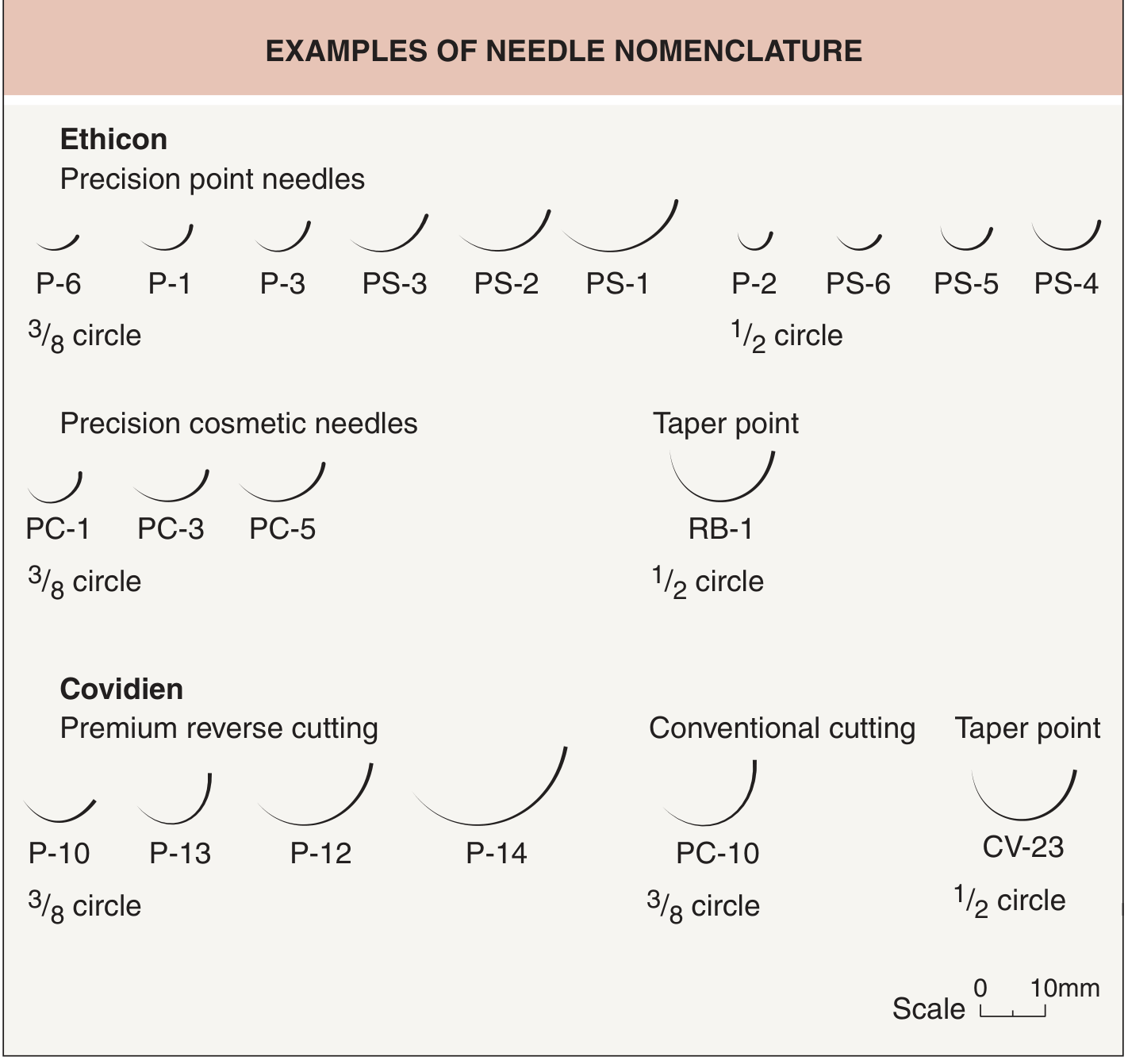
This chart shows how needle names translate to real products you use in practice:
| Series | Manufacturer | Type | Curvature |
|---|---|---|---|
| P, PS (P-3, PS-2) | Ethicon | Reverse cutting | 3/8 or 1/2 circle |
| PC (PC-1, PC-3) | Ethicon | Precision cosmetic cutting | 3/8 circle |
| RB-1 | Ethicon | Taper point | 1/2 circle |
| P-10, P-13 | Covidien | Premium reverse cutting | 3/8 circle |
| PC-10 | Covidien | Conventional cutting | 3/8 circle |
| CV-23 | Covidien | Taper point | 1/2 circle |
The P and PS series are the workhorses for most skin closures. The RB-1 taper needle is commonly used for buried dermal sutures in tight spaces.
Dermatology 2-Volume Set 5e, Fig. 144.3
Summary: Tissue Penetration by Needle Type
| Needle | Tissue Track Created | Best Tissue | Key Risk |
|---|---|---|---|
| Cutting | Triangular cut, inner edge active | Skin, tendon, oral mucosa | Tears toward wound edge |
| Reverse Cutting | Triangular cut, outer edge active | Skin, fascia, ligaments | Less - tears away from wound |
| Taper | Round hole, fibers displaced | Bowel, vessels, soft tissue | Difficult to push through dense tissue |
| Taper-cut | Initial triangular cut + round channel | Calcified/tough tissue | Minimal - hybrid design |
| Blunt | Dilated hole, no cutting | Liver, fascia (safety closure) | Harder to drive through tissue |
This is a shared conversation. Sign in to Orris to start your own chat.