
Why in patients problem with liver get water accumulated in stomach
Reading File
Finding Sources
Finding Sources
Reading File
Reading File
Searching Images
pathophysiology of ascites in cirrhosis portal hypertension diagram
Searching PubMed
ascites cirrhosis pathophysiology management
Why liver disease causes fluid accumulation in the abdomen (ascites)
What patients often call "water in the stomach" is actually ascites - fluid accumulating in the peritoneal cavity (the space around the abdominal organs), not literally inside the stomach. In liver disease this happens through two intertwined mechanisms:
1. Portal hypertension (the "plumbing" problem)
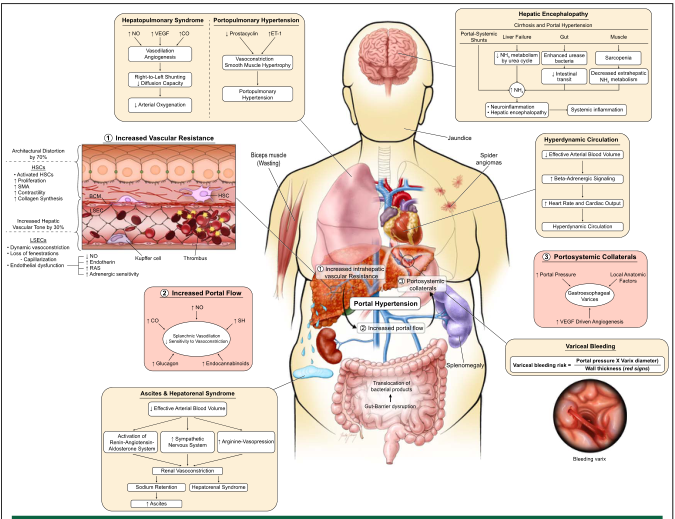
- Chronic liver injury (most commonly cirrhosis) causes scar tissue (fibrosis) and regenerative nodules to build up inside the liver. This distorts the liver's blood vessels (sinusoids) and increases resistance to blood flowing through them.
- Blood backs up in the portal vein system (the vein bringing blood from the gut to the liver), raising pressure - portal hypertension.
- In cirrhosis, once the pressure gradient across the liver (hepatic venous portal gradient) rises above about 10-12 mmHg, this back-pressure pushes fluid out of the sinusoids and splanchnic (gut) blood vessels into the surrounding tissue - Yamada's Textbook of Gastroenterology, and Goldman-Cecil Medicine.
- Normally the lymphatic system can drain this excess fluid back into circulation, but when the amount of leaked fluid overwhelms the lymphatics' capacity, fluid pools in the peritoneal cavity as ascites.
2. Kidney sodium/water retention (the "volume" problem)
- The high pressure in the splanchnic circulation also causes blood vessels in the gut to dilate abnormally (splanchnic vasodilation), partly driven by excess nitric oxide.
- This makes the body's arteries act "underfilled," even though total blood volume may be normal or high, so the kidneys sense a drop in effective circulating volume.
- This activates the renin-angiotensin-aldosterone system and other pathways, causing the kidneys to retain sodium and water in an attempt to compensate.
- That extra retained fluid has nowhere useful to go, since the pressure imbalance keeps pushing it into the abdominal cavity, further worsening the ascites - a self-perpetuating cycle. This is also why patients with cirrhotic ascites often develop dilutional problems and are prone to hepatorenal syndrome.
Additional contributing factor: low albumin
Cirrhotic livers also lose their ability to make albumin, the main protein that keeps fluid inside blood vessels by maintaining oncotic (osmotic) pressure. Low albumin further tips the balance toward fluid leaking out of vessels into the abdomen.
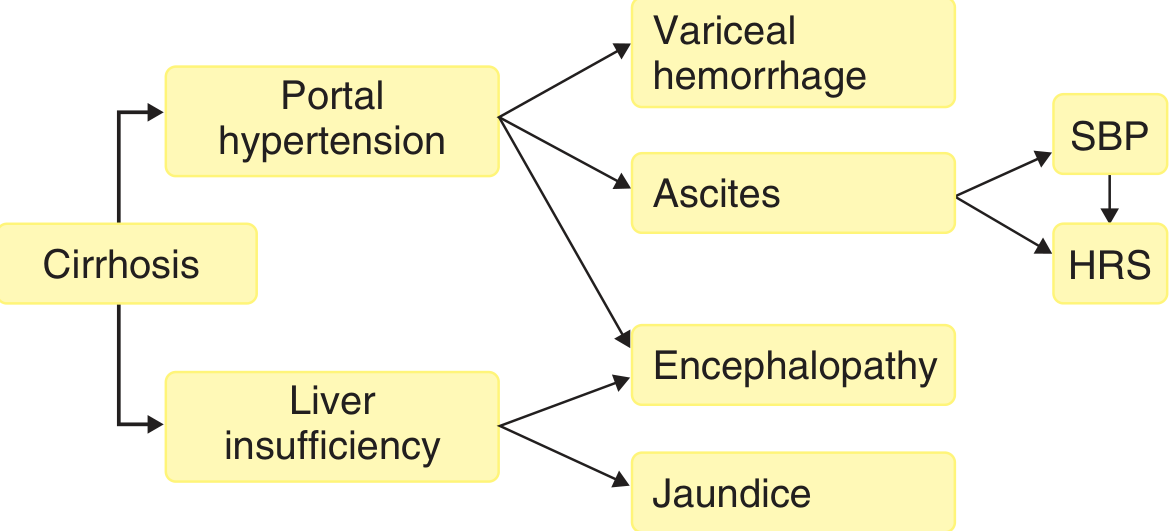
In short: cirrhosis → scarring narrows liver blood vessels → portal hypertension → fluid leaks from gut/liver vessels faster than lymphatics can clear it → kidneys retain more salt and water in response to perceived low blood volume → fluid keeps accumulating as ascites, often worsened by low albumin.
This is why ascites is treated with sodium restriction, diuretics (spironolactone +/- furosemide), and in refractory cases, large-volume paracentesis or a TIPS procedure to relieve the pressure directly - Goldman-Cecil Medicine, p. 3844-3860; Yamada's Textbook of Gastroenterology, p. 2210-2211.
Note: a recent systematic review (PMID: 40429923, 2025) explored SGLT2 inhibitors as a possible adjunct for managing ascites in cirrhosis, and another (PMID: 38916217, 2024) found early diagnostic paracentesis improves outcomes in hospitalized cirrhotic ascites patients - both are emerging evidence areas beyond standard textbook management, worth knowing about if you're following current practice.
This is a shared conversation. Sign in to Orris to start your own chat.