
Explain ECG change in MI
Reading File
Finding Sources
Finding Sources
Finding Sources
Finding Sources
Reading File
Reading File
Finding Sources
Finding Sources
Reading File
Reading File
Reading File
Reading File
Finding Sources
Reading File
Finding Sources
Now I have rich content from Harrison's. Let me fetch the key ECG diagrams and also get the localization table.
Reading File
Loading Image
Loading Image
I now have comprehensive content. Let me also fetch the Wellens T-wave sign image and look for an ECG evolution diagram.
Loading Image
Finding Sources
I have everything I need for a comprehensive answer. Let me compile it now.
ECG Changes in Myocardial Infarction
ECG changes in MI reflect two core electrical events: repolarization abnormalities (ST-T changes) and depolarization abnormalities (QRS/Q-wave changes). These evolve in a predictable sequence and differ based on whether the infarction is transmural (STEMI) or subendocardial (NSTEMI).
The Electrophysiological Basis
Severe ischemia lowers the resting membrane potential and shortens action potential duration, creating a voltage gradient between normal and ischemic zones. Current flows between these regions - these are the "currents of injury" seen as ST deviation on the surface ECG.
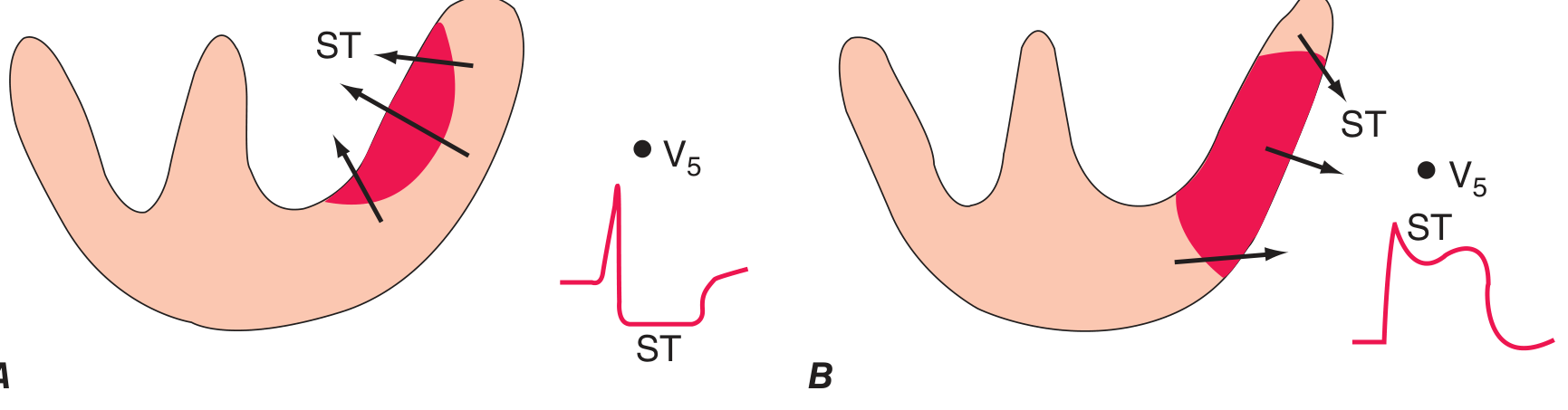
FIGURE 247-11 (Harrison's): A) Subendocardial ischemia - ST vector points inward toward cavity - overlying leads show ST depression. B) Transmural/epicardial ischemia - ST vector points outward - overlying leads show ST elevation.
Chronological Evolution of ECG Changes in STEMI
1. Hyperacute T Waves (Minutes - earliest change)
- Tall, broad, symmetrically peaked T waves in the ischemic territory
- Represent the very earliest sign before ST elevation develops
- Often transient and may be missed clinically
2. ST Segment Elevation (Minutes to hours)
- The hallmark of transmural injury / STEMI
- Caused by epicardial current of injury: the ST vector shifts toward the outer (epicardial) layer
- Morphology: typically convex upward ("tombstone") or obliquely elevated
- Reciprocal ST depression appears in electrically opposite leads
- Criteria for significance: ≥1 mm in limb leads, ≥2 mm in precordial leads (or ≥1.5 mm in V2-V3 in women)
3. Q Wave Formation (Hours to days)
- Necrosis of myocardium causes loss of depolarization forces
- Affected zone generates no electrical activity → surrounding normal tissue depolarizes away from it → initial QRS vector points away → pathological Q wave appears
- Criteria for pathological Q wave: duration ≥40 ms (≥0.04 s) and/or depth ≥25% of the R wave amplitude
- May persist permanently (marker of old infarction) or disappear with months
4. T Wave Inversion (Hours to days)
- As ST elevation resolves, T waves become inverted in the infarct leads
- Reflects abnormal repolarization of peri-infarct tissue
- Deep, symmetrical T inversions in V1-V4 ± I, aVL suggest severe LAD stenosis - called the Wellens T wave sign (Fig. 247-12, Harrison's)
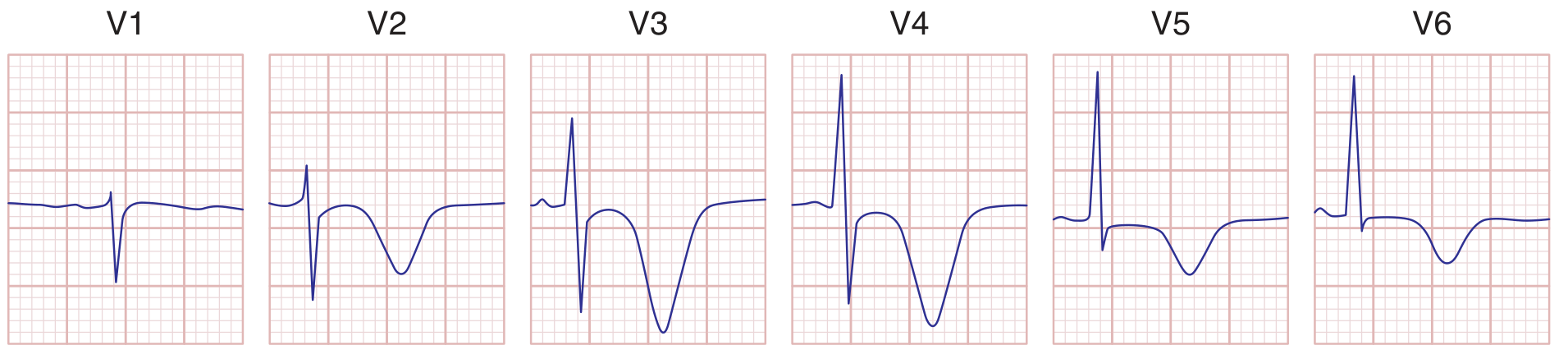
FIGURE 247-12: Severe anterior wall ischemia showing prominent T-wave inversions V1-V6, I, aVL - associated with high-grade LAD stenosis
5. R Wave Changes
- R wave loss: Progressive reduction in R wave amplitude as necrosis deepens
- Posterior/lateral MI: Loss of posterior depolarization forces causes reciprocal tall R waves in V1-V2 (no Q waves in standard leads - an "R-wave equivalent")
- Poor R-wave progression (loss of normal V1 to V5 increase) is a chronic sign of anterior MI
NSTEMI / Subendocardial Infarction
In NSTEMI, the ischemia is confined to the subendocardium. The ST vector shifts toward the cavity, so:
- ST depression in anterior/lateral leads (most commonly)
- T wave inversion (may be deep and symmetrical)
- No ST elevation, no Q waves (though Q waves can occasionally appear in NSTEMI, and transmural MI can occur without Q waves - which is why "Q-wave MI" vs "non-Q-wave MI" is the preferred classification over "transmural vs subendocardial")
From Rosen's Emergency Medicine: "Electrocardiographic manifestations of NSTEMI include ST segment depression and T wave inversion, which may be deep and symmetrical; nonspecific ST segment or T wave abnormalities may also be seen."
Localization by Lead Territory
| Territory | Leads with ST elevation | Culprit artery |
|---|---|---|
| Anterior | V1-V4 | LAD (proximal) |
| Anterolateral | V4-V6, I, aVL | LAD or LCx |
| Inferior | II, III, aVF | RCA (80%) or LCx (20%) |
| Posterior (inferobasal) | Reciprocal ST depression V1-V3; ST elevation V7-V9 | RCA or LCx |
| Right ventricular | ST elevation V1, V4R-V6R | Proximal RCA |
| Lateral | I, aVL, V5-V6 | LCx |
From Harrison's: "Acute transmural anterior wall ischemia is reflected by ST elevations or increased T-wave positivity in V1-V6, I, and aVL. Inferior wall ischemia produces changes in leads II, III, and aVF. Posterior wall ischemia may be indirectly recognized by reciprocal ST depressions in V1-V3."
Summary Table: ECG Evolution
| Timeframe | Change |
|---|---|
| Minutes | Hyperacute T waves (tall, peaked) |
| Minutes-hours | ST elevation (STEMI) / ST depression + T inversion (NSTEMI) |
| Hours-days | Q wave formation; R wave loss |
| Days | T wave inversion in infarct leads |
| Weeks-months | ST normalizes; Q waves may persist; T waves may normalize |
| Chronic | Persistent Q waves; possible persistent ST elevation if LV aneurysm |
Important Caveats
- LBBB masks ischemic changes - new LBBB in the right clinical setting should be treated as STEMI equivalent (Sgarbossa criteria can help)
- LVH can produce ST elevation mimicking STEMI (strain pattern)
- Normal ECG does not exclude MI - a normal ECG throughout an acute infarct is uncommon but occurs
- Posterior MI is the classic "STEMI without ST elevation" on a standard 12-lead - always do posterior leads (V7-V9) when V1-V3 show ST depression
- ST elevation persisting >2 weeks after MI suggests ventricular aneurysm, not ongoing ischemia
- Harrison's Principles of Internal Medicine 22E, Chapter 247 (Electrocardiogram) & Chapter 286 (Myocardial Infarction)
- Rosen's Emergency Medicine, Chapter 64 (Electrocardiographic Differential Diagnosis of ST Segment Elevation)
- Guyton and Hall Textbook of Medical Physiology (Myocardial Infarction chapter)
This is a shared conversation. Sign in to Orris to start your own chat.