
Fibrinolytics drug’s from ke Tripathi
I'll look up fibrinolytics from KD Tripathi's pharmacology textbook right away.
Searching sources...
Reading File
Finding Sources
Finding Sources
Finding Sources
Finding Sources
KD Tripathi's textbook isn't in the library, but I have Goodman & Gilman's and Tintinalli's which cover the same content. Let me pull the full fibrinolytics sections from those.
Reading File
Reading File
Reading File
Reading File
Finding Sources
Reading File
Reading File
Reading File
Reading File
I now have comprehensive data. Let me compile the full answer structured in KD Tripathi style.
Loading Image
Loading Image
Here is a complete, KD Tripathi-style coverage of Fibrinolytic Drugs (Thrombolytics), compiled from the best available pharmacology references in the library:
Fibrinolytics (Thrombolytic Drugs)
Based on KD Tripathi Essentials of Medical Pharmacology - aligned content from Goodman & Gilman, Braunwald's, Harrison's, and Tintinalli's
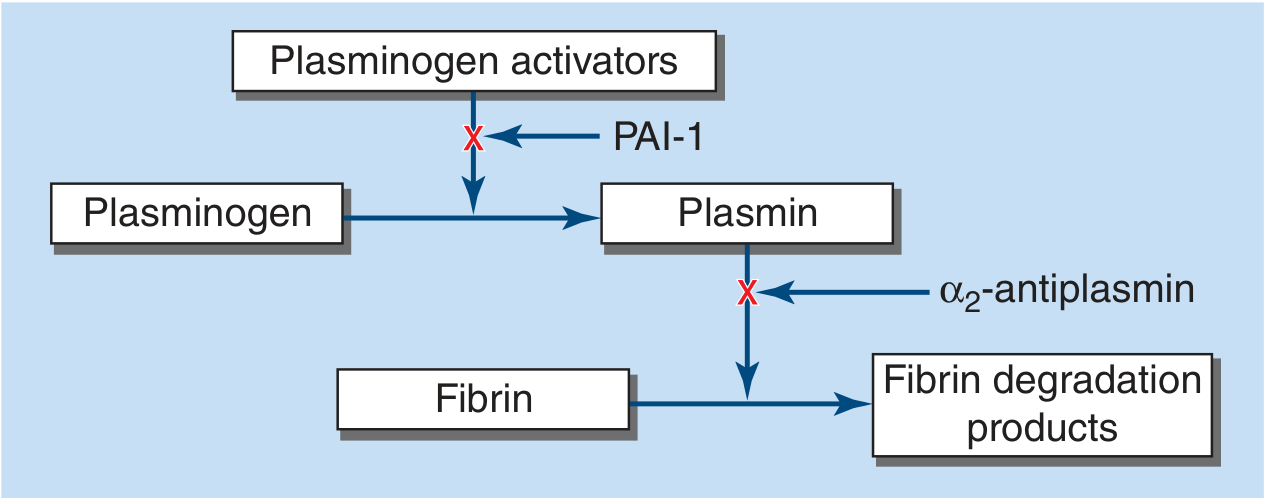
The Fibrinolytic System
Endogenous fibrinolysis is the physiological mechanism that dissolves clots after vascular repair. The key principle:
Plasminogen → (Plasminogen Activators) → Plasmin → Fibrin → Fibrin Degradation Products (FDPs)
Regulated at two levels:
- PAI-1 (Plasminogen Activator Inhibitor-1) - inhibits tPA and uPA (upstream control)
- α₂-antiplasmin - directly inhibits plasmin (downstream control)
Classification of Fibrinolytic Drugs
Generation-wise Classification (KD Tripathi style):
| Generation | Drug | Type |
|---|---|---|
| 1st Generation | Streptokinase | Non-fibrin specific |
| 1st Generation | Urokinase | Non-fibrin specific |
| 2nd Generation | Alteplase (rt-PA) | Fibrin specific |
| 2nd Generation | Anistreplase (APSAC) | Non-fibrin specific |
| 3rd Generation | Reteplase | Fibrin specific |
| 3rd Generation | Tenecteplase (TNKase) | Fibrin specific (most specific) |
Mechanism of Action (General)
All fibrinolytics act as plasminogen activators - they convert the inactive zymogen plasminogen to the active enzyme plasmin, which then degrades fibrin in the clot.
Key distinction:
- Non-fibrin specific agents (Streptokinase, Urokinase, Anistreplase): Activate both fibrin-bound AND circulating plasminogen → produce a systemic lytic state (deplete fibrinogen, factors V and VIII)
- Fibrin-specific agents (Alteplase, Reteplase, Tenecteplase): Preferentially activate plasminogen bound to fibrin → more "clot-selective"
Individual Drugs
1. Streptokinase (SK)
- Source: Beta-haemolytic streptococci
- Nature: Not an enzyme itself; acts indirectly
- Mechanism: Forms a 1:1 stoichiometric complex with plasminogen → conformational change exposes the active site → this SK-plasminogen complex then activates additional plasminogen molecules to plasmin
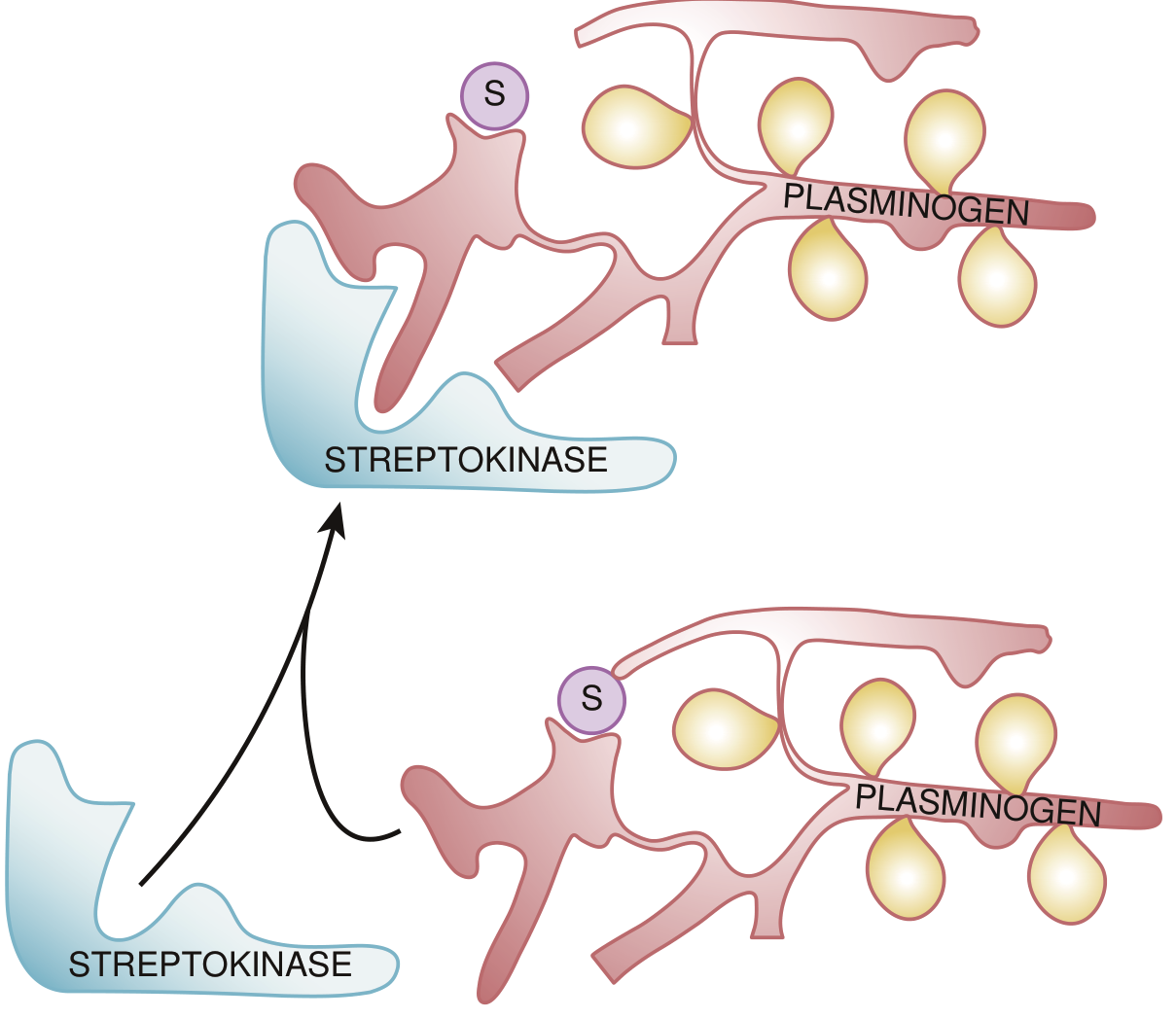
- Fibrin selectivity: None (non-specific); produces systemic lytic state
- Dose: 1.5 million units IV over 30-60 minutes (for AMI)
- Half-life: ~23 minutes
- Adverse effects:
- Allergic reactions (~5%) - rash, fever, chills, rigors, rarely anaphylaxis
- Transient hypotension (due to plasmin-mediated bradykinin release)
- Hemorrhage (major risk)
- Important: Antigenic - prior streptococcal infection or prior SK use produces antibodies that reduce efficacy. Should NOT be re-administered after 5 days (relative contraindication).
2. Urokinase (UK)
- Source: Originally from fetal kidney cells; later recombinant DNA technology
- Nature: Two-chain serine protease (MW 34,000)
- Mechanism: Directly converts plasminogen to plasmin (no intermediate complex needed)
- Fibrin selectivity: None (non-specific); produces systemic lytic state
- Antigenic: No (not immunogenic; allergic reactions rare)
- Use: Mainly catheter-directed lysis of DVT and peripheral arterial thrombi
- Note: No longer available in some countries due to production problems
3. Anistreplase (APSAC - Acylated Plasminogen Streptokinase Activator Complex)
- How made: Streptokinase + equimolar Lys-plasminogen, with active site blocked by an anisoyl group
- Mechanism: After IV infusion, the anisoyl group is removed by deacylation, exposing the active site
- Half-life: ~100 minutes (longer than SK - allows single bolus administration)
- Advantage over SK: Convenient single bolus IV administration
- Disadvantage: Like SK, no fibrin selectivity; produces systemic lytic state; same allergic reactions and hypotension as SK
- Status: Largely replaced by alteplase; offers no major clinical advantage
4. Alteplase (rt-PA, Tissue Plasminogen Activator)
- Nature: Recombinant single-chain t-PA; serine protease (MW 68,000)
- Mechanism:
- Poor plasminogen activator in the absence of fibrin
- When bound to fibrin, activates fibrin-bound plasminogen several hundred-fold more rapidly
- Physiological t-PA: 5-10 ng/mL (no systemic effect)
- Therapeutic dose: 300-3000 ng/mL (can produce systemic fibrinogen degradation)
- Fibrin selectivity: Yes (fibrin-specific, though not absolute)
- Half-life: ~5 minutes (very short; cleared by hepatic metabolism)
- Domains: Finger (F), EGF, two Kringles (K1, K2), Protease (P) - fibrin binding via finger domain and K2 domain
- Dose (AMI): 15 mg IV bolus → 0.75 mg/kg over 30 min (max 50 mg) → 0.5 mg/kg over 60 min (max 35 mg)
- Uses: Acute MI (STEMI), Acute Ischaemic Stroke, Massive Pulmonary Embolism
- Advantage over SK: Higher reperfusion rates; not antigenic; no allergic reactions; no hypotension
5. Reteplase (r-PA)
- Type: Recombinant variant of t-PA (deletion mutant - lacks finger, EGF, and K1 domains)
- Mechanism: Same as alteplase (fibrin-specific)
- Half-life: Longer than alteplase (~18 min) → allows double-bolus dosing (10 U + 10 U, 30 minutes apart)
- Advantage: More convenient administration than alteplase (bolus vs infusion)
- Efficacy/Toxicity: Similar to alteplase
6. Tenecteplase (TNK-tPA)
- Type: Recombinant t-PA variant with 3 substitutions (T→N at position 103, N→Q at 117, KHRR→AAAA at 296-299)
- Key advantages over alteplase:
- Longer half-life (18-20 min) → single IV bolus administration
- Relatively resistant to PAI-1 inhibition (due to KHRR substitution)
- Higher fibrin specificity than alteplase
- Dose: Single weight-based IV bolus (30-50 mg)
- Efficacy/Toxicity: Similar to alteplase despite structural advantages
Indications for Fibrinolytic Therapy
| Condition | Drug of Choice | Notes |
|---|---|---|
| STEMI | Alteplase/Tenecteplase/Reteplase (preferred); Streptokinase (cheap, widely available) | Within 6-12 hours of symptom onset; ≥1mm ST elevation in ≥2 contiguous leads |
| Acute Ischaemic Stroke | Alteplase (0.9 mg/kg, max 90 mg) | Within 4.5 hours; mechanical thrombectomy now preferred |
| Massive Pulmonary Embolism | Alteplase | Life-threatening PE |
| DVT / Peripheral Arterial Thrombosis | Urokinase, Alteplase (catheter-directed) | Catheter-directed preferred |
Fibrinolytic therapy saves >30 lives per 1000 patients in the first 3 hours of AMI; benefit decreases by ~1.6 lives/1000 patients per hour of delay.
Contraindications
Absolute Contraindications
- Prior intracranial haemorrhage
- Known structural cerebrovascular lesion (AVM, aneurysm)
- Known malignant intracranial neoplasm
- Ischaemic stroke within 3 months
- Suspected aortic dissection
- Active bleeding or bleeding diathesis (excluding menses)
- Significant closed-head trauma within 3 months
Relative Contraindications
- Uncontrolled hypertension (BP >180/110 mmHg)
- Major surgery or traumatic CPR within 3 weeks
- Internal bleeding within 2-4 weeks
- Noncompressible vascular punctures
- Streptokinase: Prior exposure >5 days ago or prior allergic reaction
- Pregnancy
- Active peptic ulcer
- Current warfarin use with INR >1.7
Adverse Effects
| Effect | Details |
|---|---|
| Haemorrhage | Major toxicity of all agents. Due to (1) fibrin degradation at vascular injury sites and (2) systemic lytic state depleting fibrinogen, Factor V, Factor VIII |
| Intracranial haemorrhage | Up to 1% with alteplase; streptokinase risk is slightly lower |
| Allergic reactions | SK and anistreplase only (5%); not with alteplase, reteplase, tenecteplase |
| Hypotension | SK only - bradykinin release by plasmin |
| Reperfusion arrhythmias | After coronary thrombolysis (idioventricular rhythm - a marker of successful reperfusion) |
Inhibitors of Fibrinolysis (Antifibrinolytics)
Used to reverse excessive fibrinolysis:
| Drug | Mechanism | Uses |
|---|---|---|
| Tranexamic Acid (TXA) | Lysine analogue - blocks lysine binding sites on plasminogen/plasmin → prevents interaction with fibrin | Trauma, post-partum haemorrhage, perioperative bleeding, hereditary angioedema |
| ε-Aminocaproic Acid (EACA) | Same mechanism as TXA | Haematuria, post-prostatic surgery, dental extraction in haemophilia |
| Aprotinin | Serine protease inhibitor - directly inhibits plasmin | Cardiac surgery (withdrawn in many countries due to safety concerns) |
Caution: Thrombi that form during antifibrinolytic treatment are not lysed - risk of thrombosis (e.g., ureteral clot obstruction causing renal failure with EACA in haematuria patients).
Comparison of Key Fibrinolytics (KD Tripathi Table Style)
| Feature | Streptokinase | Alteplase | Tenecteplase |
|---|---|---|---|
| Source | Streptococci | Recombinant DNA | Recombinant DNA |
| Mechanism | Indirect (SK-plasminogen complex) | Direct (serine protease) | Direct |
| Fibrin selectivity | None | Yes (moderate) | Yes (highest) |
| t½ | ~23 min | ~5 min | ~18-20 min |
| Administration | 60-min infusion | Infusion (front-loaded) | Single bolus |
| Antigenic | Yes | No | No |
| Hypotension | Yes (bradykinin) | No | No |
| PAI-1 resistance | No | No | Yes |
| Cost | Cheapest | Moderate | Expensive |
Sources: Goodman & Gilman's Pharmacological Basis of Therapeutics (Table 36-3); Braunwald's Heart Disease (Chapter 95); Harrison's Principles of Internal Medicine 22e (Chapter 123); Tintinalli's Emergency Medicine (Chapter 49).
This is a shared conversation. Sign in to Orris to start your own chat.