
Physiology of learning and memory
I'll start by reading the medical library skill, then search for content on learning and memory physiology.
Reading File
Now I'll run parallel searches across the library for learning and memory physiology.
Finding Sources
Finding Sources
Searching PubMed
"learning" AND "memory" AND "synaptic plasticity"
Excellent results. Now I'll read the most relevant sections in parallel - from Ganong's, Costanzo, Kandel's Principles of Neural Science, and Neuroscience: Exploring the Brain.
Reading File
Reading File
Reading File
Reading File
Now let me read the Ganong's section on LEARNING & MEMORY specifically, the detailed Neuroscience: Exploring the Brain content, and the Kandel synaptic plasticity section.
Reading File
Reading File
Reading File
Excellent content. Now I'll read more of the Ganong's detailed sections (LTP, LTD, hippocampus, molecular mechanisms) and more of Neuroscience: Exploring the Brain on molecular mechanisms of LTP.
Reading File
Reading File
I have excellent, rich content. Let me fetch the key memory taxonomy diagram from Ganong's and read the LTP molecular mechanism continuation.
Loading Image
Reading File
Reading File
I have comprehensive content covering all major aspects. Let me read one more section on LTP mechanisms and memory consolidation from Neuroscience: Exploring the Brain.
Reading File
I now have comprehensive, rich content to write a thorough answer. Let me compile it.
Physiology of Learning and Memory
1. Definitions
Learning is the neural mechanism by which a person changes behavior as a result of experience - the acquisition of information. Memory is the retention and storage of that acquired information. The two are inseparable: learning without the ability to store it would be useless, and memory with nothing to store is empty.
- Costanzo Physiology 7th Edition, p. 118
- Ganong's Review of Medical Physiology, 26th Ed., p. 289
2. Classification of Learning
| Type | Subtype | Description | Example |
|---|---|---|---|
| Nonassociative | Habituation | Repeated neutral stimulus → progressively diminished response | City noise no longer waking a newcomer |
| Nonassociative | Sensitization | A noxious stimulus paired with a familiar one augments future responses to it | Pain makes a soft touch feel more alarming |
| Associative | Classical conditioning | Conditioned + unconditioned stimuli paired in time; eventually conditioned stimulus alone elicits the response | Pavlov's dog salivating to a bell |
| Associative | Operant conditioning | Reinforcement (positive or negative) changes the probability of a response to a stimulus | Reward-based training |
Costanzo Physiology 7th Ed., p. 118
3. Forms of Memory
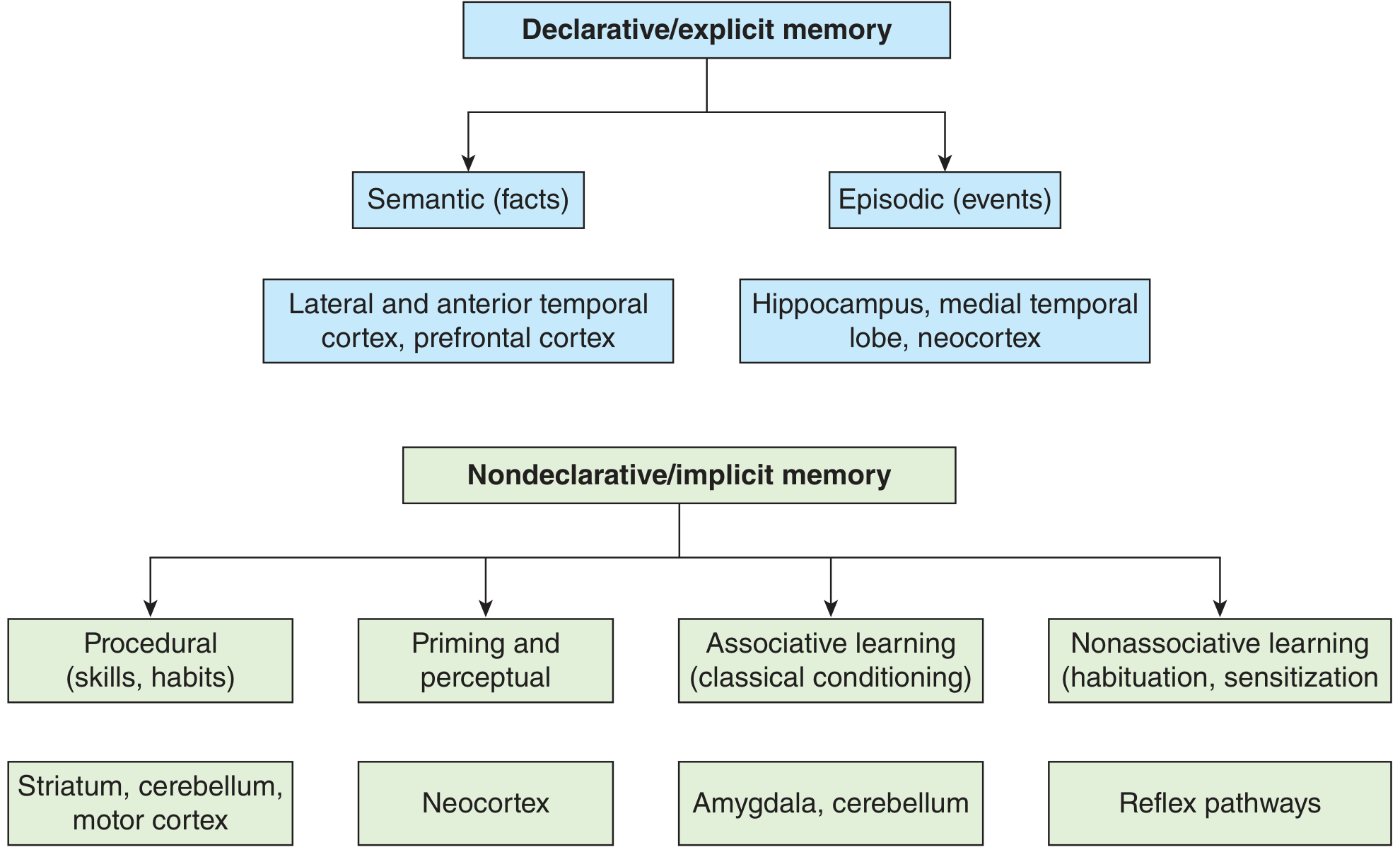
Ganong's Review of Medical Physiology, 26th Ed., p. 290
3a. Explicit (Declarative) Memory
- Involves conscious awareness
- Depends on the hippocampus and medial temporal lobes for consolidation
- Two subtypes:
- Semantic memory: factual knowledge (words, rules, language) - stored in lateral/anterior temporal cortex and prefrontal cortex
- Episodic memory: personal autobiographical events - hippocampus, medial temporal lobe, neocortex
3b. Implicit (Nondeclarative) Memory
- Does not require conscious awareness
- Does not require hippocampal processing
- Four subtypes:
- Procedural (skills and habits): striatum, cerebellum, motor cortex
- Priming and perceptual (recognition facilitated by prior exposure): neocortex
- Associative learning (classical conditioning): amygdala, cerebellum
- Nonassociative learning (habituation, sensitization): reflex pathways
Key clinical illustration - Patient H.M.: In 1953, bilateral surgical removal of the hippocampus and amygdala controlled seizures but produced severe anterograde amnesia - H.M. could not form new long-term declarative memories. His procedural memory remained intact, proving dissociation of memory systems.
Ganong's Review of Medical Physiology, 26th Ed., p. 290-291
4. Memory by Time Stage
| Stage | Duration | Substrate |
|---|---|---|
| Short-term (working) memory | Seconds to minutes | Reverberating circuits, temporary synaptic changes |
| Long-term memory | Days to lifetime | Structural synaptic changes, protein synthesis |
The encoding of short-term explicit memory involves the hippocampus. Long-term memories are then transferred and stored across neocortical areas - visual memories in visual cortex, auditory memories in auditory cortex, etc. These distributed pieces are linked by long-term synaptic strengthening so all components are brought to consciousness simultaneously on recall. Ganong's, p. 294
5. Synaptic Plasticity: The Cellular Basis of Learning
Synaptic plasticity is the fundamental mechanism of learning - the ability of synaptic strength (the responsiveness of postsynaptic neurons) to change based on prior activity. This is not a fixed property but depends on the "traffic" history through each synapse.
Costanzo Physiology 7th Ed., p. 118
5a. Hebb's Rule
Donald Hebb proposed in 1949 that when a presynaptic and postsynaptic neuron fire together repeatedly, the synapse between them is strengthened - "neurons that fire together, wire together." This rule is the theoretical foundation of associative learning and has been directly confirmed in hippocampal LTP.
Neuroscience: Exploring the Brain, 5th Ed., p. 2237
5b. Short-Term Plasticity
Posttetanic potentiation: After a brief high-frequency (tetanic) train of stimuli, postsynaptic potentials are enhanced for up to 60 seconds. The mechanism is Ca²⁺ accumulation in the presynaptic terminal beyond the capacity of intracellular buffers, leading to increased transmitter release.
Habituation (short-term): Repeated activation of a pathway leads to decreased Ca²⁺ influx into presynaptic terminals (due to gradual inactivation of Ca²⁺ channels), thus less neurotransmitter release and a diminished postsynaptic response.
5c. Long-Term Potentiation (LTP)
LTP is a rapidly developing, persistent enhancement of synaptic responses following a brief burst of high-frequency (tetanic) stimulation. It can last days to weeks and is the leading cellular model of memory storage.
Locus of study: The Schaffer collateral synapse in the hippocampus (CA3 pyramidal cell axon → CA1 pyramidal cell) is the most studied site of LTP. It is NMDA receptor-dependent.
Step-by-step NMDA receptor mechanism of LTP:
- At rest, the presynaptic neuron releases glutamate which binds to both AMPA and NMDA receptors on the postsynaptic membrane.
- At resting membrane potential, Mg²⁺ physically blocks the NMDA receptor channel, so only AMPA receptors conduct (Na⁺/K⁺ flow, small EPSP).
- During high-frequency tetanic stimulation, repeated activation of AMPA receptors produces sufficient postsynaptic depolarization to expel Mg²⁺ from the NMDA channel.
- With Mg²⁺ unblocked, glutamate binding to NMDA receptors allows Ca²⁺ influx into the postsynaptic cell.
- Elevated intracellular Ca²⁺ activates Ca²⁺/calmodulin-dependent protein kinase II (CaMKII) and other kinases.
- CaMKII phosphorylates existing AMPA receptors (increasing their conductance) and triggers insertion of additional AMPA receptors into the postsynaptic membrane.
- The result: more AMPA receptors at the synapse → larger EPSPs for the same presynaptic input → LTP.
This requires coincident pre- and postsynaptic activity - making the NMDA receptor a true "coincidence detector" and the cellular implementation of Hebb's rule.
Ganong's, p. 292-293 | Neuroscience: Exploring the Brain, p. 2237-2238 | Costanzo, p. 118
Key properties of LTP:
- Cooperativity: Multiple weak inputs arriving simultaneously can together produce LTP (spatial summation relieves Mg²⁺ block), allowing formation of associations
- Input specificity: Only active synapses are potentiated (not silent neighboring synapses)
- Associativity: A weak input can be potentiated if it is active at the same time as a strong input
5d. Long-Term Depression (LTD)
LTD is the opposite of LTP - prolonged decrease in synaptic strength. It occurs with low-frequency synaptic activity and a smaller, slower rise in postsynaptic Ca²⁺. LTD at Schaffer collateral synapses involves internalization (removal) of AMPA receptors from the postsynaptic membrane. LTD in the cerebellum (via climbing fiber inputs to Purkinje cells) is important for motor learning and adaptation. Neuroscience: Exploring the Brain, p. 2240-2241
5e. Glutamate Receptor Trafficking
The balance of AMPA receptor insertion (LTP) vs. removal (LTD) regulates synaptic strength. This receptor trafficking is the key molecular switch controlling whether a synapse is strengthened or weakened after coincident activity.
6. Memory Consolidation: Molecular Mechanisms
For a short-term memory to become a stable long-term memory, consolidation must occur. This requires:
-
CaMKII (calcium/calmodulin-dependent protein kinase II): Becomes persistently active after Ca²⁺ activation, maintaining synaptic potentiation even after Ca²⁺ returns to baseline.
-
cAMP and PKA (Protein Kinase A): Sensitization in Aplysia (the classic invertebrate model, studied by Nobel laureate Eric Kandel) showed serotonin → cAMP rise → PKA activation → increased glutamate release. This short-term mechanism.
-
CREB (cAMP Response Element Binding protein): With repeated stimulation, PKA translocates to the nucleus, phosphorylates CREB, which activates gene transcription. This triggers new protein synthesis, which is required for long-term memory consolidation.
-
Structural plasticity: Long-term memory involves actual growth of new synaptic connections (new dendritic spines, enlarged postsynaptic densities) - a physical remodeling of neural circuits. This is why long-term memory is stable: it is encoded in anatomy, not just chemistry.
-
Synaptic tagging and capture: A strongly stimulated synapse is "tagged" with a signal that allows it to capture plasticity-related proteins (synthesized in the cell body) even if it was only weakly stimulated. This mechanism allows events separated in time to become associated in memory.
Neuroscience: Exploring the Brain, 5th Ed., p. 2501-2507 | Ganong's, p. 293
7. Neural Circuits and Brain Regions
| Region | Role in Memory |
|---|---|
| Hippocampus (CA1, CA3, dentate gyrus) | Encoding and consolidation of explicit (episodic and semantic) memory; spatial memory ("cognitive maps") |
| Entorhinal cortex | Major input to hippocampus via the perforant path |
| Amygdala | Emotional coloring of memories; threat/fear learning; classical conditioning |
| Prefrontal cortex | Working memory; executive function; top-down control of memory retrieval |
| Cerebellum | Motor learning; adaptation; LTD-based procedural learning |
| Striatum | Habit formation; procedural and reward-based learning |
| Neocortex (temporal, parietal) | Long-term storage of declarative memories; semantic knowledge; visual recognition memory (inferotemporal cortex) |
The perforant path circuit in the hippocampus is critical: entorhinal cortex → dentate gyrus (via perforant path) → CA3 (mossy fibers) → CA1 (Schaffer collaterals) → back to entorhinal cortex and out to neocortex for long-term storage.
Neuroscience: Exploring the Brain, p. 2273 | Ganong's, p. 292
8. Cellular Representation of Memory - The Engram
Studies in the inferotemporal (IT) cortex of monkeys showed that as a visual recognition memory forms, individual IT neurons shift their stimulus selectivity - responding more strongly to some familiar faces and less to others with repeated presentations. This selectivity emerges over trials and is stable, suggesting we can observe the birth of a memory trace at the single-neuron level. Memory is distributed - many neurons across areas contribute rather than one single "memory cell."
Neuroscience: Exploring the Brain, 5th Ed., p. 2216
9. Homeostatic Plasticity (Metaplasticity)
Without regulatory mechanisms, LTP would drive synapses to maximum strength and LTD to silence - a runaway saturation. Three homeostatic mechanisms prevent this:
- Synaptic scaling: Chronic low activity causes global up-scaling of all synaptic strengths to restore excitability; chronic overactivity causes down-scaling
- Firing rate homeostasis: Neurons adjust their intrinsic excitability to maintain a target firing rate
- Metaplasticity: The history of prior activity determines how easily LTP or LTD can be induced in the future (the threshold for plasticity itself is plastic)
These keep the network within a useful dynamic range, preventing epileptic saturation or complete silencing.
Neuroscience: Exploring the Brain, 5th Ed., p. 2492-2496
10. Memory and Disease: Alzheimer Disease
Alzheimer disease demonstrates what happens when the molecular substrate of memory is destroyed:
- Early loss: Episodic memory (hippocampal-dependent) is first affected
- Pathology: Intracellular neurofibrillary tangles (hyperphosphorylated tau protein) + extracellular amyloid plaques (β-amyloid peptides from APP cleavage)
- Genetics: APP (chr 21), Presenilin-1 (chr 14), Presenilin-2 (chr 1), ApoE4 allele
- Mechanism: Amyloid and tau disrupt synaptic function, destroy hippocampal circuits, and progressively impair the molecular machinery of LTP
Ganong's Review of Medical Physiology, 26th Ed., p. 294-295
Summary Concept Map
LEARNING (behavior change by experience)
    └─► SYNAPTIC PLASTICITY
           ├─ Habituation (↓Ca²⁺, ↓transmitter release)
           ├─ Sensitization (↑cAMP → PKA → ↑transmitter release)
           └─ LTP (NMDA receptor-dependent Ca²⁺ influx → CaMKII
                   → ↑AMPA receptors → persistent ↑synaptic strength)

MEMORY (retention of learning)
    ├─ EXPLICIT (hippocampus required)
    │     ├─ Semantic (temporal cortex, PFC)
    │     └─ Episodic (hippocampus, MTL, neocortex)
    └─ IMPLICIT (no hippocampus needed)
          ├─ Procedural (striatum, cerebellum)
          ├─ Priming (neocortex)
          ├─ Classical conditioning (amygdala, cerebellum)
          └─ Habituation/Sensitization (reflex circuits)

CONSOLIDATION: Short-term → Long-term
    CaMKII → PKA → CREB → Gene transcription
    → Protein synthesis → Structural synaptic growth
Sources:
- Ganong's Review of Medical Physiology, 26th Edition, Chapter 15
- Costanzo Physiology, 7th Edition, Chapter 3
- Neuroscience: Exploring the Brain, 5th Edition, Chapter 25
- Eric Kandel - Principles of Neural Science, 6th Edition, Chapters on Learning & Memory
This is a shared conversation. Sign in to Orris to start your own chat.