
I am a Pharmacology resident. I have my final viva. I have to do micro teaching. Time is 7 minutes. Topic is OP poisoning. Prepare a lecture. It should start with a clinical question. It should be interactive.
Reading File
Now let me search the medical library and web in parallel for OP poisoning content.
Finding Sources
Searching the Web
organophosphate poisoning pharmacology teaching points mechanism treatment atropine pralidoxime
Finding Sources
Searching Images
organophosphate poisoning mechanism acetylcholinesterase inhibition diagram
Reading File
Finding Sources
Finding Sources
Finding Sources
Reading File
I now have rich, authoritative content from pharmacology and emergency medicine textbooks. Let me compose the full 7-minute interactive micro-teaching lecture.
Loading Image
I have everything needed. Here is your complete 7-minute interactive micro-teaching lecture on OP Poisoning, structured for a Pharmacology viva.
🎓 MICRO-TEACHING LECTURE: Organophosphate (OP) Poisoning
Duration: 7 minutes | Level: Pharmacology Residents | Format: Interactive
⏱️ TIME MAP (stick to this)
| Segment | Content | Time |
|---|---|---|
| Hook | Opening clinical question | 0:00 - 0:30 |
| Bridge | Engage audience, set context | 0:30 - 1:00 |
| Mechanism | AChE inhibition + aging | 1:00 - 2:30 |
| Clinical features | SLUDGE + BBB + Quiz | 2:30 - 4:00 |
| Management | Atropine + 2-PAM + Quiz | 4:00 - 6:00 |
| Closure | Summary + take-home message | 6:00 - 7:00 |
🔴 OPENING CLINICAL QUESTION (0:00 - 0:30)
[Display or read aloud with urgency]
"A 28-year-old farmer is brought to the emergency department by his family. He was found collapsed in his field. On examination: heart rate 42 bpm, BP 90/60, pupils are pinpoint bilaterally, he is profusely salivating, has bronchospasm, and is incontinent of urine. What has happened to him - and what is the ONE drug you must give him RIGHT NOW?"
[Pause 5 seconds. Let the room think.]
🟡 BRIDGE + CONTEXT (0:30 - 1:00)
"This is a classic OP poisoning presentation. OP compounds are everywhere - pesticides like malathion, parathion, and the most feared - nerve agents like Sarin and VX used in chemical warfare. In India, they are the single most common cause of poisoning deaths in agricultural communities. Understanding this saves lives."
Interactive Q1 (quick show of hands):
"Who can name the target enzyme that OPs inhibit?"
- Expected answer: Acetylcholinesterase (AChE)
[Affirm and proceed]
🔵 MECHANISM (1:00 - 2:30)
The Key Concept: "ORGANOPHOSPHATES = AChE KILLERS"
OPs covalently phosphorylate the serine hydroxyl group at the active site of AChE - this is an irreversible bond.
Consequence: ACh accumulates at ALL cholinergic synapses:
- Muscarinic receptors (postganglionic parasympathetic)
- Nicotinic receptors (NMJ + autonomic ganglia)
- CNS
The Aging Concept (high-yield)
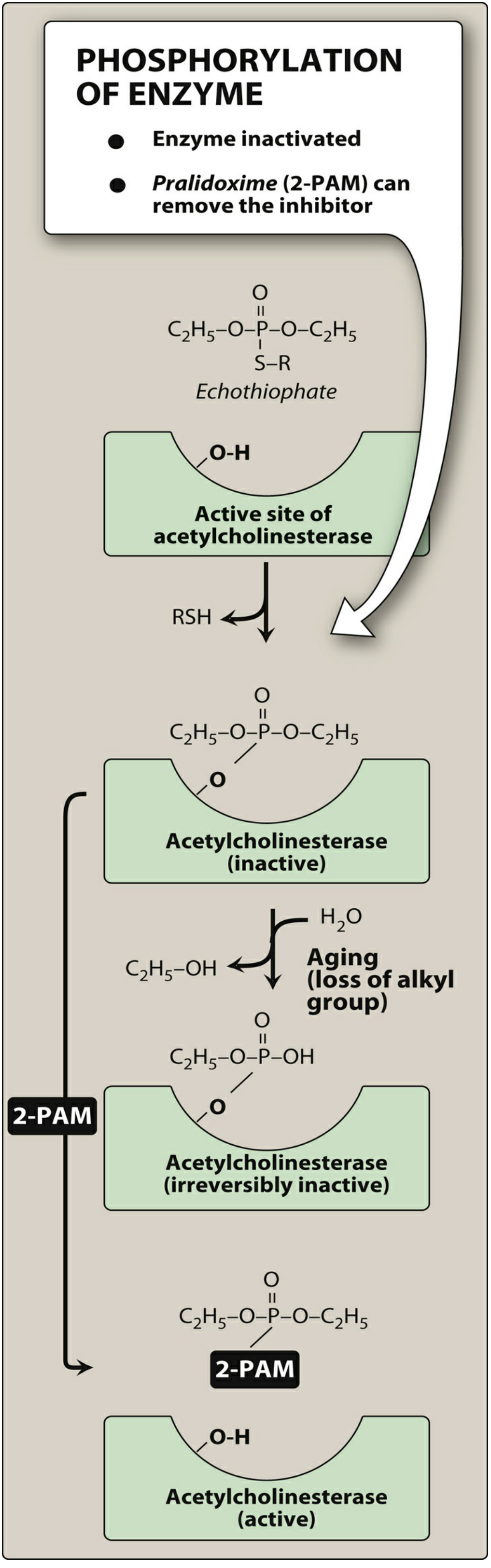
[Point to diagram]
"Look at this diagram. Once OP binds AChE - 2-PAM CAN still rescue the enzyme. But if we delay, the phosphorylated enzyme loses one alkyl group - this is called AGING. After aging, the bond becomes permanent. 2-PAM can no longer help. This is WHY time is everything."
Interactive Q2:
"So if a patient comes in 48 hours late - should we still give 2-PAM?"
- Answer: Controversial - aging has likely occurred; atropine is still essential, 2-PAM benefit is limited. [Reward any attempt to answer]
🟢 CLINICAL FEATURES (2:30 - 4:00)
Excess ACh causes two overlapping pictures:
Muscarinic Effects - Mnemonic: SLUDGE + BBB
| Letter | Feature |
|---|---|
| S | Salivation |
| L | Lacrimation |
| U | Urination |
| D | Defecation |
| G | GI distress (cramps, vomiting) |
| E | Emesis |
| B | Bradycardia |
| B | Bronchospasm |
| B | Bronchorrhea (most lethal - "drowning in secretions") |
Miosis is a hallmark sign - pinpoint pupils = muscarinic effect.
Nicotinic Effects - Mnemonic: "MTW"
- Muscle fasciculations
- Tachycardia (nicotinic - can override muscarinic bradycardia)
- Weakness / paralysis (NMJ block)
CNS Effects
- Anxiety, seizures, coma, respiratory depression
Interactive Q3 (2 minutes in - keep them sharp):
"Our farmer has bradycardia - that is muscarinic. But can an OP poisoning patient also have TACHYCARDIA?"
- Answer: Yes - early nicotinic stimulation at ganglia causes tachycardia. Later, muscarinic dominance takes over.
🔴 MANAGEMENT (4:00 - 6:00)
Step 1 - Decontamination
Remove clothes, copious water wash. Protect the treating team (secondary contamination risk - wear gloves).
Step 2 - Secure Airway + Oxygen FIRST
"Always oxygenate before giving atropine - atropine in a hypoxic myocardium can cause VF."
Step 3 - ANTIDOTES (the pharmacology core)
A. Atropine - The Life-Saving Drug
- Mechanism: Competitive antagonist at muscarinic receptors - blocks excess ACh
- Dose (adult): 2-4 mg IV bolus, DOUBLE every 5-10 minutes until atropinization is achieved
- Endpoint of atropinization: Dry secretions, clear chest (no wheeze, no bronchorrhea), HR >80 - NOT pupil dilation (misleading)
- Key point: There is NO ceiling dose. In severe cases, hundreds of mg may be needed.
- What atropine does NOT do: It does NOT reverse nicotinic effects (muscle paralysis, fasciculations) - that requires 2-PAM.
Interactive Q4 (most likely viva question):
"I give atropine - but the patient is still having muscle fasciculations and weakness. Why?"
- Answer: Atropine only blocks MUSCARINIC receptors. Nicotinic effects (NMJ) are not reversed by atropine. 2-PAM is needed.
B. Pralidoxime (2-PAM) - The Enzyme Reactivator
- Mechanism: Competes with OP for the phosphate group - cleaves the OP-AChE bond and liberates active enzyme
- Works on: Both muscarinic AND nicotinic effects (unlike atropine)
- Critical window: Must be given before aging (within 24-48 hours, compound-dependent)
- Dose: 1-2 g IV in 100-150 mL NS over 30 minutes; can repeat after 1 hour, then every 6-12 hours for 24-48 hours
- Always used with atropine, never alone
C. Benzodiazepines
- Diazepam for seizures - also reduces anxiety and CNS ACh excess
What to AVOID:
- Succinylcholine (AChE is blocked - prolonged paralysis)
- Morphine / respiratory depressants
- Beta-blockers (potentiate bradycardia)
⚪ CLOSURE + TAKE-HOME MESSAGE (6:00 - 7:00)
[Return to the opening case]
"Back to our farmer. He has OP poisoning. Your immediate steps:
- Gloves on - decontaminate
- Oxygen + airway
- Atropine 2-4 mg IV - keep doubling until secretions dry
- 2-PAM 1-2 g IV over 30 min - give early, before aging
- Diazepam if seizing Monitor: He might need ventilator support."
Final Interactive Question (the one they'll remember):
"If you could only give ONE drug in OP poisoning - atropine or 2-PAM - which would you choose and why?"
- Answer: Atropine - because it targets the lethal muscarinic effects (bronchospasm, bradycardia, bronchorrhea) and is the immediate life-saver. 2-PAM is the antidote but has a time window limitation.
🧠 THE THREE-LINE SUMMARY (write on board as you say it)
- OPs phosphorylate AChE → ACh floods everywhere
- Atropine blocks muscarinic effects; 2-PAM reactivates the enzyme (before aging)
- Dry the patient - atropinization endpoint = dry secretions, not dilated pupils
QUICK REFERENCE CARD FOR YOUR VIVA
| Feature | Detail |
|---|---|
| Mechanism | Irreversible AChE inhibition by covalent phosphorylation |
| Muscarinic mnemonics | SLUDGE + BBB |
| Nicotinic features | Fasciculations, weakness, tachycardia |
| Aging | Loss of alkyl group from phosphorylated AChE; makes 2-PAM useless |
| Atropine dose | 2-4 mg IV, double every 5-10 min; NO ceiling |
| Atropinization endpoint | Dry secretions + clear chest (NOT pupil dilation) |
| 2-PAM dose | 1-2 g IV over 30 min; repeat Q6-12h x 24-48h |
| 2-PAM does NOT work after | Aging (usually >24-48h for most OPs) |
| Avoid | Succinylcholine, beta-blockers, morphine |
| Diagnosis | Clinical + serum/RBC cholinesterase levels (decreased) |
Sources: Lippincott Illustrated Reviews Pharmacology (AChE mechanism & aging diagram); Tintinalli's Emergency Medicine (management protocol); Morgan & Mikhail's Clinical Anesthesiology (atropine in OP poisoning); The Essentials of Forensic Medicine and Toxicology, 36th Edition.
Tips for your viva performance:
- Start with the clinical question exactly as written above - it grabs attention immediately
- Write SLUDGE + BBB on the board as you list features
- Draw the synapse with AChE at the midpoint - takes 30 seconds and scores heavily
- The "atropine vs 2-PAM" closing question always generates debate and shows depth
- Speak the endpoint of atropinization with emphasis - examiners love testing this
This is a shared conversation. Sign in to Orris to start your own chat.