
Explain acoustic coupling and ossicular coupling from Scott and brown textbook
I'll read the medical library skill first, then search for acoustic coupling and ossicular coupling content.
Reading File
Now let me search the library for the Scott-Brown textbook and these specific topics in parallel.
Finding Sources
Finding Sources
Finding Sources
I found the Scott-Brown Vol 2 content. Let me now read that specific block for the full explanation, and also fetch the ossicular coupling image.
Reading File
Finding Sources
Excellent! I have the key lines. Let me now read the full sections on ossicular coupling and middle ear impedance match from Scott-Brown Vol 2.
Reading File
Reading File
Let me read a bit more of the Middle ear impedance match section and also fetch the ossicular coupling image.
Reading File
Loading Image
I now have all the content needed from Scott-Brown's textbook. Let me also check the section specifically discussing acoustic coupling in Scott-Brown to get that passage.
Finding Sources
I now have all the information needed from Scott-Brown's textbook. Let me compile the comprehensive answer.
Acoustic Coupling and Ossicular Coupling
Scott-Brown's Otorhinolaryngology Head & Neck Surgery, Vol 2 - Chapter 48
Overview: The Middle Ear as an Impedance Transformer
The middle ear functions as an efficient passive and linear transformer, conducting acoustic energy from the tympanic membrane (TM) to the stapes footplate at the oval window and then to the cochlea. Its primary role is to overcome the impedance mismatch that would otherwise occur when sound transitions from an air-filled medium (middle ear cavity) to a fluid-filled medium (perilymph and endolymph in the cochlea).
Without this matching system, approximately 99.9% of incident sound energy would be reflected at the air-fluid interface - a loss of about 30 dB. The middle ear compensates through two mechanisms: ossicular coupling and acoustic coupling.
Ossicular Coupling
Definition: Ossicular coupling is the transfer of acoustic energy from a low-impedance, high-velocity medium (air) to a high-impedance, low-velocity medium (cochlear fluid) via the TM and the ossicular chain (malleus-incus-stapes complex).
"Acoustic energy is transferred from a low-impedance, high-velocity medium to a high-impedance, low-velocity medium through this ossicular coupling (Figure 48.13)."
- Scott-Brown Vol 2, p. 621
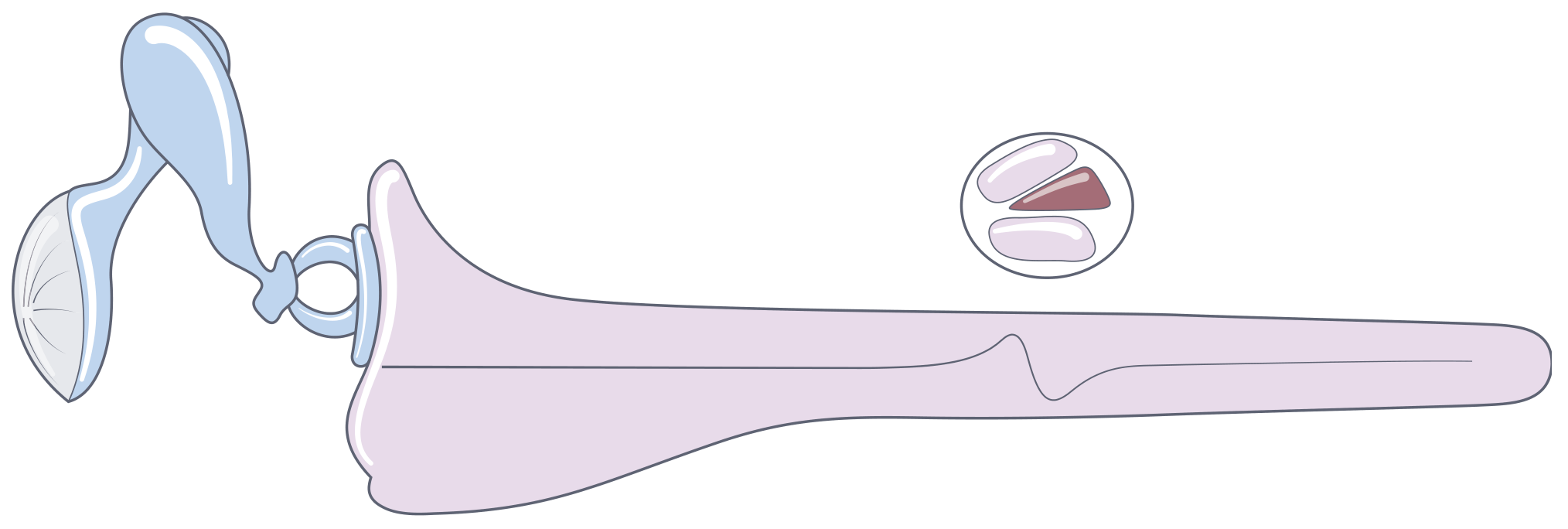
Mechanisms of Ossicular Coupling
Two primary mechanisms create the pressure gain that overcomes impedance at the stapes-oval window interface:
1. Surface Area Ratio (Hydraulic Lever)
- The ratio of the TM surface area to the stapes footplate area is approximately 18:1
- This disproportionality concentrates force over a smaller area, dramatically increasing pressure
- This is the dominant factor in overcoming the acoustic impedance mismatch
2. Ossicular Lever Action
- The lever ratio created by the arm lengths of the malleus and incus provides additional mechanical advantage
- The manubrium of the malleus is longer than the long process of the incus
- Together with the TM area ratio, these two mechanisms produce the pressure gain
Frequency-Dependence of Ossicular Coupling
Ossicular coupling is not a flat gain - it varies with frequency:
| Frequency | Ossicular Coupling Gain |
|---|---|
| 0.25-0.5 kHz | ~20 dB |
| 1 kHz | ~26.6 dB (peak) |
| Above 7 kHz | Approaches zero |
The gain decreases by approximately 8.6 dB per octave above 1 kHz. This is because cochlear impedance is lower at higher frequencies, requiring less matching from the middle ear.
At 2 kHz (the most efficient transfer frequency):
- Sound pressure loss at cochlea: 39.5 dB
- Compensated by: External canal gain of 9 dB + Middle ear gain of 26.6 dB = 35.6 dB total gain
- At the resonant frequency of 2.7 kHz, the match is even more precise (loss ~35 dB, nearly fully compensated)
"Ossicular coupling, which is mainly contributory to the pressure gain, is frequency-dependent; between 0.25 and 0.5 kHz it is 20 dB, reaching to 26.6 dB at 1 kHz and then decreasing by about 8.6 dB per octave until near zero above 7 kHz."
- Scott-Brown Vol 2, p. 625
Stapes Footplate Motion
The stapes moves in a piston-like fashion at low frequencies. At higher frequencies, the motion becomes more complex, with spatial movements along both the long and short axes of the footplate.
Ossicular Coupling When Disrupted
- Ossicular discontinuity (congenital or acquired): The preferential distribution of sound to the oval window is lost, and the cochlear partition pressure driving the travelling wave is compromised. The total expected conductive loss is ~60 dB (though less if there is incomplete discontinuity or a pathological bridge such as cholesteatoma).
- Ossicular fixation (e.g., chronic adhesive otitis media, otosclerosis): Continuity is maintained but mobility is restricted, creating high system impedance. The resulting conductive loss is less than with total disruption due to inbuilt redundancy mechanisms. Otosclerosis specifically affects the stapes footplate, with hearing loss proportional to stapes mobility loss.
- Tympanoplasty and ossicular chain reconstruction (using soft tissue, synthetic, or autologous grafts) attempts to re-establish the broken ossicular bridge.
Acoustic Coupling
Definition: Acoustic coupling refers to the direct transmission of sound pressure differences across the cochlear windows (oval and round) that occurs without the ossicular chain, simply through the pressure difference created in the middle ear space itself.
Unlike ossicular coupling - which is a mechanically amplified, directed system - acoustic coupling depends on the differential sound pressure reaching the two cochlear windows (oval window vs. round window). The oval and round windows must receive sound at different amplitudes or phases for cochlear fluid to be set into motion.
How Acoustic Coupling Works
In a normal ear, sound arriving via the EAC reaches the TM and is transmitted to the oval window via the ossicular chain. The TM also acts as a shield - it prevents direct sound from reaching the round window (via the middle ear cavity). This means:
- Sound pressure at the oval window is high (from ossicular coupling)
- Sound pressure at the round window is low (shielded by the TM)
- The pressure differential between the two windows drives cochlear fluid movement
When ossicular coupling is functioning normally, acoustic coupling is approximately 60 dB smaller than ossicular coupling and is therefore negligible in the normal ear.
Clinical Relevance of Acoustic Coupling
Acoustic coupling becomes clinically important when ossicular coupling is compromised:
-
Tympanic membrane perforation:
- A perforation allows sound to access the round window more directly through the middle ear cavity
- This reduces the shielding effect, allowing more equal sound pressure at both oval and round windows
- This reduces the pressure differential between windows, thereby reducing ossicular coupling
- Perforations also cause an enhancement of acoustic coupling by 10-20 dB compared to the normal ear (due to loss of the shielding effect)
-
Loss of TM and malleus/incus:
- With loss of ossicular coupling, acoustic coupling becomes the dominant (if limited) mechanism
- Acoustic coupling can be enhanced by 10-20 dB compared to the normal ear in this scenario
-
Type IV and V Tympanoplasty:
- In these procedures, hearing depends almost entirely on acoustic coupling (no ossicular reconstruction)
- A tissue graft shielding the round window from sound enhances acoustic coupling by increasing the sound pressure difference between oval and round windows
- Under optimal conditions (intact graft shield, adequate round window aeration), maximum acoustic coupling results in a residual conductive hearing loss of only 20-25 dB
Summary: Key Differences
| Feature | Ossicular Coupling | Acoustic Coupling |
|---|---|---|
| Mechanism | Mechanical lever + area ratio via TM-ossicle chain | Pressure differential between oval & round windows |
| Magnitude (normal ear) | Dominant mechanism (baseline) | ~60 dB smaller than ossicular coupling |
| Frequency dependence | Yes - peaks at 1 kHz, falls above 7 kHz | Less frequency-dependent |
| When clinically relevant | Normal hearing; disrupted in conductive loss | Becomes important when ossicular chain is absent/disrupted |
| Surgical target | Ossicular reconstruction (tympanoplasty Types I-III) | Type IV/V tympanoplasty; round window shielding |
Sources: Scott-Brown's Otorhinolaryngology Head & Neck Surgery, Vol 2, Chapter 48 - "The Middle Ear" (pp. 621-625)
This is a shared conversation. Sign in to Orris to start your own chat.