I have all the content needed. The two images show pages from what appears to be Lippincott's Pharmacology (the user's physical book, which is a different edition - the chapter is Chapter 35 in their copy vs. Chapter 37 in the digital version). The content is the same. Let me now deliver a thorough simplified breakdown of both pages.
Antitumor Antibiotics - Simplified from Lippincott (Chapter 35)
These pages cover the antitumor antibiotic class of anticancer drugs.
Overview - What are Antitumor Antibiotics?
Despite the name "antibiotics," these drugs are used for cancer, not infections. They work by interacting with DNA in multiple ways:
| Mechanism | Example |
|---|
| DNA intercalation (inserting between base pairs) | Doxorubicin |
| Inhibit topoisomerase I and II | Doxorubicin |
| Produce free radicals → DNA damage | Doxorubicin, Bleomycin |
Key rule: Almost all antitumor antibiotics are cell cycle NON-specific - they kill cells regardless of which phase they're in. Exception: Bleomycin (G₂ phase specific).
A. Anthracyclines
Members:
- Doxorubicin (most important) - hydroxylated analog of daunorubicin
- Daunorubicin - used in acute leukemias
- Idarubicin - 4-demethoxy analog of daunorubicin; acute leukemias
- Epirubicin - used in breast cancer protocols
- Mitoxantrone - AML and prostate cancer
Doxorubicin - The Most Important One
Clinical Uses
- Sarcomas (bone/soft tissue)
- Breast cancer, many solid tumors (in combination)
- Leukemias and lymphomas
1. Mechanism of Action (3 ways it kills)
| Mechanism | What happens |
|---|
| DNA intercalation | Doxorubicin inserts itself between DNA base pairs → blocks DNA and RNA synthesis |
| Topoisomerase II inhibition | Prevents DNA repair → DNA fragments accumulate |
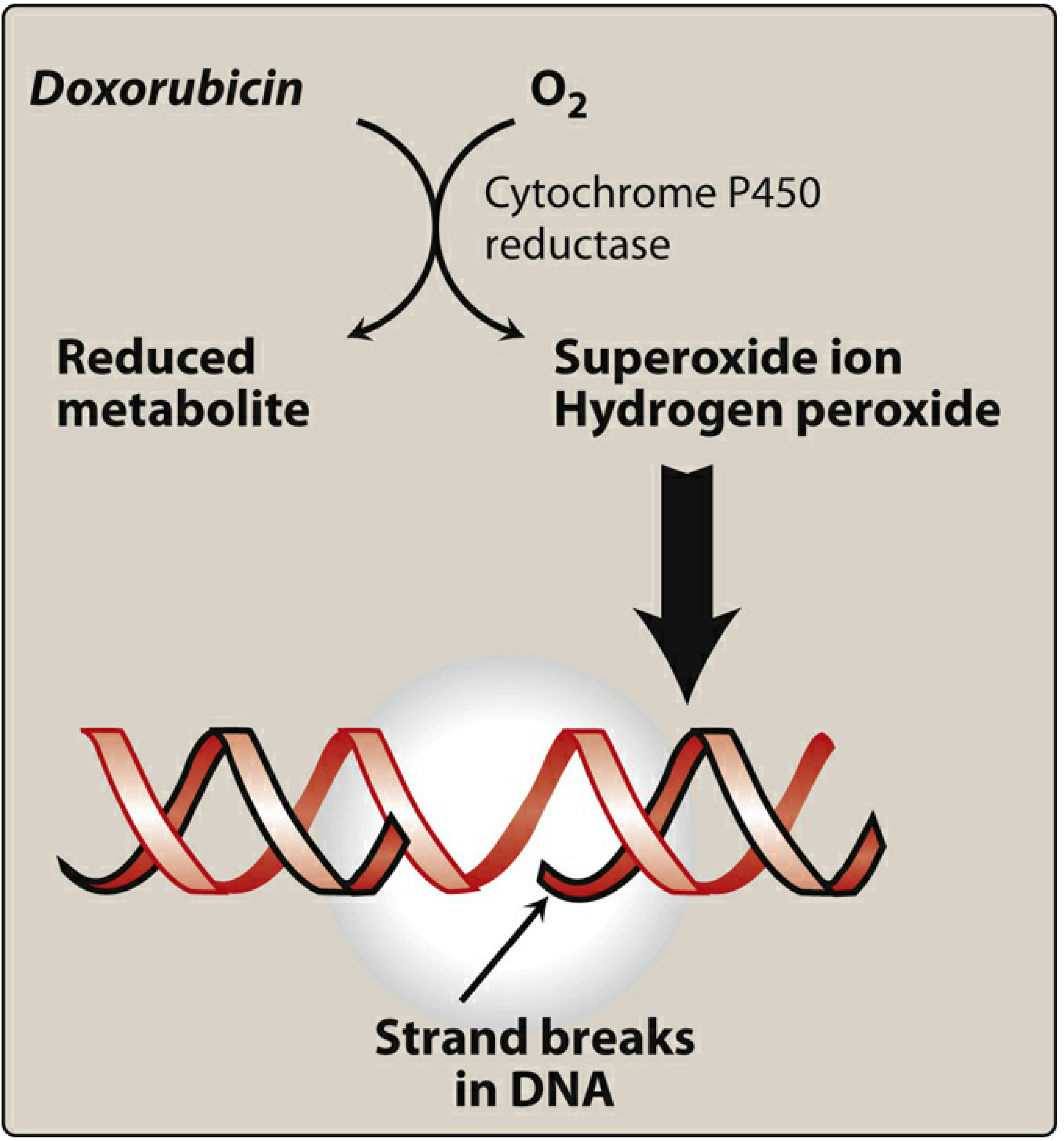
| Free radical generation | Doxorubicin + cytochrome reductase → superoxide/H₂O₂ → lipid peroxidation, DNA strand scission, oxidation of bases |
2. Pharmacokinetics
| Parameter | Detail |
|---|
| Route | IV only (inactivated in GI tract) |
| Extravasation risk | Serious - causes tissue necrosis if it leaks |
| Distribution | Wide - binds plasma proteins and tissues; does NOT cross BBB or enter testes |
| Metabolism | Extensive hepatic metabolism - dose adjust in liver disease |
| Excretion | Biliary (major route) |
| Urine color | Red discoloration (drug's dark red color) |
3. Adverse Effects
| Adverse Effect | Notes |
|---|
| Cardiotoxicity ⚠️ | Most serious - IRREVERSIBLE, dose-dependent; causes LV dysfunction and heart failure |
| Mechanism of cardiotoxicity | Free radical generation + lipid peroxidation in cardiac muscle |
| Adding trastuzumab | Increases risk of heart failure (avoid combining) |
| Prevention | Liposomal doxorubicin (less cardiotoxic) OR add dexrazoxane (iron chelator) |
| Myelosuppression | Bone marrow suppression |
| N/V/D, alopecia, stomatitis | General chemotherapy toxicities |
Memory trick for cardiotoxicity: "Doxo-rubiCIN damages the cardiaCIN" - the free radicals generated are the same ones that cause cardiac damage.
B. Bleomycin
Uses:
- Testicular cancers
- Hodgkin lymphoma
1. Mechanism of Action
Bleomycin-Fe²⁺ complex → oxidized to bleomycin-Fe³⁺ → releases electrons → reacts with O₂ → superoxide/hydroxyl radicals → attack phosphodiester bonds → DNA strand breaks + chromosomal aberrations
Simple version: Bleomycin is a copper/iron-chelating glycopeptide that creates damaging free radicals next to DNA.
Cell cycle specific: G₂ phase (unlike other antitumor antibiotics!)
2. Pharmacokinetics
- Given by multiple routes
- Bleomycin-inactivating enzyme (hydrolase) is high in liver and spleen but LOW in lung and skin → explains why toxicity concentrates there
- Excreted unchanged in urine → dose adjust in renal failure
3. Adverse Effects
| Adverse Effect | Notes |
|---|
| Pulmonary toxicity ⚠️ | Most serious - progresses from cough/rales → infiltrate → fatal pulmonary fibrosis |
| "Bleomycin lung" | Classic term for bleomycin-induced pulmonary fibrosis |
| Skin changes | Hypertrophic skin changes, hyperpigmentation of the hands |
| Myelosuppression is RARE | This is unique - unlike most chemo drugs, bleomycin barely suppresses the bone marrow |
Gemcitabine (Figure 35.13 - from your book)
Gemcitabine (2',2'-difluorodeoxycytidine) is a pyrimidine analog shown in your left page.
- Activated by deoxycytidine kinase → becomes the triphosphate form
- Inhibits DNA synthesis
- Used in pancreatic cancer, lung cancer, bladder cancer, breast cancer
Quick Comparison Table
| Drug | Class | Key Use | Unique Toxicity | Myelosuppression? |
|---|
| Doxorubicin | Anthracycline | Breast ca, sarcomas, lymphomas | Cardiotoxicity (irreversible) | Yes |
| Daunorubicin | Anthracycline | Acute leukemias | Cardiotoxicity | Yes |
| Idarubicin | Anthracycline | Acute leukemias | Cardiotoxicity (less) | Yes |
| Bleomycin | Antibiotic | Testicular ca, Hodgkin | Pulmonary fibrosis | Rare/No |
High-Yield Exam Points from These Pages
- All antitumor antibiotics = cell cycle NON-specific, EXCEPT bleomycin = G₂ specific
- Doxorubicin's worst toxicity = irreversible cardiotoxicity → use dexrazoxane to protect
- Bleomycin's worst toxicity = pulmonary fibrosis ("bleomycin lung")
- Bleomycin causes myelosuppression rarely - this makes it useful in combination regimens
- Biliary excretion is the main route for anthracyclines - adjust dose in liver disease
- Extravasation with doxorubicin = tissue necrosis (nurse it carefully!)
- Combining doxorubicin + trastuzumab = increased heart failure riskI can see your pages clearly. These cover Alkylating Agents from Lippincott Chapter 35. Let me give you a full simplified breakdown of all three pages.
Alkylating Agents - Simplified from Lippincott (Chapter 35)
What are Alkylating Agents?
Alkylating agents work by covalently bonding to DNA - they attach chemical groups (alkyl groups) to nucleophilic sites on DNA strands, particularly the N-7 position of guanine.
Key Concepts:
- Cell cycle NON-specific - kill both dividing AND resting cells
- Mutagenic and carcinogenic - can cause secondary malignancies (e.g., acute leukemia) - this is a serious long-term risk
- They do NOT discriminate between tumor and normal cells - toxicity to all rapidly dividing cells
- Alkylation = the crucial cytotoxic reaction
A. Cyclophosphamide and Ifosfamide
These are the most commonly used alkylating agents and are very closely related mustard agents.
Clinical Uses:
- Non-Hodgkin lymphoma
- Sarcoma
- Breast cancer
- Wide variety of neoplastic diseases (single agent or combinations)
1. Mechanism of Action
Both are prodrugs activated by the liver:
Cyclophosphamide/Ifosfamide
         ↓ (CYP450 - liver)
  Hydroxylated intermediates
  (phosphoramide mustard + acrolein)
         ↓
  Phosphoramide mustard → reacts with DNA
         ↓
    ALKYLATED DNA → cell death
Acrolein is a toxic byproduct responsible for bladder toxicity (see adverse effects).
Memory trick: "Cyclo needs CYP450 to cycle into action"
2. Pharmacokinetics
| Feature | Cyclophosphamide | Ifosfamide |
|---|
| Route | IV or PO (oral available) | IV only |
| Metabolism | Liver → active + inactive metabolites | CYP450 3A4 and 2B6 isoenzymes |
| Excretion | Minimal unchanged in urine | Mainly renally excreted |
3. Adverse Effects
| Adverse Effect | Notes |
|---|
| Hemorrhagic cystitis ⚠️ | Most unique toxicity - caused by acrolein in urine (cyclophosphamide) and toxic metabolites of ifosfamide |
| Prevention | Good hydration + MESNA (sodium 2-mercaptoethane sulfonate) - neutralizes toxic metabolites in bladder |
| Myelosuppression | Bone marrow suppression |
| N/V, alopecia | General chemo toxicities |
| Amenorrhea | Reproductive toxicity |
| Secondary malignancies | Long-term leukemogenic risk |
| Neurotoxicity | Reported with high-dose ifosfamide (due to chloroacetaldehyde metabolite) |
Key exam point: Hemorrhagic cystitis → give MESNA + adequate hydration. MESNA is specifically protective against bladder toxicity, NOT other toxicities.
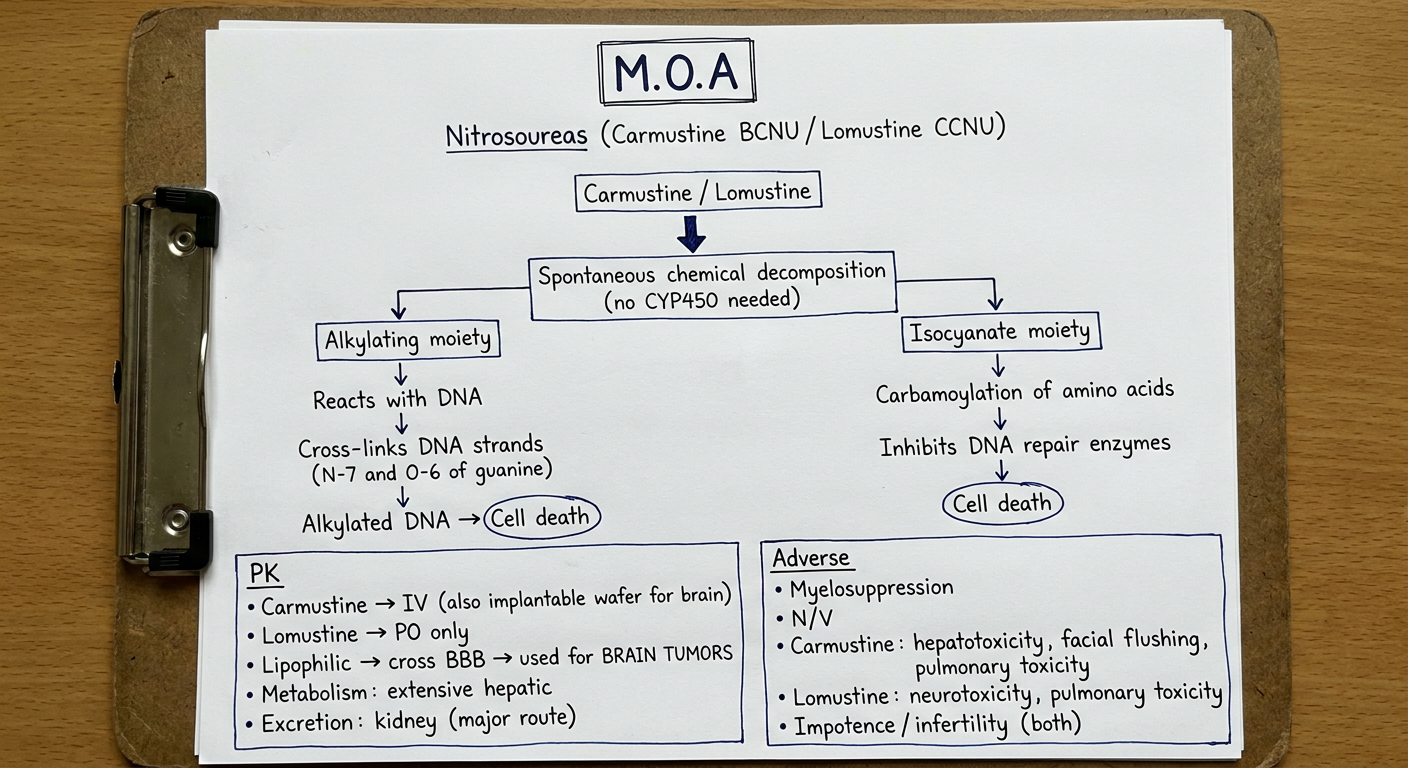
B. Nitrosoureas: Carmustine (BCNU) and Lomustine (CCNU)
Why are these special?
They cross the blood-brain barrier (BBB) → used primarily for brain tumors
1. Mechanism of Action
- Exert cytotoxic effects by alkylation (like other alkylating agents)
- Also inhibit key enzymatic processes by carbamoylation of amino acids in proteins
- Alkylate DNA in resting cells, but cytotoxicity is mainly expressed in actively dividing cells
- Non-dividing cells can escape if DNA repair occurs
2. Pharmacokinetics
| Feature | Carmustine (BCNU) | Lomustine (CCNU) |
|---|
| Route | IV (also available as implantable wafer for brain tumors) | PO (oral only) |
| Lipophilicity | High → widely distributed, penetrates CNS | High → same |
| Metabolism | Extensive | Metabolized to active products |
| Excretion | Kidney (major route) | Kidney |
Memory: Carmustine = Chemo wafer (implantable); Lomustine = Let's swallow (oral)
3. Adverse Effects
| Carmustine (BCNU) | Lomustine (CCNU) |
|---|
| Myelosuppression | Myelosuppression |
| N/V | N/V |
| Facial flushing | Pulmonary toxicity |
| Hepatotoxicity | Impotence/infertility |
| Pulmonary toxicity | Neurotoxicity |
| Impotence/infertility | Take on empty stomach |
C. Dacarbazine and Temozolomide
Both must be converted to the same active metabolite: MTIC (methyltriazenoimidazole carboxamide)
Shared Mechanism:
MTIC → forms methyl carbonium ions → methylates DNA at O-6 and N-7 positions of guanine → blocks replication
Dacarbazine
- Requires CYP450 for biotransformation to MTIC
- Uses: Melanoma and Hodgkin lymphoma
- Route: IV
- Adverse effects: Myelosuppression, N/V, flu-like syndrome, CNS toxicity, hepatotoxicity, photosensitivity (vesicant!)
Temozolomide
- Does NOT need CYP450 - undergoes chemical transformation at normal physiological pH
- Also inhibits O-6-guanine-DNA alkyltransferase (repair enzyme)
- Crosses the BBB → used for brain tumors (glioblastoma, astrocytoma) + metastatic melanoma
- Route: IV or oral (excellent bioavailability)
- Adverse effects: N/V, myelosuppression, headache, fatigue, photosensitivity
- Special note: Requires Pneumocystis pneumonia prophylaxis
Key difference: Dacarbazine needs CYP450 (liver), Temozolomide does NOT. Temozolomide crosses BBB, dacarbazine does NOT.
D. Other Alkylating Agents
| Drug | Key Use | Unique Points | Unique Toxicity |
|---|
| Mechlorethamine | Lymphatic cancers | First nitrogen mustard (developed in WWI as vesicant) | Vesicant |
| Melphalan | Multiple myeloma | Phenylalanine derivative of nitrogen mustard; dose adjusted by platelet/WBC monitoring | Myelosuppression, mucositis, hypersensitivity (IV) |
| Chlorambucil | Chronic lymphocytic leukemia (CLL) | Bifunctional alkylating agent; take with food | Myelosuppression, pulmonary fibrosis (rare), hyperuricemia, seizures |
| Busulfan | Chronic myelogenous leukemia (CML) | Effective against CML | "Busulfan lung" (pulmonary fibrosis), myelosuppression, hepatotoxicity, mucositis |
Master Summary Table (Figure 35.17 from your book)
| Drug | Route | Key Adverse Effects | Notable Drug Interactions | Notes |
|---|
| Cyclophosphamide | IV/PO | Myelosuppression, hemorrhagic cystitis, N/V/D, alopecia, amenorrhea, secondary malignancies | Phenobarbital, phenytoin (CYP450), digoxin, anticoagulants | Good hydration + MESNA with high doses |
| Ifosfamide | IV | Myelosuppression, hemorrhagic cystitis, N/V, neurotoxicity, alopecia, amenorrhea | Phenobarbital, phenytoin, cimetidine, allopurinol, warfarin | Use MESNA + hydration to prevent bladder toxicity |
| Carmustine (BCNU) | IV | Myelosuppression, N/V, facial flushing, hepatotoxicity, pulmonary toxicity, impotence/infertility | Cimetidine, amphotericin B, digoxin, phenytoin | Implantable wafer (brain) available |
| Lomustine (CCNU) | PO | Myelosuppression, N/V, pulmonary toxicity, impotence, neurotoxicity | Cimetidine, alcohol | Give on empty stomach |
| Dacarbazine | IV | Myelosuppression, N/V, flu-like syndrome, CNS toxicity, hepatotoxicity, photosensitivity | Phenytoin, phenobarbital (CYP450) | Vesicant |
| Temozolomide | PO | N/V, myelosuppression, headache, fatigue, photosensitivity | - | Requires Pneumocystis prophylaxis |
| Melphalan | IV/PO | Myelosuppression, N/V/D, mucositis, hypersensitivity (IV) | Cimetidine, steroids, cyclosporine | Take on empty stomach |
| Chlorambucil | PO | Myelosuppression, skin rash, pulmonary fibrosis (rare), hyperuricemia, seizures | Phenobarbital, phenytoin (CYP450) | Take with food |
| Busulfan | IV/PO | Myelosuppression, N/V/D, mucositis, skin rash, pulmonary fibrosis, hepatotoxicity | Acetaminophen, itraconazole, phenytoin | "Busulfan lung" |
High-Yield Exam Points
- Hemorrhagic cystitis = cyclophosphamide/ifosfamide → treat/prevent with MESNA + hydration
- Nitrosoureas (BCNU/CCNU) cross the BBB → brain tumors
- Temozolomide vs Dacarbazine: Same MTIC metabolite, but temozolomide doesn't need CYP450, crosses BBB
- Secondary malignancies = long-term risk with ALL alkylating agents (they are leukemogenic)
- Busulfan lung = pulmonary fibrosis (same pattern as bleomycin lung)
- Carmustine = only alkylating agent available as an implantable wafer (Gliadel) for brain tumors
- Ifosfamide neurotoxicity = caused by chloroacetaldehyde metabolite (high doses)
- Melphalan dose adjusted by monitoring platelets and WBC counts
- All alkylating agents are cell cycle NON-specific - they kill resting cells too