

Label this diagram. First diagram is of morphogenic stage, organogenic stage, formative stage, maturative stage. And similarly, create a diagram similar way of decimalytic stage and protithic stage of life cycle of amyloblast and label this diagram and send it to me.
desmolytic stage ameloblast life cycle features characteristics histology
A clean, professional medical educational diagram showing 4 stages of the Life Cycle of Ameloblast arranged in a 2x2 grid layout with clear labels and bullet points. Top-left box labeled "1. MORPHOGENIC STAGE" with a simple elongated cell drawing showing: Cell Short Columnar shape, Large oval nucleus (centrally placed), Golgi apparatus and mitochondria located at proximal end. Top-right box labeled "2. ORGANIZING STAGE (Organizing Stage)" with a taller elongated cell drawing showing: Cells become Longer, Reversal of Polarity - Golgi apparatus and centrioles migrate to distal part, Nuclei shifts to Proximal part, Amount of Rough ER increases, Basal lamina disintegrates after dentin formation, Change in nutritional supply occurs. Bottom-left box labeled "3. FORMATIVE STAGE" with a cell drawing showing Tomes process: This stage starts after first layer of Dentin is laid down, Development of a blunt process (Tomes' process) on ameloblast surface, It penetrates basal lamina to enter predentin. Bottom-right box labeled "4. MATURATIVE (MINERALIZING) STAGE" with a cell drawing showing microvilli: Enamel maturation occurs after most of Enamel Matrix in occlusal/incisal areas is laid down, Ameloblasts are slightly reduced in length, Microvilli appear at distal surface, Most organelles are enclosed in phagocytic vacuoles and digested by lysosomal enzymes. Title at top: "LIFE CYCLE OF AMELOBLAST (Stages 1-4)" in bold. Each box has a numbered header with colored border. Simple black line cell diagrams with labeled organelles. Clean white background, medical textbook style, by Prof. Shaheen Chandra.
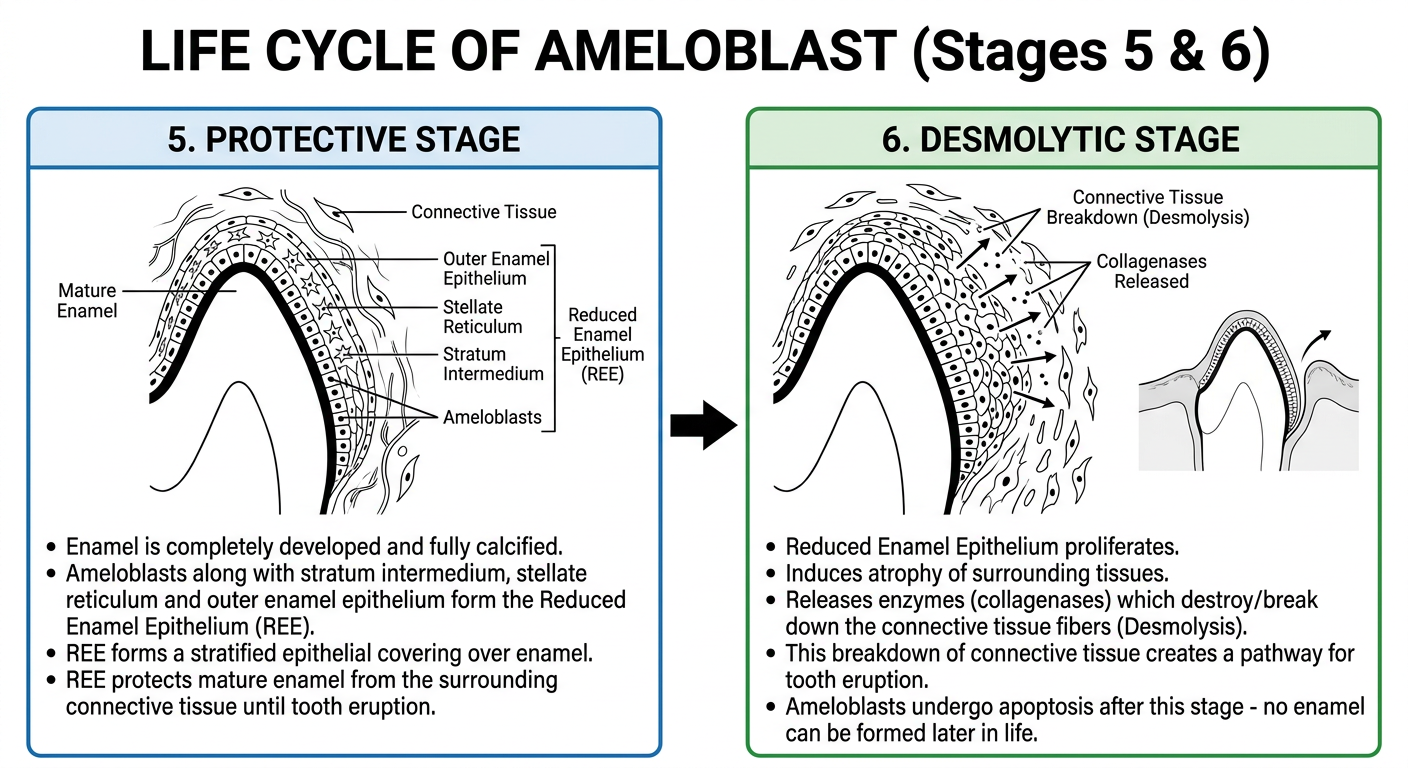
A clean, professional medical educational diagram showing 2 stages of the Life Cycle of Ameloblast side by side with clear labels and bullet points. Left box labeled "5. PROTECTIVE STAGE" with a simple cell drawing showing: Enamel is completely developed and fully calcified, Ameloblasts along with stratum intermedium, stellate reticulum and outer enamel epithelium form the Reduced Enamel Epithelium (REE), REE forms a stratified epithelial covering over enamel, REE protects mature enamel from the surrounding connective tissue until tooth eruption. Right box labeled "6. DESMOLYTIC STAGE" with a cell diagram showing: Reduced Enamel Epithelium proliferates, Induces atrophy of surrounding tissues, Releases enzymes (collagenases) which destroy/break down the connective tissue fibers (Desmolysis), This breakdown of connective tissue creates a pathway for tooth eruption, Ameloblasts undergo apoptosis after this stage - no enamel can be formed later in life. An arrow connecting the two boxes from left to right showing progression. Title at top: "LIFE CYCLE OF AMELOBLAST (Stages 5 & 6)" in bold. Each box has a numbered header with colored border. Simple black line cell diagrams. Clean white background, medical textbook style. Include a small tooth eruption pathway diagram next to the desmolytic stage box.
Diagram 1 - Life Cycle of Ameloblast: Stages 1-4
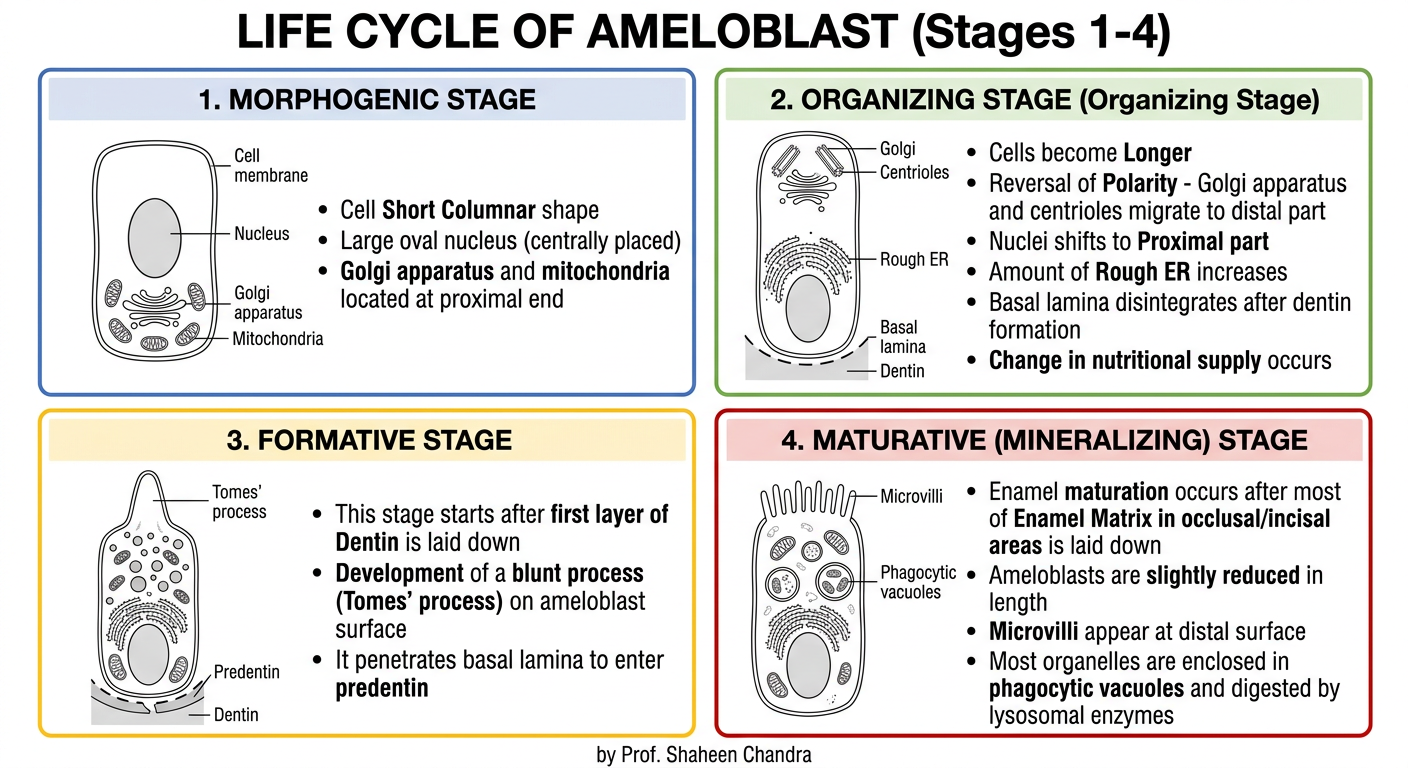
Diagram 2 - Life Cycle of Ameloblast: Stages 5 & 6 (Protective + Desmolytic)
- Cell: Short columnar
- Large oval nucleus (central)
- Golgi apparatus and mitochondria at proximal end
- Cells become longer
- Reversal of polarity - Golgi and centrioles shift to distal end
- Nucleus shifts to proximal end
- Rough ER increases
- Basal lamina disintegrates after dentin formation
- Nutritional supply changes
- Starts after first dentin layer is laid down
- Blunt process (Tomes' process) develops on ameloblast surface
- Process penetrates basal lamina to enter predentin
- Enamel maturation occurs after matrix is laid down in occlusal/incisal areas
- Ameloblasts slightly reduced in length
- Microvilli appear at distal surface
- Organelles enclosed in phagocytic vacuoles, digested by lysosomes
- Enamel fully calcified
- Ameloblasts + stratum intermedium + stellate reticulum + outer enamel epithelium = Reduced Enamel Epithelium (REE)
- REE forms protective stratified covering over enamel until eruption
- REE proliferates and releases collagenase enzymes
- Enzymes break down connective tissue fibers (desmolysis)
- Creates an eruption pathway for the tooth
- Ameloblasts then undergo apoptosis - enamel cannot be reformed later in life
Similarly create the protective stage and desmolytic stage in a similar way in a box-like structure. Similar, can you please create a diagram in a making a box-like structure as you have already made?
A clean professional medical educational diagram in the exact same style as a textbook slide, showing 2 stages side by side in two large bordered boxes on a dark/black background with white text, exactly matching the style of the previous slides. LEFT BOX - thick white border, labeled at top: "5. Protective Stage" in large white bold text. Inside the box, bullet points in white text: • Enamel is completely developed and fully calcified • Ameloblasts along with stratum intermedium, stellate reticulum, and outer enamel epithelium form the Reduced Enamel Epithelium (REE) • REE forms a stratified epithelial covering over enamel • REE protects mature enamel from surrounding connective tissue until tooth eruption On the right side inside the box: a small black-and-white cell diagram showing a flat/squamous-shaped ameloblast with reduced organelles, labeled "Reduced Enamel Epithelium" RIGHT BOX - thick white border, labeled at top: "6. Desmolytic Stage" in large white bold text. Inside the box, bullet points in white text: • Reduced Enamel Epithelium proliferates • Induces atrophy of surrounding tissues • Releases enzymes (collagenases) which break down connective tissue fibers • This process is called Desmolysis • Creates a pathway for tooth eruption • Ameloblasts undergo apoptosis after eruption On the right side inside the box: a small black-and-white diagram showing cells releasing enzymes destroying fibrous connective tissue strands, with an arrow pointing downward indicating tooth eruption pathway Footer text in small white font: "Prof. Shaheen Chandra" Overall layout: dark background, two equal-sized boxes side by side, clean medical lecture slide appearance, matching the morphogenic and organizing stage slide style shown in the original images.
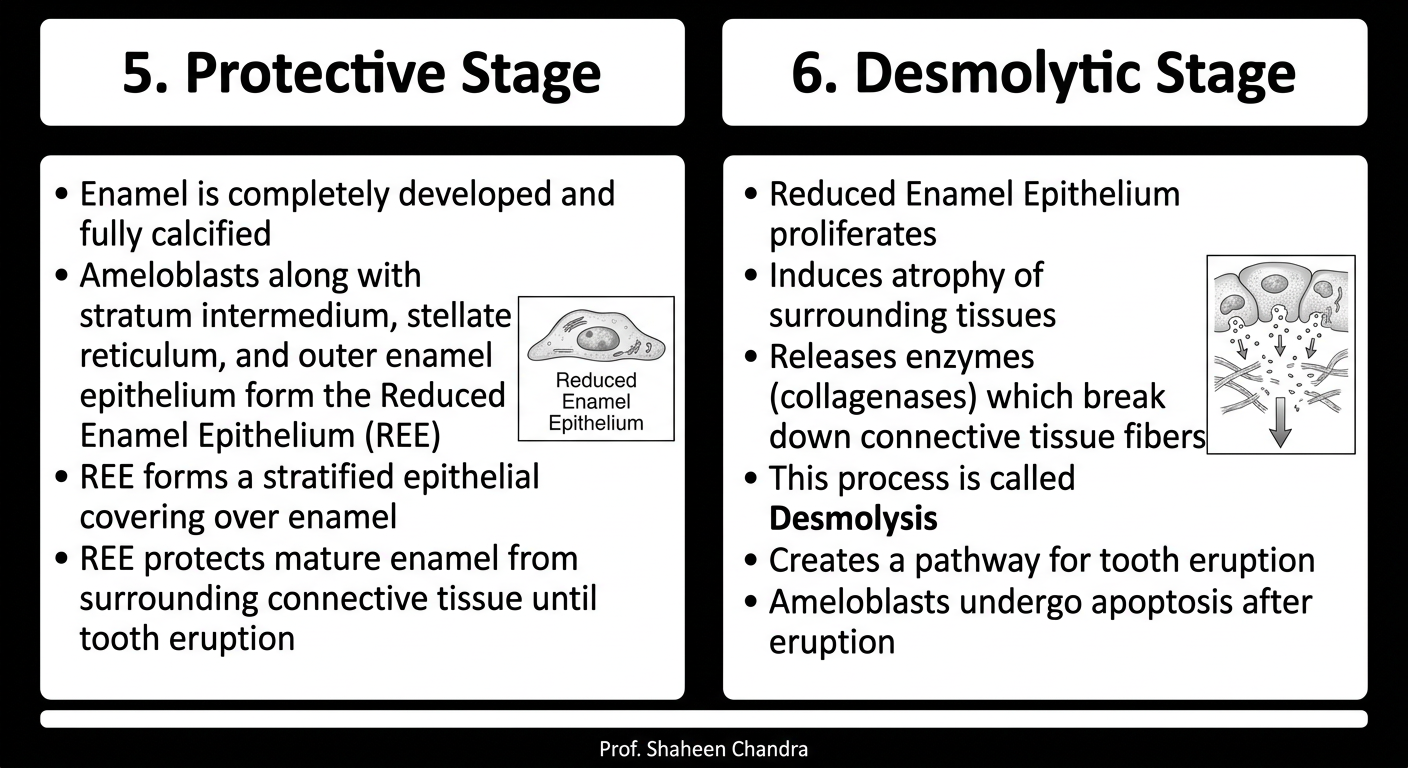
- Enamel is completely developed and fully calcified
- Ameloblasts + stratum intermedium + stellate reticulum + outer enamel epithelium together form the Reduced Enamel Epithelium (REE)
- REE forms a stratified epithelial covering over enamel
- REE protects mature enamel from surrounding connective tissue until tooth eruption
- REE proliferates and induces atrophy of surrounding tissues
- Releases enzymes (collagenases) that break down connective tissue fibers
- This process is called Desmolysis
- Creates a pathway for tooth eruption
- Ameloblasts undergo apoptosis after eruption - enamel cannot be regenerated later in life