
Normal purperium
Reading File
The puerperium is the 6-week period after delivery during which the body returns to its pre-pregnant state. Let me pull up comprehensive textbook content on this topic.
Searching sources...
Finding Sources
Finding Sources
Reading File
Reading File
Reading File
Finding Sources
Reading File
Finding Sources
Reading File
Finding Sources
Reading File
Finding Sources
Reading File
I now have comprehensive textbook content. Let me compile the full answer.
Loading Image
Here is a thorough, textbook-grounded overview of the Normal Puerperium.
Normal Puerperium
Definition
The puerperium (also called the postpartum period) is the 6-week period that begins immediately after delivery of the placenta and ends when the mother's body has returned to its pre-pregnant anatomical, physiological, and biochemical state. - Textbook of Family Medicine 9e, p.517; Gray's Anatomy for Students
1. Uterine Involution
| Time After Delivery | Uterine Position/State |
|---|---|
| Immediately after delivery | At or near the umbilicus (~1000 g) |
| Day 1 | Firm, at umbilicus level |
| Days 5-7 | Firm, nontender; midway between symphysis pubis and umbilicus |
| 2 weeks | No longer palpable abdominally; returned to true pelvis |
| 6 weeks | Back to non-pregnant size (~50 g) |
- The uterus loses more than half its postpartum weight within the first week.
- If the mother lactates, involution is faster because suckling suppresses ovarian hormones, keeping the uterus in a relatively hypoestrogenic state.
- Uterine contractions during involution cause afterpains, especially in multiparous women; these may require analgesics.
- The placental site on the endometrium undergoes autolysis, producing the vaginal discharge called lochia.
Guyton and Hall Textbook of Medical Physiology; Textbook of Family Medicine 9e
2. Lochia
| Phase | Timing | Character |
|---|---|---|
| Lochia rubra | Days 1-3 (or 1-4) | Grossly bloody, dark red |
| Lochia serosa | Days 4-10 | Serous, pinkish-brown; decreasing amount |
| Lochia alba | Day 10 onward | Pale yellow-white; scant |
Total duration is approximately 10 days, after which the endometrial surface becomes re-epithelialized. Persistent heavy or foul-smelling lochia suggests retained products or infection. - Guyton and Hall; Textbook of Family Medicine 9e
3. Changes in Other Systems
Cardiovascular and Hematological
- Pulse rate drops within the first 24 hours.
- Temperature may be slightly elevated in the first 24 hours (physiologic, due to the exertion of labor).
- Leukocytosis is normal - WBC count may rise to 20,000/μL in the first 24 hours postpartum.
- Diuresis occurs, especially when oxytocin infusion is stopped, with temporary proteinuria and glycosuria possible.
- The diuresis reduces intravascular volume, which artificially elevates the hematocrit for a few days.
Urinary Tract
- Regional anesthesia (spinal/epidural) can delay spontaneous urination.
- Urinary retention and bladder overdistension must be avoided.
- Catheterization is recommended if significant urine output is not achieved by 12 hours with a distended bladder.
Cervix and Vagina
- The cervix gradually closes; within about 1 week it is closed to external examination.
- The vaginal walls regain tone over the weeks following delivery.
Gastrointestinal
- Regular diet can be resumed as soon as desired after normal vaginal delivery.
- Constipation is common; laxatives/mild cathartics may be needed if no bowel movement within 3 days.
- Hemorrhoids can be managed with warm sitz baths and dietary measures.
Textbook of Family Medicine 9e, p.517-518
4. Hormonal Changes and Lactation
After delivery of the placenta, estrogen and progesterone levels fall sharply. This removes their inhibitory effect on prolactin and allows lactation to begin.
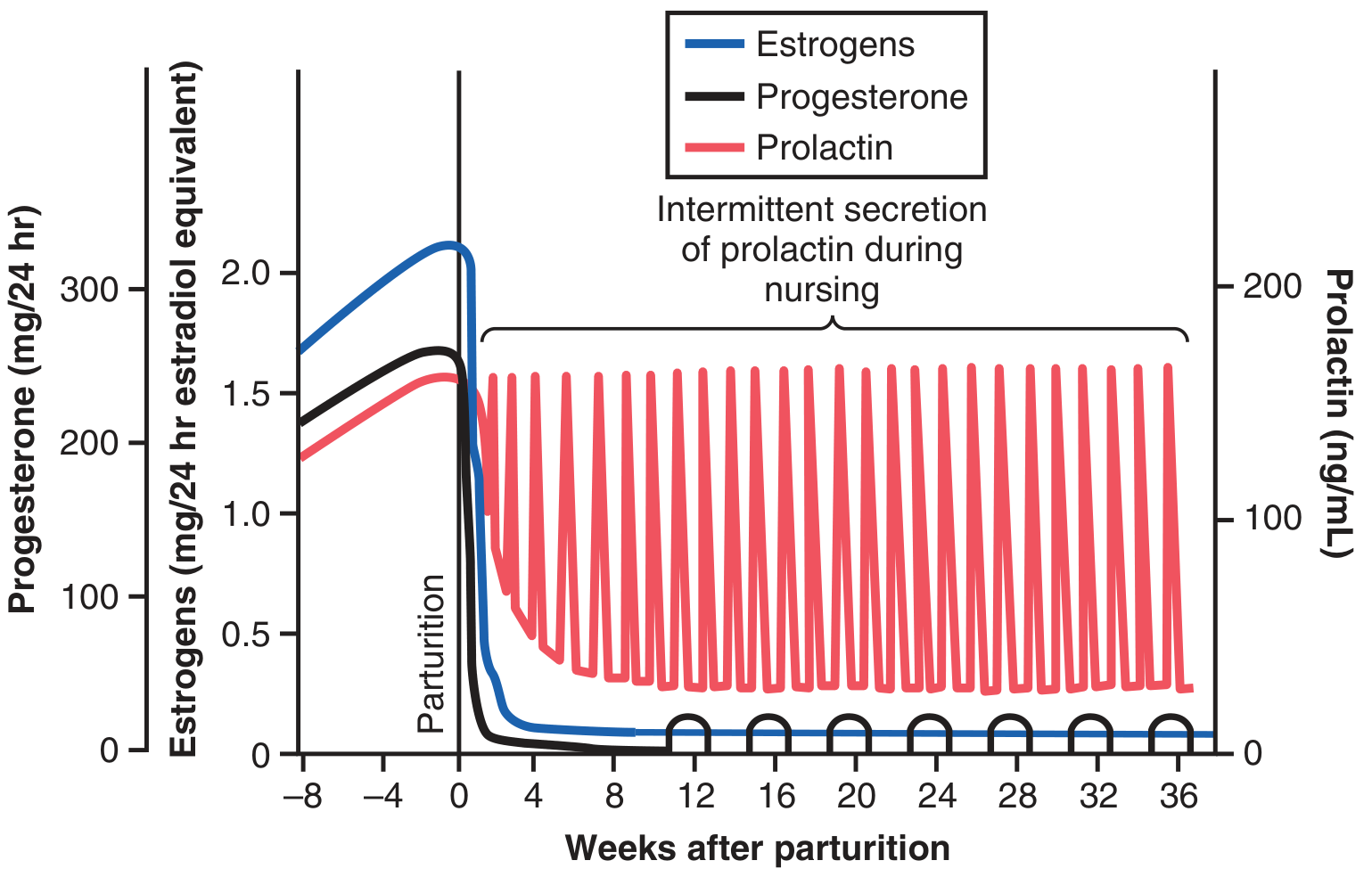
Figure: Changes in estrogen, progesterone, and prolactin from 8 weeks before to 36 weeks after parturition. Note the intermittent prolactin spikes with each nursing episode. - Guyton and Hall Textbook of Medical Physiology
Colostrum
- Secreted during the last few days before and first few days after delivery.
- Contains proteins and lactose similar to mature milk but almost no fat.
- Rich in immunoglobulins (especially IgA) providing passive immunity to the newborn.
Mature Milk Production
- Begins 1-7 days after delivery once prolactin is no longer suppressed by placental hormones.
- Each suckling episode triggers a 10-20 fold surge in prolactin (lasting ~1 hour) via nipple-hypothalamus neural reflexes.
- Oxytocin causes myoepithelial cells around the alveoli to contract → milk let-down reflex. This begins 30 seconds to 1 minute after suckling starts.
- Psychogenic factors and sympathetic stimulation (stress, pain, anxiety) can inhibit milk ejection.
Breast Engorgement
- Occurs in the early days of lactation as milk supply increases.
- In non-breastfeeding mothers, lactation is suppressed by firm breast support (avoiding gravity-stimulated let-down) and fluid restriction; lasts 3-5 days.
Guyton and Hall Textbook of Medical Physiology, pp.1044-1046
5. Return of Menstruation and Ovulation
- In breastfeeding mothers: suckling signals suppress hypothalamic GnRH → suppressed LH and FSH → ovarian cycles typically do not resume until weeks after weaning. Some nursing mothers resume cycles within several months even while breastfeeding.
- In non-breastfeeding mothers: menstruation typically resumes within 6-8 weeks postpartum.
- Ovulation can precede the first menstrual period, meaning pregnancy is possible before the return of menses.
Guyton and Hall Textbook of Medical Physiology, p.1045
6. Psychological Changes
| Condition | Onset | Features | Duration/Management |
|---|---|---|---|
| Baby blues | Day 3-5 | Tearfulness, mood lability, anxiety, irritability, fatigue | Self-limited; resolves by day 10 |
| Postpartum major depression | 24 hrs to several months | Lack of interest in infant, suicidal/homicidal ideation, hallucinations | ~10% of women; requires psychotherapy ± pharmacotherapy |
Textbook of Family Medicine 9e, p.518
7. Routine Postpartum Care
- Uterine monitoring: Massage for 1 hour after the third stage of labor; oxytocin (10 U IM or dilute IV) if uterus fails to contract adequately.
- Ambulation: Full ambulation encouraged as soon as possible.
- CBC before discharge: To rule out significant anaemia.
- Rubella immunization: On day of discharge if mother is seronegative.
- Rh(D) immune globulin 300 μg IM: Within 72 hours for Rh-negative, unsensitized mothers with Rh-positive infants.
- Contraception: Can resume intercourse whenever comfortable; oral contraceptives can be started at discharge (low-dose estrogen or progestogen-only preferred in breastfeeding mothers). Diaphragm fitting deferred until 6-8 weeks postpartum when uterine involution is complete.
- Episiotomy care: Hot sitz baths several times daily; analgesics as needed.
Textbook of Family Medicine 9e, p.517-518
Key Summary Points
- Puerperium = 6 weeks from delivery of placenta to return to pre-pregnant state.
- Uterus involutes from ~1000 g at delivery to ~50 g (non-pregnant) by 6 weeks.
- Lochia progresses rubra → serosa → alba over approximately 10 days.
- Leukocytosis up to 20,000/μL and mild fever in the first 24 hours are physiological.
- Prolactin drives milk production; oxytocin drives milk ejection (let-down reflex).
- Suckling suppresses GnRH → lactational amenorrhoea in breastfeeding mothers.
- Baby blues (peak day 4-5, resolves by day 10) is distinct from postpartum depression (~10% incidence).
This is a shared conversation. Sign in to Orris to start your own chat.