
Help me read physiology topic on respiratory system for neet pg and inicet from standard textbook only also include pyq and pyts and images and flowcharts and mnemonics for easy remembering also integrate with medicine, pharmacology
Asking for Preferences
Which respiratory physiology subtopic(s) do you want to cover? (Select all that apply) · What level of depth do you need?
Got it - full respiratory physiology at high-yield exam level with PYQs, mnemonics, images, flowcharts, and medicine/pharma integration. Let me pull everything from the standard textbooks now.
Searching sources...
Reading File
Finding Sources
Finding Sources
Finding Sources
Finding Sources
Finding Sources
Finding Sources
Now let me read the key textbook content in parallel:
Reading File
Reading File
Reading File
Reading File
Finding Sources
Reading File
Finding Sources
Finding Sources
Reading File
Loading Image
Loading Image
Loading Image
Searching the Web
NEET PG INICET respiratory physiology previous year questions PYQ 2022 2023 2024
Now I have all the material needed. Let me compile the comprehensive high-yield respiratory physiology notes.
🫁 RESPIRATORY PHYSIOLOGY - NEET PG / INICET HIGH-YIELD NOTES
Source: Medical Physiology (Boron & Boulpaep), Guyton & Hall, Harrison's 22e, Costanzo Physiology
MODULE 1: LUNG VOLUMES & CAPACITIES
Standard Spirogram
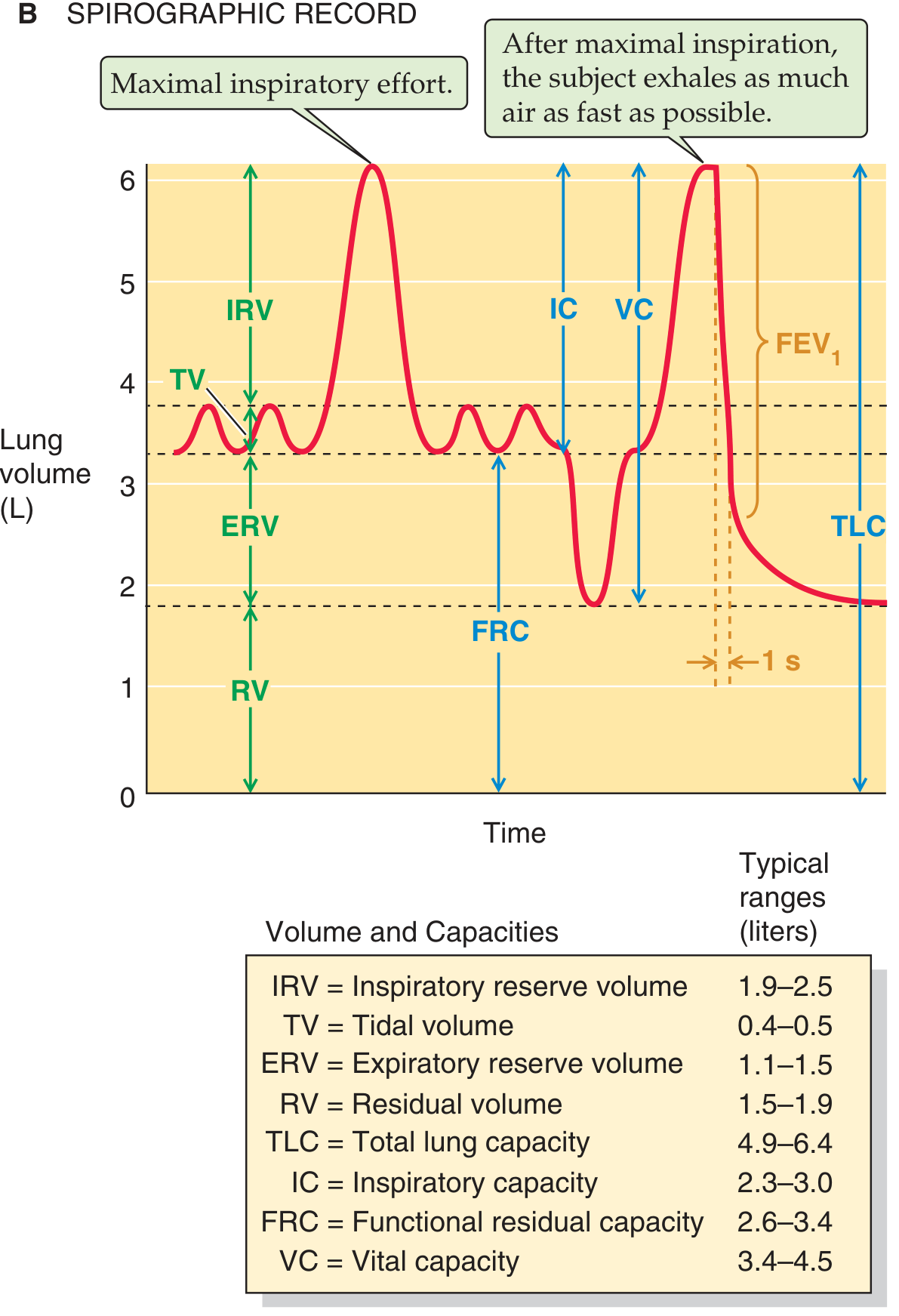
Medical Physiology (Boron & Boulpaep), p. 880
High-Yield Values Table
| Parameter | Value | Measured by |
|---|---|---|
| TV (Tidal Volume) | 500 mL | Spirometry |
| IRV | 1900-2500 mL | Spirometry |
| ERV | 1100-1500 mL | Spirometry |
| RV (Residual Volume) | 1500-1900 mL | NOT by spirometry |
| FRC | 2600-3400 mL | Helium dilution / Body plethysmography |
| IC = TV + IRV | ~3000 mL | Spirometry |
| VC = TV + IRV + ERV | 3400-4500 mL | Spirometry |
| TLC | 4900-6400 mL | NOT by spirometry |
MNEMONIC - "TIRE Capacity"
Volumes: TV · IRV · ERV · RV
Capacities (always 2 or more volumes):
  TLC  = TV + IRV + ERV + RV   → Total Lung Capacity
  VC   = TV + IRV + ERV        → Vital Capacity
  IC   = TV + IRV              → Inspiratory Capacity
  FRC  = ERV + RV              → Functional Residual Capacity
MNEMONIC - What CANNOT be measured by spirometry?
"RV Fails To Come" RV, FRC, and TLC Cannot be measured by simple spirometry (Need helium dilution, N2 washout, or body plethysmography)
PYQs - Lung Volumes
NEET PG: RV is not measured by spirometry because: (A) it cannot be expelled from the lungs Answer: RV is the air remaining after maximal expiration - cannot be measured by spirometry.
INICET/AIIMS: FRC is best measured by: (A) Helium dilution (B) Spirometry (C) Peak flow meter (D) Pulse oximetry Answer: (A) Helium dilution - also body plethysmography (most accurate).
NEET PG: In obstructive lung disease (e.g., COPD, Asthma) - which volumes INCREASE? Answer: RV, FRC, TLC increase (air trapping); FEV1/FVC decreases below 0.70.
NEET PG 2025 Recall: A person develops headache and breathlessness at >3000m altitude. Which is NOT used in treatment? Answer: IV Digoxin (Correct tx: Descent + O2 + Acetazolamide + Dexamethasone + Nifedipine)
Obstructive vs Restrictive - High-Yield Comparison
                OBSTRUCTIVE         RESTRICTIVE
FEV1             ↓                    ↓
FVC              N or ↓               ↓↓
FEV1/FVC         <0.70 (↓↓)          >0.70 (N or ↑)
TLC              ↑ (air trapping)     ↓
RV               ↑↑                   ↓
FRC              ↑                    ↓

Examples:        Asthma, COPD         Pulmonary fibrosis,
                 Emphysema            Kyphoscoliosis, IRDS
Medicine Integration: GOLD Criteria for COPD severity uses post-bronchodilator FEV1/FVC < 0.70 as the diagnostic threshold.
MODULE 2: MECHANICS OF BREATHING - COMPLIANCE & SURFACTANT
Compliance
- Definition: Change in volume per unit change in pressure (ΔV/ΔP)
- Normal lung compliance: ~200 mL/cm H2O
- Normal chest wall compliance: ~200 mL/cm H2O
- Combined (total): ~100 mL/cm H2O (they act in series)
COMPLIANCE ↑ (easier to inflate):    Emphysema, old age
COMPLIANCE ↓ (harder to inflate):    Pulmonary fibrosis, ARDS,
                                      pulmonary edema, IRDS (neonates)
Surfactant - HIGH-YIELD
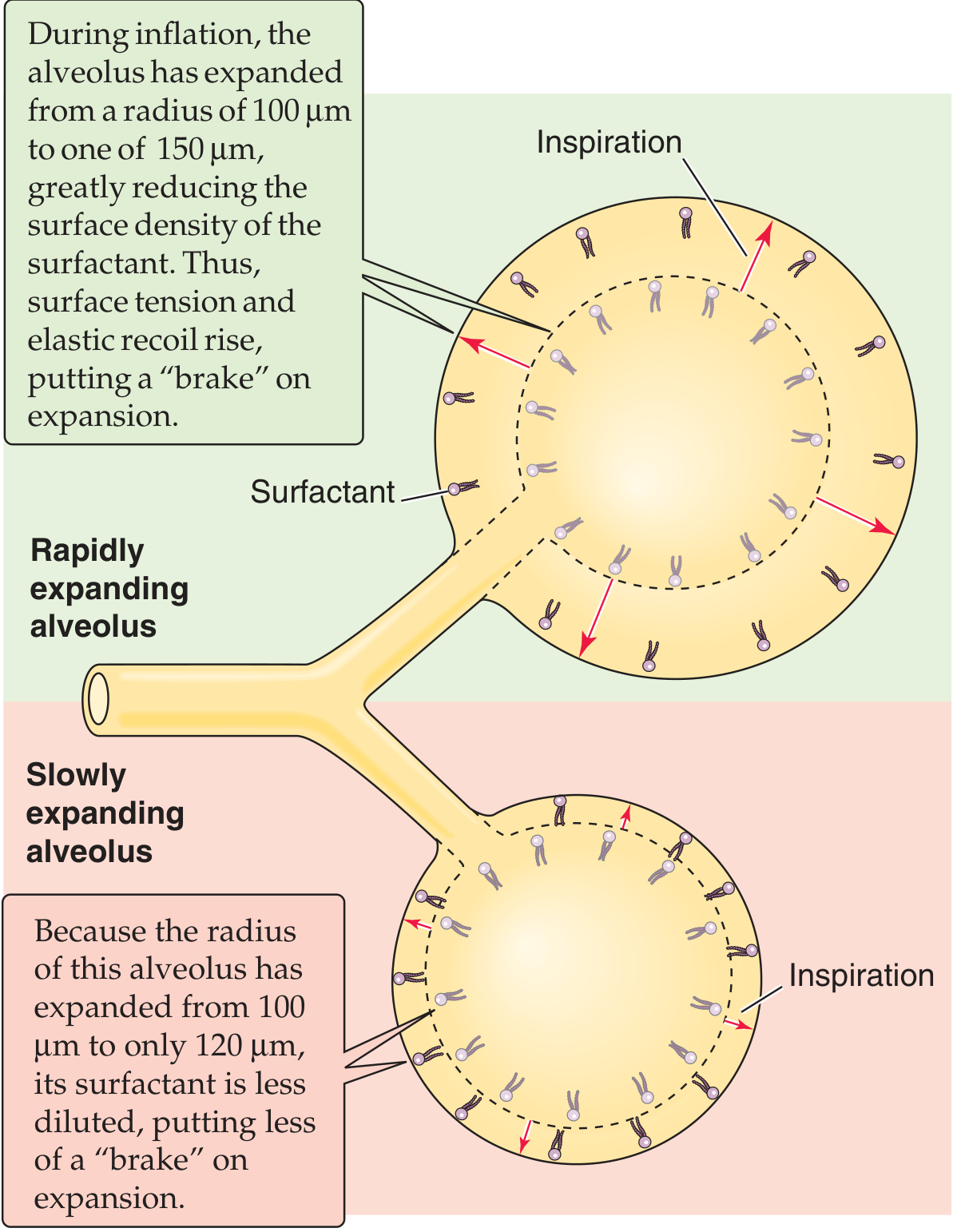
Medical Physiology (Boron & Boulpaep), p. 900 - Surfactant "braking action"
| Feature | Detail |
|---|---|
| Composition | Mainly DPPC (dipalmitoyl phosphatidylcholine) - 70% |
| Produced by | Type II pneumocytes (alveolar cells) |
| Appears at | ~28 weeks gestation; mature by 35 weeks |
| Function 1 | Reduces surface tension → increases compliance |
| Function 2 | Prevents alveolar collapse (prevents fluid accumulation) |
| Function 3 | Equalizes alveolar size (stabilizes small alveoli relative to large) |
| Follows | La Place's Law: P = 2T/r (small radius = high collapse pressure without surfactant) |
MNEMONIC - Surfactant Functions: "3 P's"
Pliability (compliance ↑), Prevents alveolar collapse, Prevents fluid accumulation
Surfactant Deficiency Diseases:
- IRDS (Infant Respiratory Distress Syndrome) = prematurity (<35 weeks)
- ARDS (Adult) = destruction of Type II cells by cytokines
- Tx for IRDS: Antenatal steroids (betamethasone/dexamethasone) to accelerate surfactant maturation + postnatal exogenous surfactant
Pharma Integration:
- Antenatal corticosteroids (betamethasone 12mg IM x2 doses) given at 24-34 weeks → stimulate fetal lung maturation (↑ surfactant synthesis)
- Poractant alfa / Beractant = exogenous surfactant used in NICU for IRDS
PYQs - Mechanics
AIIMS/INICET: In emphysema, lung compliance is: (A) Increased (B) Decreased (C) Normal Answer: (A) Increased - destruction of alveolar walls and elastic tissue.
NEET PG: Surfactant is produced by: (A) Type II pneumocytes (B) Type I pneumocytes (C) Clara cells (D) Alveolar macrophages Answer: (A) Type II pneumocytes
NEET PG: DPPC (Dipalmitoyl Phosphatidylcholine) is the main component of: (A) Surfactant - 70% composition
INICET: La Place's law: P = 2T/r - this explains why small alveoli tend to collapse into large ones in the absence of surfactant.
MODULE 3: GAS EXCHANGE & TRANSPORT
Partial Pressures (Normal Values - MEMORIZE)
                     Inspired air    Alveolar air    Arterial blood    Venous blood
PO2 (mmHg)              159              104              100               40
PCO2 (mmHg)              0.3             40               40               45
PN2 (mmHg)              597              569              569               569
PH2O (mmHg)              ~0              47               47               47
MNEMONIC for Alveolar PO2: "104 = easy to remember as one-oh-four"
Oxygen Transport
- Dissolved O2: Only 0.3 mL/dL at PO2 = 100 mmHg (only 1.5% of total)
- Hb-bound O2: ~20 mL/dL (98.5% of total)
- Total O2 content = (Hb × 1.34 × SaO2) + (PaO2 × 0.003)
- Normal Hb binds 1.34 mL O2 per gram
O2-Hb Dissociation Curve - HIGH-YIELD
         Factors shifting curve RIGHT (↓ affinity, ↑ O2 unloading to tissues):
         ↑ CO2 (Bohr effect), ↑ Temp, ↑ 2,3-DPG, ↑ H+ (acidosis)
         Mnemonic: "CADET face RIGHT"
         C=CO2, A=Acid, D=2,3-DPG, E=Exercise, T=Temperature

         Factors shifting curve LEFT (↑ affinity, ↓ O2 unloading):
         ↓ CO2, ↓ Temp, ↓ 2,3-DPG, Alkalosis, HbF, COHb, MetHb
         Mnemonic: LEFT = Low Everything (CO2, Temp, DPG) + Fetal Hb
PYQ: HbF has ↓ 2,3-DPG binding → higher O2 affinity → LEFT shift → allows fetus to extract O2 from mother's blood.
CO2 Transport
| Form | % | Mechanism |
|---|---|---|
| Bicarbonate (HCO3-) | 70% | Via carbonic anhydrase in RBCs |
| Carbamino-Hb | 23% | Binds to globin NH2 groups |
| Dissolved CO2 | 7% | Physical dissolution |
MNEMONIC: "70-23-7 = BCD" (Bicarbonate-Carbamino-Dissolved)
Haldane Effect: Deoxygenated Hb carries MORE CO2 (carbamino + better buffering). This is the physiological basis of CO2 transport from tissues to lungs.
Pharma Integration:
- Acetazolamide inhibits carbonic anhydrase → reduces HCO3- formation → metabolic acidosis → stimulates ventilation → used in altitude sickness
- Sildenafil (PDE5 inhibitor) → used in altitude sickness and pulmonary arterial hypertension
PYQs - Gas Transport
NEET PG: CO2 is transported mainly as: (A) Bicarbonate ions (HCO3-) = 70% of CO2
AIIMS: Which shifts the O2-Hb curve to RIGHT? (A) 2,3-DPG (B) HbF (C) Alkalosis (D) Hypothermia Answer: (A) 2,3-DPG
NEET PG: HbF (Fetal hemoglobin) compared to HbA: (A) Has higher affinity for O2 - shifts curve LEFT, ↓ 2,3-DPG binding
NEET PG 2025 (ARDS recall): PaO2/FiO2 ratio of 100 = severe ARDS → Management: (A) High PEEP + Low tidal volume (lung-protective ventilation, TV 6 mL/kg IBW)
MODULE 4: VENTILATION-PERFUSION (V/Q) RATIO
Concept Summary
NORMAL V/Q = 0.8 (alveolar ventilation ~4 L/min; pulmonary blood flow ~5 L/min)

V/Q = 0 (NO VENTILATION, perfusion present):
  → Alveolar air = venous blood gases
  → PO2 = 40, PCO2 = 45 mmHg
  → "Pure SHUNT" e.g., atelectasis, lobar pneumonia
  → O2 therapy does NOT correct hypoxia!

V/Q = ∞ (NO PERFUSION, ventilation present):
  → Alveolar air = inspired air
  → PO2 = 149, PCO2 = 0 mmHg
  → "DEAD SPACE" e.g., pulmonary embolism
  → O2 therapy DOES correct hypoxia
V/Q Flowchart
            LOW V/Q                          HIGH V/Q
         (Shunt-like)                     (Dead space-like)
              ↓                                 ↓
     Hypoxia + Hypercapnia           Hypoxia + Hypocapnia
              ↓                                 ↓
   O2 therapy partially helps       O2 helps (dead space)
              ↓
   Causes: COPD, Asthma,           Causes: PE, Emphysema,
   pneumonia, atelectasis          Low cardiac output
Regional V/Q Variation in Upright Lung
APEX:   V/Q = 3.3  (more ventilation, little perfusion → "wasted ventilation")
BASE:   V/Q = 0.6  (more perfusion, relatively less ventilation)
OVERALL: V/Q = 0.8
MNEMONIC: "Apex is high and BASE is low" (V/Q ratio)
Why? Gravity effects: blood pools at base (↑ Q at base); pleural pressure more negative at apex (↑ V at apex proportionally).
Dead Space
| Type | Definition | Value |
|---|---|---|
| Anatomical DS | Volume of conducting airways (no gas exchange) | ~150 mL |
| Alveolar DS | Ventilated but unperfused alveoli | ~0 in normal |
| Physiological DS | Anatomical + Alveolar DS | = Anatomical in normal |
Bohr Equation (Physiological dead space):
VD/VT = (PaCO2 - PECO2) / PaCO2 Where PECO2 = CO2 in mixed expired air
Alveolar ventilation (VA) = (VT - VD) × RR
- Normal: (500 - 150) × 14 = 4900 mL/min ≈ 5 L/min
PYQs - V/Q
NEET PG 2025 (Recall): In pulmonary embolism, V/Q graph shows complete obstruction of blood flow - which point? (D) = V/Q = ∞ (dead space point - no perfusion)
INICET: In lobar pneumonia, hypoxia is due to: (A) V/Q mismatch (low V/Q / shunt) - alveoli filled with exudate, no ventilation
NEET PG: Anatomical dead space is measured by: (A) Fowler's method (single breath N2 washout) Physiological dead space = Bohr's method
MODULE 5: CONTROL OF RESPIRATION
Respiratory Control Centers
MEDULLA (primary):
  - Dorsal Respiratory Group (DRG) → inspiration (basic rhythm)
  - Ventral Respiratory Group (VRG) → expiration (active) + forced breathing

PONS:
  - Pneumotaxic center (Pontine Respiratory Group) → LIMITS inspiration, ↑ RR
  - Apneustic center → PROLONGS inspiration (held in check by pneumotaxic)
MNEMONIC: "Pneumotaxic Prevents Apneusis"
- If pneumotaxic center is damaged → apneustic breathing (prolonged gasping inspiration)
- If BOTH pons lesions → Biot's breathing (irregular)
Chemoreceptors
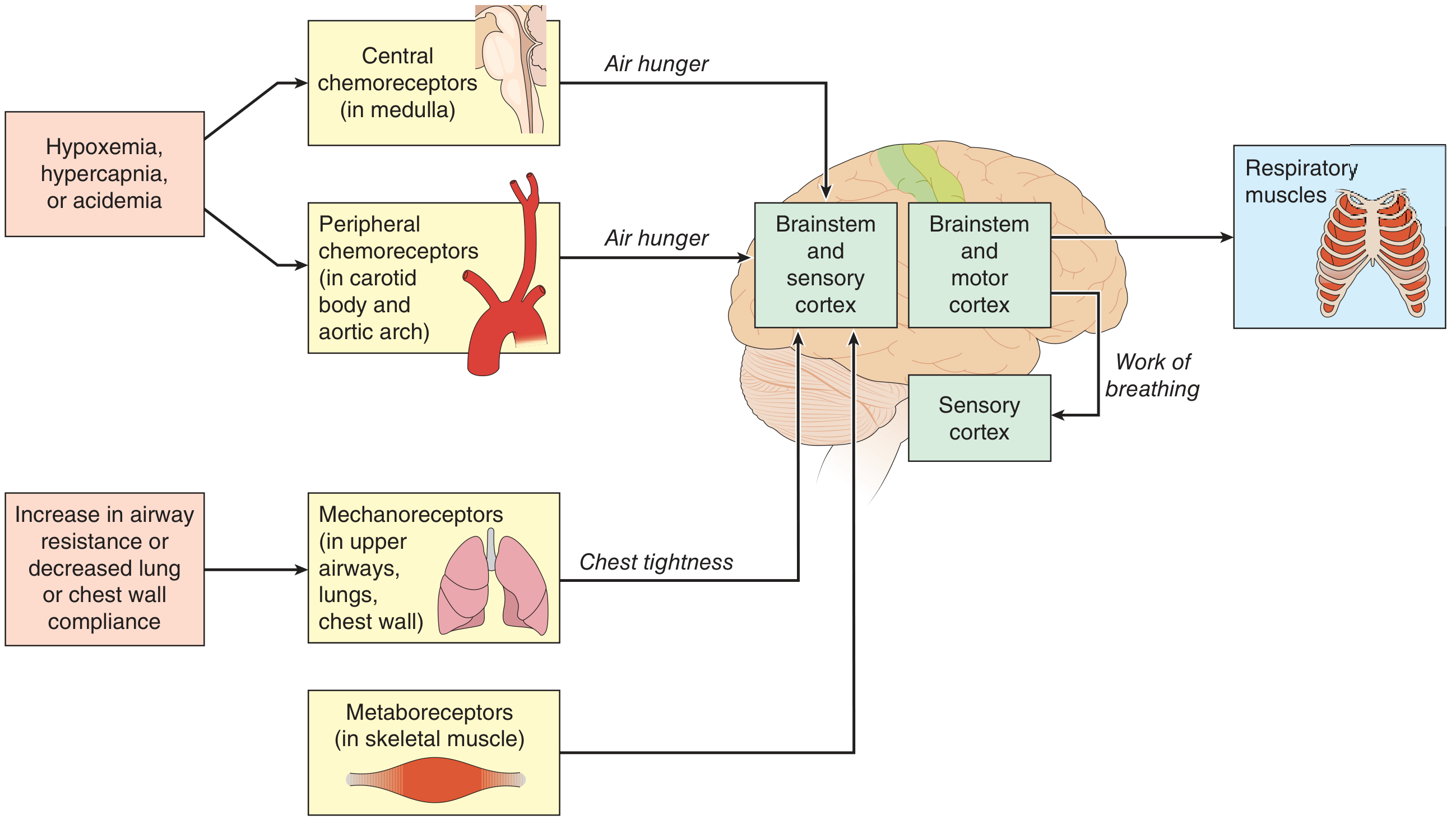
Harrison's 22e - Respiratory control pathways
CENTRAL CHEMORECEPTORS (Medulla, ventral surface):
  → Respond to: ↑ PCO2 (via ↑ CSF H+ → most potent stimulus)
  → Do NOT respond directly to O2
  → Blood-brain barrier is permeable to CO2 but NOT to H+ directly
  → CO2 crosses → forms H2CO3 → H+ in CSF → stimulates receptors

PERIPHERAL CHEMORECEPTORS (Carotid body >> Aortic body):
  → Respond to: ↓ PO2 (primary), ↑ PCO2, ↓ pH
  → Carotid body: via CN IX (Hering's nerve) → NTS (medulla)
  → Aortic body: via CN X → NTS
  → Only source of hypoxic drive
  → Also respond to ↓ blood flow (e.g., cyanide → ↑ firing despite normal PO2)
HIGH-YIELD Chemoreceptor Comparison:
| Feature | Central | Peripheral |
|---|---|---|
| Location | Medulla (ventral) | Carotid body + Aortic body |
| Primary stimulus | ↑ PCO2 / ↑ CSF H+ | ↓ PO2 (primary hypoxic drive) |
| Also responds to | H+ (blood) slowly | ↑ PCO2, ↓ pH |
| Magnitude of response | Stronger (70-80%) | Weaker (20-30%) |
| Speed | Slower | Faster |
MNEMONIC - Chemoreceptors: "Central CO2, Peripheral O2"
Central = CO2 sensitive Peripheral = PO2 sensitive (+ CO2 & pH)
Hering-Breuer Reflex
- Lung stretch receptors (slowly adapting, myelinated) → via vagus
- Triggered by lung inflation → inhibits inspiration → prevents over-inflation
- Active when TV > 1.5 L (minimal role in quiet breathing in adults)
- Important in neonates (active at normal TV)
Pharmacology Integration - Control of Breathing:
- Opioids (morphine, fentanyl) → directly depress respiratory centers → ↓ RR, respiratory acidosis → Rx: Naloxone
- Benzodiazepines → potentiate GABA → respiratory depression (less severe than opioids)
- Doxapram → stimulates peripheral chemoreceptors → used as respiratory stimulant
- Almitrine → peripheral chemoreceptor stimulant
- Nikethamide / Ethamivan → central respiratory stimulants (obsolete)
PYQs - Control of Respiration
NEET PG: Primary stimulus for central chemoreceptors: (A) Increased PCO2 / increased H+ in CSF
NEET PG: Peripheral chemoreceptors are stimulated by: (A) Decrease in PO2 (primary), not just decrease in O2 content (anemia alone doesn't stimulate unless PO2 also drops)
AIIMS: CO2 stimulates central chemoreceptors by crossing BBB and forming: (A) H+ ions in CSF - H+ is the actual stimulus (not CO2 directly)
INICET: Apneustic breathing occurs due to lesion at: (A) Pneumotaxic center (pontine respiratory group - upper pons)
NEET PG: Hering-Breuer reflex - receptor type: (A) Slowly adapting pulmonary stretch receptors via vagus nerve
NEET PG (Altitude sickness): IV Digoxin is NOT used in acute mountain sickness - correct treatment uses: Descent, O2, Acetazolamide, Dexamethasone, Nifedipine.
INTEGRATION: MEDICINE + PHARMACOLOGY
COPD (Medicine + Physiology Integration)
Pathophysiology:
  Airway inflammation + mucus → ↑ airway resistance
  Alveolar wall destruction → ↑ compliance, ↓ elastic recoil
  Air trapping → ↑ RV, ↑ FRC, ↑ TLC → barrel chest
  Ventilation-Perfusion mismatch → hypoxia ± hypercapnia

"Blue Bloater" (Chronic Bronchitis): V/Q mismatch, cyanosis, cor pulmonale
"Pink Puffer" (Emphysema): increased dead space, V/Q high, hyperventilates

Drug Targets:
  SABA (Salbutamol/Albuterol)     → β2 agonist → bronchodilation
  LABA (Salmeterol, Formoterol)   → long-acting β2 agonist
  SAMA (Ipratropium)              → M3 antagonist → bronchodilation
  LAMA (Tiotropium)               → long-acting M3 antagonist
  ICS (Fluticasone, Budesonide)   → anti-inflammatory
  Theophylline                    → PDE inhibitor → bronchodilation + respiratory stimulant
  Roflumilast                     → PDE4 inhibitor → anti-inflammatory in COPD
Asthma (Medicine + Physiology Integration)
Pathophysiology:
  Airway hyperresponsiveness → bronchoconstriction → ↑ Raw
  Mucus plugging → V/Q mismatch (low V/Q)
  Air trapping → ↑ RV, ↑ FRC
  FEV1/FVC < 0.70, reversible with bronchodilators

Pharmacology:
  Acute:  SABA (Salbutamol 200-400 mcg inhaled) + O2 + steroids IV
  Chronic:ICS (first-line controller), LABA add-on, Montelukast (LTD4 antagonist)
  Severe: Omalizumab (anti-IgE), Mepolizumab (anti-IL-5), Dupilumab (anti-IL-4/13)
  Mast cell stabilizer: Sodium cromoglicate (prophylaxis, not treatment)
  Avoid: Beta-blockers (cause bronchoconstriction), NSAIDs in aspirin-sensitive asthma
Pulmonary Embolism (Medicine + Physiology Integration)
Physiology: V/Q = ∞ (dead space) → hypoxia + hypocapnia (↑ RR initially)
  → A-a gradient ↑
  → Pulmonary hypertension → RV strain → RV failure

ABG: ↓ PaO2, ↓ PaCO2 (hyperventilation), respiratory alkalosis
ECG: S1Q3T3, sinus tachycardia, RBBB
CXR: Hampton's hump, Westermark sign, Fleischner lines
ARDS (Medicine + Physiology Integration)
Pathophysiology:
  Diffuse alveolar damage → ↓ surfactant (Type II cell damage)
  → ↓ compliance, ↑ shunt (V/Q = 0)
  → Refractory hypoxia (doesn't respond to O2)

Berlin Criteria: PaO2/FiO2 ratio:
  Mild:     200-300 mmHg
  Moderate: 100-200 mmHg
  Severe:   <100 mmHg

Management:
  Lung-protective ventilation: TV 6 mL/kg IBW + High PEEP
  Prone positioning for severe ARDS
  Dexamethasone (COVID-ARDS - RECOVERY trial)
MASTER MNEMONIC SUMMARY
All Lung Volumes and Capacities
"IRV TEC" for Volumes: IRV · TV · ERV · RV (top to bottom in spirogram)
"VITAL CAPACITY" = TV + IRV + ERV (vital = alive, doesn't include RV)
"TOTAL = ALL" = TLC includes everything
"FRC = ERV + RV" → Remember: FRC is where the lung rests at end-expiration
Bohr/Haldane Effects (Frequently Confused in PYQs)
BOHR Effect:   ↑ CO2/H+ → Hb releases O2 (RIGHT shift) → tissues get O2
               "BOHR = Blood Offloads O2 in tissues when CO2 Rises"

HALDANE Effect:↓ O2 → Hb picks up MORE CO2 (deoxygenated Hb carries more CO2)
               "HALDANE = Hypoxia Allows Lots of Dissolved AND new CO2 to bind Hb"
Shunt vs Dead Space
SHUNT (V/Q = 0):    No ventilation → O2 therapy FAILS → PaO2 doesn't rise
DEAD SPACE (V/Q=∞): No perfusion  → O2 therapy WORKS → PaO2 rises
MNEMONIC: "SHUNT = Stubborn, O2 doesn't help"
PREVIOUS YEAR THEMES (NEET PG / INICET / AIIMS)
| Topic | Frequency | Key Point |
|---|---|---|
| Lung volumes - which NOT by spirometry | ★★★★★ | RV, FRC, TLC |
| O2-Hb curve - right vs left shift | ★★★★★ | CADET = right; HbF = left |
| Surfactant - composition, producer | ★★★★ | DPPC, Type II pneumocytes |
| Central vs peripheral chemoreceptors | ★★★★ | Central = CO2, Peripheral = O2 |
| V/Q ratio - shunt vs dead space | ★★★★ | Shunt: O2 fails; DS: O2 works |
| Obstructive vs restrictive pattern | ★★★★ | FEV1/FVC ratio |
| FRC measurement method | ★★★ | Helium dilution, plethysmography |
| Hering-Breuer reflex | ★★★ | Lung stretch via vagus |
| CO2 transport - % forms | ★★★ | 70% bicarbonate |
| Dead space - Bohr vs Fowler | ★★★ | Physiological=Bohr; Anatomical=Fowler |
| Acute mountain sickness | ★★★ | Acetazolamide, not Digoxin |
| ARDS - PaO2/FiO2 | ★★★ | <100 = severe; PEEP + low TV |
QUICK REVISION FLOWCHART
RESPIRATORY PHYSIOLOGY - MASTER FLOWCHART

Breathing Mechanics
    ├── Compliance = ΔV/ΔP
    │     ↑ in Emphysema, ↓ in Fibrosis/ARDS
    └── Surfactant (DPPC, Type II cells)
          → ↓ surface tension, La Place's law

Lung Volumes (Spirometry)
    ├── Measured:  TV, IRV, ERV, VC, IC
    └── NOT measured: RV, FRC, TLC → need He dilution / plethysmography

Gas Exchange
    ├── Diffusion: PO2 alveoli 104 → capillary 40 mmHg
    ├── O2 Transport: 98.5% as OxyHb (1.34 mL/g Hb)
    ├── CO2 Transport: 70% HCO3- | 23% carbamino | 7% dissolved
    └── Hb Curves: RIGHT = CADET (↑ CO2, acid, DPG, exercise, temp)
                   LEFT  = HbF, COHb, alkalosis

V/Q Matching
    ├── Normal = 0.8
    ├── Shunt (V/Q=0): alveoli filled, no ventilation, O2 therapy fails
    └── Dead space (V/Q=∞): no perfusion, O2 therapy works

Respiratory Control
    ├── Central (medulla): CO2/H+ via CSF
    └── Peripheral (carotid/aortic body): ↓PO2, ↑PCO2, ↓pH
          └── Only source of hypoxic drive
Sources: Medical Physiology - Boron & Boulpaep, pp. 880-1059 | Guyton & Hall Textbook of Medical Physiology, Chapter 41 | Harrison's Principles of Internal Medicine 22e (2025) | Goldman-Cecil Medicine | Costanzo Physiology 7e
---Here's your complete Respiratory Physiology high-yield guide for NEET PG / INICET - everything is sourced directly from Boron & Boulpaep's Medical Physiology, Guyton & Hall, Harrison's 22e, and Goldman-Cecil Medicine.
What's covered in this guide:
Module 1 - Lung Volumes & Capacities
- Standard spirogram with actual textbook image
- Exact values table with which volumes CANNOT be measured by spirometry
- Obstructive vs Restrictive comparison table
- Mnemonics: "TIRE Capacity," "RV Fails To Come"
Module 2 - Mechanics & Surfactant
- Compliance definitions, normal values, disease changes
- Surfactant (DPPC, Type II cells) with textbook diagram showing braking action
- La Place's Law application
- Pharma: Antenatal betamethasone, Poractant alfa
Module 3 - Gas Exchange & Transport
- Complete partial pressure values table (inspired → venous blood)
- O2-Hb dissociation curve factors - CADET mnemonic for right shift
- CO2 transport: 70-23-7 (Bicarbonate-Carbamino-Dissolved)
- Bohr Effect vs Haldane Effect (frequently confused in PYQs)
- Pharma: Acetazolamide, Sildenafil in altitude sickness
Module 4 - V/Q Ratio
- V/Q = 0 (shunt) vs V/Q = ∞ (dead space) with gas values
- Why O2 therapy fails in shunt but works in dead space
- Regional V/Q variation: Apex vs Base
- Bohr vs Fowler methods for dead space
Module 5 - Control of Respiration
- Medullary + Pontine centers with Harrison's 22e diagram
- Central vs Peripheral chemoreceptors comparison table
- Hering-Breuer reflex
- Pharma: Opioid respiratory depression + Naloxone, Doxapram, Theophylline
Medicine Integration
- COPD (Blue Bloater vs Pink Puffer), Asthma drug targets, PE physiology (V/Q = ∞), ARDS Berlin criteria + lung-protective ventilation
PYQ Frequency Table with 14 most-tested topics ranked by star rating.
This is a shared conversation. Sign in to Orris to start your own chat.