
Homeostasis physiology mbbs 1st year Guyton reference
I'll check the medical library skill first, then pull the Guyton content on homeostasis.
Reading File
Now let me search the library for Guyton's textbook and homeostasis content in parallel.
Finding Sources
Finding Sources
Guyton and Hall is confirmed (ISBN 9780443111013). Now let me search its TOC and paragraphs for homeostasis content.
Finding Sources
Finding Sources
The main homeostasis chapter is in block1. Let me read the dedicated homeostasis section and control systems section together.
Reading File
Reading File
Excellent content. Now let me read the control systems section (line 158 onwards) to get feedback mechanisms.
Reading File
I now have all the essential content. Let me also fetch the key diagram image (baroreceptor feedback loop) and read the summary section.
Reading File
Loading Image
I now have everything needed to write a comprehensive answer. Here is the full Guyton-referenced homeostasis notes for MBBS 1st year:
Homeostasis - Physiology (Guyton & Hall, 14th Edition)
Reference: Guyton and Hall Textbook of Medical Physiology, Chapter 1 - "Functional Organization of the Human Body and Control of the Internal Environment"
1. Definition
Walter Cannon (American physiologist, 1871-1945) coined the term homeostasis in 1929. He defined it as the maintenance of stable conditions in the internal environment.
Guyton: "Homeostasis is a dynamic, rather than static, process that is continually adjusting the body's functions to maintain internal stability despite the challenges of daily life in health, as well as in disease."
2. The Internal Environment - Claude Bernard's Concept
- The French physiologist Claude Bernard first described the concept of the "milieu intérieur" (internal environment) in the 19th century.
- About 50-70% of the adult human body is fluid - a water solution of ions and other substances.
- This fluid is divided into:
- Intracellular fluid (ICF) - inside the cells (~28 litres)
- Extracellular fluid (ECF) - outside the cells (~14 litres)
- Interstitial fluid - surrounds the cells (~11 litres)
- Plasma - fluid portion of blood (~3 litres)
The ECF is the true "internal environment" in which cells live. It continuously bathes the cells and must be kept stable for cells to survive.
3. Composition of the Extracellular Fluid (Key Ions)
| Constituent | Normal Value |
|---|---|
| Oxygen | 35-40 mmHg (PO₂) |
| Carbon dioxide | 35-45 mmHg (PCO₂) |
| Sodium ion (Na⁺) | 142 mEq/L |
| Potassium ion (K⁺) | 4.2 mEq/L |
| Calcium ion (Ca²⁺) | 1.2 mmol/L |
| Glucose | 85 mg/dL |
| pH (H⁺) | 7.4 (varies by < 5 nmol/L) |
| Body temperature | 37°C |
Guyton: "Variations in the blood hydrogen ion concentration are normally less than 5 nanomoles/L. The blood sodium concentration is also tightly regulated, normally varying only a few millimoles per liter, even with large changes in sodium intake."
4. How Homeostasis is Maintained - Organ Systems Working Together
Guyton describes each organ's contribution:
| Organ/System | Homeostatic Contribution |
|---|---|
| Lungs | Supply O₂ to ECF; remove CO₂ |
| Kidneys | Regulate ion concentrations (Na⁺, K⁺, H⁺, phosphate); water balance |
| GI Tract | Provide nutrients; eliminate solid waste |
| Liver & Pancreas | Regulate blood glucose concentration |
| Cardiovascular System | Distribute nutrients; remove wastes from all tissues |
| Nervous System | Coordinates rapid responses; controls respiratory and vasomotor centers |
| Endocrine System | Long-term regulation via hormones (ADH, aldosterone, insulin, etc.) |
5. Control Systems of the Body
Guyton states: "The human body has thousands of control systems." They operate at genetic, cellular, organ, and whole-body levels.
Components of a Control System
Every control system has three essential components:
- Sensor (Detector) - detects the change in the variable being controlled
- Control center (Integrator/Set point) - compares the detected value against the desired set point; generates an error signal
- Effector - carries out the corrective response
6. Negative Feedback - The Main Mechanism
Guyton: "Most control systems of the body act by negative feedback... when some factor becomes excessive or deficient, a control system initiates negative feedback, which consists of a series of changes that return the factor toward a certain mean value, thus maintaining homeostasis."
Principle: The output opposes the change that triggered it, thus stabilizing the system around the set point.
Classic example - Baroreceptor blood pressure control:
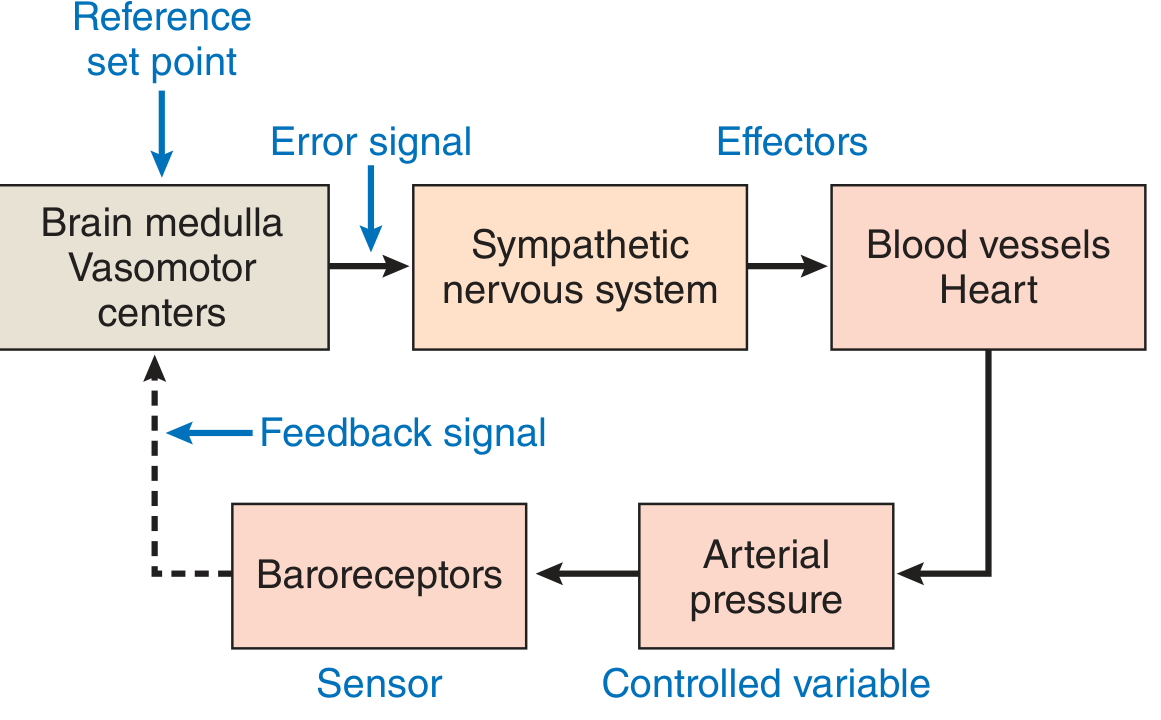
Sequence:
- Arterial pressure rises
- Baroreceptors (in carotid sinus and aortic arch) - sense stretch → ↑ impulses
- Impulses → Medulla (vasomotor center)
- Vasomotor center inhibited → ↓ sympathetic output
- → Vasodilation + ↓ cardiac pumping
- → Blood pressure returns toward normal
Other examples of negative feedback:
- Oxygen regulation via hemoglobin's oxygen-buffering function
- CO₂ regulation: ↑CO₂ → stimulates respiratory center → ↑ ventilation → CO₂ eliminated
- Blood glucose: ↑glucose → insulin secretion → glucose uptake → normalization
- Body temperature: Hypothalamus-regulated sweating/shivering
7. Positive Feedback - A Destabilizing Force
Guyton: "Positive feedback does not lead to stability but, instead, to instability and sometimes death."
In positive feedback, the output amplifies the original change rather than opposing it - creating a "vicious cycle."
Physiological examples (beneficial):
| Situation | Role |
|---|---|
| Childbirth (parturition) | Oxytocin → uterine contractions → more oxytocin (until delivery) |
| Blood clotting | Platelet activation → thrombin generation → more clotting factors activated |
| Action potential depolarization | Na⁺ influx → more Na⁺ channels open → full depolarization |
| LH surge during ovulation | Estrogen → more LH → ovulation |
Pathological examples (vicious cycles):
- Severe hemorrhage → ↓ cardiac output → ↓ coronary blood flow → weaker heart → ↓ cardiac output further → death
- High fever: occasionally becomes self-sustaining
8. Feed-Forward Control
Some control systems anticipate a disturbance and act before the error occurs. Example: Salivation and gastric acid secretion begin when food is merely seen or smelled - before it is even consumed.
9. Gain of a Control System
Guyton defines the gain of a control system as a measure of its effectiveness:
Gain = (Correction achieved) / (Error remaining)
- A high gain system corrects almost all of the disturbance.
- The baroreceptor system has a relatively low gain (~1-2) for short-term pressure control.
- The renal-body fluid system for long-term blood pressure control has an infinite gain - it can completely normalize blood pressure over days to weeks.
10. Homeostasis at Multiple Levels
| Level | Example |
|---|---|
| Molecular/Genetic | DNA replication accuracy; gene expression control |
| Cellular | Ion pumps (Na⁺-K⁺ ATPase); autophagy |
| Tissue | Cell signaling via extracellular vesicles |
| Organ | Tubuloglomerular feedback in kidney |
| Whole body | Cardiovascular, respiratory, renal integration |
11. Disease as Disrupted Homeostasis
Guyton: "Disease is often considered to be a state of disrupted homeostasis. However, even with diseases, homeostatic mechanisms continue to operate and maintain vital functions through multiple compensations."
- In renal disease: impaired salt/water excretion → ↑ blood pressure (compensation to restore excretion) → but sustained hypertension itself causes damage (compensation becomes pathological)
- Homeostatic compensations can cause clinical signs that mimic or mask the primary disease.
12. Summary - Automaticity of the Body
Guyton: "The body is actually a social order of about 35 to 40 trillion cells organized into different functional structures... Each cell benefits from homeostasis and, in turn, each cell contributes toward the maintenance of homeostasis. This reciprocal interplay provides continuous automaticity of the body until one or more functional systems lose their ability to contribute their share of function. When this happens, all the cells of the body suffer. Extreme dysfunction leads to death; moderate dysfunction leads to sickness."
Quick Revision Points for Exam
- Coined by: Walter Cannon (1929)
- Internal environment concept: Claude Bernard
- Main mechanism: Negative feedback
- Components: Sensor → Control center (set point) → Effector
- Negative feedback: opposes change → stabilizes
- Positive feedback: amplifies change → destabilizes (useful in: childbirth, clotting, action potential)
- Gain: Correction achieved / Error remaining
- Renal system: infinite gain for long-term BP control
- Disease: disrupted homeostasis with ongoing compensations
Source: Guyton and Hall Textbook of Medical Physiology (14th Edition), Chapter 1, pp. 19-29
This is a shared conversation. Sign in to Orris to start your own chat.