
Kisspeptin 10 marks obgy pg exam
Reading File
Searching sources...
Finding Sources
Searching PubMed
kisspeptin reproduction GnRH
Good - I have multiple textbook hits. Let me read the most relevant sections from Harrison's, Goodman & Gilman, and Guyton to build a comprehensive 10-mark answer.
Reading File
Reading File
Reading File
Now let me fetch more content on clinical applications of kisspeptin - especially in obstetrics/gynecology (precocious puberty, hypogonadotropic hypogonadism, IVF, preeclampsia).
Finding Sources
Finding Sources
Let me read a bit more from Harrison's on puberty and the clinical section on kisspeptin in female reproduction, plus fetch the diagram image.
Reading File
Reading File
Loading Image
Excellent! I now have comprehensive information from multiple authoritative textbooks. Let me also quickly search for kisspeptin's role in preeclampsia and IVF trigger, which are important clinical aspects for OBGyn PG exams.
Finding Sources
I now have enough comprehensive information to write an excellent 10-mark OBGyn PG exam answer on Kisspeptin. Let me compile it.
Kisspeptin
(10-mark OBGyn PG Exam Answer)
Introduction
Kisspeptin is a neuropeptide encoded by the KISS1 gene on chromosome 1q32, initially discovered as a metastasis suppressor gene (hence the name - from Hershey, Pennsylvania, famous for its chocolate "Kisses"). It acts through its receptor GPR54 (also called KISS1R), a G-protein coupled receptor. It is now recognized as the master regulator of the hypothalamic-pituitary-gonadal (HPG) axis and is indispensable for reproduction.
Structure and Source
- Kisspeptin-1 (KISS1) is the parent peptide; it is cleaved into shorter bioactive fragments: kisspeptin-54, -14, -13, and -10 (the number denotes amino acid length).
- Kisspeptin-10 is the shortest biologically active form and contains the RF-amide motif essential for receptor binding.
- Produced by KNDy neurons (Kisspeptin, Neurokinin B, Dynorphin) in the arcuate nucleus of the hypothalamus.
- Also produced in the anteroventral periventricular nucleus (AVPV) - important for the LH surge.
- Additional production sites: placenta, gonads, liver, bone.
Mechanism of Action
The diagram below shows the pathway beautifully (from Goodman & Gilman's):
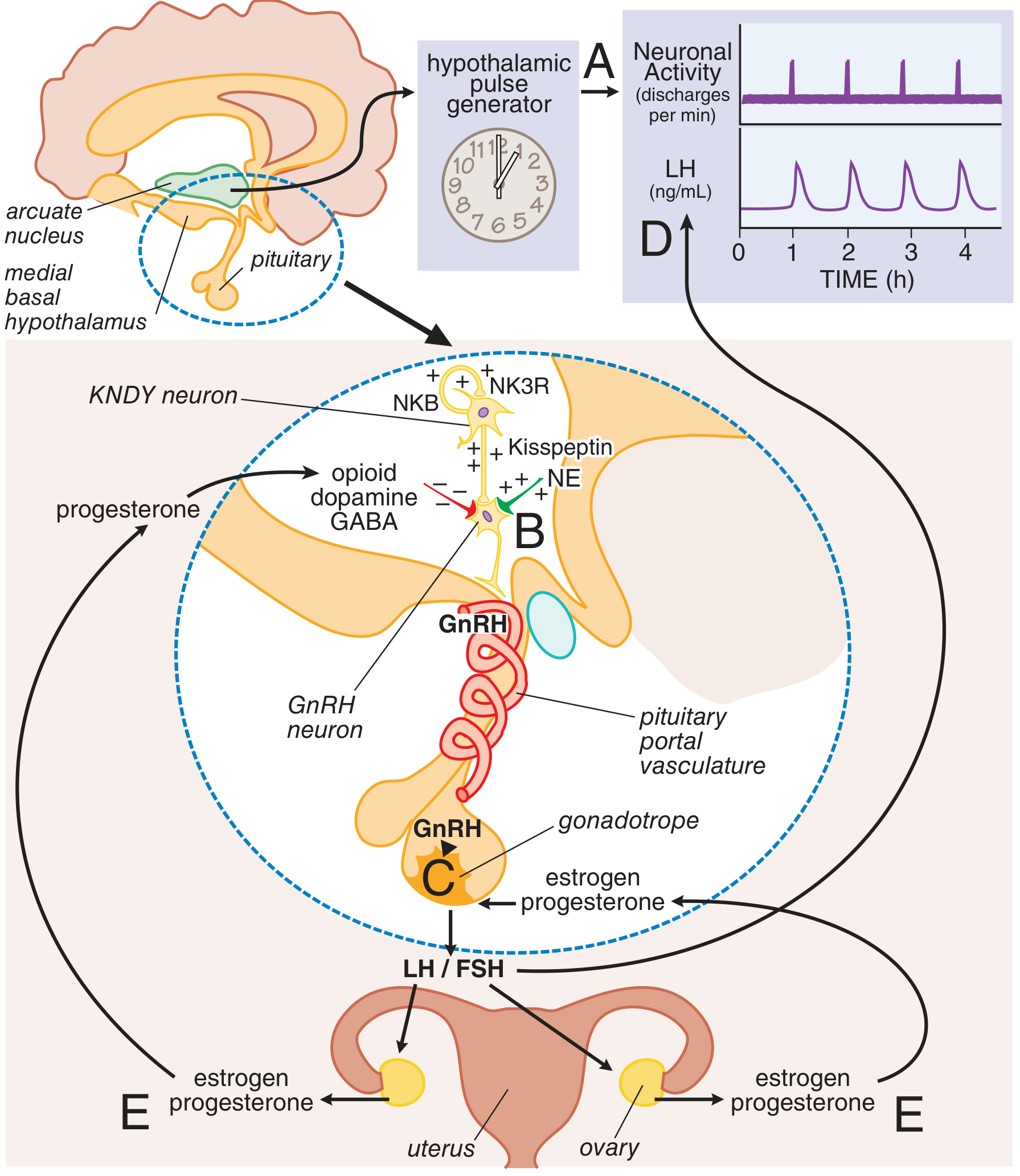
KNDy autocrine/paracrine loop:
- Neurokinin B (NKB) binds NK3R on adjacent KNDy neurons -> stimulates kisspeptin release (the "on" signal)
- Dynorphin (Dyn) acts on kappa-opioid receptors on KNDy neurons -> inhibits kisspeptin release (the "off" signal, terminating each pulse)
- This self-regulating loop creates the rhythmic, synchronized pulsatile release of GnRH
Downstream pathway:
- Kisspeptin binds GPR54 on GnRH neuron cell bodies AND on GnRH nerve terminals in the median eminence
- GnRH is released in pulses into the hypothalamic-pituitary portal vasculature
- GnRH stimulates pituitary gonadotropes -> pulsatile LH and FSH release
- LH/FSH act on ovaries/testes -> sex steroid production
(Harrison's Principles of Internal Medicine 22E, p. 3147; Guyton & Hall Medical Physiology, p. 1025)
Feedback Regulation
| Feedback | Effect on Kisspeptin | Mechanism |
|---|---|---|
| Low estrogen (follicular phase) | Maintained/mildly inhibited | Negative feedback via ERα on KNDy neurons in arcuate nucleus |
| High estrogen (pre-ovulatory) | Stimulated (positive feedback) | Acts on AVPV kisspeptin neurons -> LH surge |
| Progesterone | Inhibits | Multiplies estrogen's inhibitory effect |
| Testosterone | Inhibits | Acts on arcuate KNDy neurons |
| Opioids | Inhibits | Mimic dynorphin via k-opioid receptor |
Key concept: GnRH neurons do not express estrogen receptor-alpha (ERα), so kisspeptin neurons serve as the essential intermediary through which estrogen exerts its feedback on GnRH secretion. (Scott-Brown's Otorhinolaryngology; Goodman & Gilman)
Role in Puberty
- During childhood, GnRH secretion is suppressed by inhibitory GABAergic tone and other neuroendocrine brakes.
- At puberty onset: kisspeptin signaling increases, overcoming the inhibitory brake -> reactivation of GnRH pulses.
- Puberty initially shows nocturnal LH/FSH surges, then progresses to round-the-clock pulsatility.
- Leptin (from adipocytes) plays a permissive role, likely acting through kisspeptin neurons - explaining why severe undernutrition delays puberty.
- MKRN3 (Makorin ring finger protein 3) acts as an upstream inhibitor of kisspeptin; loss-of-function mutations in MKRN3 "remove the brake" and cause central precocious puberty.
(Harrison's Principles of Internal Medicine 22E; Guyton & Hall)
Role in the Menstrual Cycle
- Follicular phase: Low, pulsatile kisspeptin drives steady GnRH/FSH/LH pulses -> follicle development.
- Pre-ovulatory LH surge: Rising estradiol switches from negative to positive feedback -> activates AVPV kisspeptin neurons -> massive LH surge -> triggers ovulation. Goodman & Gilman describes this as "an estrogen-induced rise in kisspeptin and a change in pituitary responsiveness to GnRH."
- Luteal phase: Progesterone + estrogen suppress arcuate kisspeptin -> lower GnRH frequency.
Clinical Significance
1. Hypogonadotropic Hypogonadism (HH)
- Loss-of-function mutations in KISS1 gene or GPR54 (KISS1R) -> normosmic idiopathic hypogonadotropic hypogonadism (nIHH).
- Patients fail to enter puberty; low LH, FSH, sex steroids; normal olfaction (unlike Kallmann syndrome).
- Mutations in NKB (TAC3) or its receptor (TACR3) also cause HH by disrupting kisspeptin stimulation.
2. Central Precocious Puberty (CPP)
- Gain-of-function (activating) mutations in KISS1 or KISS1R -> premature activation of HPG axis -> CPP.
- MKRN3 loss-of-function mutations are the most common genetic cause of CPP.
- DLK1 (Delta-like homolog 1) loss-of-function also associated with CPP.
3. Role in the LH Surge / Ovulation Trigger (IVF Context)
- Kisspeptin is being studied as an alternative LH surge trigger in IVF cycles.
- Exogenous kisspeptin-54 injection can reliably trigger oocyte maturation in women undergoing controlled ovarian stimulation.
- Advantage: unlike hCG trigger, kisspeptin may reduce the risk of ovarian hyperstimulation syndrome (OHSS) because it produces a more physiological, self-limiting LH surge.
- Phase II trials have shown good oocyte yield with kisspeptin trigger, particularly relevant for women at high risk of OHSS.
4. Kisspeptin in Pregnancy and Preeclampsia
- Placenta is a major source of kisspeptin during pregnancy; serum kisspeptin levels rise dramatically during the first trimester and peak in the third trimester.
- Kisspeptin suppresses GnRH/LH/FSH during pregnancy (explaining gonadal quiescence).
- Markedly elevated in preeclampsia compared to normal pregnancy - may reflect abnormal trophoblast function; proposed as a biomarker for preeclampsia.
- Low first-trimester kisspeptin levels are associated with poor placentation and adverse pregnancy outcomes.
5. Polycystic Ovary Syndrome (PCOS)
- Elevated kisspeptin activity may contribute to increased GnRH pulse frequency seen in PCOS, driving preferential LH over FSH secretion and androgen excess.
6. Hypothalamic Amenorrhea (Functional)
- Stress, excessive exercise, and low energy availability suppress kisspeptin neurons (via NPY/AgRP pathways and low leptin), leading to reduced GnRH pulsatility and amenorrhea.
Therapeutic Potential
| Application | Status |
|---|---|
| Kisspeptin-54 as IVF trigger | Phase II/III trials - promising for OHSS prevention |
| Kisspeptin agonists for HH | Under investigation |
| Kisspeptin antagonists for CPP, endometriosis, hormone-sensitive cancers | Early research |
| Biomarker for preeclampsia | Research stage |
Summary Box
| Feature | Detail |
|---|---|
| Gene | KISS1 (chromosome 1q32) |
| Receptor | GPR54 / KISS1R (Gq-coupled) |
| Site of production | Arcuate nucleus (KNDy neurons), AVPV, placenta |
| Main function | Master regulator of GnRH pulsatility |
| KNDy "on" signal | Neurokinin B via NK3R |
| KNDy "off" signal | Dynorphin via kappa-opioid receptor |
| Loss-of-function mutation | Hypogonadotropic hypogonadism |
| Gain-of-function mutation | Central precocious puberty |
| IVF relevance | Alternative trigger; reduces OHSS risk |
| Pregnancy | Produced by placenta; elevated in preeclampsia |
References:
- Harrison's Principles of Internal Medicine 22E (2025), Chapters 403 & 404
- Goodman & Gilman's Pharmacological Basis of Therapeutics - Chapter 48
- Guyton & Hall Textbook of Medical Physiology - Chapter 82
- Goldman-Cecil Medicine, Chapter on Reproductive Endocrinology
- Koysombat K et al. "Kisspeptin and neurokinin B: roles in reproductive health." Physiol Rev 2025 - a recent comprehensive review confirming therapeutic potential (PMID: 39813600)
Fertility preserving surgery in Obgy 10 marks
Searching sources...
Finding Sources
Finding Sources
Reading File
Finding Sources
Finding Sources
Reading File
Reading File
Reading File
Finding Sources
Finding Sources
Reading File
Finding Sources
Finding Sources
I now have comprehensive information from multiple authoritative sources. Let me compile the full 10-mark answer.
Fertility-Preserving Surgery in Obstetrics & Gynecology
(10-mark OBGyn PG Exam Answer)
Introduction
Fertility-preserving (conservative) surgery refers to surgical procedures that treat gynecological disease while maintaining the patient's reproductive potential. With increasing trends toward delayed childbearing and improved cancer survival rates, it has become a cornerstone of modern gynecological oncology and benign gynecology. The primary goal is to adequately treat the condition (oncological or otherwise) while preserving uterine and/or ovarian function.
I. BENIGN CONDITIONS
1. Myomectomy (for Uterine Fibroids)
Indication: Symptomatic fibroids (menorrhagia, pressure, infertility) in a woman wishing to preserve fertility.
Types:
| Route | Best For |
|---|---|
| Abdominal (open) myomectomy | Multiple, large, or deep intramural fibroids |
| Laparoscopic myomectomy | Few fibroids, <10 cm, accessible location |
| Hysteroscopic myomectomy | Submucous fibroids (Type 0, I, II) |
| Robotic-assisted myomectomy | Complex cases, obesity |
Key points:
- Preserves the uterus and endometrial cavity.
- Adhesion formation post-myomectomy can impair future fertility; careful hemostasis and anti-adhesion measures are essential.
- Recurrence rate of fibroids is ~27% at 40 months by TVS; patients should be counseled.
- Uterine rupture in subsequent pregnancy is a recognized risk, especially after deep intramural myomectomy; cesarean section is usually recommended.
(Berek & Novak's Gynecology)
2. Ovarian Cystectomy (for Benign Ovarian Cysts / Endometrioma)
Indication: Endometrioma, dermoid cyst, serous/mucinous cystadenoma in reproductive-age women.
- Laparoscopic cystectomy (enucleation) is preferred over aspiration or fenestration.
- For endometriomas, cystectomy is preferred over drainage/coagulation as it reduces recurrence and is associated with better pain relief - but note it can reduce ovarian reserve (AMH may fall). This is a critical counseling point.
- Ovarian cortex damage during endometrioma cystectomy is the main risk to fertility.
- Avoid bilateral oophorectomy unless absolutely necessary; always aim to preserve ovarian cortex.
(Berek & Novak's Gynecology)
3. Surgery for Endometriosis
- Conservative surgery (laparoscopic excision/ablation of endometriotic lesions, adhesiolysis) improves spontaneous pregnancy rates.
- Colorectal endometriosis: A fertility-preserving operation (rather than bowel resection + BSO) provided symptom relief in 76% of women in one study; BSO provided 86% relief but at the cost of fertility and premature menopause.
- Target: remove all visible disease while preserving both ovaries and uterus.
(Yamada's Textbook of Gastroenterology)
4. Tubal Surgery (Salpingostomy / Tuboplasty)
- For ectopic pregnancy: Salpingostomy (linear incision + removal of ectopic) vs. salpingectomy. Salpingostomy is fertility-preserving but carries a ~15-20% risk of persistent ectopic trophoblast - requires serum beta-hCG follow-up.
- Preferred if the contralateral tube is damaged or absent.
- Tubal reanastomosis after sterilization: best results when >4 cm of tube remains and the procedure was performed with clips (reversible method).
5. Cervical Cerclage (for Cervical Incompetence)
- Preserves the pregnancy in women with cervical incompetence.
- McDonald's or Shirodkar's cerclage.
- Transabdominal cerclage for anatomically short cervix.
II. GYNECOLOGICAL MALIGNANCIES
This is the most exam-important aspect of fertility-preserving surgery.
1. Cervical Cancer
Indications for fertility-preserving surgery:
- Young woman wishing to preserve fertility
- FIGO Stage IA1 to IB1 (selected IB2)
- Squamous or adenocarcinoma
- Lesion size ≤2 cm
- No lymphovascular space invasion (LVSI) for the most conservative approach
- No lymph node metastases
- Adequate length of proximal cervix must remain (≥1 cm above lesion)
Surgical Options:
| Procedure | Indication | Technique |
|---|---|---|
| Cone biopsy (cold knife conization) | Stage IA1 without LVSI | Removes transformation zone + 1-2 cm canal with clear margins |
| Simple (extrafascial) trachelectomy | Stage IA1 with LVSI, IA2 | Removes cervix without parametria; ovaries & uterus retained |
| Radical (Dargent's) trachelectomy | Stage IA2, IB1 (≤2 cm) | Removes cervix + parametria + upper vaginal cuff + pelvic LN dissection |
Radical trachelectomy (vaginal or abdominal approach):
- Devised by Dargent (1994); the vaginal radical trachelectomy (VRT) is most widely practiced.
- A cervical cerclage is placed at the time of surgery to maintain uterine competence.
- Selection criteria (strict): lesion ≤2 cm, no nodal involvement, no LVSI, adequate proximal margin, patient understands risk.
- Pregnancy rates post-trachelectomy: ~50-70% achieve pregnancy; spontaneous abortion and preterm delivery rates are higher.
- After radical trachelectomy, all pregnancies require close surveillance; elective cesarean section at 36-37 weeks.
(Berek & Novak's Gynecology; Sabiston Textbook of Surgery; Creasy & Resnik's MFM)
2. Endometrial Cancer / Atypical Endometrial Hyperplasia
Criteria for fertility-sparing (non-surgical) management:
- Histology: Grade 1 endometrioid adenocarcinoma OR atypical hyperplasia
- MRI staging: No myometrial invasion (or minimal superficial only)
- No extrauterine disease
- No contraindication to progestins
- Patient desires fertility and understands the risks
- Must consent to close follow-up with endometrial biopsies
Treatment:
- Megestrol acetate 40-160 mg/day OR Levonorgestrel-IUS (Mirena) - local delivery, fewer systemic side effects.
- Response rate: ~76% regression overall; median time to regression = 12 weeks.
- Recurrence rate: 24% among responders; most within 1 year.
- After achieving regression confirmed on biopsy, patient should attempt pregnancy promptly.
- Definitive hysterectomy + staging is recommended after completion of childbearing.
- Endometrial biopsy every 3-6 months during treatment to assess response.
(Berek & Novak's Gynecology; Robbins Pathology)
3. Ovarian Tumors
Borderline Ovarian Tumors (BOTs):
- Unilateral salpingo-oophorectomy (USO) OR unilateral cystectomy is acceptable for Stage I disease.
- Though cystectomy carries higher recurrence risk than oophorectomy, overall survival is not compromised.
- Contralateral ovary and uterus are preserved.
- Close follow-up with ultrasound.
Malignant Germ Cell Tumors (dysgerminoma, immature teratoma, etc.):
- Unilateral salpingo-oophorectomy + surgical staging (peritoneal washing, omentectomy, lymph node sampling).
- Contralateral ovary and uterus retained.
- Adjuvant BEP chemotherapy (bleomycin, etoposide, cisplatin) as needed.
- Excellent prognosis; pregnancy rates after treatment are good.
Sex Cord-Stromal Tumors (granulosa cell, etc.):
- Stage IA: USO + surgical staging.
Early Epithelial Ovarian Cancer (Stage IA, Grade 1):
- Selected cases may be managed with USO + staging.
- Highly controversial; must be thoroughly counseled.
(Berek & Novak's Gynecology; Sabiston Textbook of Surgery)
4. Ovarian Transposition (Oophoropexy)
- Indication: Women requiring pelvic radiotherapy (e.g., for cervical cancer, Hodgkin's lymphoma) who wish to preserve ovarian function.
- The ovaries are surgically transposed (moved) out of the radiation field, typically to the paracolic gutters or behind the uterus.
- Clips are placed to mark the transposed ovaries on imaging.
- Success rate: ~50-70% in preserving ovarian function.
- Risk: ~10-15% risk of ovarian metastasis in cervical cancer; therefore, must screen histology first.
- Ovarian function may be preserved in majority of women, avoiding premature menopause.
(Berek & Novak's Gynecology; Campbell Walsh Wein Urology)
III. OTHER FERTILITY PRESERVATION ADJUNCTS (Surgical Context)
| Method | Indication |
|---|---|
| Oocyte/embryo cryopreservation before gonadotoxic chemo/RT | Standard of care (ART cycle prior to treatment) |
| Ovarian tissue cryopreservation | Pre-pubertal girls; no time for ART cycle |
| GnRH agonist co-treatment during chemotherapy | Investigational; not proven |
| Uterine sparing procedures (endometrial ablation) | Not truly fertility sparing - destroys endometrium |
Summary Table
| Condition | Fertility-Sparing Procedure |
|---|---|
| Fibroid | Myomectomy (abdominal / laparoscopic / hysteroscopic) |
| Endometrioma | Laparoscopic cystectomy |
| Endometriosis | Conservative laparoscopic excision/ablation |
| Ectopic pregnancy | Salpingostomy |
| Cervical CA ≤IA1 (no LVSI) | Cone biopsy |
| Cervical CA IA1 (LVSI)/IA2 | Simple trachelectomy |
| Cervical CA IB1 (≤2 cm) | Radical trachelectomy + pelvic LND |
| Endometrial CA Grade 1 / atypical hyperplasia | Progestin therapy (Megestrol/LNG-IUS) + biopsy follow-up |
| Borderline ovarian tumor | USO or cystectomy |
| Malignant germ cell tumor | USO + staging + BEP chemo |
| Pelvic radiotherapy | Ovarian transposition (oophoropexy) |
References:
- Berek & Novak's Gynecology - Chapters on Endometrial Cancer, Cervical Cancer, Ovarian Tumors, Reproductive Endocrinology
- Creasy & Resnik's Maternal-Fetal Medicine - Chapter on Cervical Carcinoma
- Sabiston Textbook of Surgery - Chapter on Gynecologic Malignancies
- Goldman-Cecil Medicine - Reproductive Oncology chapter
This is a shared conversation. Sign in to Orris to start your own chat.