
Different types of laryngectomy and what the difference with each other Also add images describing it
Reading File
Reading File
Reading File
Reading File
Reading File
Finding Sources
Finding Sources
Finding Sources
Searching Images
illustration types of partial and total laryngectomy surgery larynx preservation
Searching PubMed
laryngectomy AND functional outcomes
Searching the Web
American Cancer Society laryngectomy partial total surgery laryngeal cancer
Reading File
Reading File
Reading File
Finding Sources
Searching Images
total laryngectomy permanent tracheal stoma diagram illustration
Searching Images
supraglottic laryngectomy diagram illustration epiglottis hyoid
Reading Web Page
https://www.cancer.org/cancer/types/laryngeal-and-hypopharyn…
Loading Image
Loading Image
Reading File
Reading File
Finding Sources
Laryngectomy: main types and how they differ
A laryngectomy removes part or all of the larynx, also called the voice box. It is most often performed for laryngeal cancer, but can occasionally be needed for severe non-cancer damage or a non-functioning larynx.
The key distinction is:
- Partial laryngectomy: some larynx remains, so natural breathing through the upper airway and some voice can usually be preserved.
- Total laryngectomy: the entire larynx is removed, permanently separating the airway from the mouth and nose. Breathing is through a permanent neck opening called a stoma.
Normal anatomy and the change after total laryngectomy
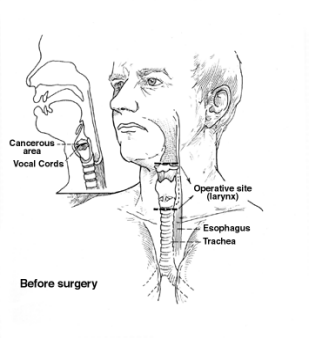
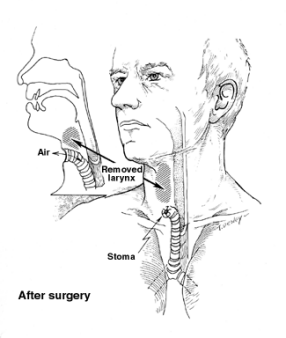
These illustrations are from the American Cancer Society surgery guide.
| Type | What is removed | Typical use | Breathing after surgery | Voice after surgery | Main functional issue |
|---|---|---|---|---|---|
| Endoscopic cordectomy / transoral laser resection | A small lesion and part or all of one vocal cord, through the mouth | Small, early glottic tumors | Normal route, no permanent stoma | Often preserved but hoarse, depending on amount of cord removed | Voice quality |
| Vertical partial laryngectomy / hemilaryngectomy | One vertical side of the larynx, often including one vocal cord and adjacent thyroid cartilage | Selected early glottic cancers | Usually normal after healing. A temporary tracheostomy may be used | Usually retained, but breathy or rough | Voice impairment; temporary swallowing issues |
| Supraglottic laryngectomy | Structures above the true vocal cords, such as the epiglottis, false cords, and upper thyroid cartilage | Selected supraglottic cancers | Usually normal after recovery. Temporary tracheostomy may be needed | True vocal cords remain, so speech is generally retained | Aspiration risk, especially early after surgery |
| Supracricoid partial laryngectomy (SCPL) with CHEP or CHP reconstruction | Most of the larynx, including thyroid cartilage and vocal cords, while retaining the cricoid and at least one functioning arytenoid | Selected intermediate glottic, transglottic, or supraglottic cancers, including some recurrences after radiation | Usually no permanent stoma if rehabilitation succeeds | A new, low-pitched and rough but usable voice may develop | Major swallowing and rehabilitation demands; aspiration risk |
| Near-total laryngectomy | Almost all larynx, with a small segment retained to create a voice shunt | Rarely used, selected cases | Usually an airway stoma, depending on technique | Can permit pulmonary-powered speech in selected patients | Less commonly performed today |
| Total laryngectomy (TL) | The entire larynx, including vocal cords | Advanced tumor, extensive cartilage involvement, nonfunctional larynx, or salvage after chemoradiotherapy failure | Permanent tracheal stoma. Air no longer travels through mouth or nose to the lungs | Natural laryngeal voice is lost | Permanent airway change and voice rehabilitation |
| Total laryngopharyngectomy | Total laryngectomy plus part or all of the pharynx | Cancer extending into the hypopharynx or pharyngoesophageal region | Permanent stoma | Requires voice rehabilitation | Swallowing tract often needs flap or jejunal reconstruction |
The partial laryngectomy subtypes
1. Cordectomy
The smallest form of laryngeal resection. The surgeon removes cancer from one vocal cord, commonly using a laser through the mouth. It is often grouped with partial laryngeal surgery but may not require an open neck incision.
- Best suited to selected early vocal-cord cancers.
- Breathing remains normal.
- The dominant long-term effect is hoarseness, ranging from mild to severe.
2. Vertical partial laryngectomy or hemilaryngectomy
This removes tissue in a vertical plane, commonly one vocal cord, part of the opposite cord if necessary, and a section of thyroid cartilage.
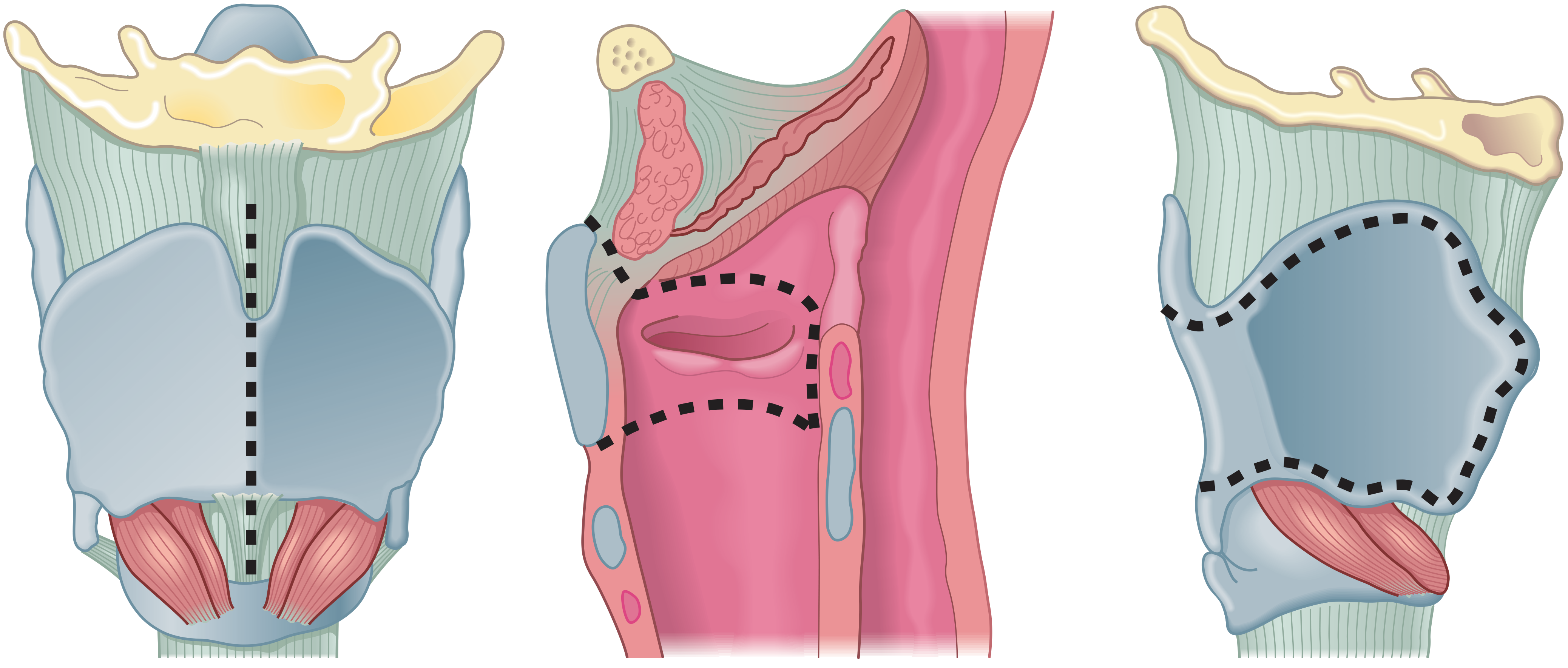
- Used mainly for selected glottic tumors.
- It preserves a functioning portion of the larynx.
- The remaining structures are reconstructed to provide an airway and a vibrating sound source.
- Speech remains possible, but the voice is usually hoarse or weak.
- A temporary tracheostomy and feeding tube may be needed during early healing.
3. Supraglottic laryngectomy
This removes the larynx above the true vocal cords. It may include the epiglottis, false vocal folds, and pre-epiglottic tissues while leaving the true vocal cords in place.
- Used for selected cancers of the supraglottis.
- Because the vocal cords are retained, speaking is usually possible.
- The greatest concern is swallowing safety: the epiglottis and supraglottic structures normally protect the airway during swallowing, so aspiration and aspiration pneumonia can occur during recovery.
- Good tongue-base movement, sensation, pulmonary reserve, and rehabilitation are important for candidacy. Cummings notes that impaired cord movement or tumor extension below the false cord argues against this operation. Cummings Otolaryngology Head and Neck Surgery, p. 2086.
4. Supracricoid partial laryngectomy
This is a more extensive organ-preserving operation. Much of the larynx is removed but the cricoid cartilage and one or both arytenoids are retained. The remaining larynx is reconstructed by joining it to the hyoid bone, with or without the epiglottis:
- CHEP: cricohyoidoepiglottopexy, retaining the epiglottis.
- CHP: cricohyoidopexy, without retaining the epiglottis.
It can treat selected tumors that are too extensive for a simpler supraglottic or vertical partial procedure, while avoiding total laryngectomy. It requires intensive swallowing and voice rehabilitation. Cummings Otolaryngology Head and Neck Surgery, p. 2089.
Total laryngectomy: the major differences
In a total laryngectomy, the voice box is completely removed and the trachea is brought forward to the skin of the lower neck.
What permanently changes
- Breathing: through the neck stoma, not the nose or mouth.
- Voice: vocal cords are gone, so normal voice is not possible.
- Airflow and swallowing are separated: unlike a tracheostomy, food and drink cannot enter the lungs through the larynx because the larynx is no longer connected to the airway.
- Smell and taste: may be reduced because air no longer passes normally through the nose.
- Air conditioning: inhaled air is less naturally warmed, humidified, and filtered. A heat-moisture exchanger is often used.
Voice rehabilitation after total laryngectomy
Speech can still be regained using:
- Tracheoesophageal puncture (TEP) with a voice prosthesis: commonly provides the most natural-sounding option.
- Electrolarynx: handheld vibrating device.
- Esophageal speech: air is learned to be injected into and released from the esophagus to create sound.
The American Cancer Society explanation notes that swallowing can often remain possible after uncomplicated total laryngectomy because the pharynx-esophagus connection is usually retained. This differs from laryngopharyngectomy, where reconstruction may be required.
Important terminology: laryngectomy versus tracheostomy
These are not the same procedure.
- Tracheostomy: an opening into the trachea, often temporary. The larynx remains in place.
- Total laryngectomy: removes the larynx and creates a permanent stoma. The airway and food passage become permanently separate.
In one line
- Cordectomy: remove part of a cord.
- Hemilaryngectomy / vertical partial: remove one side of the voice box.
- Supraglottic laryngectomy: remove the upper voice box, leave true cords.
- Supracricoid partial: remove most of the voice box but reconstruct from preserved cricoid/arytenoid structures.
- Total laryngectomy: remove the entire voice box, permanent neck breathing, alternative speech method required.
- Laryngopharyngectomy: total laryngectomy plus removal of part or all of the throat.
For selected early or intermediate tumors, partial procedures aim to preserve speech, swallowing, and normal upper-airway breathing. They are only appropriate when the tumor’s location and extent, arytenoid mobility, cartilage involvement, lung function, and swallowing reserve make safe preservation realistic. Recent systematic reviews on salvage procedures and outcomes do not change these definitions, but reinforce that the choice is highly individualized, particularly after prior radiation or chemoradiotherapy (PMID 40968204).
This is a shared conversation. Sign in to Orris to start your own chat.