
structure of virus
A virus is a non-cellular infectious agent consisting of a few core components: genetic material (DNA or RNA), a protein coat called the capsid, and in many cases an outer lipid envelope.
Searching sources...
Reading File
Finding Sources
Searching the Web
structure of virus components capsid envelope genome
Reading File
Reading File
Reading File
Here is a thorough breakdown of viral structure, drawn directly from Jawetz, Melnick & Adelberg's Medical Microbiology (28th ed.).
Structure of a Virus
A virus (or virion - the complete infectious particle) is not a cell. It lacks ribosomes, mitochondria, and the metabolic machinery of life. Instead, it is a stripped-down package of genetic information with a protein shell, and sometimes a lipid membrane.
1. Core Components
A. Viral Nucleic Acid (Genome)
- Every virus contains one type of nucleic acid only - either DNA or RNA, never both.
- The genome may be:
- Single-stranded (ss) or double-stranded (ds)
- Linear or circular
- Segmented (multiple pieces, e.g., influenza) or nonsegmented (single piece)
- DNA genome size: 3.2 kbp (hepatitis B / hepadnaviruses) up to 375 kbp (poxviruses)
- RNA genome size: ~4 kb (picobirnaviruses) up to 32 kb (coronaviruses)
- Polarity matters:
- Positive-sense RNA (e.g., picornaviruses, togaviruses) - the isolated RNA is itself infectious and acts directly as mRNA
- Negative-sense RNA (e.g., orthomyxoviruses/influenza, rhabdoviruses) - isolated RNA is NOT infectious; requires a packaged RNA polymerase to first make mRNA copies
B. Capsid (Protein Coat)
- The capsid is a protein shell surrounding and protecting the genome from nucleases and the environment.
- Built from repeating protein subunits called capsomeres (and individual folded polypeptides called subunits).
- Functions:
- Protects viral nucleic acid
- Mediates attachment to host cell receptors
- Determines antigenic characteristics (the immune response targets capsid/surface proteins)
- The nucleocapsid = nucleic acid + capsid together
C. Capsid Symmetry - Three Types
Genetic economy means a virus builds its shell from many copies of just one or a few proteins. The arrangement follows strict geometric rules:
| Symmetry | Shape | Examples |
|---|---|---|
| Cubic (Icosahedral) | 20 equilateral triangular faces, 12 vertices - appears spherical | Adenovirus, poliovirus, herpesvirus |
| Helical | Protein subunits wind around the nucleic acid in a rod/coil | Influenza, rabies (rhabdovirus), measles |
| Complex | Neither cubic nor helical - unique structures | Poxviruses (brick-shaped with internal core + lateral bodies), bacteriophages |
Icosahedral detail: Has 5-fold, 3-fold, and 2-fold rotational symmetry. Vertex subunits are pentavalent (5 neighbors); others are hexavalent. A minimum of 60 identical subunits needed; larger viruses use multiples of 60.
Helical detail: Protein subunits bind periodically to the nucleic acid, winding it into a helix. All animal helical viruses have RNA genomes. "Empty" helical particles cannot form (unlike empty icosahedral shells).
2. Viral Proteins
Structural proteins serve several functions:
- Transfer the genome from one host cell to another
- Protect the genome against nucleases
- Attach to host cell receptors (e.g., influenza hemagglutinin binds sialic acid)
- Carry enzymatic activities - some virions package essential enzymes:
- RNA polymerase (negative-sense RNA viruses - must make mRNA before replication begins)
- Reverse transcriptase (retroviruses - converts RNA genome into DNA)
- Transcriptional machinery (poxviruses - entire transcription system packaged inside the core)
- Antigenic determinants - the host immune system targets surface proteins/glycoproteins
3. Viral Lipid Envelope (Present in Some Viruses)
Many viruses - influenza, HIV, herpes, measles, hepatitis C - are enveloped; others (poliovirus, adenovirus) are naked (non-enveloped).
- The envelope is a lipid bilayer derived from the host cell membrane, acquired when the nucleocapsid buds out through the cell membrane during maturation.
- Budding occurs only where virus-specific proteins have been inserted into the host membrane.
- The phospholipid composition of the envelope reflects the host cell membrane (not virus-coded).
- Glycoproteins (virus-coded) are embedded in the envelope and project as spikes:
- Examples: influenza hemagglutinin (HA) and neuraminidase (NA)
- These are the key surface antigens recognized by the immune system
Envelope significance:
- Enveloped viruses are generally more fragile - they are inactivated by lipid solvents (ether, detergents)
- Non-enveloped viruses are hardier and can survive harsh environments (gut acid, desiccation)
4. Virus Size
Viruses range from ~20 nm to ~300 nm in diameter:
| Reference | Size |
|---|---|
| Parvovirus (smallest) | ~20 nm |
| Poliovirus | ~30 nm |
| Influenza | ~100 nm |
| Poxvirus (largest animal virus) | ~300 nm |
| Bacterium (e.g., Staph) | ~1000 nm (1 µm) |
| Red blood cell | ~7,000 nm (7 µm) |
A virus with twice the diameter of another has 8 times the volume (cubic relationship). A poxvirus is ~1000x the mass of poliovirus.
5. Summary Diagram (Conceptual)
NON-ENVELOPED VIRUS           ENVELOPED VIRUS
+------------------+         +---------------------+
|   Capsid         |         | Envelope (lipid)    |
|  [Capsomeres]    |         |  + Glycoprotein      |
|                  |         |    spikes (HA, NA)  |
|  Nucleic Acid    |         |  Nucleocapsid inside|
|  (DNA or RNA)    |         |  (Nucleic acid +    |
|                  |         |   capsid proteins)  |
+------------------+         +---------------------+
e.g., Poliovirus              e.g., Influenza, HIV
Source: Jawetz, Melnick & Adelberg's Medical Microbiology, 28th Edition - Chapter 29: Principles of Virus Structure and Chemical Composition of Viruses
where is virion located in virus
The virion is the virus - it's not a part located inside the virus, but rather the term for the complete, intact, infectious virus particle itself.
Searching sources...
Finding Sources
Searching the Web
what is a virion definition location in virus
Reading File
Loading Image
This is a very common point of confusion. The short answer: the virion is not located inside a virus - the virion IS the virus. Let me clarify this properly.
The Virion = The Complete Virus Particle
The word "virion" is simply the technical term for the entire, complete, intact virus particle - the whole thing, from the outermost layer to the innermost genome.
Think of it this way:
"Virus" is the general biological concept (like saying "a dog"). "Virion" is the specific, complete physical particle (like saying "this particular dog standing in front of you").
As defined in Jawetz, Melnick & Adelberg's Medical Microbiology (28th Ed.):
"Virion: The complete virus particle... this structure serves to transfer the viral nucleic acid from one cell to another."
What the Virion Contains (Inside → Outside)
The virion encompasses ALL of these layers together:
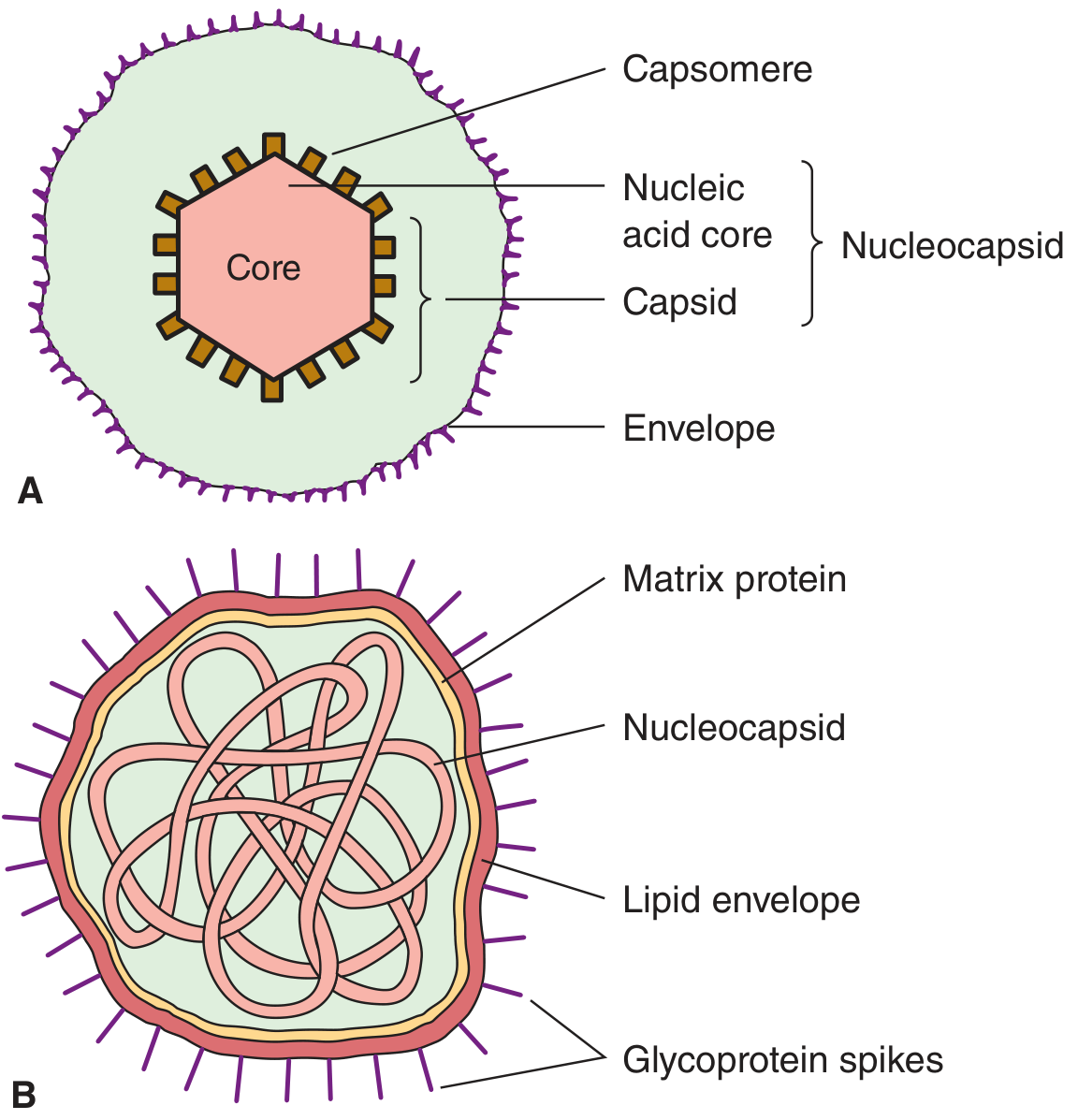
| Layer | What It Is | Location |
|---|---|---|
| Nucleic acid core | DNA or RNA genome | Innermost center |
| Capsid | Protein shell made of capsomeres | Surrounds the genome |
| Nucleocapsid | Genome + capsid combined | Inner portion of virion |
| Envelope (only in some viruses) | Lipid bilayer with glycoprotein spikes | Outermost layer |
So the virion = nucleocapsid alone (in simple viruses) OR nucleocapsid + envelope (in complex viruses).
Two Types of Virions
Simple (naked) virion - e.g., poliovirus, papillomavirus:
[Nucleic acid] → [Capsid] = Virion
(the nucleocapsid alone IS the complete virion)
Complex (enveloped) virion - e.g., influenza, herpesvirus:
[Nucleic acid] → [Capsid] → [Envelope + spikes] = Virion
(all three layers together make the complete virion)
Where the Virion Exists
The virion exists outside a host cell - it is the free, extracellular form of the virus. This is its "traveling" form, built to survive outside and infect new cells. Once it enters a cell and starts replicating, it disassembles and is no longer called a virion.
- Outside cell = Virion (complete, infectious particle)
- Inside cell = The virus has uncoated and the genome is actively replicating
In summary: You cannot point to a spot within a virus and say "that is where the virion is." The virion IS the entire virus particle. Every component - the genome, capsid, envelope - is part of the virion.
Source: Jawetz, Melnick & Adelberg's Medical Microbiology, 28th Ed., Chapter 29 - Terms and Definitions in Virology
so if virus id infectious it is virion?
Yes, that's essentially correct - but with a small nuance worth clarifying.
Searching sources...
Finding Sources
Yes - but here is the precise relationship:
Virion = Complete Virus Particle = (Usually) Infectious
A virion is defined as the complete, fully assembled virus particle. Because it is complete and intact, it is normally capable of infecting a cell - so yes, infectious virus = virion is a good working rule.
But there are two important nuances:
1. Virion = Complete, but not always infectious
A virion is complete by structure, not by function. Some complete virions can be:
- Defective - structurally intact but carrying a mutated/incomplete genome, so they cannot replicate
- Inactivated - physically complete but their genome or surface proteins have been damaged (by heat, UV light, antibodies), making them non-infectious
So: all infectious free virus = virion, but not all virions are infectious.
2. Virus inside a cell is NOT called a virion
Once the virion injects its genome into a host cell and disassembles, it is no longer a virion. The virus exists as loose genetic material and proteins inside the cell - replicating, but not a discrete particle.
It only becomes a virion again when new complete particles are assembled and released from the cell.
Simple Way to Remember It
| State | Term | Infectious? |
|---|---|---|
| Complete, intact, free-floating particle | Virion | Usually yes |
| Disassembled inside a host cell | Not a virion | N/A (replicating) |
| Complete but mutated/damaged | Defective virion | No |
So your statement is correct in the vast majority of cases. When someone says "infectious virus particle," they are describing a virion. The word "virion" just emphasizes that the particle is structurally complete - genome + capsid + envelope (if applicable) - all assembled and ready to infect.
classification of virus
Viruses are classified based on genome type (DNA/RNA), strandedness, symmetry, presence of envelope, and host range. The Baltimore classification system groups them into 7 classes based on how they make mRNA.
Searching sources...
Finding Sources
Searching the Web
virus classification Baltimore system DNA RNA families 2024
Reading File
Reading File
Reading File
Here is a complete breakdown of viral classification from both Jawetz and Sherris & Ryan's Medical Microbiology:
Classification of Viruses
Viruses are classified using two major systems that complement each other:
- ICTV Taxonomic System - based on structure and genome
- Baltimore Classification - based on how the virus makes mRNA
System 1 - ICTV Taxonomy (Structural Classification)
The International Committee on Taxonomy of Viruses (ICTV) classifies viruses using these properties:
| Criterion | What It Includes |
|---|---|
| Virion morphology | Size, shape, symmetry (icosahedral/helical/complex), envelope presence |
| Genome properties | DNA or RNA, single or double stranded, linear or circular, segmented or not, polarity (+/-) |
| Replication strategy | Where in cell, transcription pattern |
| Protein properties | Number, size, glycosylation, enzymatic activity |
| Antigenic properties | Reactions to antisera |
| Biologic properties | Host range, transmission, pathogenicity, tissue tropism |
Naming convention (ICTV):
- Family: suffix -viridae (e.g., Herpesviridae)
- Subfamily: suffix -virinae (e.g., Herpesvirinae)
- Genus: suffix -virus (e.g., Herpesvirus)
- Species: common name (e.g., herpes simplex virus 1)
System 2 - Baltimore Classification (7 Groups)
Proposed by David Baltimore (1971). All viruses must make mRNA to produce proteins. The Baltimore system is centered on how the genome gets converted to mRNA:
| Group | Genome Type | Polarity | Replication Route | Examples |
|---|---|---|---|---|
| I | dsDNA | - | DNA → mRNA | Herpesviruses, Adenoviruses, Poxviruses, Papillomaviruses |
| II | ssDNA | + | DNA → dsDNA → mRNA | Parvoviruses, Anelloviruses |
| III | dsRNA | - | RNA → mRNA | Reoviruses, Rotavirus |
| IV | ssRNA | + (positive sense) | RNA directly = mRNA | Picornaviruses (Polio, HAV, Rhinovirus), Flaviviruses (Dengue, HCV, Zika), Coronaviruses |
| V | ssRNA | - (negative sense) | RNA → mRNA via RNA polymerase | Influenza, Measles, Rabies, Ebola, Mumps |
| VI | ssRNA-RT | + | RNA → DNA → mRNA (reverse transcription) | HIV (retroviruses) |
| VII | dsDNA-RT | - | DNA → RNA → DNA → mRNA | Hepatitis B virus (hepadnaviruses) |
Key rule: Positive-sense RNA (+ssRNA) acts directly as mRNA. Negative-sense RNA (-ssRNA) needs its own RNA polymerase packaged in the virion to first make mRNA.
Classification by Genome Type
RNA Viruses Infecting Humans
| Family | Structure & Size | Genome | Key Members |
|---|---|---|---|
| Picornaviridae | Icosahedral, naked, 22-30 nm | ss linear (+) | Poliovirus, HAV, Rhinovirus, Coxsackievirus, Echovirus |
| Caliciviridae | Icosahedral, naked, 27-38 nm | ss linear (+) | Norovirus, Norwalk virus |
| Hepeviridae | Icosahedral, naked, 27-34 nm | ss linear (+) | Hepatitis E virus (HEV) |
| Flaviviridae | Icosahedral, enveloped, 40-50 nm | ss linear (+) | Dengue, Yellow fever, Zika, West Nile, HCV |
| Togaviridae | Icosahedral, enveloped, 70 nm | ss linear (+) | Rubella, Chikungunya |
| Coronaviridae | Helical, enveloped, 80-160 nm | ss linear (+) | SARS-CoV-2, MERS-CoV, common cold |
| Reoviridae | Icosahedral, naked, 80 nm | ds, 10 segments | Rotavirus, Colorado tick fever |
| Rhabdoviridae | Helical, enveloped, bullet-shaped | ss linear (-) | Rabies virus |
| Filoviridae | Helical, enveloped, filamentous | ss linear (-) | Ebola, Marburg |
| Paramyxoviridae | Helical, enveloped, 150-300 nm | ss linear (-) | Measles, Mumps, RSV, Parainfluenza |
| Orthomyxoviridae | Helical, enveloped, 80-120 nm | ss, 8 segments (-) | Influenza A, B, C |
| Bunyaviridae | Helical, enveloped | ss, 3 segments (-) | Hantavirus, Crimean-Congo HF |
| Arenaviridae | Helical, enveloped | ss, 2 segments (ambisense) | Lassa fever, LCMV |
| Retroviridae | Icosahedral, enveloped, 80-110 nm | ss linear (+), diploid, RT | HIV-1, HIV-2, HTLV |
| Deltaviridae | Icosahedral, enveloped, 36-43 nm | ss circular (+) | Hepatitis D virus (HDV) |
DNA Viruses Infecting Humans
| Family | Structure & Size | Genome | Key Members |
|---|---|---|---|
| Parvoviridae | Icosahedral, naked, 20 nm | ss linear (~5 kb) | Parvovirus B19, Adeno-associated virus |
| Anelloviridae | Icosahedral, naked, 30 nm | ss circular | TT virus |
| Polyomaviridae | Icosahedral, naked, 45 nm | ds circular (5 kb) | JC virus, BK virus, Merkel cell virus |
| Papillomaviridae | Icosahedral, naked, 55 nm | ds circular (8 kb) | HPV (~100 genotypes) |
| Adenoviridae | Icosahedral, naked, 80-110 nm | ds linear (36-38 kb) | Adenoviruses (respiratory, GI disease) |
| Hepadnaviridae | Icosahedral, enveloped, 42 nm | ds circular, partial gap (3.2 kb), RT | Hepatitis B virus (HBV) |
| Herpesviridae | Icosahedral, enveloped, 180-200 nm | ds linear (124-235 kb) | HSV-1, HSV-2, VZV, CMV, EBV, HHV-6, HHV-7, HHV-8 |
| Poxviridae | Complex (brick-shaped), enveloped, ~300 nm | ds linear (130-375 kb) | Smallpox, Vaccinia, Monkeypox, Molluscum contagiosum |
Quick Summary - How to Remember
DNA Viruses (mnemonic: "Please Have Some Pretty Hot Popcorn"):
  Parvo → Hepadna → Polyoma → Papilloma → Adeno → Herpes → Pox

RNA Viruses (positive-sense = naked tend to be; enveloped tend to be negative/RT):
  Naked (+): Picorna, Calici, Reo, Astro, Hepe
  Enveloped (+): Flavi, Toga, Corona
  Enveloped (-): Paramyxo, Orthomyxo, Rhabdo, Filo, Bunya, Arena
  RT (Enveloped): Retro (RNA→DNA), Hepadna (DNA→RNA→DNA)
Sources: Jawetz, Melnick & Adelberg's Medical Microbiology 28th Ed., Chapter 29; Sherris & Ryan's Medical Microbiology 8th Ed., Chapter 6
which is important for mbbs baltimore or ictv
Both are important for MBBS, but Baltimore is more frequently tested. Here's the practical breakdown:
For MBBS Exams - Priority Guide
Baltimore Classification - Higher Priority
- Asked directly in exams: "Which group does HIV belong to?", "Classify HBV", "Positive-sense RNA viruses"
- Helps you understand replication - which is tested heavily in microbiology practicals and theory
- Only 7 groups - easy to memorize
- Explains WHY certain viruses behave differently (e.g., why HIV needs reverse transcriptase, why influenza needs its own RNA polymerase)
- Forms the conceptual backbone for understanding antiviral drugs (e.g., reverse transcriptase inhibitors for Group VI)
ICTV Classification - Also Required, but More as Reference
- You need to know family names (-viridae) and which viruses belong to which family
- Directly tested as: "Hepatitis B belongs to which family?" (Hepadnaviridae), "Rabies belongs to?" (Rhabdoviridae)
- The full table is not memorized - used as a reference, as Sherris & Ryan explicitly states: "The tables should not be memorized but rather used as a reference guide"
- Important for identifying structural features - naked vs enveloped, size, symmetry
What MBBS Students Actually Need to Know
| Topic | What to Focus On |
|---|---|
| Baltimore Groups I-VII | Know all 7, their genome type, polarity, and 2-3 examples each |
| Family names | Memorize families of common/important viruses (Herpes, Pox, Adeno, Parvovirus for DNA; Picorna, Flavi, Ortho/Paramyxo, Retro, Corona for RNA) |
| Enveloped vs Naked | Know which is which - affects disinfection, transmission, vaccine design |
| Positive vs Negative sense | Know the difference and examples |
| Reverse transcriptase viruses | HIV (Group VI) and HBV (Group VII) - very commonly asked |
Bottom Line
Learn Baltimore first - it gives you the logic. Then layer ICTV family names on top. Together they cover ~90% of virology questions in MBBS exams (1st Prof Microbiology, and clinical years).
Standalone ICTV taxonomy (subfamilies, genera) is rarely asked in MBBS - that level of detail is for postgraduate (MD/MS) microbiology.
explain baltimore classification
The Baltimore classification groups viruses into 7 classes based on how they produce mRNA from their genome. mRNA is central because all viruses depend on the host cell's ribosomes to make proteins - and ribosomes only read mRNA.
Searching sources...
Finding Sources
Searching the Web
Baltimore classification 7 groups virus mRNA explained simply
Finding Sources
Finding Sources
Finding Sources
I have enough from the previous research plus core knowledge to give you a thorough, exam-focused explanation. Here it is:
Baltimore Classification - Full Explanation
The Core Idea
David Baltimore proposed this system in 1971 (he won the Nobel Prize for it). The central logic is:
Every virus must produce mRNA. Why? Because viruses have no ribosomes. They MUST use the host cell's ribosomes to make proteins. Ribosomes only read mRNA. So no matter what genome a virus has - DNA or RNA - it must get to mRNA somehow.
Baltimore put mRNA at the center and asked: "How does this virus get from its genome to mRNA?" The answer to that question defines the group.
The Concept of Polarity (+ and - Sense)
Before understanding the groups, you must understand polarity:
| Term | Meaning | Can ribosomes read it directly? |
|---|---|---|
| Positive sense (+) | RNA has the same sequence as mRNA | YES - acts directly as mRNA |
| Negative sense (-) | RNA is the mirror/complement of mRNA | NO - must first be converted to mRNA |
| Ambisense | Part positive, part negative | Partially |
The 7 Baltimore Groups
GROUP I - Double-Stranded DNA (dsDNA)
dsDNA →[transcription]→ mRNA →[translation]→ Proteins
- Genome: Two strands of DNA (like our own chromosomes)
- Replication: Goes into the nucleus, uses host DNA-dependent RNA polymerase to make mRNA - just like normal cells do
- Highly dependent on host cell cycle - cell must be dividing for many of these
- Examples: Herpesviruses (HSV, VZV, CMV, EBV), Adenoviruses, Papillomaviruses (HPV), Polyomaviruses, Poxviruses (exception: replicates in cytoplasm, carries its own enzymes)
GROUP II - Single-Stranded DNA (ssDNA)
ssDNA →[DNA polymerase]→ dsDNA →[transcription]→ mRNA
- Genome: Only ONE strand of DNA
- Must first make a complementary strand to become dsDNA, THEN transcribe mRNA
- Smallest DNA viruses
- Examples: Parvoviruses (Parvovirus B19 - causes fifth disease / slapped cheek), Anelloviruses (TT virus)
GROUP III - Double-Stranded RNA (dsRNA)
dsRNA →[viral RNA polymerase]→ mRNA (positive strand)
- Genome: Two strands of RNA
- Cannot use host enzymes (host has no RNA-dependent RNA polymerase)
- Must carry their own RNA polymerase packaged inside the virion
- Replication occurs inside the capsid core in the cytoplasm (never in nucleus)
- Genome is usually segmented (multiple pieces)
- Examples: Reoviruses, Rotavirus (major cause of childhood diarrhea)
GROUP IV - Positive-Sense Single-Stranded RNA (+ssRNA)
(+)ssRNA  =  mRNA directly  →[translation]→  Proteins
             ↓[RNA-dependent RNA polymerase made]
           (-)ssRNA intermediate  →  more (+)ssRNA copies
- Genome IS the mRNA - ribosomes can read it immediately upon cell entry
- Most infectious isolated RNA (inject the RNA alone into a cell = infection)
- First thing that happens: genome gets translated into a polyprotein, which includes an RNA-dependent RNA polymerase (RdRp) for replication
- Largest group - most human RNA viruses are positive sense
- Examples:
- Picornaviridae: Poliovirus, HAV, Rhinovirus (common cold), Coxsackievirus
- Flaviviridae: Dengue, Zika, Yellow fever, West Nile, Hepatitis C (HCV)
- Togaviridae: Rubella, Chikungunya
- Coronaviridae: SARS-CoV-2, MERS, common cold coronaviruses
- Caliciviridae: Norovirus
GROUP V - Negative-Sense Single-Stranded RNA (-ssRNA)
(-)ssRNA →[viral RNA polymerase]→ mRNA (+) →[translation]→ Proteins
- Genome CANNOT be read directly - it is the complement/mirror image of mRNA
- MUST carry RNA-dependent RNA polymerase (RdRp) packaged inside the virion - without it, the genome is useless
- Isolated RNA from these viruses is non-infectious
- Often have segmented genomes (influenza has 8 segments - key fact for exams!)
- Examples:
- Orthomyxoviridae: Influenza A, B (8 segments - replicates in nucleus, unique among RNA viruses)
- Paramyxoviridae: Measles, Mumps, RSV, Parainfluenza
- Rhabdoviridae: Rabies (bullet-shaped)
- Filoviridae: Ebola, Marburg (filamentous)
- Bunyaviridae: Hantavirus, Crimean-Congo hemorrhagic fever
GROUP VI - ssRNA with Reverse Transcriptase (ssRNA-RT)
(+)ssRNA →[Reverse Transcriptase]→ DNA →[integrates into host genome]→ mRNA
- Retroviruses - unique because they go RNA → DNA (reverse of normal flow of genetic information)
- Carry reverse transcriptase (RT) and integrase in the virion
- After RT makes DNA copy, it integrates permanently into host chromosome as a provirus
- Host cell then transcribes it like its own gene → viral mRNA and proteins
- Genome is diploid (2 copies of RNA per virion)
- Examples: HIV-1, HIV-2 (causes AIDS), HTLV-1 (causes T-cell leukemia)
- Clinical importance: All anti-HIV drugs (NRTIs, NNRTIs) target reverse transcriptase
GROUP VII - dsDNA with Reverse Transcriptase (dsDNA-RT)
dsDNA →[transcription]→ pregenomic RNA →[Reverse Transcriptase]→ new dsDNA
- Most unusual group - DNA virus that uses reverse transcription in its replication cycle
- Goes DNA → RNA → DNA (uses an RNA intermediate called pregenomic RNA)
- Also carries reverse transcriptase
- Only one major human pathogen in this group
- Example: Hepatitis B virus (HBV) - Hepadnaviridae
- Clinical importance: Why HBV can integrate into the genome; why it can persist even after treatment; why drugs like tenofovir (an RT inhibitor) work against HBV
Summary Table - All 7 Groups
| Group | Genome | Key Feature | Must Carry Own Polymerase? | Examples |
|---|---|---|---|---|
| I | dsDNA | Standard transcription | No (uses host) | Herpes, Adeno, HPV, Pox |
| II | ssDNA | Makes dsDNA first | No | Parvovirus B19 |
| III | dsRNA | Packaged RdRp | Yes | Rotavirus, Reovirus |
| IV | +ssRNA | Genome = mRNA | No (at first) | Polio, Dengue, Zika, HCV, COVID-19 |
| V | -ssRNA | Must flip to mRNA | Yes | Influenza, Measles, Rabies, Ebola |
| VI | +ssRNA-RT | RNA → DNA (retrovirus) | Yes (RT) | HIV, HTLV |
| VII | dsDNA-RT | DNA → RNA → DNA | Yes (RT) | Hepatitis B |
Memory Aid for MBBS
"Don't Stupid People Really Never Read Books"
 D     S    P     R     N    R    B
 I    II   IV    III    V   VI   VII
dsDNA ssDNA +RNA  dsRNA -RNA RT-RNA RT-DNA
Or think of it in 3 blocks:
- Groups I & II = DNA viruses
- Groups III, IV, V = Pure RNA viruses
- Groups VI & VII = Reverse transcriptase viruses (RNA↔DNA)
Most Commonly Tested in MBBS
- HIV = Group VI (RT, integrase, diploid)
- HBV = Group VII (dsDNA but uses RT - "DNA virus that behaves like a retrovirus")
- Influenza = Group V (8 segments, carries RdRp, replicates in nucleus)
- Poliovirus/Rotavirus/Rhinovirus = Group IV/III
- Rabies = Group V (-ssRNA, bullet shape)
- COVID-19 = Group IV (+ssRNA, largest RNA genome)
so this doent classify family of virus
Correct - that's a sharp observation.
Baltimore Does NOT Classify Families
The Baltimore system only tells you HOW a virus makes mRNA - it groups viruses by their replication strategy, not by family, shape, host, or disease.
This means viruses from completely different families can sit in the same Baltimore group:
| Baltimore Group | Different Families Inside It |
|---|---|
| Group I (dsDNA) | Herpesviridae, Adenoviridae, Papillomaviridae, Poxviridae - all totally different families |
| Group IV (+ssRNA) | Picornaviridae, Flaviviridae, Coronaviridae, Togaviridae - all different families |
| Group V (-ssRNA) | Orthomyxoviridae, Paramyxoviridae, Rhabdoviridae, Filoviridae - all different families |
And conversely, the same family cannot span two Baltimore groups - a family always has one genome type.
What Each System Actually Does
| Feature | Baltimore | ICTV (Family Classification) |
|---|---|---|
| Based on | How mRNA is made (replication strategy) | Structure, morphology, genome, serology, biology |
| Classifies | Replication groups (I-VII) | Family → Genus → Species |
| Tells you | How the virus replicates | What family/genus the virus belongs to |
| Groups viruses by | Genome type + polarity + RT use | Shared structural and biological features |
| Number of groups | 7 | Hundreds of families |
| Clinical use | Predicts antiviral drug targets | Identifies specific virus, guides treatment |
Think of It This Way
Baltimore = sorting people by blood group (A, B, AB, O) - a functional property, not physical appearanceICTV = sorting people by nationality - based on origin, features, shared characteristics
A person can be "blood group A" AND "Indian" - those are two different ways of classifying the same person. Similarly, HIV is Group VI (Baltimore) AND Retroviridae (ICTV) - both labels are true simultaneously.
So for MBBS - Use Both Together
- When asked "classify HIV" → Give BOTH: "HIV belongs to Baltimore Group VI (ssRNA-RT) and family Retroviridae"
- When asked "which family does influenza belong to?" → ICTV answer: Orthomyxoviridae
- When asked "classify influenza by genome" → Baltimore answer: Group V, negative-sense ssRNA
The two systems are complementary, not competing. ICTV tells you the identity; Baltimore tells you the behavior.
what is positive and negative sense
Positive sense RNA has the same sequence as mRNA, so ribosomes can read it directly. Negative sense RNA is the mirror complement of mRNA, so ribosomes cannot read it - it must first be converted.
Searching sources...
Finding Sources
Here is a clear, complete explanation:
Positive Sense vs Negative Sense RNA
First - Understand mRNA
mRNA (messenger RNA) is the molecule ribosomes read to make proteins. Its sequence is the reference standard. Everything in RNA sense/polarity is compared to mRNA.
Positive Sense (+) RNA
Same sequence as mRNA
- The viral genome RNA reads exactly like mRNA
- Ribosomes can grab it and translate it directly into proteins the moment it enters the cell
- No extra step needed
- The genome itself IS the mRNA
Analogy: You receive a letter already written in English. You can read it immediately.
Viral (+) RNA enters cell
        ↓
Ribosome reads it directly
        ↓
Viral proteins made immediately
Key consequences:
- Isolated (+) RNA is infectious on its own - inject it into a cell, infection begins
- Does NOT need to carry an RNA polymerase in the virion (because no conversion needed at first)
- Fastest to start infection - proteins made immediately
Examples: Poliovirus, Dengue, HCV, Zika, Rhinovirus, SARS-CoV-2, Rubella, Norovirus
Negative Sense (-) RNA
Complementary (mirror) to mRNA - opposite/antiparallel
- The viral genome RNA is the exact opposite of mRNA
- Ribosomes cannot read it - it is like a template strand, not a coding strand
- Must first be converted into positive-sense mRNA before anything can happen
- Needs an enzyme to do this conversion: RNA-dependent RNA polymerase (RdRp)
- This RdRp must be packaged inside the virion - because the host cell has no such enzyme
Analogy: You receive a letter written in mirror image. You need a special mirror (RdRp) to read it first.
Viral (-) RNA enters cell
        ↓
RdRp (brought in the virion) converts it
        ↓
(+) mRNA produced
        ↓
Ribosome reads mRNA → Viral proteins
Key consequences:
- Isolated (-) RNA is NOT infectious - without the packaged RdRp, it cannot be read
- Must carry RdRp in the virion - this is a defining feature
- Slightly slower to start infection (extra conversion step)
Examples: Influenza, Measles, Mumps, Rabies, Ebola, RSV
Side-by-Side Comparison
| Feature | Positive Sense (+) | Negative Sense (-) |
|---|---|---|
| Sequence vs mRNA | Same as mRNA | Complementary to mRNA |
| Acts directly as mRNA? | Yes | No |
| Isolated RNA infectious? | Yes | No |
| Carries RdRp in virion? | No (initially) | Yes (must) |
| First step in cell | Direct translation | RdRp makes mRNA first |
| Baltimore group | IV | V |
| Examples | Polio, Dengue, COVID | Flu, Measles, Rabies |
Simple Memory Trick
Think of a book:
- (+) sense = the book is printed normally - you open it and read immediately
- (-) sense = the book is printed in mirror image - you need a mirror (RdRp) before you can read it
Or think of photography:
- (+) sense = the final photograph (what you see)
- (-) sense = the photographic negative (you need to develop/convert it first)
What About Ambisense?
Some viruses (e.g., Arenaviruses like Lassa fever, Bunyaviruses) have ambisense RNA - part of the genome is positive sense, part is negative sense. They partially need conversion, partially don't.
Why This Matters Clinically
- Influenza (-ssRNA): Its RdRp is the target of baloxavir (a newer anti-influenza drug)
- HIV (+ssRNA): Goes RNA → DNA via reverse transcriptase - its RT is targeted by NRTIs and NNRTIs
- HCV (+ssRNA): Its RdRp is targeted by sofosbuvir (a direct-acting antiviral)
- Understanding polarity helps you predict which antivirals work on which virus
Source: Jawetz, Melnick & Adelberg's Medical Microbiology 28th Ed., Chapter 29 - Viral Nucleic Acid
does mrna should have fixed gene code to read by ribosome
Yes - and this is the heart of molecular biology. The ribosome reads mRNA using the genetic code, which is fixed and universal.
Searching sources...
Finding Sources
Reading File
Reading File
Loading Image
Yes - absolutely. mRNA must follow a fixed, universal code for ribosomes to read it. Here is the full explanation:
The Genetic Code - How Ribosomes Read mRNA
The Rule: Codons
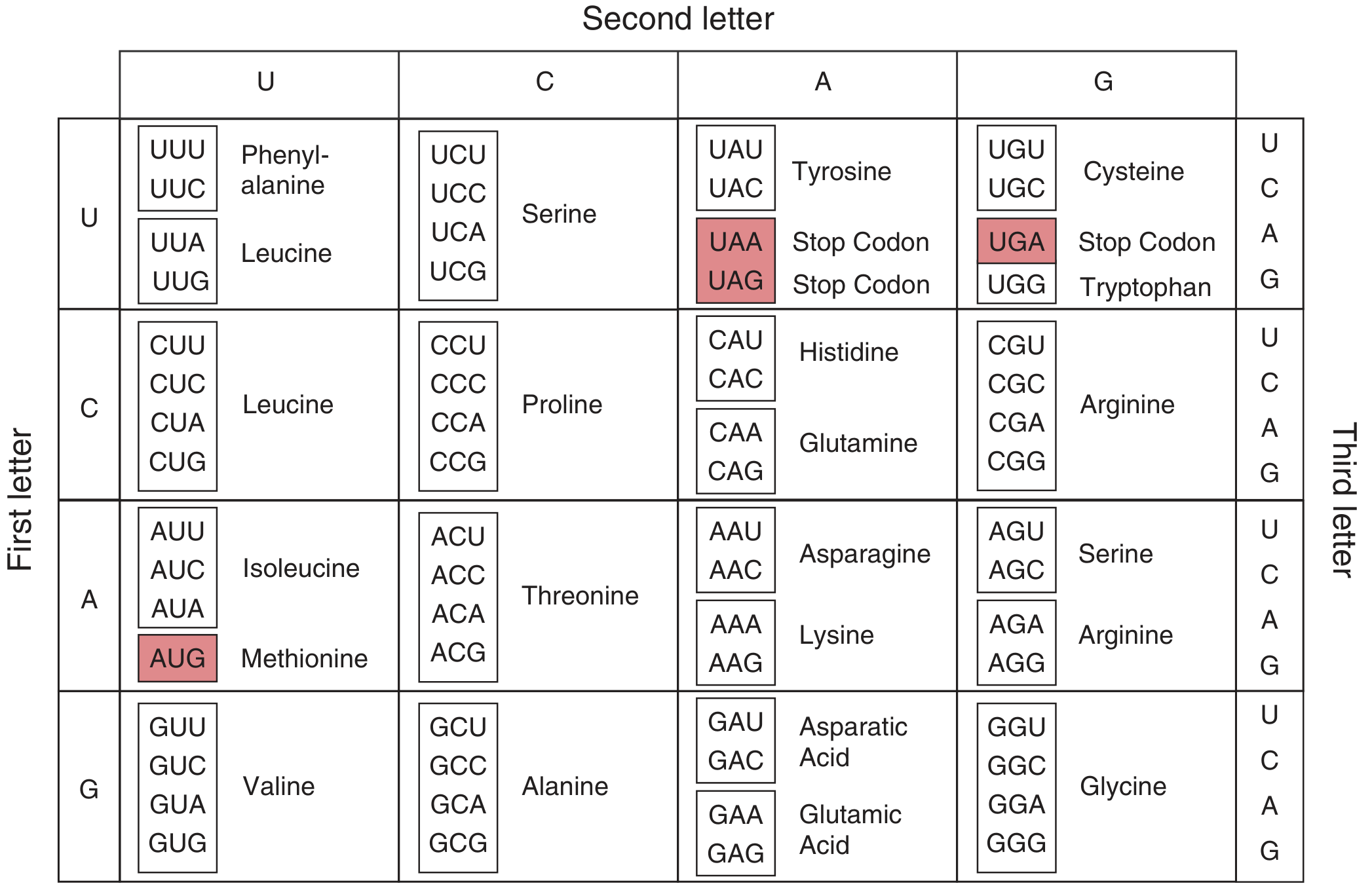
The ribosome reads mRNA in groups of 3 bases called codons.
- mRNA is made of 4 bases: A, U, G, C
- Every 3 bases = 1 codon
- Each codon codes for one specific amino acid
- This is the genetic code - fixed, universal, and non-overlapping
With 4 bases in groups of 3: 4³ = 64 possible codons for only 20 amino acids - so the code is redundant (multiple codons can code for the same amino acid).
The Complete Genetic Code
The Fixed Rules of the Code
1. Start Codon - AUG
- Every mRNA must start with AUG (codes for Methionine)
- This is where the ribosome begins reading
- Without AUG, the ribosome cannot start
2. Stop Codons - UAA, UAG, UGA
- These three codons do not code for any amino acid
- When the ribosome hits one of these, it stops and releases the protein
- Called nonsense codons
3. Reading Frame
- The ribosome reads one codon at a time, left to right, without overlap
- The starting point (AUG) sets the reading frame - shift by even one base and the whole meaning changes
How Translation Works (Step by Step)
mRNA:  5'---AUG---UUU---CAG---UAA---3'
            MET   PHE   GLN   STOP

Ribosome reads left to right, 3 bases at a time
→ Makes protein: Methionine - Phenylalanine - Glutamine → Released
From Ganong's Review of Medical Physiology:
"The tRNA recognizes the proper spot to attach on the mRNA template because it has on its active end a set of three bases (anticodon) that are complementary to a set of three bases (codon) on the mRNA chain."
Now - Back to Positive vs Negative Sense
This is why polarity matters so much:
| RNA Type | Sequence direction | Ribosome can read? |
|---|---|---|
| (+) sense RNA | Same as mRNA - has AUG start, codons in correct order, stop codons at end | YES |
| (-) sense RNA | Complementary and antiparallel - AUG becomes UAC, all codons are flipped | NO |
(-) sense RNA is the opposite strand - it does not have AUG in the right place, the codons are all reversed/complementary - the ribosome cannot recognize or read it. It first needs to be converted to (+) sense mRNA by RdRp before any translation can begin.
Properties of the Genetic Code (Important for Exams)
| Property | Meaning |
|---|---|
| Universal | Same code in all living things - humans, bacteria, viruses |
| Triplet | 3 bases = 1 codon |
| Non-overlapping | Each base read only once |
| Degenerate/Redundant | Multiple codons can code for same amino acid (e.g., UUU and UUC both = Phenylalanine) |
| Unambiguous | One codon always codes for only ONE amino acid (never two) |
| Commaless | No "spaces" between codons - read continuously |
Why Viruses Exploit This
Viruses have no ribosomes of their own. They hijack the host's ribosomes using the exact same genetic code. This is why:
- A viral mRNA (or +sense RNA genome) placed inside a human cell gets translated perfectly
- The ribosome cannot distinguish "self" mRNA from "viral" mRNA - same code, same rules
- This is the fundamental trick of viral infection
Sources: Ganong's Review of Medical Physiology 26th Ed.; Tietz Textbook of Laboratory Medicine 7th Ed.
why would ds dna go reverse transcription
Great question - this is one of the most confusing things in virology. The answer is: HBV does NOT replicate like a normal dsDNA virus. Its replication cycle goes through an RNA intermediate, which is then reverse transcribed back to DNA.
Searching sources...
Finding Sources
Reading File
Reading File
Reading File
Loading Image
This is an excellent conceptual question. Here is the full answer:
Why Does HBV (a dsDNA Virus) Use Reverse Transcription?
First - Understand What Makes HBV Unusual
HBV enters the cell with a partially double-stranded DNA genome - but here is the twist: it does NOT replicate its DNA directly like other dsDNA viruses. Instead, it takes a bizarre detour through RNA, then converts that RNA back to DNA using reverse transcriptase.
This is why it sits in Baltimore Group VII - it is technically a DNA virus, but it behaves partly like a retrovirus.
The Reason - It Is a Problem of Accuracy
The textbook explanation (Sherris & Ryan) states it directly:
"Due to lack of accurate DNA synthesis from the HBV DNA template, it utilizes the pregenomic RNA as a template to synthesize its genomic DNA through the action of reverse transcriptase."
In simple terms: HBV's DNA polymerase cannot accurately copy its own DNA directly. Using an RNA intermediate is its workaround - it is more reliable for HBV to transcribe DNA → RNA → DNA than DNA → DNA directly.
The Full HBV Replication Cycle (Step by Step)
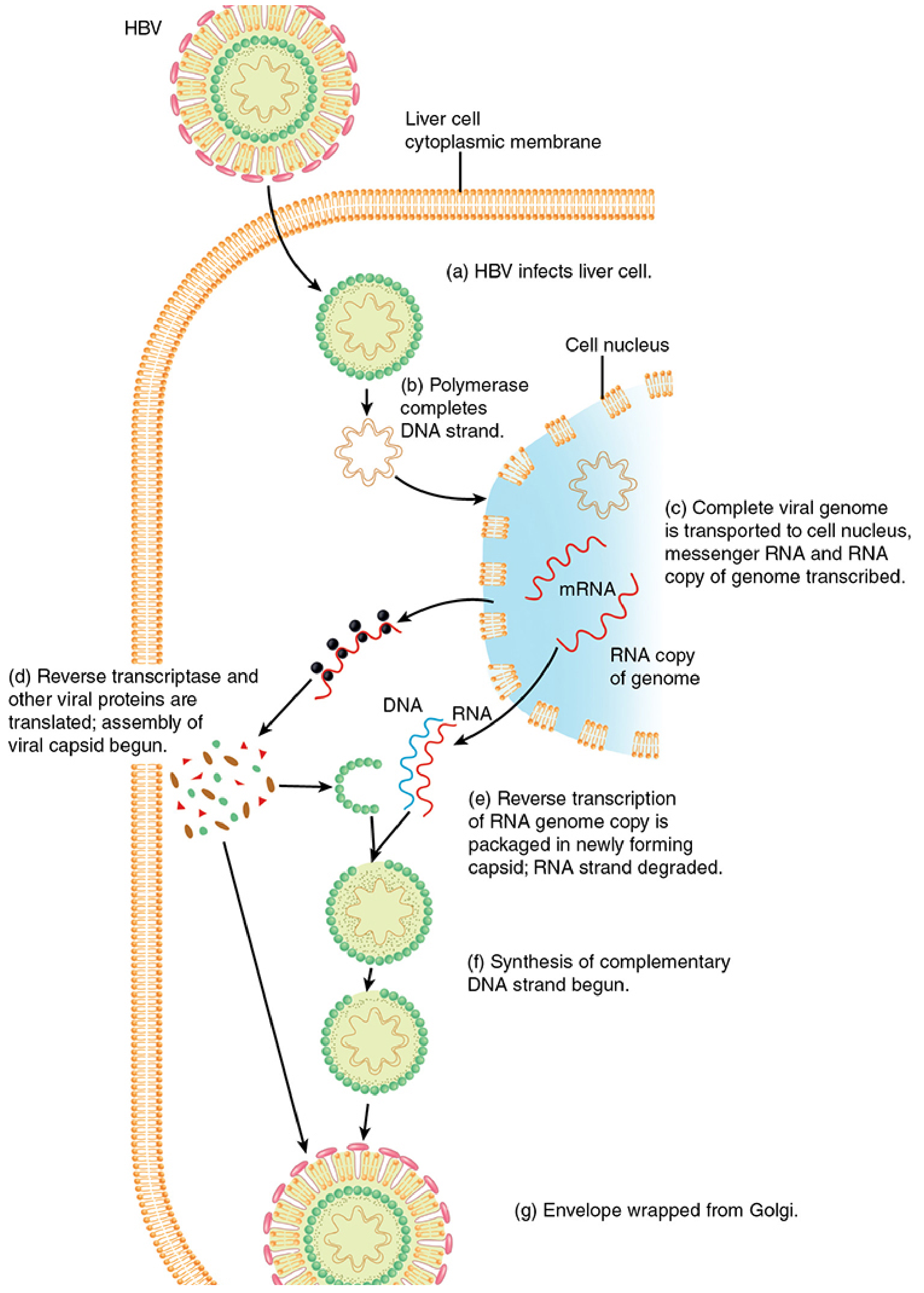
Step 1 - Entry and Repair
- HBV enters liver cells (hepatocytes) specifically
- The partially dsDNA genome is transported to the nucleus
- The incomplete (+) strand is repaired → forms cccDNA (covalently closed circular DNA)
Step 2 - Transcription (DNA → RNA)
- Host RNA polymerase transcribes the cccDNA into:
- mRNAs - for making viral proteins (HBsAg, HBcAg, HBeAg, DNA polymerase)
- Pregenomic RNA (pgRNA) - a full-length positive-sense RNA copy of the entire genome
Step 3 - Packaging
- The pgRNA + reverse transcriptase enzyme are packaged together inside the forming nucleocapsid core
Step 4 - Reverse Transcription (RNA → DNA) ← THE KEY STEP
- Inside the capsid, reverse transcriptase converts the pgRNA into (-) strand DNA
- The RNA template (pgRNA) is then degraded by the RNase H activity of the same reverse transcriptase enzyme
- The (+) strand DNA is then partially synthesized from the (-) strand DNA template
Step 5 - Maturation and Release
- The result is the characteristic partially dsDNA genome (one complete strand, one incomplete strand)
- Envelope (HBsAg) wraps around the nucleocapsid from the Golgi/ER
- Complete virion released by exocytosis
The Simplified Flow
NORMAL dsDNA virus (e.g., Herpes):
dsDNA → [transcription] → mRNA → proteins
dsDNA → [DNA polymerase] → new dsDNA copies

HBV (Group VII - dsDNA-RT):
Partial dsDNA → [repair] → cccDNA
cccDNA → [host RNA pol] → mRNA + pregenomic RNA (pgRNA)
pgRNA → [REVERSE TRANSCRIPTASE] → (-)DNA
(-)DNA → [DNA pol] → partial (+)DNA
= New partial dsDNA virion
Comparison: HBV vs HIV Reverse Transcription
| Feature | HIV (Group VI) | HBV (Group VII) |
|---|---|---|
| Genome in virion | (+)ssRNA | Partial dsDNA |
| RNA intermediate | Genome itself | Pregenomic RNA (made inside cell) |
| RT converts | RNA → DNA | pgRNA → DNA |
| Integration into host | Yes - always (provirus) | Sometimes (especially in liver cancer) |
| End product | dsDNA provirus | Partial dsDNA virion |
Why This Matters Clinically
-
cccDNA persistence: The cccDNA sits in the nucleus like a mini-chromosome. Even if you kill all the circulating virus, the cccDNA remains. This is why HBV cannot be fully cured with current antivirals - only suppressed.
-
Antiviral targets: Drugs like tenofovir and entecavir inhibit HBV's reverse transcriptase - the same class of drugs used against HIV.
-
Hepatocellular carcinoma: HBV DNA can integrate into host chromosomes (especially in HCC patients), disrupting tumor suppressor genes.
-
HBeAg: The pregenomic RNA also encodes HBeAg - when HBeAg is detectable, active reverse transcription (active replication) is occurring. High infectivity.
Bottom line: HBV uses reverse transcription not because it started as an RNA virus, but because its replication strategy evolved to use RNA as an intermediate for more efficient genome copying. The cccDNA → pgRNA → DNA route is its unique replication trick - and the source of its persistence and difficulty to cure.
Source: Sherris & Ryan's Medical Microbiology, 8th Ed., Chapter 13 - Hepatitis B Replication Cycle
does it form ss rna or ds rna
The pregenomic RNA of HBV is single-stranded RNA (ssRNA) - positive sense.
Searching sources...
Finding Sources
The RNA formed during HBV replication is ssRNA (single-stranded RNA), specifically positive-sense (+) ssRNA.
Here is exactly what happens at each stage:
RNA in HBV Replication - Always Single Stranded
What Gets Made: Pregenomic RNA (pgRNA)
- When cccDNA is transcribed by host RNA polymerase, it produces single-stranded mRNAs and single-stranded pregenomic RNA
- pgRNA is (+) ssRNA - it is a full-length, positive-sense single-stranded RNA copy of the entire genome
- It looks exactly like a regular mRNA - single strand, positive sense
- It serves two purposes simultaneously:
- Acts as mRNA - gets translated into viral proteins (core protein, reverse transcriptase)
- Acts as template for reverse transcription to make new DNA
Does dsRNA Ever Form?
- Technically, during reverse transcription inside the capsid, there is a brief moment where RNA and the new (-) DNA strand exist together as an RNA:DNA hybrid (not dsRNA - one strand is DNA, one is RNA)
- The RNA strand is then immediately degraded by RNase H activity of the reverse transcriptase
- So no stable dsRNA is formed at any point in HBV replication
Full Picture in One Flow
cccDNA (nucleus)
    ↓ [Host RNA polymerase]
(+) ssRNA  ←── This is the pregenomic RNA (pgRNA)
    ↓ [Packaged into capsid with RT]
    ↓ [Reverse transcriptase - RNA → DNA]
RNA:DNA hybrid  ←── Brief intermediate (NOT dsRNA)
    ↓ [RNase H degrades RNA strand]
(-) ssDNA
    ↓ [DNA polymerase activity of RT]
Partial dsDNA  ←── Final genome in virion
Summary
| RNA Type | Formed in HBV? | Purpose |
|---|---|---|
| (+) ssRNA (pgRNA) | Yes | Template for RT + mRNA for proteins |
| dsRNA | No | Never formed |
| RNA:DNA hybrid | Briefly, inside capsid | Intermediate - immediately degraded |
So the answer is: HBV forms (+) ssRNA (the pregenomic RNA) - single stranded, never double stranded. The dsRNA stage never occurs because the RNA strand is destroyed as soon as the DNA copy is made.
This also has an important implication: since HBV never makes dsRNA, it largely evades the innate immune system (which detects dsRNA as a danger signal - pattern recognition receptors like RIG-I and MDA5 look for dsRNA). This is one reason HBV can establish chronic, silent infection.
if +ssrna is formed then why needed to form dna agqin
This is a brilliant question - it gets to the heart of why HBV evolved this way.
The Short Answer
Because HBV is fundamentally a DNA virus. Its genome that gets packaged into new virions, transmitted to new cells, and maintained in the nucleus - is DNA. The RNA is just a temporary working copy used during replication inside one cell. It is never put into the new virion.
The Key Distinction: What Goes INTO the New Virion?
| Virus Type | What is packaged into the new virion? |
|---|---|
| Retrovirus (HIV - Group VI) | (+) ssRNA genome |
| HBV (Group VII) | Partial dsDNA genome |
HBV is defined as a DNA virus because the mature virion that leaves the cell and infects the next cell carries DNA - not RNA.
Why Not Just Package the RNA and Skip the DNA Step?
Think about what HBV needs to do when it infects the NEXT liver cell:
- Enter the cell
- Go to the nucleus
- Establish cccDNA - a stable, persistent DNA minichromosome that stays in the nucleus and keeps producing RNA long-term
- From that cccDNA, keep transcribing mRNA and pgRNA forever
If it packaged RNA instead:
- The RNA would enter the cell
- It could make proteins once
- But RNA is unstable - it degrades quickly, cannot form cccDNA, cannot persist in the nucleus
- Infection would be short-lived, non-persistent
- HBV would lose its ability to cause chronic infection
DNA is stable. cccDNA in the nucleus can persist for the lifetime of the hepatocyte - this is exactly why HBV causes chronic hepatitis that lasts decades.
The Analogy
Think of it like a master blueprint vs a working photocopy:
cccDNA = Master blueprint (stored safely in nucleus, never used up)
pgRNA  = Working photocopy (used on the factory floor to make parts)
New DNA = Fresh copy of the master blueprint (sent to infect next cell)
If you only sent photocopies to the next factory (RNA), they would degrade quickly. You need to send a proper blueprint (DNA) so the next cell can set up its own permanent master copy (cccDNA).
Full Logic of the Cycle
CELL 1:
cccDNA (stable, nucleus)
  ↓ transcription
(+)ssRNA / pgRNA
  ↓ reverse transcription
New partial dsDNA  ← packed into virion

VIRION travels to CELL 2:
Partial dsDNA enters nucleus
  ↓ repaired
New cccDNA (stable again, persists for life of cell)
  ↓ transcription
pgRNA again...  → cycle repeats
Contrast With HIV (Group VI)
| Feature | HIV | HBV |
|---|---|---|
| Virion genome | (+)ssRNA | Partial dsDNA |
| Why DNA needed? | Makes proviral DNA to integrate into host | Makes cccDNA to persist in nucleus |
| RNA intermediate purpose | Genome itself | Replication intermediate only |
| Chronicity mechanism | Proviral DNA integrated permanently | cccDNA in nucleus permanently |
Both use reverse transcription, but for different reasons - HIV to integrate and hide, HBV to recreate stable DNA for nuclear persistence.
Bottom line: The (+)ssRNA cannot be the final product for HBV because RNA is unstable and cannot form cccDNA. HBV must convert back to DNA so the next infected cell can establish a permanent nuclear reservoir - which is the biological basis of chronic hepatitis B infection.
laboratory test of viruses for mbbs exam
Laboratory diagnosis of viruses is a high-yield topic for MBBS. Tests fall into four broad categories: direct detection, serology, culture, and molecular methods.
Searching sources...
Finding Sources
Finding Sources
Finding Sources
Reading File
Reading File
Reading File
Here is a complete, exam-focused breakdown of viral laboratory tests for MBBS:
Laboratory Diagnosis of Viral Infections - MBBS Guide
There are 4 major categories of viral diagnostic tests:
Category 1 - Direct Detection of Virus
A. Electron Microscopy
- Visualizes the virus particle directly
- Used for: Rotavirus, Norovirus, Poxvirus
- Expensive, rarely used clinically now
- Exam point: Negative staining with potassium phosphotungstate
B. Light Microscopy - Inclusion Bodies
Viruses leave characteristic marks inside infected cells - called inclusion bodies (aggregates of viral particles/proteins):
| Inclusion Body | Location | Virus | Disease |
|---|---|---|---|
| Negri bodies | Cytoplasm of neurons | Rabies virus | Rabies |
| Cowdry type A | Nucleus | HSV, VZV, CMV | Herpes infections |
| Owl eye inclusions | Nucleus (large, surrounded by halo) | CMV | CMV disease |
| Guarnieri bodies | Cytoplasm | Poxvirus | Smallpox/Vaccinia |
| Torres bodies | Cytoplasm | Yellow fever virus | Yellow fever |
| Henderson-Patterson bodies | Cytoplasm | Molluscum contagiosum | Molluscum |
High-yield exam fact: Negri bodies in hippocampus (Ammon's horn) = pathognomonic of rabies
C. Antigen Detection Tests
Direct Fluorescent Antibody (DFA/Direct IF):
- Fluorescent-labelled antibodies directly applied to specimen
- Fast, same day result
- Used for: Rabies (skin biopsy/brain), RSV, influenza, HSV
Rapid Antigen Tests:
- Lateral flow immunoassay (like a pregnancy test strip)
- Used for: Influenza (rapid flu test), COVID-19, RSV, Rotavirus, Norovirus
- Advantage: Bedside/point-of-care, results in 15-30 minutes
- Disadvantage: Less sensitive than PCR - many false negatives
ELISA (Enzyme-Linked Immunosorbent Assay):
- Detects viral antigens in specimens
- Used for: HBsAg (Hepatitis B), HIV p24 antigen, Rotavirus in stool, Dengue NS1 antigen
- Most commonly used antigen test in clinical labs
Category 2 - Virus Isolation (Culture)
A. Cell Culture (Most Important)
- Inoculate patient specimen into live cell monolayers
- Virus infects the cells → produces Cytopathic Effect (CPE)
- CPE = visible changes in cells under light microscope
Types of CPE and their viruses:
| CPE Type | Virus |
|---|---|
| Syncytia (multinucleated giant cells) | RSV, Measles, HSV, Paramyxoviruses |
| Grape-like clusters (cell rounding) | Adenovirus |
| Cell rounding and detachment | Enteroviruses (Polio, Coxsackie) |
| Intranuclear inclusions | CMV, Herpesvirus |
| No visible CPE | Rubella (detected by viral interference) |
Types of cell cultures used:
- Primary cell cultures (monkey kidney - for enteroviruses, influenza)
- Diploid cell strains (MRC-5 human fibroblasts - for CMV, VZV, HSV)
- Continuous cell lines (HEp-2 cells - for RSV; Vero cells - for many viruses)
Disadvantages: Slow (days to weeks), expensive, requires BSL-2/3 lab
B. Shell Vial Culture (Centrifugation-Enhanced)
- Faster than standard culture - results in 18-24 hours (vs 2-4 weeks for CMV)
- Specimen centrifuged onto cell monolayer on coverslip
- Detected with fluorescent monoclonal antibodies
- Used mainly for: CMV, VZV
C. Embryonated Eggs
- Old method, rarely used now
- Influenza was classically grown in eggs (still used for vaccine production)
- Inoculated into: amniotic cavity, allantoic cavity, chorioallantoic membrane (CAM)
D. Animal Inoculation
- Suckling mice for arboviruses, coxsackievirus A
- Rarely used clinically now - mainly research
Category 3 - Serology (Antibody Detection)
Measures the patient's immune response to virus - looks for antibodies in blood.
Key principle:
- IgM = recent/acute infection (appears first, disappears in weeks)
- IgG = past infection or immunity (persists for years)
- Rising titer = 4-fold rise in antibody between acute and convalescent sera (collected 2-4 weeks apart) = confirms active infection
Major Serological Tests:
| Test | Principle | Used For |
|---|---|---|
| ELISA | Enzyme-labeled antibody detects patient Ab | HIV, HBV, HCV, EBV, CMV, Dengue |
| Western Blot | Patient Ab binds viral proteins separated by electrophoresis | HIV confirmation (older method) |
| Neutralization (Nt) test | Patient Ab neutralizes virus, prevents CPE in culture | Most sensitive, gold standard for serology |
| Complement Fixation (CF) | Antibody-antigen complex fixes complement | Many viruses - older test |
| Hemagglutination Inhibition (HI) | Patient Ab prevents virus from clumping RBCs | Influenza, Measles, Rubella |
| Indirect IF (IIF) | Patient Ab detected using fluorescent anti-human Ab | HSV, VZV, EBV, CMV |
| Heterophile antibody test (Monospot) | EBV Ab agglutinates sheep/horse RBCs | EBV (Infectious Mononucleosis) |
Important Serology Exam Points:
| Virus | Key Serological Marker | Meaning |
|---|---|---|
| HBV | HBsAg | Surface antigen - active infection |
| HBV | Anti-HBs | Immunity (vaccination or recovery) |
| HBV | HBeAg | Active replication, high infectivity |
| HBV | Anti-HBc IgM | Acute infection |
| HIV | Anti-HIV + p24 Ag (4th gen ELISA) | Screening test |
| HIV | HIV differentiation assay or NAAT | Confirmation |
| EBV | Heterophile antibodies (Monospot) | Infectious mononucleosis |
| Rubella | IgM antibody | Acute rubella |
| Dengue | NS1 antigen (early) + IgM/IgG | Dengue diagnosis |
Category 4 - Molecular Methods (Nucleic Acid Tests)
PCR (Polymerase Chain Reaction) - Gold Standard Now
- Detects viral DNA or RNA directly in specimen
- Most sensitive and specific test available
- Results in hours
- RT-PCR (Reverse Transcriptase PCR) - for RNA viruses (converts RNA → DNA first, then amplifies)
- Real-time PCR (qPCR) - quantifies viral load (copies/mL)
Uses:
- HIV viral load monitoring
- HBV DNA and HCV RNA quantification (treatment monitoring)
- CMV and EBV in immunocompromised patients
- HSV encephalitis (CSF PCR - gold standard)
- COVID-19 diagnosis (RT-PCR from nasopharyngeal swab)
- Rabies, Dengue, Zika
Other Molecular Methods:
- NASBA (Nucleic Acid Sequence Based Amplification) - for RNA viruses
- Branched DNA (bDNA) - HIV, HCV, HBV viral load
- In-situ hybridization - detects viral nucleic acid in tissue sections
- Next Generation Sequencing (NGS) - virus identification and genotyping
Quick Reference - Which Test for Which Virus
| Virus | First-line Test | Gold Standard / Confirmation |
|---|---|---|
| HIV | 4th/5th gen ELISA (Ag+Ab) | HIV NAAT / viral load |
| Hepatitis B | HBsAg ELISA | HBV DNA PCR |
| Hepatitis C | Anti-HCV ELISA | HCV RNA PCR |
| Herpes simplex | Clinical + PCR (CSF/swab) | Cell culture (skin lesions) |
| CMV | pp65 antigenemia / PCR | Shell vial culture |
| EBV | Monospot (heterophile Ab) | EBV-specific serology, PCR |
| Influenza | Rapid antigen test | RT-PCR |
| Rabies | DFA on brain/skin biopsy | Negri bodies on histology |
| Rotavirus | ELISA antigen in stool | EM |
| Dengue | NS1 antigen + IgM ELISA | RT-PCR |
| COVID-19 | RT-PCR nasopharyngeal swab | RT-PCR |
| Rubella | IgM serology | RT-PCR |
Most Exam-Tested Points Summary
- Negri bodies = Rabies (cytoplasmic, neurons)
- Owl eye inclusions = CMV
- Heterophile antibody / Monospot = EBV
- HBsAg = Hepatitis B active infection; Anti-HBs = immunity
- CPE = syncytia = RSV, measles; grape clusters = Adenovirus
- PCR is gold standard for most viral diagnoses now
- IgM = acute, IgG = past/immune
- 4-fold rise in titer between acute and convalescent = confirms infection
- Shell vial = faster CMV detection (18-24 hrs)
- RT-PCR = used for RNA viruses (influenza, HIV, HCV, COVID)
Source: Jawetz, Melnick & Adelberg's Medical Microbiology 28th Ed., Chapter 47 - Diagnostic Virology
This is a shared conversation. Sign in to Orris to start your own chat.