
Feedback system physiology mbbs 1st year
Reading File
Searching sources...
Finding Sources
Finding Sources
Good - I found relevant sources. Now let me read the core sections on feedback systems from the physiology textbooks:
Reading File
Finding Sources
Finding Sources
Reading File
Finding Sources
Finding Sources
Finding Sources
Finding Sources
Now I have the exact sections I need. Let me read the core Guyton content on feedback systems:
Reading File
Reading File
Reading File
I now have all the essential content. Let me also fetch the key diagram image:
Loading Image
I now have everything I need to write a thorough, exam-ready answer for MBBS 1st year. Here is the complete response:
Feedback System in Physiology - MBBS 1st Year
1. What is a Feedback System?
A feedback system (feedback control system) is a mechanism by which the body monitors a physiological variable, compares it to a desired level (set point), and makes corrections to keep that variable within its normal range. This is the fundamental basis of homeostasis.
"In 1929, Walter Cannon coined the term homeostasis to describe the maintenance of stable conditions in the internal environment. Homeostasis is a dynamic, rather than static, process that is continually adjusting the body's functions to maintain internal stability." - Guyton and Hall Textbook of Medical Physiology
2. Components of a Feedback Control System
Every feedback loop has four essential components:
| Component | Function | Example (BP control) |
|---|---|---|
| Sensor (Detector) | Detects the change in the controlled variable | Baroreceptors in carotid sinus & aortic arch |
| Control Centre (Integrating Centre / Set Point) | Compares input with the set point; generates an error signal | Vasomotor centre in medulla |
| Effector | Carries out the corrective response | Heart & blood vessels (via sympathetic NS) |
| Feedback signal | Sends result of the effector action back to the control centre | Nerve signals from baroreceptors back to medulla |
The set point is the normal desired value. The error signal is the difference between the actual value and the set point.
3. Types of Feedback Systems
A. Negative Feedback (Most Common)
Definition: The response of the effector opposes (is "negative to") the original stimulus, bringing the variable back toward the set point.
Mechanism:
- If the controlled variable rises above set point → effector action DECREASES it
- If the controlled variable falls below set point → effector action INCREASES it
- The end result counters the initial deviation
Classic example - Blood pressure regulation:
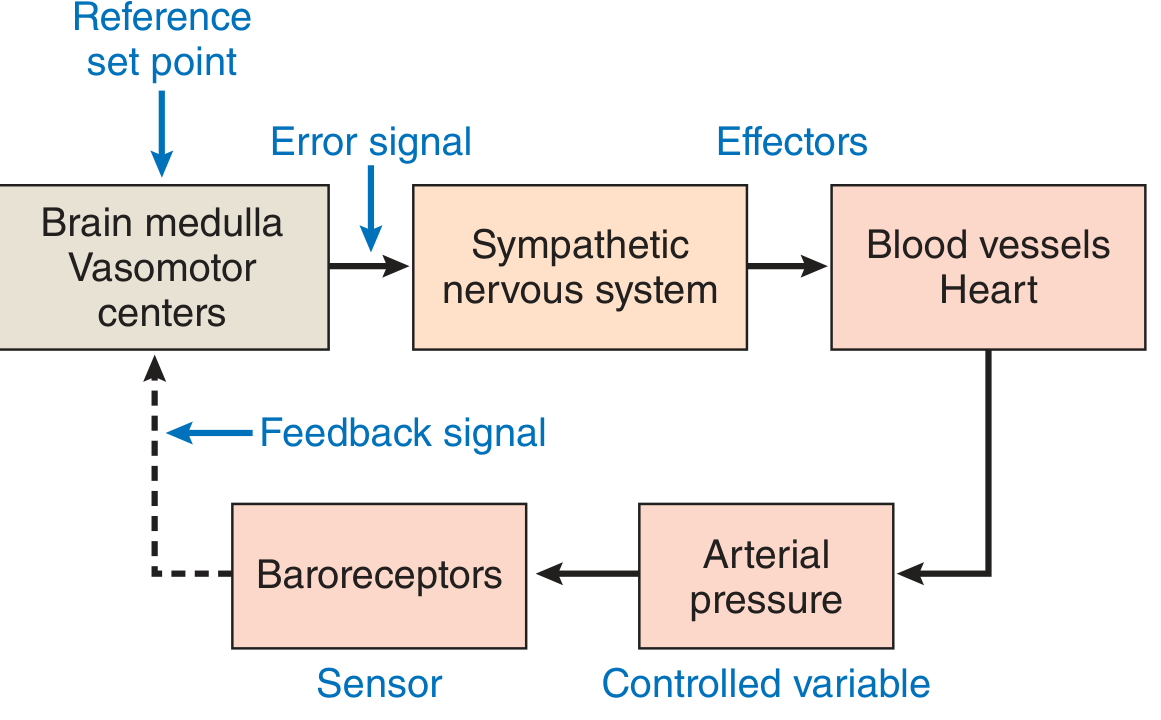
Sequence: Rise in BP → baroreceptors stretched → impulses to medulla → vasomotor centre inhibited → sympathetic activity decreases → vasodilation + reduced cardiac output → BP falls back to normal.
Other negative feedback examples:
- CO₂ regulation: high CO₂ → stimulates respiratory centre → increased ventilation → CO₂ falls
- Blood glucose: hyperglycemia → pancreas secretes insulin → glucose uptake increases → blood glucose falls
- Body temperature: rise in temperature → sweating + vasodilation → heat loss → temperature falls
- Thyroid hormone: high T₃/T₄ → inhibits TRH and TSH → less thyroid stimulation (classic HPA axis negative feedback)
B. Positive Feedback
Definition: The response of the effector amplifies (is "positive to") the original stimulus - the change keeps increasing rather than reversing.
Mechanism:
- Deviation from normal → effector action makes deviation even GREATER
- Creates a "vicious cycle" - can be dangerous or physiologically useful
Key principle from Guyton: "Positive feedback leads to a vicious cycle. However, the body sometimes uses this mechanism to its advantage - such as during childbirth or blood clotting."
Physiological examples of positive feedback:
| Example | Mechanism |
|---|---|
| Childbirth (parturition) | Fetal head stretches cervix → oxytocin released → stronger uterine contractions → more stretching → more oxytocin (cycle ends at delivery) |
| Blood clotting | Platelet aggregation → releases chemicals → attracts more platelets → more aggregation (cycle ends when clot is formed) |
| Action potential (depolarization phase) | Membrane depolarization → Na⁺ channels open → Na⁺ rushes in → more depolarization → more Na⁺ entry (cycle ends at +35 mV when channels inactivate) |
| LH surge before ovulation | Rising estrogen (at high levels) → stimulates LH release → LH peak causes ovulation |
| Childbirth/fever - pathological example | Severe blood loss → decreased cardiac output → decreased coronary blood flow → heart weakens further → more blood loss |
Difference: Physiological vs. Pathological positive feedback:
- Physiological: self-limiting (ends when the goal is achieved - e.g., delivery, clot formed)
- Pathological: not self-limiting - can lead to death (e.g., cardiogenic shock spiral)
4. Gain of a Control System
Gain measures how effectively the system corrects a disturbance. From Guyton:
Gain = (Correction achieved) / (Error remaining)
For the baroreceptor system, gain = about -7 (it corrects ~7/8 = 87.5% of a blood pressure change).
A higher gain = more effective correction but can cause oscillation (instability). A lower gain = more stable but allows larger errors to persist.
5. Adaptive Control
Some control systems can alter their own gain or set point based on past experience. For example:
- The cerebellum adjusts its control of movement with practice
- Immune tolerance is a form of adaptive control
6. Feedforward Control
A less-emphasized but important concept: feedforward (anticipatory) control acts before a disturbance occurs, rather than after.
Example: When you start exercising, heart rate increases BEFORE oxygen levels actually drop (anticipatory response via the motor cortex activating the cardiovascular system).
7. Important Physiological Values Regulated by Feedback (Table from Guyton)
| Parameter | Normal Value | Normal Range |
|---|---|---|
| Arterial pH | 7.4 | 7.3 - 7.5 |
| Plasma Na⁺ | 142 mmol/L | 135 - 145 |
| Plasma K⁺ | 4.2 mmol/L | 3.5 - 5.3 |
| Blood glucose | 90 mg/dL | 70 - 115 |
| Body temperature | 37.0°C | ~37°C |
| Venous CO₂ | 45 mm Hg | 41 - 51 |
8. Comparison: Negative vs. Positive Feedback
| Feature | Negative Feedback | Positive Feedback |
|---|---|---|
| Direction of response | Opposes the change | Amplifies the change |
| Effect on stability | Stabilizing | Destabilizing (usually) |
| Frequency | Very common | Rare |
| Purpose | Maintain homeostasis | Rapid completion of a process |
| End result | Variable returns to set point | Variable keeps changing until an event stops it |
| Examples | BP, temperature, blood glucose, CO₂ | Parturition, clotting, action potential upstroke, LH surge |
9. Clinical Relevance
- Hypertension: baroreceptor set point "resets" to a higher level over time - a failure of normal resetting
- Diabetes mellitus: glucose-insulin negative feedback is broken
- Addison's disease: loss of cortisol → no negative feedback on ACTH → very high ACTH levels
- Cushing's disease: pituitary tumor secretes ACTH regardless of cortisol (negative feedback ignored)
- DIC (Disseminated Intravascular Coagulation): pathological positive feedback of clotting run out of control
Sources:
- Guyton and Hall Textbook of Medical Physiology, Chapter 1 - Functional Organization of the Human Body
- Medical Physiology (Boron & Boulpaep) - Chapter 1: Homeostasis and Feedback
- Ganong's Review of Medical Physiology, 26th Ed. - Functional Morphology and Homeostasis
Feed forward mechanism physiology mbbs 1st year
Finding Sources
Finding Sources
Good finds. Now let me read the key sections - especially from Principles of Neural Science (motor control feedforward) and the biochemistry text, plus search Guyton for anticipatory control:
Reading File
Finding Sources
Reading File
Reading File
Reading File
Finding Sources
Reading File
Finding Sources
Excellent - found a key passage in Medical Physiology (Boron) about feed-forward and exercise. Let me read that:
Reading File
Loading Image
I now have all the content needed for a thorough, exam-oriented MBBS 1st year answer. Here it is:
Feed-Forward (Anticipatory) Mechanism in Physiology - MBBS 1st Year
1. Definition
A feed-forward mechanism (also called open-loop control or anticipatory control) is a control system in which a corrective response is initiated before any error or disturbance actually occurs in the controlled variable. The system acts based on a predicted or anticipated disturbance, not in response to a detected change.
"Instead of merely responding through feedback loops, the ANS also anticipates the future needs of the individual... This anticipation of future activity, or feed-forward stimulation prior to (and during) exercise, is a key component of the regulation of homeostasis during stress because it prevents large changes in physiological parameters that could be detrimental to optimal function."
- Medical Physiology (Boron & Boulpaep)
2. Feed-Forward vs. Feedback - Core Distinction
| Feature | Feedback Control | Feed-Forward Control |
|---|---|---|
| Also called | Closed-loop control | Open-loop control / Anticipatory control |
| When does it act? | AFTER an error is detected | BEFORE any error occurs |
| Trigger | Deviation from set point | Anticipated or predicted disturbance |
| Error monitoring | Continuous (uses a sensor + comparator) | None during the action |
| Speed | Slower (limited by sensory delay) | Faster (anticipates the need) |
| Accuracy | Self-correcting (adjusts for errors) | Cannot self-correct once initiated |
| Role | Maintains homeostasis reactively | Prevents disturbance proactively |
| Example | Baroreceptor control of BP | Heart rate rise before a 100-m dash |
3. Diagram: Feed-Forward vs. Feedback Control
A. Feed-Forward (Open-Loop): Desired state → Feedforward controller → Motor command → Actuator (muscle) → Action. No sensory loop back.
B. Feedback (Closed-Loop): Desired state → Comparator (generates error) → Controller → Actuator → Action → Sensor → back to Comparator.
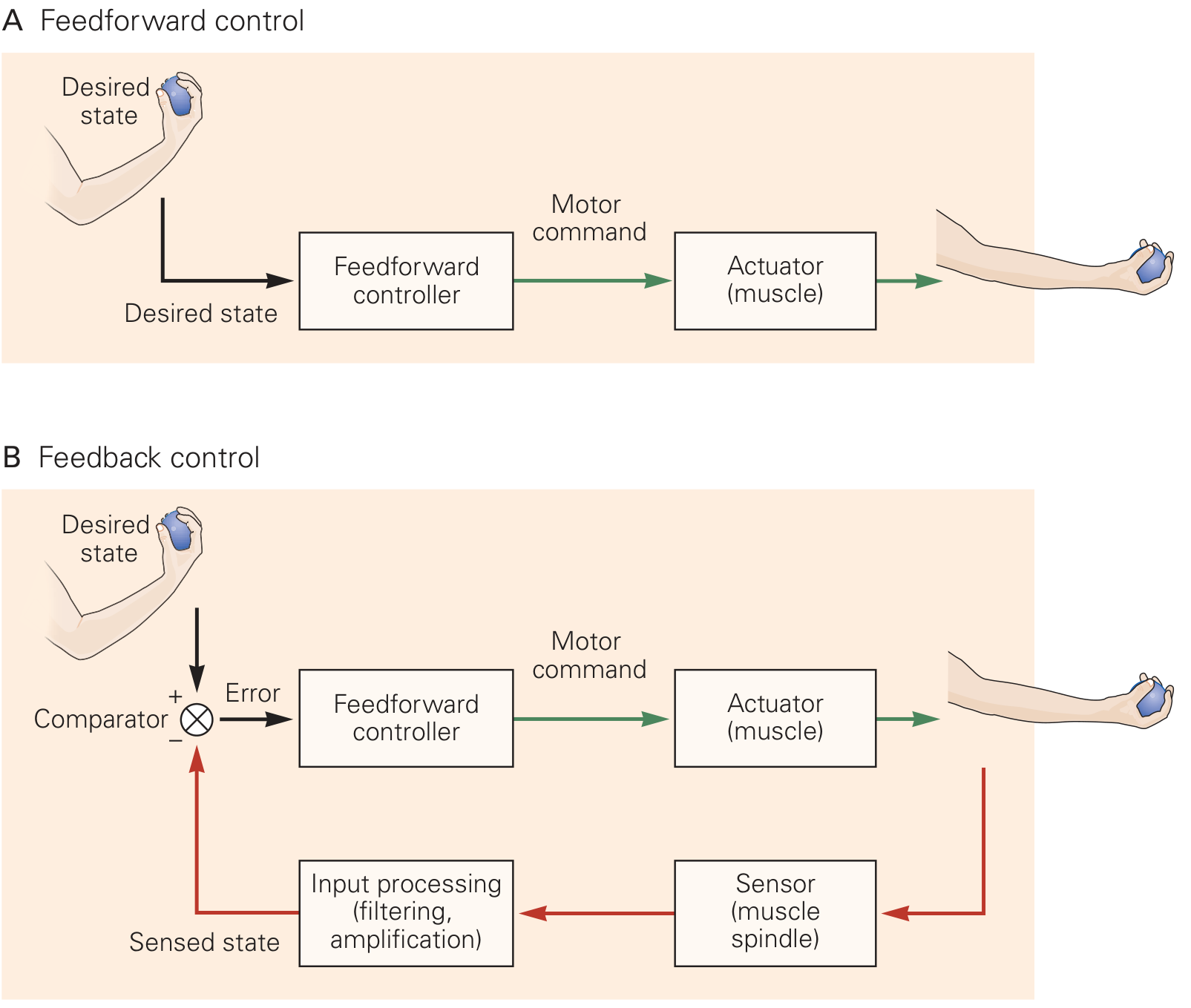
4. Why is Feed-Forward Needed? (The Problem of Delay)
Sensory feedback loops have inherent time delays:
- Visual input: ~60 ms to reach visual cortex
- Sensorimotor loop (stimulus to motor response): ~120-150 ms
- A saccadic eye movement is completed in 30 ms - far too fast for sensory feedback to play any role
"This delay means that movements like saccades, which redirect gaze within 30 ms, cannot use sensory feedback to guide movement. Even for slower movements like reaching (~500 ms), sensory information cannot be used to guide the initial part of a movement, so open-loop control must be used."
- Principles of Neural Science (Kandel), 6th Ed.
So for rapid, ballistic movements, the nervous system must preprogram the entire command using feed-forward - it cannot wait for feedback.
5. Physiological Examples of Feed-Forward Mechanism
A. Exercise - Cardiovascular and Respiratory Anticipation
- Before exercise begins, the motor cortex sends collateral signals (corollary discharge) to cardiovascular and respiratory centres in the brainstem
- Heart rate and ventilation increase before metabolic demand rises
- Classic proof: At the onset of exercise, blood CO₂ levels actually fall (not rise), because ventilation increased preemptively
- A trained athlete's heart rate begins to rise several seconds before the starting gun fires for a 100-m sprint
"Because of this anticipatory response, alveolar ventilation rises to such an extent that blood levels of CO₂ actually drop at the onset of exercise. This is the opposite of what would be expected if the ANS worked purely through feedback loops."
- Medical Physiology (Boron & Boulpaep)
B. Motor Control - Rapid Voluntary Movements
- When reaching for an object, the initial part of the arm movement is driven by a pre-programmed feed-forward motor command
- The brain uses an inverse model (internal model) to calculate the exact motor command needed before movement begins
- Only the later, corrective phase uses sensory feedback
C. Vestibulo-Ocular Reflex (VOR)
- When the head rotates, the vestibular labyrinth senses the rotation and drives eye movements to maintain gaze stability
- This is feedforward: the eye moves based on head rotation signal, without waiting for visual feedback to confirm whether gaze is stable
- Works even in complete darkness (no visual feedback available)
D. Postural Anticipatory Adjustments
- When you raise your arms forward while standing, the first muscle to activate is an ankle flexor (tibialis anterior)
- This prevents you from falling forward - the postural correction fires before the arm movement even begins
- The motor cortex sends anticipatory signals to spinal motor neurons controlling posture
E. Salivation Before Eating (Cephalic Phase)
- Sight, smell, or even thought of food triggers salivary secretion, gastric acid, and insulin release
- This happens before food enters the mouth or stomach
- The vagus nerve carries these feed-forward signals (conditioned/learned anticipatory response)
- Cephalic phase insulin release: insulin is released in anticipation of glucose load, preventing large post-meal spikes
F. Feed-Forward Regulation in Biochemistry
- Substrate concentration-driven activation: when substrate supply to an enzyme with a high Km increases, pathway flux increases preemptively
- Example: ethanol induces cytochrome P450-2E1 via feed-forward gene induction - the enzyme is upregulated in anticipation of continued substrate (ethanol) availability
- Insulin response to meal: cephalic phase insulin rise before significant blood glucose elevation
6. Neural Basis - Internal Models
Feed-forward control in motor systems relies on internal models stored in the cerebellum and motor cortex:
| Model Type | Function | Analogy |
|---|---|---|
| Forward model | Predicts the sensory consequences of a motor command | "If I do X, what will happen?" |
| Inverse model | Calculates the motor command needed to achieve a desired state | "What do I do to achieve X?" |
The cerebellum is critical for storing and updating these internal models through motor learning.
7. Advantages and Disadvantages
Advantages
- Speed - no delay waiting for sensory feedback; essential for ballistic movements
- Prevention - prevents large deviations from homeostasis before they occur
- Efficiency - reduces the metabolic "debt" that would occur if the body waited for feedback
- Smoothness - produces smooth, coordinated movements
Disadvantages
- Cannot self-correct - if the initial command is wrong, errors cannot be corrected mid-course
- Requires prior learning/knowledge - the system must have an accurate internal model or prior experience
- Inflexible - does not adapt to unexpected disturbances during execution
8. Combined Feed-Forward + Feedback (Reality)
In practice, the body uses both mechanisms together:
- Feed-forward initiates the action based on anticipated needs (fast, but imprecise)
- Feedback then monitors and fine-tunes the response as it proceeds (slower, but corrective)
Example - Reaching for a glass of water:
- Feed-forward: Motor cortex programs arm trajectory and activates trunk muscles for postural stability before arm moves
- Feedback: As hand approaches the glass, sensory feedback from eyes and muscle spindles corrects the path in real time
9. Clinical Relevance
| Condition | Feed-Forward Disruption |
|---|---|
| Cerebellar ataxia | Loss of internal models → dysmetria (overshooting/undershooting), intention tremor |
| Parkinson's disease | Impaired anticipatory postural adjustments → frequent falls |
| Diabetic autonomic neuropathy | Impaired cephalic phase insulin release → poor post-prandial glucose control |
| PTSD / anxiety disorders | Exaggerated feed-forward cardiovascular response (heart rate rise to perceived - not actual - threat) |
10. Summary Box (Exam Quick Revision)
Feed-Forward = ANTICIPATORY = OPEN-LOOP

Acts BEFORE error occurs
↓
Based on PREDICTED disturbance
↓
No sensory monitoring during action
↓
Fast but cannot self-correct
↓
Examples:
- Heart rate ↑ before exercise starts
- Ventilation ↑ before CO₂ rises
- Ankle muscle fires before arm raises
- VOR (eye movement to head rotation)
- Cephalic phase insulin/saliva
- Rapid saccadic eye movements
Sources:
- Medical Physiology (Boron & Boulpaep) - Chapter 14: Autonomic Nervous System
- Principles of Neural Science (Kandel, 6th Ed.) - Chapter 30: Principles of Sensorimotor Control
- Basic Medical Biochemistry: A Clinical Approach, 6e - Chapter 9: Feed-Forward Regulation
This is a shared conversation. Sign in to Orris to start your own chat.