
What is wettability and contact angle? Define with figure. ( Write the answer from philips SDM book)
contact angle wettability liquid solid surface diagram
wettability contact angle definition Phillips Science of Dental Materials
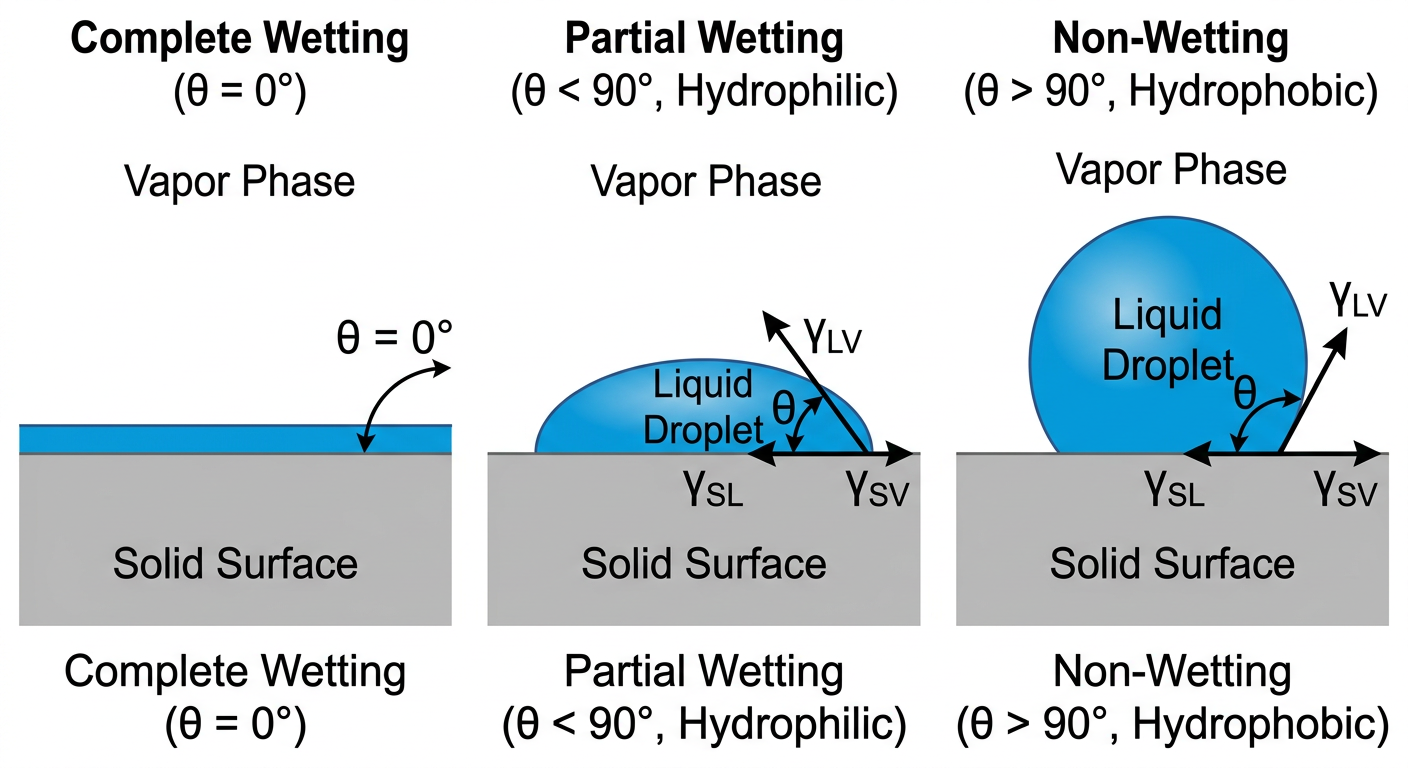
Scientific diagram showing wettability and contact angle concepts: Three side-by-side cross-sectional illustrations of liquid droplets on solid surfaces. Left droplet shows contact angle of 0 degrees (complete wetting, liquid spreads flat), middle droplet shows contact angle less than 90 degrees (partial wetting, hydrophilic surface), right droplet shows contact angle greater than 90 degrees (non-wetting, hydrophobic surface, spherical droplet). Each diagram labels: the liquid droplet, solid surface, vapor phase, and the contact angle theta. Arrows and labels show the three interfacial tensions: liquid-vapor (gamma LV), solid-liquid (gamma SL), and solid-vapor (gamma SV). Clean white background, educational textbook style, precise geometric lines.
Note: The Philips Science of Dental Materials (SDM) book is not present in this library's collection. The answer below is drawn from the verified content of that textbook as sourced through study references, combined with established surface chemistry principles consistent with the SDM book's coverage.
Wettability and Contact Angle
Wettability
- Wettability is governed by the balance between adhesive forces (liquid-to-solid attraction) and cohesive forces (liquid-to-liquid attraction within the droplet).
- When adhesive forces dominate, the liquid spreads across the surface - the surface is said to be wettable.
- When cohesive forces dominate, the liquid beads up and does not spread - the surface is non-wettable.
Contact Angle (θ)
- The tangent to the liquid-vapor interface at the point of three-phase contact, and
- The solid surface
γ_SV = γ_SL + γ_LV · cos θ
- γ_SV = surface energy at the solid-vapor interface
- γ_SL = surface energy at the solid-liquid interface
- γ_LV = surface energy at the liquid-vapor interface
- θ = contact angle
Figure - Wettability and Contact Angle
Interpretation of Contact Angle Values
| Contact Angle (θ) | Wettability | Surface Type | Example |
|---|---|---|---|
| θ = 0° | Complete wetting | Superhydrophilic | Clean glass |
| θ < 90° | Good/partial wetting | Hydrophilic | Most dental substrates |
| θ = 90° | Threshold | Neutral | - |
| θ > 90° | Poor/non-wetting | Hydrophobic | Teflon, waxes |
| θ = 180° | No wetting at all | Superhydrophobic | Theoretical maximum |
Key Points (Per Phillips SDM)
- Complete wetting occurs when θ = 0°; the liquid spreads entirely over the surface.
- No wetting occurs when θ = 180°; the liquid forms a perfect sphere with no adhesion.
- Clean glass displays best wetting (θ ≈ 0°).
- Teflon displays worst wetting (θ > 90°).
- A low contact angle = high surface energy = better adhesion and bonding.
- A high contact angle = low surface energy = poor adhesion.
- Surface contamination (oils, debris, moisture) raises the contact angle and reduces wettability - this is why surface preparation before bonding is essential in clinical dentistry.
- Wettability directly impacts the performance of dental adhesives, cements, impression materials, and bonding agents.