
Explain to me 10 common heart diseases with ecg changes and ecg images of those diseases
Reading File
Finding Sources
Finding Sources
Finding Sources
Finding Sources
Finding Sources
Finding Sources
Reading File
Reading File
Reading File
Finding Sources
Reading File
Finding Sources
Reading File
Finding Sources
Reading File
Finding Sources
Reading File
Reading File
Reading File
Reading File
Now I have enough information to compile a comprehensive answer. Let me also gather the ECG images for the remaining conditions (WPW, pulmonary embolism, pericarditis, ventricular tachycardia).
Reading File
Reading File
Now let me fetch the key ECG images I've found in the textbooks:
Loading Image
Loading Image
Loading Image
Loading Image
Loading Image
Loading Image
Loading Image
Loading Image
Loading Image
Here is a comprehensive overview of 10 common heart diseases with their ECG changes and textbook ECG images.
10 Common Heart Diseases: ECG Changes and Images
1. ST-Elevation Myocardial Infarction (STEMI)
Pathophysiology: Complete occlusion of a coronary artery causes transmural ischemia. Three electrical events occur simultaneously: rapid repolarization, decreased resting membrane potential (K+ loss), and delayed depolarization in infarcted cells - all producing current flow directed outward that elevates the ST segment in leads overlying the infarct.
ECG Changes:
- Hyperacute T waves - earliest sign (tall, peaked T waves)
- ST-segment elevation in leads overlying the infarct (the hallmark)
- Reciprocal ST depression in opposite leads
- Pathological Q waves develop hours to days later (necrosis)
- T-wave inversions in evolving phase
- R-wave loss ("failure of R-wave progression")
Localization:
- Anterior STEMI: ST elevation in V1-V6, I, aVL; reciprocal changes in II, III, aVF
- Inferior STEMI: ST elevation in II, III, aVF; reciprocal depression in I, aVL
- Posterior STEMI: Reciprocal ST depression in V1-V3 (with tall R waves)
ECG - Anterior STEMI (Acute and Evolving):
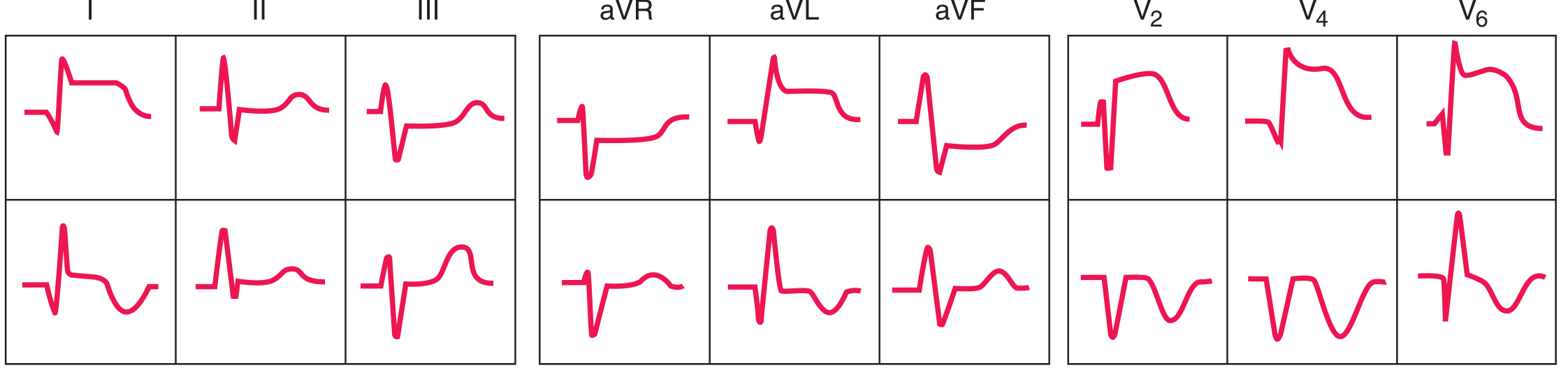
Acute (top row) and evolving (bottom row) anterior wall STEMI. Note ST elevation across precordial leads with developing Q waves. - Harrison's Principles of Internal Medicine, Fig. 247-13
ECG - Inferior STEMI (Acute and Evolving):
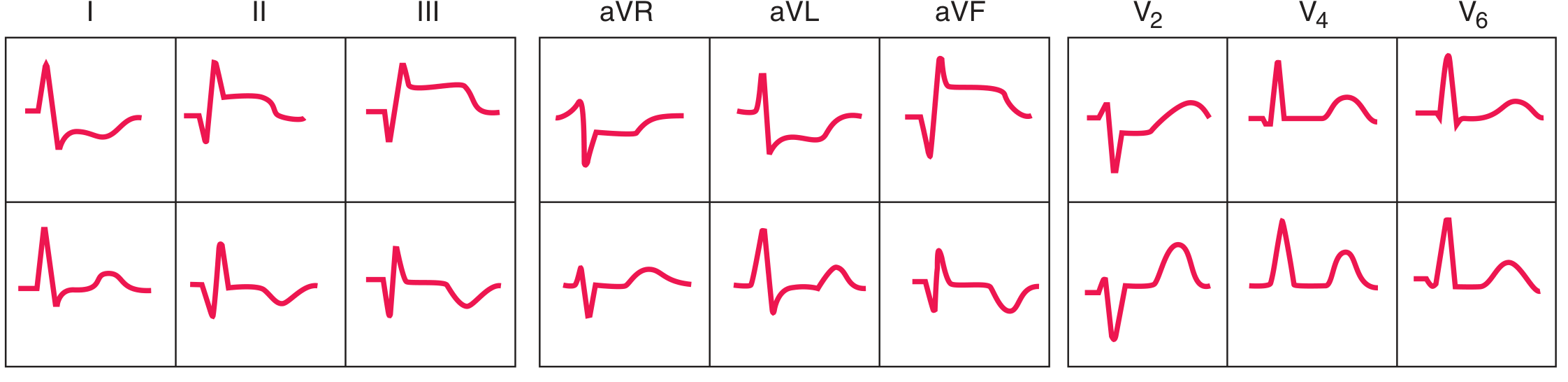
Acute (top row) and evolving (bottom row) inferior STEMI. ST elevation in II, III, aVF with reciprocal changes. - Harrison's Principles of Internal Medicine, Fig. 247-13
2. NSTEMI / Unstable Angina (Subendocardial Ischemia)
Pathophysiology: Partial occlusion or severe subendocardial ischemia. The ischemic ST vector shifts inward (toward the subendocardium and cavity), causing depression rather than elevation in overlying leads.
ECG Changes:
- ST-segment depression in precordial or limb leads (often V4-V6)
- ST elevation in aVR (reciprocal to widespread subendocardial ischemia)
- T-wave inversions - may be deep (Wellens' pattern in LAD disease)
- No pathological Q waves (by definition in NSTEMI)
- Wellens T-wave sign: Deep symmetric T-wave inversions in V1-V4 = critical LAD stenosis
ECG - Wellens Pattern / Severe Anterior Ischemia:
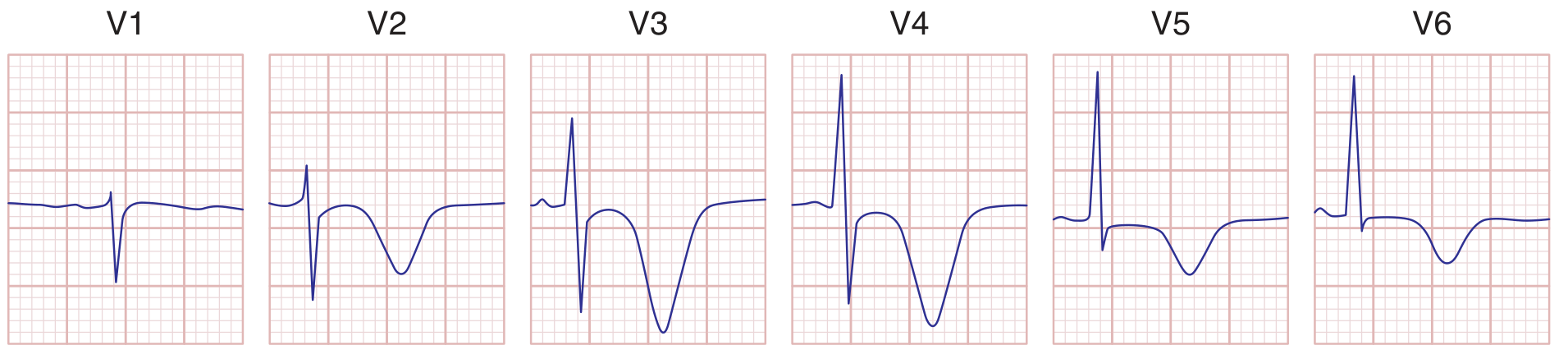
Deep T-wave inversions in V1-V4 (Wellens sign), typically indicating high-grade LAD stenosis. - Harrison's Principles of Internal Medicine, Fig. 247-12
3. Atrial Fibrillation (AF)
Pathophysiology: Multiple small re-entrant circuits in atrial myocardium fire chaotically at rates >600 beats/min. The AV node acts as a filter, resulting in an irregular ventricular response.
ECG Changes:
- Absent P waves - replaced by chaotic fibrillatory (f) waves or flat baseline
- Irregularly irregular RR intervals (the pathognomonic feature)
- Narrow QRS complexes (unless pre-existing bundle branch block)
- Ventricular rate typically 120-170 bpm when AV node is unaffected
- No organized atrial activity visible
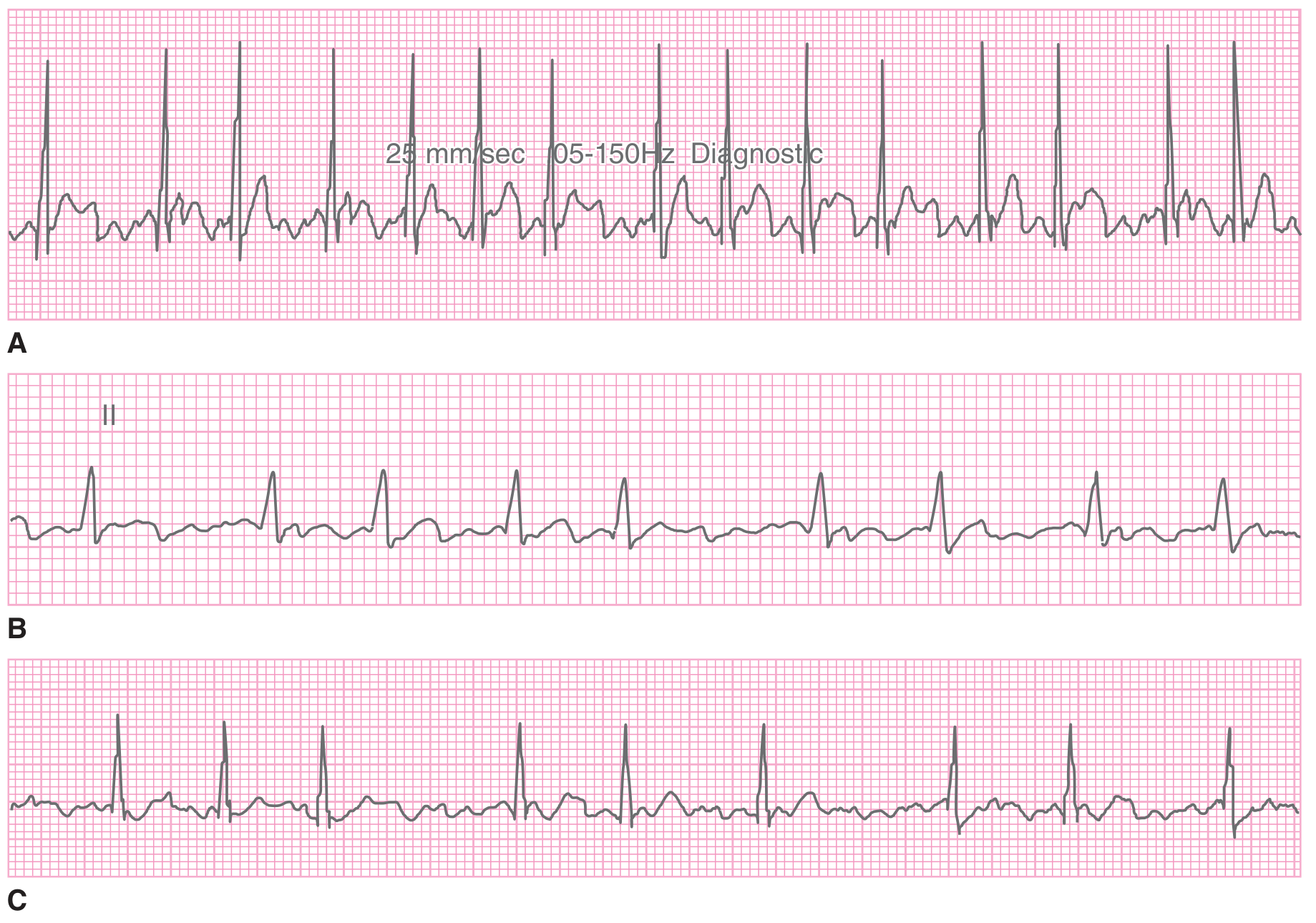
Three examples of atrial fibrillation (A, B, C) demonstrating the irregularly irregular ventricular rhythm and absent P waves. - Tintinalli's Emergency Medicine, Fig. 18-10
4. Ventricular Fibrillation (VF)
Pathophysiology: Completely disorganized depolarization and chaotic contraction of small areas of ventricular myocardium. No effective cardiac output. Most commonly occurs with severe ischemic heart disease.
ECG Changes:
- No discernible P waves
- No organized QRS complexes
- Chaotic, irregular waveforms of varying amplitude
- May be fine (low amplitude), intermediate, or coarse (mimics VT)
- Pattern is non-repetitive and cannot be assigned a rate
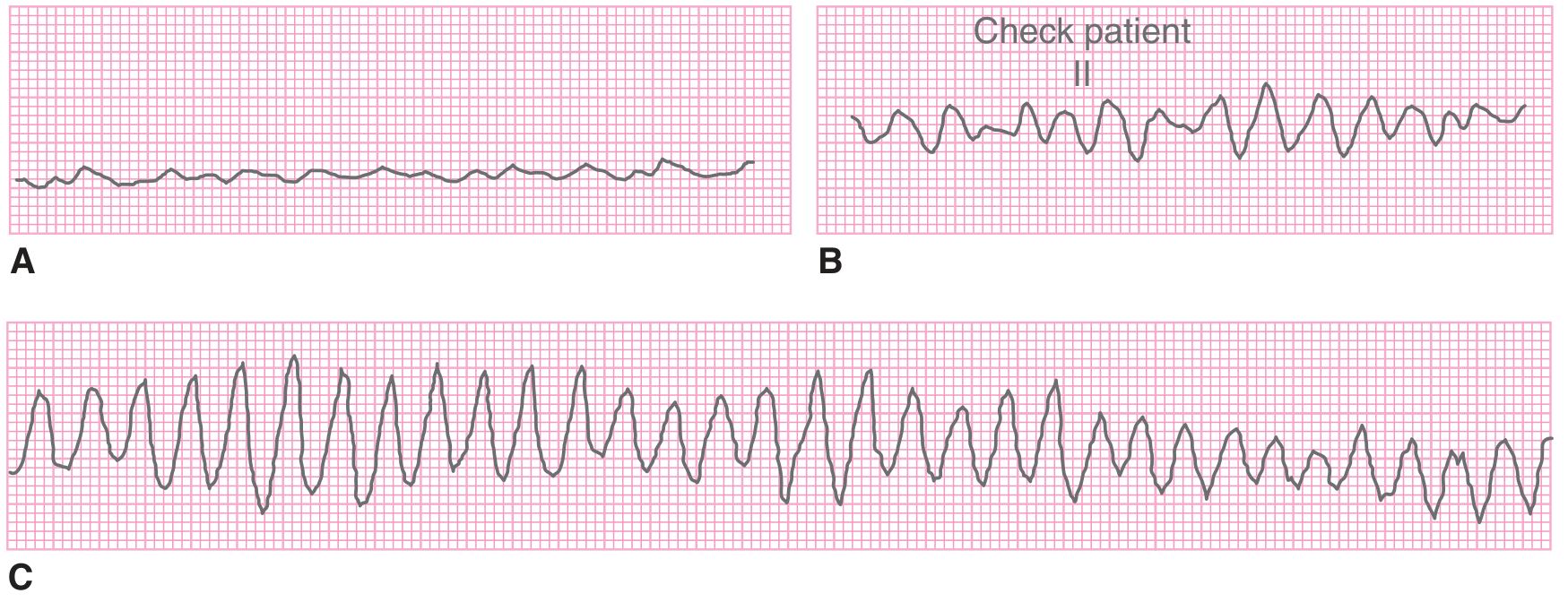
Three forms of VF: A. Fine amplitude, B. Coarse amplitude, C. Coarse amplitude mimicking ventricular tachycardia. - Tintinalli's Emergency Medicine, Fig. 18-23
5. Left Ventricular Hypertrophy (LVH)
Pathophysiology: Hypertrophy from chronic pressure overload (hypertension, aortic stenosis) increases the mass of depolarizing tissue and shifts the QRS vector leftward and posteriorly, producing tall left precordial voltages.
ECG Changes (voltage criteria):
- Tall R waves in left precordial leads (V5-V6): SV1 + RV5 or RV6 >35 mm (Sokolow-Lyon)
- Deep S waves in right precordial leads (V1-V2)
- RaVL >20 mm (women) or >28 mm (men)
- "Strain" pattern: ST depression with T-wave inversions in I, aVL, V5-V6
- Left axis deviation common
- May progress to left bundle branch block
Right Ventricular Hypertrophy (RVH) ECG Changes:
- Tall R waves in V1 (dominant R in V1)
- Deep S waves in V5-V6
- Right axis deviation
- T-wave inversions in right precordial leads (V1-V3)
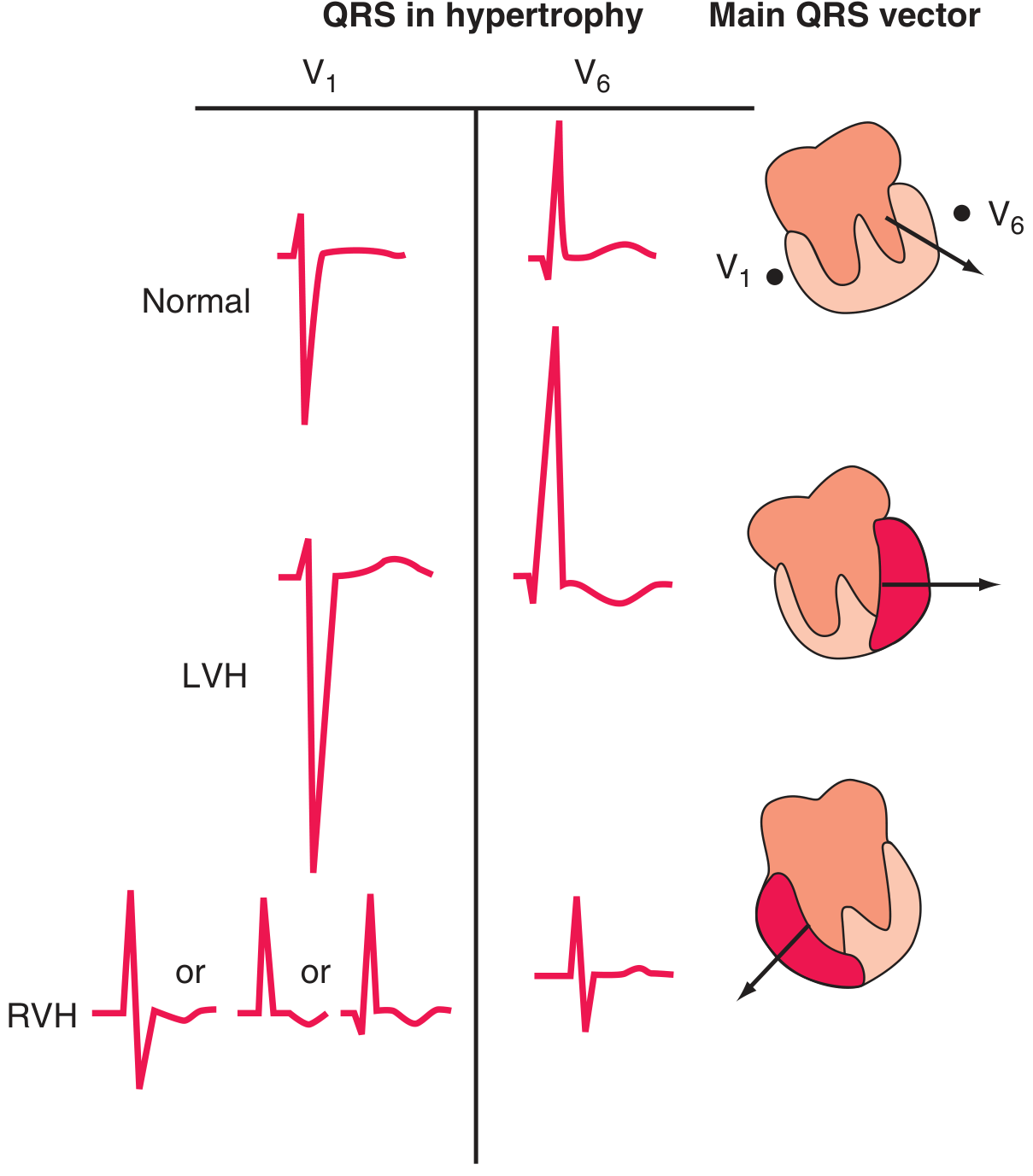
Comparison of normal, LVH, and RVH patterns in V1 and V6. LVH shows deep S in V1 and tall R in V6 with ST-T strain. RVH shows tall R in V1 and deep S in V6. - Harrison's Principles of Internal Medicine, Fig. 247-9
6. Atrioventricular (AV) Heart Block
Pathophysiology: Fibrosis/sclerosis of the conduction system (most common in elderly), ischemia, medications, or infiltrative disease slows or blocks conduction from atria to ventricles.
ECG Changes by degree:
First-Degree AV Block:
- Fixed PR interval >200 ms (>5 small squares)
- All P waves conduct; no dropped beats
Second-Degree AV Block - Mobitz I (Wenckebach):
- Progressive PR prolongation with each beat until a P wave is not conducted (dropped QRS)
- Grouped beating pattern
- RR intervals shorten before the dropped beat
- Located within the AV node; generally benign
Second-Degree AV Block - Mobitz II:
- Fixed PR interval before a suddenly non-conducted P wave (no warning)
- QRS is often wide (infranodal block)
- High risk of progression to complete block; requires pacing
Third-Degree (Complete) AV Block:
- Complete AV dissociation: P waves and QRS complexes march independently
- Ventricular rate slower than atrial rate
- Wide QRS escape rhythm if block is infranodal; narrow QRS if nodal
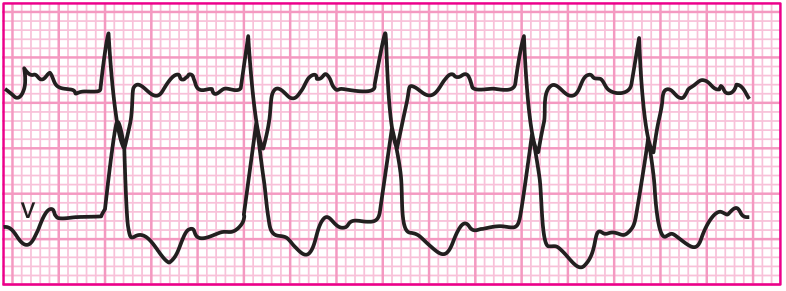
Second-degree Mobitz II AV block: fixed PR interval before a non-conducted P wave. - Harrison's Principles of Internal Medicine, Fig. 252-1

Complete AV block (third-degree): P waves and QRS complexes are completely dissociated. Note the independent atrial and ventricular rates. - Harrison's Principles of Internal Medicine, Fig. 252-1
7. Bundle Branch Block (RBBB and LBBB)
Pathophysiology: Interruption of conduction in the right or left bundle branch forces activation to spread slowly through ventricular muscle rather than the fast His-Purkinje system, widening the QRS. LBBB is a marker of serious underlying heart disease (CAD, hypertensive heart disease, cardiomyopathy). RBBB can be seen in normal individuals.
Right Bundle Branch Block (RBBB) ECG:
- QRS ≥120 ms (wide complex)
- rSR' ("M-shaped") pattern in V1 - terminal R' deflection (the hallmark)
- Wide, slurred S wave in V6 (and leads I, aVL)
- T-wave inversion in V1-V2 (secondary, discordant)
- QRS axis usually normal
Left Bundle Branch Block (LBBB) ECG:
- QRS ≥120 ms
- Broad, notched ("M-shaped") R wave in V5-V6 (entirely positive)
- Wide QS (deeply negative) complex in V1 - no R wave
- No septal q waves in lateral leads (reversed septal activation)
- T-wave inversion in V5-V6 (discordant to QRS)
- Left axis deviation
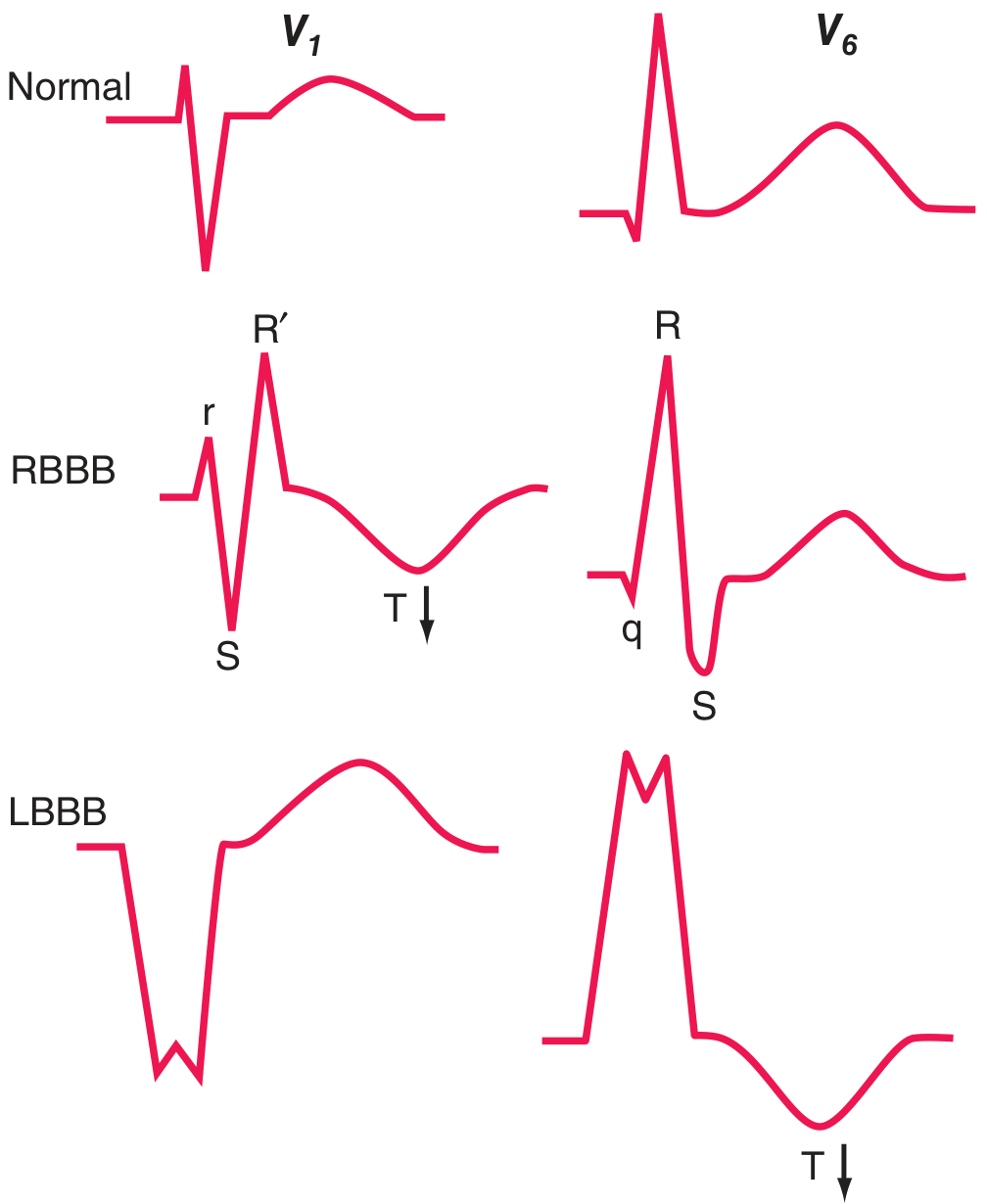
Normal (top), RBBB (middle), and LBBB (bottom) patterns in V1 and V6. RBBB shows the classic rSR' in V1; LBBB shows a broad R in V6 and QS in V1 with discordant T waves. - Harrison's Principles of Internal Medicine, Fig. 247-10
8. Wolff-Parkinson-White Syndrome (WPW)
Pathophysiology: An accessory pathway (Bundle of Kent) bypasses the AV node, creating a direct atrial-ventricular connection. Ventricular pre-excitation via this pathway (slower than the His-Purkinje system) produces the delta wave. The bypass tract creates a substrate for re-entrant tachycardias.
ECG Changes (classic triad during sinus rhythm):
- Short PR interval (<120 ms) - impulse bypasses the AV node
- Delta wave - slurring/notching of the initial QRS upstroke (slow accessory pathway activation)
- Slightly widened QRS - fusion of accessory pathway + AV node activation
- Discordant ST-T changes opposite to the delta wave direction
- Can mimic Q waves of infarction (pseudo-infarct pattern)
During tachycardia:
- Orthodromic AVRT: Narrow QRS, rate 160-220 bpm, no delta wave
- Antidromic AVRT: Wide QRS (can mimic VT), rate 160-220 bpm
- AF with WPW: Irregularly irregular, very wide bizarre QRS, rates often >200 bpm (dangerous)
(ECG image from textbook databases was not available in high resolution for this entry; the pattern is well-characterised by the short PR, delta wave, and widened QRS.)
9. Acute Pericarditis
Pathophysiology: Inflammation of the pericardium causes a diffuse "current of injury" originating from the epicardium, producing widespread (not regional) ST changes across multiple leads.
ECG Changes (4 stages):
- Stage 1 (acute): Diffuse concave (saddle-shaped) ST elevation in most leads except aVR and V1 (where there is ST depression); PR segment depression (most specific finding)
- Stage 2: ST returns to baseline; T waves flatten
- Stage 3: Diffuse T-wave inversions
- Stage 4: ECG normalizes
Key differentiators from STEMI:
- Changes are diffuse (not localized to a coronary territory)
- ST shape is concave up (saddle), not convex (dome-shaped as in STEMI)
- PR segment depression is highly specific for pericarditis
- No reciprocal ST changes between limb leads
- No Q waves
(Pericarditis produces a distinctive diffuse, saddle-shaped ST elevation pattern - as described in Harrison's Principles of Internal Medicine.)
10. Pulmonary Embolism (Acute Cor Pulmonale)
Pathophysiology: A large PE causes acute right ventricular pressure overload and dilation. This shifts the QRS axis rightward and produces right ventricular strain patterns on the ECG.
ECG Changes:
- Sinus tachycardia - the most common finding
- S1Q3T3 pattern: Prominent S wave in lead I, Q wave in lead III, T-wave inversion in lead III
- New right bundle branch block (complete or incomplete) - due to acute RV dilation
- T-wave inversions in V1-V4 (right ventricular strain)
- Right axis deviation
- P pulmonale: Peaked P waves in II (right atrial strain)
- Atrial fibrillation or flutter may occur
- Normal ECG is also common and does not exclude PE
(These changes are non-specific but arise together in the right clinical context. As noted in Harrison's, sinus tachycardia is the most common arrhythmia, with the S1Q3T3 pattern and new RBBB being more specific markers of acute right heart strain from PE.)
Quick Reference Summary Table
| Disease | Key ECG Feature(s) |
|---|---|
| STEMI | ST elevation in territory + Q waves + reciprocal depression |
| NSTEMI / Unstable Angina | ST depression, T-wave inversions, Wellens sign |
| Atrial Fibrillation | Absent P waves, irregularly irregular RR intervals |
| Ventricular Fibrillation | Chaotic undulations, no QRS, no P waves |
| LVH | Tall R waves (V5-V6), deep S (V1), strain pattern |
| AV Heart Block | PR prolongation (1°), grouped beating (Wenckebach), P-QRS dissociation (3°) |
| Bundle Branch Block | Wide QRS: rSR' in V1 (RBBB), broad R in V6 + QS in V1 (LBBB) |
| WPW Syndrome | Short PR + delta wave + wide QRS (sinus rhythm) |
| Acute Pericarditis | Diffuse concave ST elevation + PR depression |
| Pulmonary Embolism | Sinus tachycardia, S1Q3T3, new RBBB, RV strain T inversions |
*Sources: Harrison's Principles of Internal Medicine 22E (2025); Tintinalli's Emergency Medicine; Ganong's Review of Medical Physiology; Braunwald's Heart Disease - A Textbook of Cardiovascular Medicine.*Here is what was covered across all 10 conditions, with textbook ECG images where available:
Key takeaways by condition:
-
STEMI - ST elevation in the territory of the blocked artery, with reciprocal depression. Q waves follow necrosis. Anterior and inferior patterns are shown with their evolving sequences.
-
NSTEMI/Unstable Angina - ST depression and T-wave inversions without Q waves. The Wellens sign (deep V1-V4 T inversions) signals critical LAD disease.
-
Atrial Fibrillation - The only rhythm with a completely absent P wave AND an irregularly irregular QRS. Three real ECG examples are shown from Tintinalli's.
-
Ventricular Fibrillation - No QRS, no P waves, just chaotic waveforms. Fine, coarse, and VT-mimicking patterns are shown.
-
LVH/RVH - Voltage-based diagnosis. Tall lateral R waves + "strain" ST changes for LVH; dominant R in V1 + right axis for RVH. The comparison diagram from Harrison's is shown.
-
AV Heart Block - Three degrees, each progressively worse. Mobitz II and complete heart block ECGs are shown from Harrison's - both require urgent attention.
-
Bundle Branch Block - RBBB = rSR' in V1; LBBB = broad R in V6 + QS in V1. The side-by-side comparison diagram from Harrison's is included.
-
WPW - Short PR + delta wave + widened QRS during sinus rhythm. Dangerous when combined with AF (rates >200 bpm).
-
Acute Pericarditis - Diffuse saddle-shaped ST elevation + PR depression. Distinguished from STEMI by the distribution (all leads, not one artery territory) and concave shape.
-
Pulmonary Embolism - Sinus tachycardia is most common; S1Q3T3 and new RBBB are more specific but less sensitive markers of acute RV strain.
This is a shared conversation. Sign in to Orris to start your own chat.