
Normal bp readings according to body weight
Blood pressure classification is not based on body weight in standard clinical guidelines. Normal BP is defined by fixed numeric thresholds (e.g., less than 120/80 mmHg for adults) regardless of weight. However, body weight does influence BP - obesity raises BP risk, and in children, normal BP ranges are based on age, height, and sex (not weight directly).
Searching sources...
Reading File
Searching the Web
normal blood pressure readings by body weight adults children 2024
Finding Sources
Reading Web Page
https://pmc.ncbi.nlm.nih.gov/articles/PMC4553889
Finding Sources
Finding Sources
Reading File
Reading File
Reading File
Reading File
Finding Sources
Reading File
Now I have all the information needed for a thorough answer. Here is a complete, well-sourced response:
Blood Pressure and Body Weight: What the Evidence Shows
The Key Point
Standard BP classifications are NOT based on body weight. Normal blood pressure in adults and older adolescents is defined by fixed numeric thresholds, regardless of a person's weight. Body weight is a risk factor that influences BP, not a variable used to define what is "normal."
Adult BP Classification (ACC/AHA 2017 Guidelines)
These apply to all adults regardless of weight or BMI:
| Category | Systolic (mmHg) | Diastolic (mmHg) | |
|---|---|---|---|
| Normal | < 120 | and | < 80 |
| Elevated | 120-129 | and | < 80 |
| Stage 1 Hypertension | 130-139 | or | 80-89 |
| Stage 2 Hypertension | ≥ 140 | or | ≥ 90 |
- Harrison's Principles of Internal Medicine 22E, Table 288-1
The European classification (ESH/ESC) adds more granularity:
| Category | Systolic (mmHg) | Diastolic (mmHg) | |
|---|---|---|---|
| Optimal | < 120 | and | < 80 |
| Normal | 120-129 | and/or | 80-84 |
| High-Normal | 130-139 | and/or | 85-89 |
| Grade 1 HTN | 140-159 | and/or | 90-99 |
| Grade 2 HTN | 160-179 | and/or | 100-109 |
| Grade 3 HTN | ≥ 180 | and/or | > 110 |
| Isolated systolic HTN | ≥ 140 | and | < 90 |
- Park's Textbook of Preventive and Social Medicine
The ONE Exception: Neonates (Newborns)
For newborns, normal BP actually DOES vary by birth weight:
| Birth Weight | Normal BP Range |
|---|---|
| 1-2 kg (premature/low birth weight) | ~50/25 mmHg |
| > 3 kg (full-term) | ~70/40 mmHg |
- Morgan & Mikhail's Clinical Anesthesiology, 7e
This is because in neonates, BP closely correlates with intravascular volume and physiological maturity - both of which are reflected by birth weight.
Children & Adolescents: BP Based on Age, Height, and Sex (Not Weight)
In children aged 1-13 years, BP norms are based on age, sex, and height percentile - not weight:
- Normal: BP < 90th percentile for age/sex/height
- Elevated: 90th-95th percentile (or ≥ 120/80 in adolescents)
- Stage 1 HTN: 95th-99th percentile + 12 mmHg
- Stage 2 HTN: > 99th percentile + 12 mmHg
For adolescents > 13 years, adult thresholds apply (< 120/80 = normal).
- Campbell-Walsh Urology, citing AAP 2017 guidelines
Note: The AAP's updated normative tables deliberately exclude obese children to provide clean reference data, then flag obesity separately as a risk factor.
How Body Weight DOES Affect Blood Pressure
Even though weight doesn't define "normal," it strongly influences measured BP:
-
Obesity raises BP: Each ~10 lb (4.5 kg) of excess weight raises systolic BP measurably; losing that weight reduces it
-
Childhood obesity: Rising childhood obesity rates have driven hypertension prevalence in children from ~2.7% (1990s) to ~3.7% (2000s)
-
Low birth weight: Adults born with low birth weight have higher rates of hypertension due to reduced nephron mass and upregulated renin-angiotensin system
-
Cuff size matters: Using an incorrect cuff size relative to arm circumference (which correlates with body size) gives falsely high or low readings - always match cuff bladder width to at least 40% of mid-arm circumference
-
Brenner & Rector's The Kidney; Campbell-Walsh Urology
Bottom Line
Body weight is not a determinant of what BP reading is "normal" - the thresholds above apply universally. However, weight affects your actual BP reading and your cardiovascular risk. The only context where weight directly defines normal BP norms is in newborns (birth weight-based ranges), and in children, height (not weight) is used to look up normative percentile tables.
Bp cuff size measurements
BP cuff size selection is based on arm circumference. The bladder width should be ~40% of mid-arm circumference, and the bladder length should encircle at least 80% of the arm. Using the wrong size gives false readings - too small a cuff reads falsely high, too large reads falsely low.
Searching sources...
Finding Sources
Searching the Web
blood pressure cuff size chart arm circumference measurements guidelines 2024
Reading File
Reading File
Reading File
Loading Image
Reading File
Here is a comprehensive guide on BP cuff sizing:
Blood Pressure Cuff Size Measurements
The Two Key Rules (AHA Guidelines)
The correct cuff size is determined by arm circumference, using two criteria:
- Bladder WIDTH = at least 40% of the arm's midpoint circumference (some validation studies suggest up to 50%)
- Bladder LENGTH = at least 80% of the arm circumference (or roughly twice the width)
The cuff bladder must also extend at least halfway around the extremity.
- Roberts & Hedges' Clinical Procedures in Emergency Medicine; Morgan & Mikhail's Clinical Anesthesiology 7e
Standard Cuff Size Chart (AMA/AHA)
Measure mid-upper arm circumference (halfway between shoulder and elbow):
| Cuff Size | Arm Circumference | Weight Guide (approx.) |
|---|---|---|
| Small Adult | 22-26 cm (8.7-10.2 in) | Thin adults, older children |
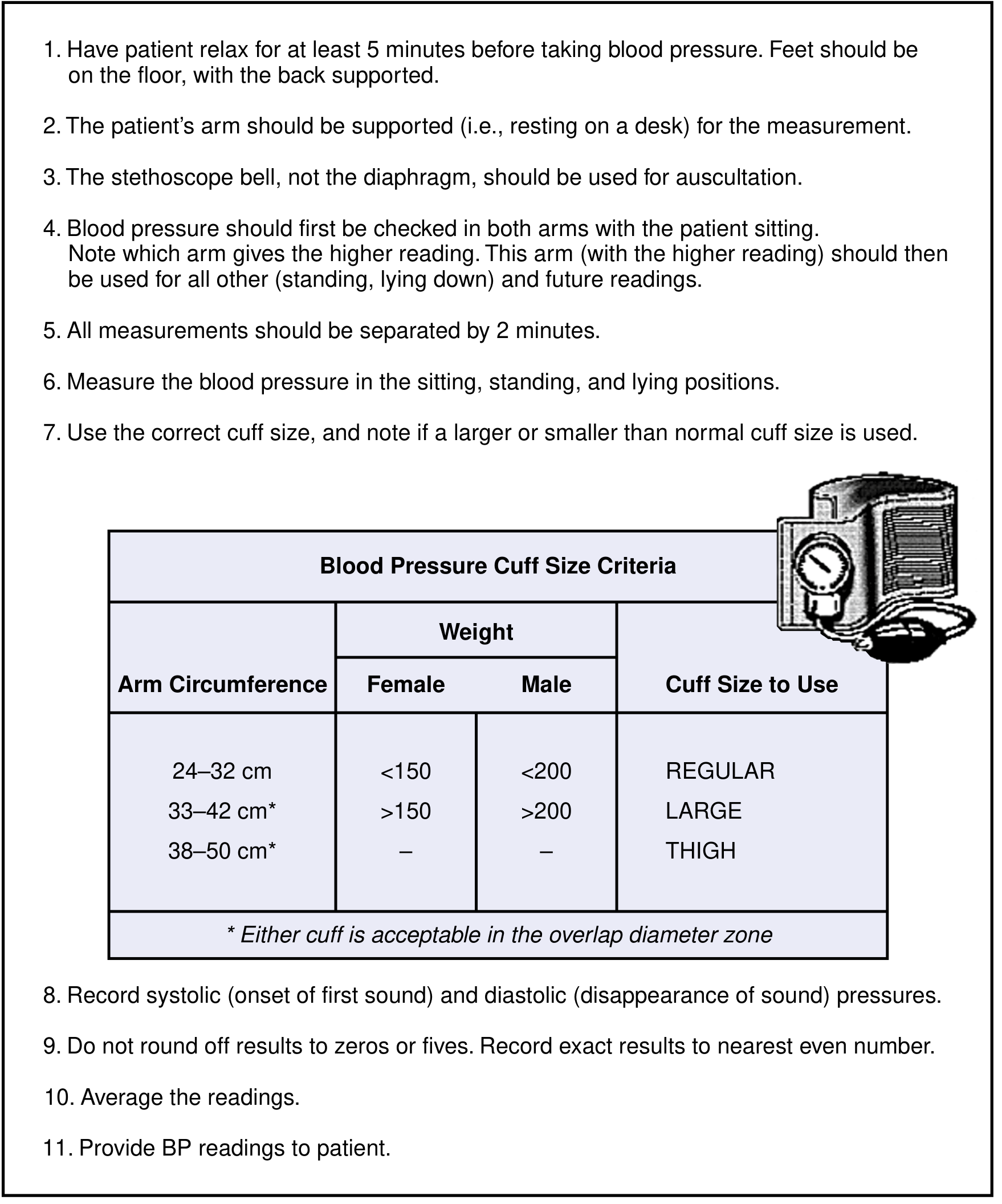
| Regular Adult | 24-32 cm (9.5-12.6 in) | Female < 150 lbs / Male < 200 lbs |
| Large Adult | 33-44 cm (13-17.3 in) | Female > 150 lbs / Male > 200 lbs |
| Extra-Large Adult | 45-52 cm (17.7-20.5 in) | Very large/obese arms |
| Thigh Cuff | 38-50 cm (15-20 in) | Morbidly obese arms, thigh use |
In overlap zones (e.g., 33-42 cm), either the large or thigh cuff is acceptable.
- National Kidney Foundation Primer on Kidney Diseases 8e, Fig. 64.1 (below)
How to Measure Arm Circumference
- Position arm relaxed, slightly bent at elbow
- Find the midpoint between the acromion (shoulder tip) and the lateral epicondyle (elbow)
- Wrap a tape measure around the mid-upper arm
- Match the measurement to the chart above
Errors from Wrong Cuff Size
| Wrong Cuff | Effect on Reading |
|---|---|
| Too small/narrow | Falsely HIGH BP (overestimates by avg. 8.5 mmHg systolic, 4.6 mmHg diastolic) |
| Too large/wide | Falsely LOW BP (less error than too-small, but still significant) |
Real-world impact: Using a regular cuff on a large arm can overestimate systolic BP by 4.8-19.5 mmHg, causing misdiagnosis of hypertension. About 41% of adults require non-standard cuffs.
- Roberts & Hedges' Clinical Procedures in Emergency Medicine
Pediatric Cuff Sizing
For children, the same proportional rules apply:
-
Bladder width = at least 40% of mid-arm circumference
-
Bladder length = covers at least two-thirds of the upper arm
-
Use oscillometric devices for infants/young children (auscultation is difficult)
-
Normative BP data for children is based on auscultatory, not oscillometric standards
-
Campbell-Walsh Urology 3-Volume Set
Neonatal BP Cuff Note
In neonates, BP reading accuracy depends on using the correct-sized cuff relative to the small limb, and normal BP itself varies by birth weight (50/25 mmHg for 1-2 kg; 70/40 mmHg for >3 kg).
Practical Tips for Accurate Readings
- Always measure arm circumference - do not guess by visual appearance
- Use the arm with the higher reading consistently for follow-up
- If only one cuff is available and it is the wrong size, document it in the chart
- Wrist cuffs are not recommended for clinical use (less accurate); finger devices should not be used clinically
- About 80% of patients do not fit the standard 12-cm large cuff, and over 17 million U.S. adults cannot get accurate home readings because of cuff sizing mismatches (AHA, 2024)
This is a shared conversation. Sign in to Orris to start your own chat.