
Phimosis ward teaching
Reading File
Reading File
Finding Sources
Searching PubMed
"phimosis"[MeSH Terms]
Reading File
Reading File
Reading File
Reading Article
PMID: 38269441
Searching Images
phimosis foreskin non-retractile pathologic phimosis balanitis xerotica obliterans
Reading File
Finding Sources
Searching the Web
phimosis boys management guideline topical steroid circumcision indications EAU BAUS
Phimosis: ward teaching
1. Definition
Phimosis means the foreskin cannot be retracted over the glans (Smith and Tanagho's General Urology, 19e, p. 665-666).
Two types matter most:
| Physiological (primary) | Pathological (true) | |
|---|---|---|
| Age | Infants and young boys | Any age, including adults |
| Cause | Natural adhesions between glans and inner preputial skin, plus a narrow preputial ring | Scarring from balanoposthitis, forceful retraction, balanitis xerotica obliterans (BXO) or lichen sclerosus (LS), and diabetes |
| Treatment | None needed | Treat if symptomatic |
2. Natural history (the point students most often miss)
- At birth, the foreskin is non-retractile in essentially all boys. Smegma accumulation and intermittent erections gradually separate the prepuce from the glans. About 90% of uncircumcised boys have a fully retractile prepuce by age 3, and fewer than 1% still have phimosis by age 17 (Campbell-Walsh-Wein Urology, ch. 44, p. 1116).
- Bailey and Love says adhesions start to disappear around age 2 and may persist to age 6 or later. This gives a false impression of phimosis (Bailey and Love's, 28e, ch. 85).
- Children younger than 2 years seldom have true phimosis (Smith and Tanagho's).
- Forceful retraction causes tears and then scarring, which produces secondary phimosis. Tell parents and staff not to do it (Campbell-Walsh-Wein Urology).
3. Causes of pathological phimosis
- Children: BXO, which is genital lichen sclerosus; recurrent balanoposthitis; forceful retraction.
- Adults: chronic balanoposthitis (often in diabetics, and sometimes the first presentation of diabetes), LS, poor hygiene, and excess skin left after circumcision that becomes stenotic (Smith and Tanagho's).
- In LS the foreskin becomes thickened and whitish. It forms a constricting band that prevents retraction, makes cleaning difficult and leads to recurrent balanitis (Bailey and Love's).
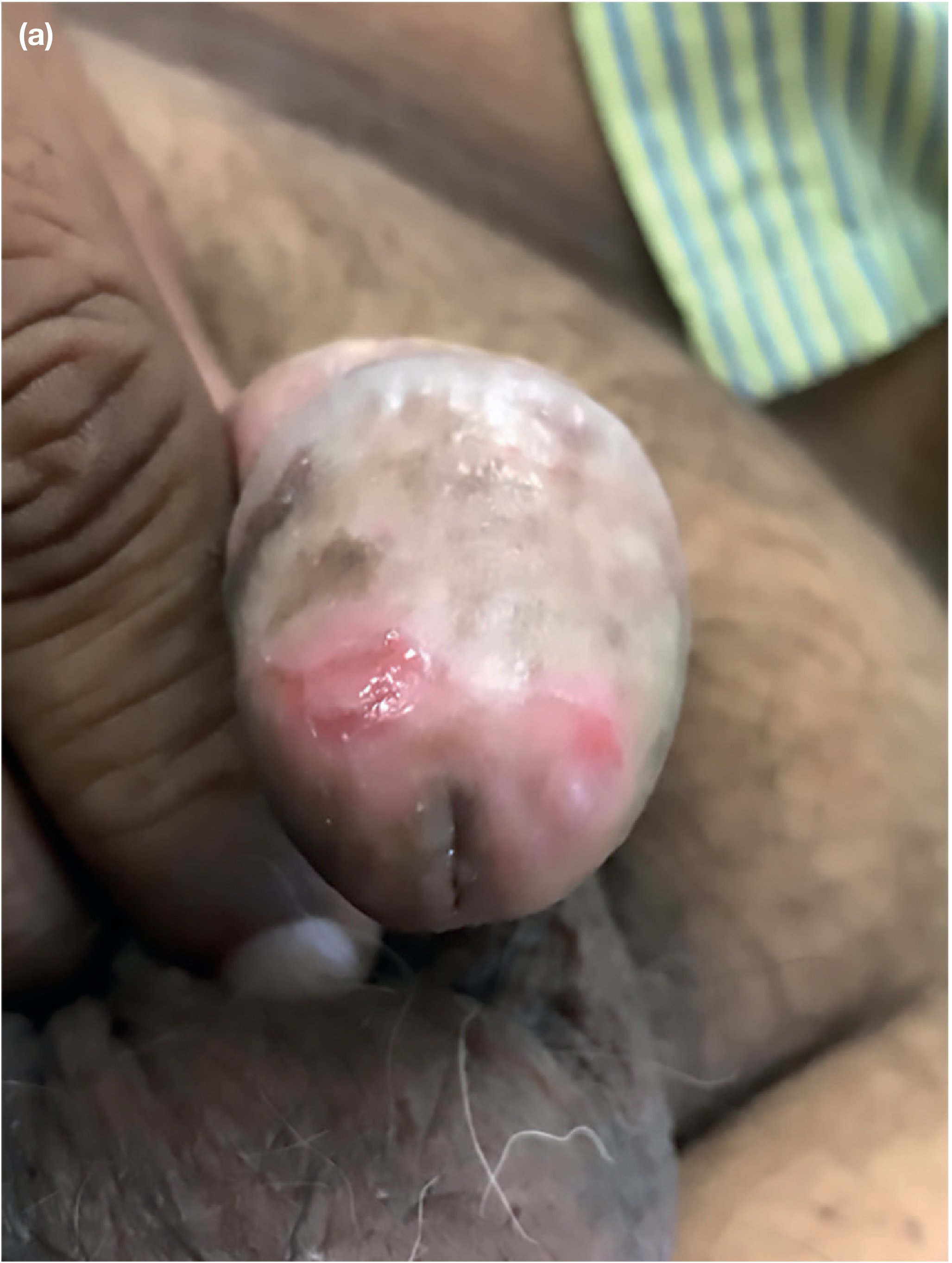
Bailey and Love's Fig. 85.14, lichen sclerosus (active phase shown first, burnt-out phase second in the book).
4. Clinical features
History:
- Ballooning of the foreskin on micturition
- Spraying or a poor urinary stream
- Recurrent balanoposthitis (erythema, swelling, purulent discharge)
- Dysuria
- Pain on erection or intercourse
- Preceding forceful retraction
- Diabetes symptoms in adults
Examination:
- Look for a white, fibrotic, scarred ring. This suggests pathological phimosis or BXO.
- A healthy, pink, elastic foreskin with a non-retractile tip in a young boy is physiological.
- Check the meatus, which can be involved in BXO.
- Check for hypospadias or a buried penis before any surgical plan.
- Do not forcibly retract the foreskin in clinic.
Complications to name on the round:
- Recurrent balanoposthitis and UTI
- Paraphimosis
- Urinary obstruction or retention
- Calculi and squamous cell carcinoma under the foreskin (chronic cases, mainly adults)
- Problems with catheterisation
5. Management
Physiological or asymptomatic: reassure the parents, give hygiene advice and observe. No treatment is appropriate (Bailey and Love's).
Symptomatic primary phimosis in a boy:
- The first-line option is topical corticosteroid to the stenotic ring. The EAU-ESPU guidance as summarised in a recent review recommends this. Circumcision is reserved for scarred phimosis or LS, for treatment failure, and for specific urological indications.
- A commonly quoted regimen is a potent steroid such as betamethasone 0.05% twice daily for 4 to 8 weeks. This comes from a secondary web source, so check your local formulary and protocol.
- Steroid does not separate simple glanular adhesions. It works on a true narrow ring.
- Evidence from the 2024 Cochrane review of 14 RCTs (1,459 boys) (Moreno et al., PMID 38269441):
- Complete resolution at 4 to 8 weeks: RR 2.73 versus placebo or no treatment (low-certainty evidence).
- Long-term complete resolution at 6 months or more: RR 4.09.
- The trials varied a lot in drug, age and duration.
- A 2026 systematic review looked at phimosis treatment and recurrent UTI in infant boys (PMID 41274309). I only saw the title, so I can't comment on its findings.
Pathological phimosis, BXO or LS, or failed steroids: circumcision (or preputioplasty in selected cases). Send the specimen for histology.
Acute infection:
- Treat with broad-spectrum antimicrobials.
- Slit the dorsal foreskin if drainage is needed.
- Circumcise after the infection settles (Smith and Tanagho's).
Emergency: if catheterisation is needed, do a dorsal slit under local anaesthetic (Bailey and Love's).
Circumcision cautions:
- Do not circumcise with hypospadias, penile curvature or a buried penis (Bailey and Love's).
- In children who need general anaesthesia, avoid circumcision for phimosis unless there are recurrent infections. Postpone it until local anaesthesia is feasible (Smith and Tanagho's).
6. Related: paraphimosis (emergency)
The retracted foreskin is trapped behind the glans. It causes swelling and pain and can lead to gangrene if not reduced (Campbell-Walsh-Wein Urology). Reduce it urgently, for example with analgesia, compression and manual reduction. If that fails, do a dorsal slit. Always put the foreskin back after catheterisation or examination.
7. Bedside teaching points
- A non-retractile foreskin in a toddler is normal. Don't label it phimosis.
- Look for a white scarred ring to identify true pathology.
- Never forcibly retract.
- Try topical steroids before circumcision in primary symptomatic phimosis.
- In an adult with new phimosis, check blood glucose and think of LS.
- Reduce paraphimosis urgently, and replace the foreskin after any procedure.
8. Quick questions for students
- How would you tell physiological from pathological phimosis?
- What percentage of boys have a retractile foreskin at age 3?
- Name two causes of secondary phimosis.
- When is steroid unlikely to work?
- Why must you replace the foreskin after catheterisation?
I couldn't find a clinical photo of phimosis in the image library, so the only image here is the lichen sclerosus figure from Bailey and Love's. I can turn this into a one-page handout or slides if you'd like.
Introduction
Introduction: phimosis ward teaching
Opening statement (about 1 minute)
Phimosis means the foreskin cannot be retracted over the glans. The word comes from the Greek for "muzzling". The key teaching point is that it is a normal finding in young boys but a pathological one if it persists or develops later. Most of the skill in managing it lies in telling the two apart (Smith and Tanagho's General Urology, 19e, p. 665).
Why it matters
- It is one of the most common reasons for paediatric urology referral. Many of those referrals are physiological non-retractability that never needed treatment.
- Unnecessary circumcision is avoidable if you recognise the natural history.
- Missed pathological phimosis in adults can hide diabetes, lichen sclerosus or penile malignancy.
- Related emergencies (paraphimosis, urinary obstruction) are straightforward to treat if you recognise them early.
Core facts to set up the session
- At birth the foreskin is non-retractile in essentially all boys, because of natural adhesions between the glans and inner preputial skin.
- Retractability increases with age. About 90% of uncircumcised boys can retract fully by age 3, and fewer than 1% have phimosis by age 17 (Campbell-Walsh-Wein Urology, ch. 44).
- Physiological phimosis needs no treatment. True (pathological) phimosis is caused by scarring from infection, forceful retraction, balanitis xerotica obliterans or lichen sclerosus, and is treated if symptomatic (Bailey and Love's, 28e).
Learning objectives for the session
By the end, students should be able to:
- Distinguish physiological from pathological phimosis at the bedside.
- List the causes and complications.
- Outline stepwise management, including when topical steroids are used and when circumcision is indicated.
- Recognise and manage paraphimosis as an emergency.
Opening question for the group
"A mother brings in her 3-year-old because she cannot pull back his foreskin. What do you tell her, and what would change your mind?"
I can continue with the next section (clinical features and examination), or turn this into slides or a handout.
Summary and conclusion
Summary and conclusion: phimosis ward teaching
Key take-home points
- Definition: Phimosis means the foreskin cannot be retracted over the glans.
- Physiological versus pathological:
- Non-retractability is normal in infants and young boys. Natural adhesions separate gradually, and about 90% of boys can retract fully by age 3.
- True phimosis involves a scarred, fibrotic, often white ring. Causes are balanoposthitis, forceful retraction, balanitis xerotica obliterans (BXO) or lichen sclerosus (LS), and diabetes in adults.
- Do not force it: Forceful retraction causes tears and scarring, which leads to secondary phimosis.
- Complications: recurrent balanoposthitis, UTI, ballooning and obstructed voiding, paraphimosis, and, in chronic adult cases, calculi and squamous cell carcinoma.
- Management by situation:
| Situation | Approach |
|---|---|
| Physiological or asymptomatic | Reassure, give hygiene advice, observe |
| Symptomatic primary phimosis in a boy | Trial of topical corticosteroid for 4 to 8 weeks |
| Scarred phimosis, BXO or LS, or steroid failure | Circumcision or preputioplasty, with histology |
| Acute infection | Antimicrobials, dorsal slit for drainage if needed, circumcise later |
| Urgent catheterisation | Dorsal slit under local anaesthetic |
| Paraphimosis | Urgent reduction, dorsal slit if that fails |
- Circumcision cautions: Avoid it with hypospadias, penile curvature or a buried penis. In children, avoid general anaesthesia for phimosis alone unless there are recurrent infections.
- Evidence: The 2024 Cochrane review of 14 RCTs found that topical steroids probably increase complete resolution at 4 to 8 weeks (RR 2.73) and at 6 months or more (RR 4.09). Certainty is low, and trials varied in drug, age and duration (Moreno et al., PMID 38269441). Check your local protocol for the exact steroid and regimen.
Conclusion
Phimosis is common and usually harmless in childhood. Management depends on telling normal development from scarring. Most physiological cases need nothing. Symptomatic primary cases usually respond to topical steroids. Surgery is for scarred phimosis, BXO or LS, treatment failure and specific urological indications. Adults with new phimosis need a check for diabetes and LS, and the specimen should go for histology if they are circumcised. Paraphimosis is the emergency to recognise and reduce promptly.
Closing questions for students
- What do you tell the parents of a 3-year-old with a non-retractile foreskin and no symptoms?
- Which finding on examination points to pathological phimosis?
- When would you choose circumcision over steroids?
- Why must the foreskin always be replaced after catheterisation?
Sources: Smith and Tanagho's General Urology (19e), Bailey and Love's Short Practice of Surgery (28e), Campbell-Walsh-Wein Urology (ch. 44), the 2024 Cochrane review, and EAU-ESPU guidance as summarised in a recent review.
I can put the whole session into a slide deck or a one-page handout if that would help.
Summary and conclusion
Summary and conclusion (condensed version)
Summary
- Definition: Phimosis means the foreskin cannot be retracted over the glans.
- Physiological: Non-retractability is normal in young boys. About 90% can retract fully by age 3. It needs no treatment.
- Pathological: The cause is scarring from infection, forceful retraction, BXO or LS, or diabetes in adults. The ring looks white and fibrotic.
- Complications: recurrent balanoposthitis, UTI, obstructed voiding, paraphimosis, and in chronic adult cases, carcinoma.
- Management:
- Physiological or asymptomatic: reassure and observe.
- Symptomatic primary phimosis in a boy: topical steroid for 4 to 8 weeks. The 2024 Cochrane review supports this (RR 2.73 for complete resolution, low-certainty evidence).
- Scarred phimosis, BXO or LS, or steroid failure: circumcision or preputioplasty, with histology.
- Acute infection: antimicrobials, then circumcise once settled.
- Urgent catheterisation: dorsal slit.
- Paraphimosis: reduce urgently.
Conclusion
Phimosis is common and usually harmless in childhood. The task is to separate normal development from scarring. Never retract the foreskin forcibly. Try steroids before surgery in primary symptomatic phimosis. Reserve circumcision for scarred disease, treatment failure and specific indications. Check adults with new phimosis for diabetes and LS. Always replace the foreskin after catheterisation or examination.
Three questions to close
- What do you tell the parents of a well 3-year-old with a non-retractile foreskin?
- What finding suggests pathological phimosis?
- Why must the foreskin be replaced after catheterisation?
Last turn I gave a fuller version with a management table and sources. I can make this into a single slide or a handout if you want.
This is a shared conversation. Sign in to Orris to start your own chat.