
Structure of placenta
Reading File
Finding Sources
Searching Images
placenta structure anatomy diagram
Reading File
Finding Sources
Reading File
Reading File
Reading File
Reading File
Loading Image
Loading Image
Loading Image
Loading Image
Loading Image
Reading File
Now I have rich content from Langman's Medical Embryology and Histology A Text and Atlas. Let me compose a comprehensive answer.
Structure of the Placenta
The placenta is a discoid, hemochorial organ derived from both fetal and maternal tissues. It is the primary site of gas, nutrient, and waste exchange between the mother and fetus.
1. Two Major Components
| Component | Origin | Structure |
|---|---|---|
| Fetal portion | Chorion frondosum | Chorionic plate + villous trees |
| Maternal portion | Decidua basalis | Decidual (basal) plate |
By the beginning of the 4th month, the placenta is well established with both portions clearly defined. The fetal side is bordered by the chorionic plate; the maternal side by the decidua basalis (decidual plate). (Langman's Medical Embryology)
2. Gross Anatomy at Full Term
- Shape: Discoid
- Diameter: 15–25 cm
- Thickness: ~3 cm
- Weight: ~500–600 g
- Coverage: 15–30% of the internal uterine surface
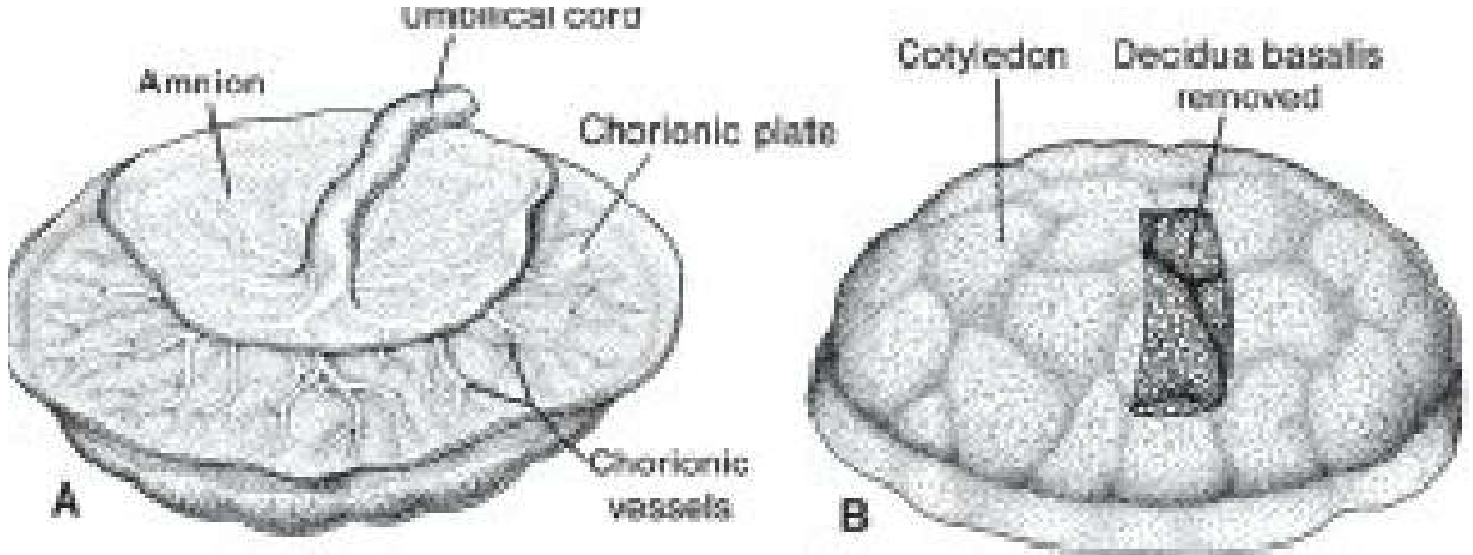
Fetal surface: Covered by the chorionic plate (smooth, shiny), itself covered by amnion. Large chorionic arteries and veins converge toward the umbilical cord. Umbilical cord insertion is usually eccentric, occasionally marginal, rarely velamentous.
Maternal surface: Shows 15–20 cotyledons — slightly bulging lobular areas covered by a thin layer of decidua basalis. Grooves between cotyledons are formed by decidual septa.
3. Junctional Zone
Where fetal trophoblast and maternal decidual cells intermingle. This zone is:
- Rich in amorphous extracellular material
- Characterized by decidual and syncytial giant cells
- Most cytotrophoblast cells have degenerated by the 4th month
4. Cotyledons
Formed by decidual septa that project from the decidual plate into the intervillous space during the 4th–5th months. Key features:
- Septa have a core of maternal tissue but are surfaced by syncytial cells
- Septa do not reach the chorionic plate — cotyledons remain in communication
- Each placenta has 15–25 cotyledons
- Each cotyledon is supplied by 80–100 spiral arteries that pierce the decidual plate
5. Intervillous Space
- Lies between the chorionic plate and decidual plate
- Filled with maternal blood (lacunae derived from syncytiotrophoblast, lined by syncytium of fetal origin)
- Contains ~150 mL of blood at term, replenished 3–4 times/minute
- Villous surface area: 4–14 m²
6. Chorionic Villi — Development & Types
| Type | Timing | Composition |
|---|---|---|
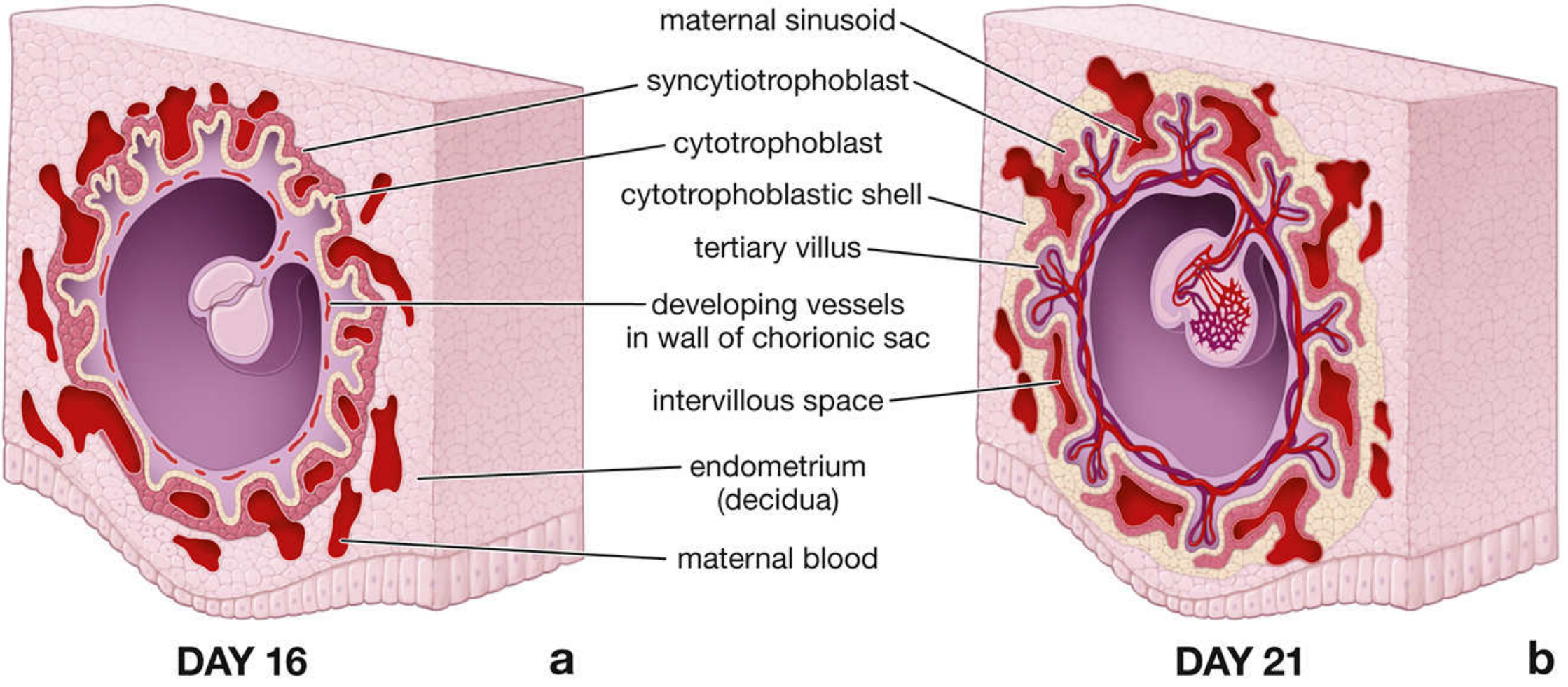
| Primary villi | Days 11–13 | Cytotrophoblast cords extending into syncytiotrophoblast lacunae |
| Secondary villi | ~Day 16 | Cytotrophoblast + syncytiotrophoblast + mesenchymal core |
| Tertiary villi | End of week 3 | Above + blood vessels in connective tissue core |
Functional categories:
- Floating (free) villi — project freely into intervillous space; primary exchange units
- Anchoring (stem) villi — penetrate basal plate, anchor placenta to uterine wall
7. Villous Histology (Microscopic Structure)
Early pregnancy villi:
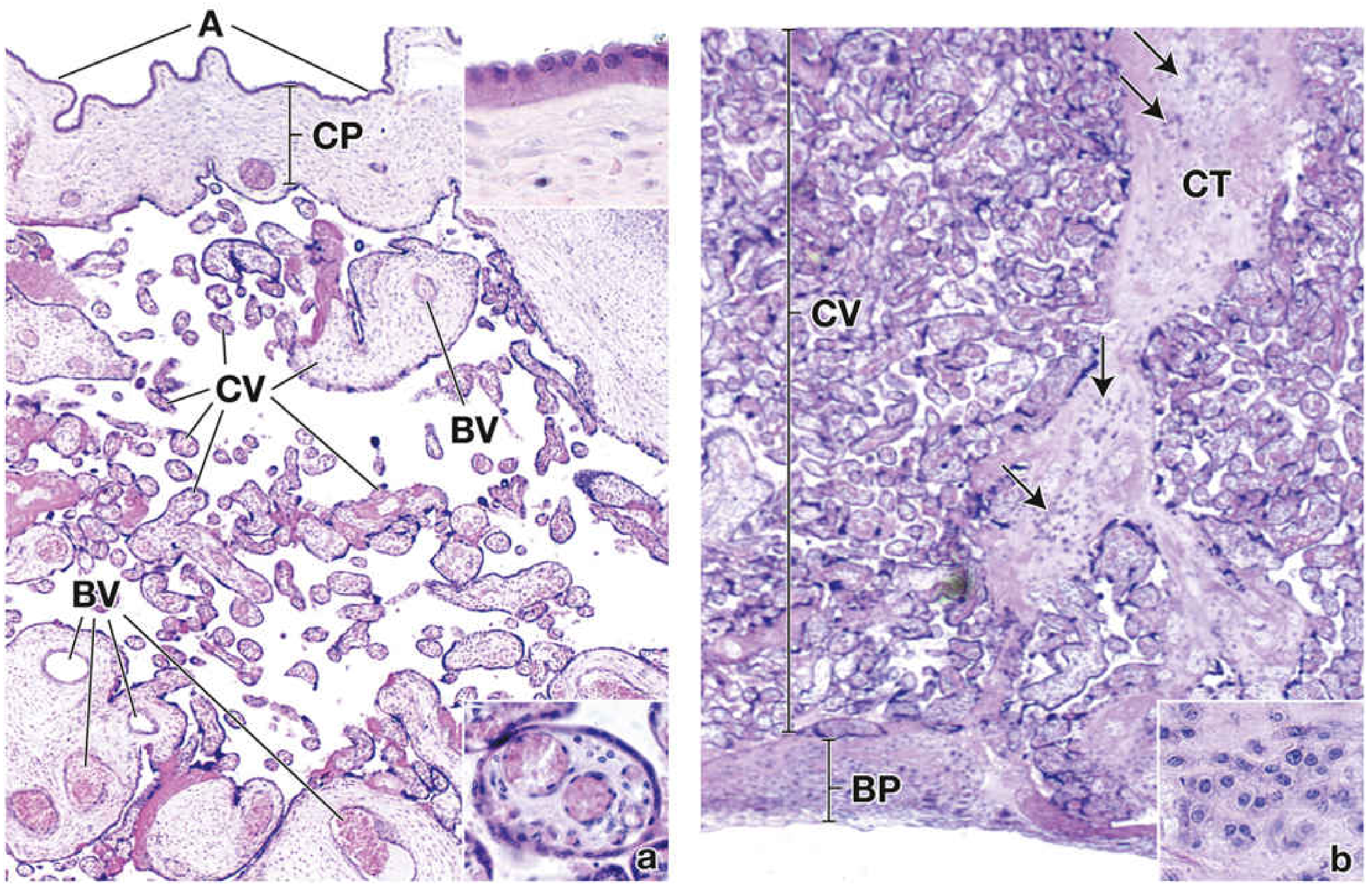
- Large, edematous
- Thick outer syncytiotrophoblast layer
- Continuous inner cytotrophoblast (Langhans cells)
- Few fetal blood vessels, cellular stroma
Late pregnancy villi:
- Smaller in diameter
- Cytotrophoblast layer becomes thin and discontinuous
- Syncytial knots form (aggregated syncytiotrophoblast nuclei); their number increases with gestational age
- More numerous fetal capillaries, now in intimate contact with syncytium
Stromal cells of villi:
- Mesenchymal cells
- Reticular (fibroblast-like) cells
- Hofbauer cells — fetal placental macrophages that participate in innate immune defense and are the primary repository of HIV in infected placentas
8. Placental Membrane ("Barrier")
Separates fetal blood (within villous capillaries) from maternal blood (intervillous space). Composed initially of 4 layers:
- Endothelium of fetal capillaries
- Connective tissue of villus core
- Cytotrophoblast layer
- Syncytiotrophoblast
From the 4th month onward, the membrane thins dramatically as fetal capillary endothelium comes into intimate contact with the syncytium — greatly accelerating exchange. The syncytium often develops a brush border of microvilli, further enlarging surface area.
This is a hemochorial placenta — maternal blood is in direct contact with the fetal chorionic tissue (no interposed maternal endothelium).
9. Placental Circulation
- Arterial supply (maternal): 80–100 spiral arteries pierce the decidual plate → blood jets into intervillous space → bathes villous trees
- Venous drainage (maternal): Blood drains back through endometrial veins into maternal circulation
- Fetal circulation: Umbilical arteries (deoxygenated blood) → branch on chorionic plate → penetrate villi → capillaries at villous tip → umbilical vein (oxygenated)
10. Decidua
The decidua is the modified endometrium of pregnancy, divided into three regions:
| Region | Location | Fate |
|---|---|---|
| Decidua basalis | Between embryo and myometrium | Forms maternal portion of placenta |
| Decidua capsularis | Overlies the embryo | Degenerates as uterus expands |
| Decidua parietalis | Rest of uterine lining | Fuses with chorion laeve, obliterating uterine lumen |
Sources:
- Langman's Medical Embryology, 14th ed. — Chapter 8
- Histology: A Text and Atlas with Correlated Cell and Molecular Biology, 8th ed. — Chapter 23
This is a shared conversation. Sign in to Orris to start your own chat.