
does extramedullary erythropoiesis cause increase in iron absorption in beta thaasemia
Reading File
Now let me search the medical library for relevant content on this topic.
Finding Sources
Finding Sources
Searching PubMed
"beta thalassemia" AND "iron absorption" AND "erythropoiesis"
Excellent results. Let me read the key passages for full detail.
Reading File
Reading File
Reading File
Let me fetch the key diagram and read a bit more on the hepcidin/GDF15/ERFE mechanism.
Reading File
Finding Sources
I now have comprehensive information from multiple authoritative textbooks. Let me also fetch the key diagram.
Loading Image
I now have all the information needed for a thorough answer. Here is the complete explanation:
Does Extramedullary Erythropoiesis Cause Increased Iron Absorption in Beta-Thalassemia?
Short answer: Partially - but with an important nuance. The increased iron absorption in beta-thalassemia is driven primarily by ineffective erythropoiesis (both medullary and extramedullary), not by extramedullary erythropoiesis alone. The unifying mechanism is suppression of hepcidin by erythroid-derived signals from the massively expanded erythroid progenitor pool.
The Core Pathophysiology
In beta-thalassemia, defective beta-globin synthesis leads to an excess of unpaired alpha-globin chains that precipitate in erythroid precursors, causing apoptosis in the bone marrow. This is ineffective erythropoiesis - the hallmark of the disease. In response to the resulting severe anemia and hypoxia, erythropoietin rises sharply, driving a massive expansion of erythroid progenitors. When the marrow is overwhelmed, erythropoiesis spills out to the liver, spleen, and other sites - this is extramedullary hematopoiesis (erythropoiesis).
The expanded total mass of erythroid progenitors (both in marrow and extramedullary sites) secretes large amounts of erythroferrone (ERFE), also known as erythroferrone or TWSG1/GDF15 in older literature.
The Hepcidin Suppression Mechanism
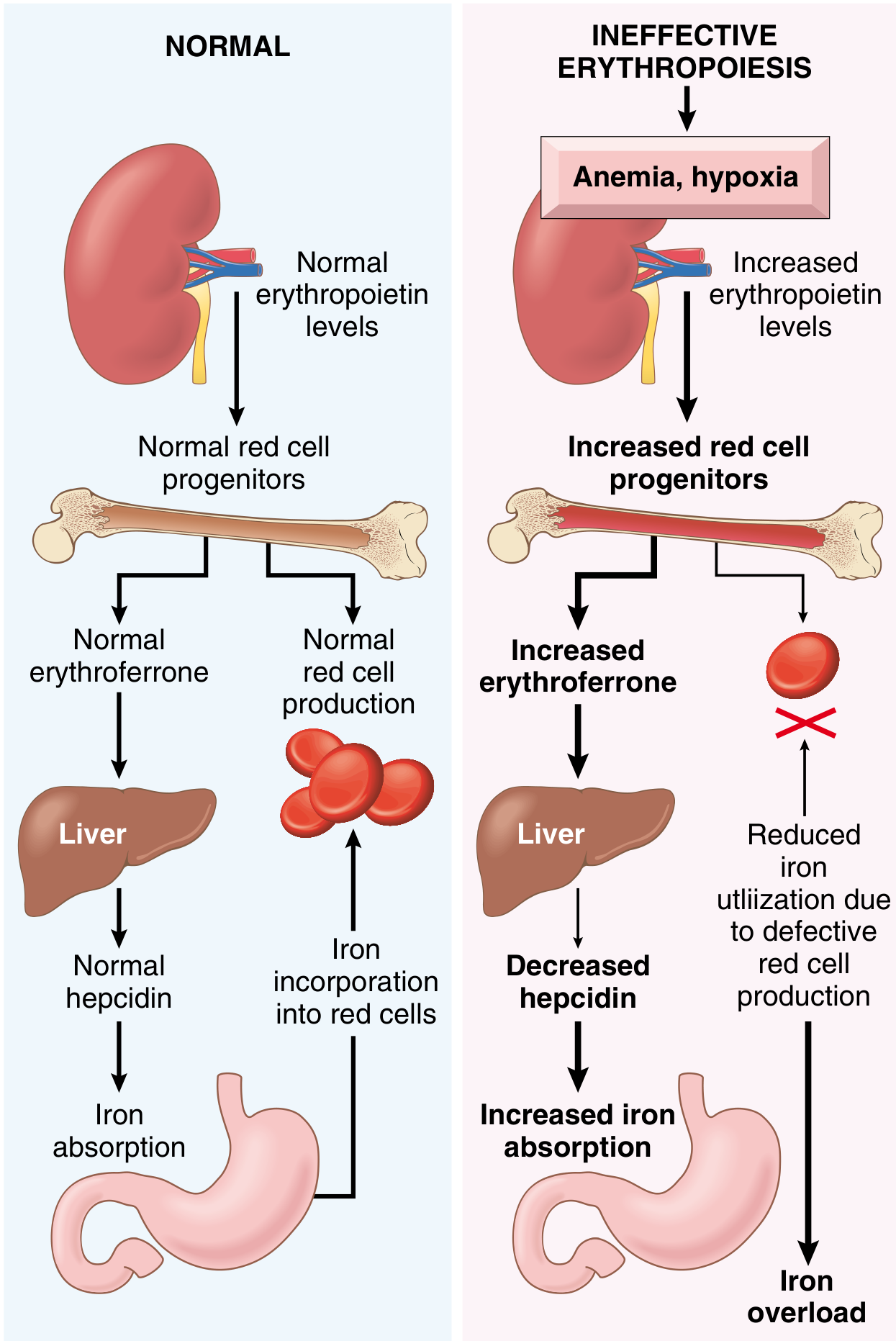
Fig. 14.11 from Robbins, Cotran & Kumar - Pathologic Basis of Disease: Mechanism of iron overload due to ineffective hematopoiesis.
The sequence is:
- Ineffective erythropoiesis + anemia/hypoxia --> massively increased erythroid progenitor mass
- Expanded erythroid progenitors secrete large amounts of erythroferrone (ERFE) (and other signals including GDF15, TWSG1)
- Erythroferrone suppresses hepcidin production in the liver
- Low hepcidin removes the brake on dietary iron absorption in the gut
- Increased iron uptake from the gut + reduced utilization due to failed red cell production = iron overload
As stated in Robbins, Cotran & Kumar - Pathologic Basis of Disease: "In the setting of ineffective erythropoiesis, such as in those with severe thalassemia, increased release of erythroferrone from the expanded mass of erythroid progenitors suppresses hepcidin production, leading to increased iron uptake from the gut."
Robbins & Kumar Basic Pathology also confirms: "Ineffective hematopoiesis is also associated with an inappropriate increase in the absorption of dietary iron... The increased iron absorption is caused by low plasma levels of hepcidin, a critical negative regulator of iron absorption."
Role of Extramedullary Erythropoiesis Specifically
Extramedullary erythropoiesis contributes to, but is not the sole cause of, increased iron absorption. Here is why:
- The erythroid progenitors at extramedullary sites (liver, spleen, lymph nodes, paraspinal masses) are part of the same expanded, ineffective erythroid mass - they also produce erythroferrone
- Hepatosplenomegaly from extramedullary hematopoiesis is a marker of the severity of ineffective erythropoiesis
- More extramedullary erythropoiesis = more total erythroid progenitors = more ERFE = more hepcidin suppression = more iron absorption
- However, the primary driver is the total magnitude of ineffective erythropoiesis, which includes both intramedullary and extramedullary components
From Goldman-Cecil Medicine: "Taken together, ineffective erythropoiesis (leading to increased GDF15) and chronic anemia/hypoxia result in hepcidin suppression, increased dietary iron absorption from the gut, and increased release of recycled iron from the reticuloendothelial system, thereby leading to an iron overload situation."
Clinical Consequences
- Iron overload occurs even in non-transfused (or minimally transfused) patients with thalassemia intermedia due to this mechanism
- In transfusion-dependent thalassemia major, transfusions themselves add a second iron load on top of the absorption-driven overload
- Suppression of ineffective erythropoiesis (by regular transfusions) actually reduces the drive for increased iron absorption - this is one therapeutic goal of transfusion therapy
- Iron chelation therapy is mandatory to prevent hemosiderosis and secondary hemochromatosis (cardiac disease is a leading cause of death)
Summary
| Factor | Role in Increased Iron Absorption |
|---|---|
| Ineffective erythropoiesis (intramedullary) | Primary driver - most apoptosis happens in marrow |
| Extramedullary erythropoiesis | Contributes - adds to total erythroid progenitor mass and ERFE secretion |
| Erythroferrone (ERFE) | Key mediator - released from expanded erythroid progenitors |
| Hepcidin suppression | Final common pathway - removes brake on GI iron absorption |
| Anemia/hypoxia | Additional stimulus to hepcidin suppression |
So yes - extramedullary erythropoiesis does contribute to increased iron absorption in beta-thalassemia, but it does so as part of the broader mechanism of ineffective erythropoiesis, not independently. The real driver is the total expanded erythroid mass (wherever it occurs) suppressing hepcidin via erythroferrone.
Sources: Robbins, Cotran & Kumar Pathologic Basis of Disease; Robbins & Kumar Basic Pathology; Goldman-Cecil Medicine; Tietz Textbook of Laboratory Medicine, 7th ed.
This is a shared conversation. Sign in to Orris to start your own chat.