
Basics of metabolism
I'll start by reading the medical library skill, then search for metabolism content in parallel.
Reading File
Now let me search the library for metabolism content in parallel:
Finding Sources
Finding Sources
Reading File
Finding Sources
Finding Sources
Excellent - I have rich content. Let me now read the key biochemistry sections in parallel for a thorough answer:
Reading File
Reading File
Reading File
Now let me fetch the key metabolism diagram and search for glycolysis and regulation details:
Loading Image
Loading Image
Finding Sources
Reading File
Finding Sources
I now have comprehensive content from multiple authoritative textbooks. Let me compile the full answer:
Basics of Metabolism
Metabolism is the totality of all chemical reactions occurring within a living organism to sustain life. It has two fundamental, interlinked components: catabolism and anabolism.
1. What Is Metabolism?
Metabolism is composed of two components:
- Catabolism - processes that harvest energy from the breakdown of complex molecules (e.g., glucose, fatty acids, proteins), using that energy to synthesize ATP.
- Anabolism (biosynthesis) - processes that use the energy stored in ATP to synthesize and assemble the building blocks of macromolecules (proteins, nucleic acids, lipids, carbohydrates).
In a weight-stable person, anabolism and catabolism are in net balance - zero energy balance. Most people cycle between the two: net anabolism after meals (storing glycogen and triacylglycerol) and net catabolism during fasting (mobilizing those stores).
Harper's Illustrated Biochemistry, 32nd Ed, p. 145 | Jawetz Melnick & Adelberg's Medical Microbiology, 28e
2. Metabolic Fuels
The three major fuel substrates are:
| Fuel | Primary Store | When Used |
|---|---|---|
| Carbohydrates (glucose) | Glycogen (liver, muscle) | Fed state, high-intensity exercise |
| Fats (fatty acids) | Triacylglycerol (adipose) | Fasting, prolonged exercise |
| Proteins (amino acids) | Muscle protein | Prolonged starvation |
The resting (basal) metabolic rate accounts for approximately 60% of daily energy expenditure. Physical activity can raise metabolic rate 40-50% above basal. The mix of fuel being oxidized depends on diet composition, fed/fasting state, and exercise intensity (you burn what you eat).
Harper's Illustrated Biochemistry, 32nd Ed, p. 145
3. The Three Stages of Cellular Respiration
All three macronutrients ultimately converge on a common pathway to produce ATP. This is best illustrated by the classic three-stage model:
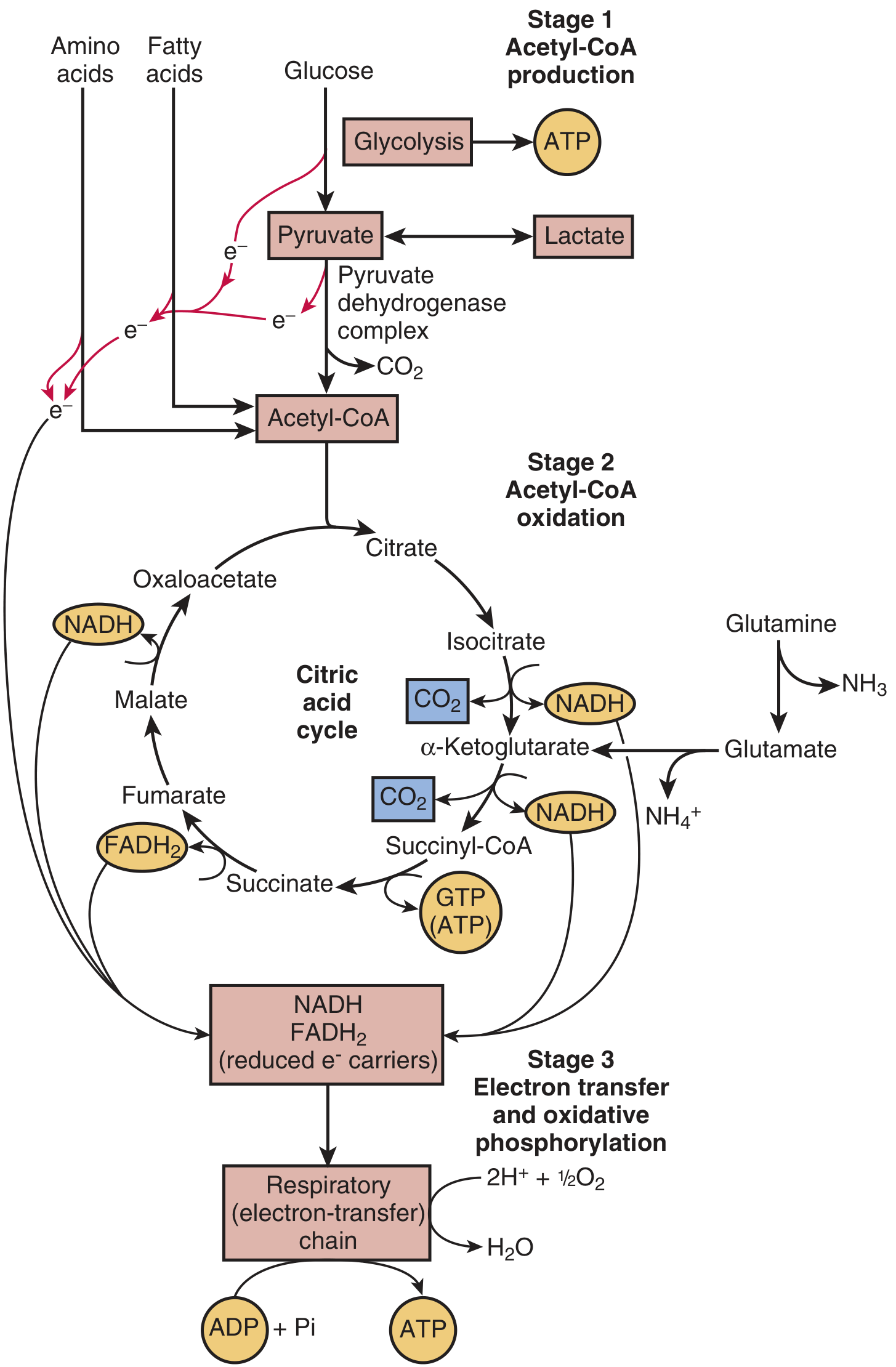
Fig. 5.4 - Three stages of cellular respiration: Stage 1 = Acetyl-CoA production; Stage 2 = Citric acid cycle; Stage 3 = Electron transport and oxidative phosphorylation. (Brenner and Rector's The Kidney)
Stage 1 - Acetyl-CoA Production (Cytosol + Mitochondria)
Glycolysis (occurs in the cytosol):
- Glucose (6-carbon) is split into 2 molecules of pyruvate (3-carbon) through 10 enzyme-catalyzed steps
- Net yield: 2 ATP per glucose (4 ATP produced, 2 consumed in activation)
- Also produces 2 NADH
Pyruvate to Acetyl-CoA (mitochondria):
- Pyruvate enters the mitochondria and is converted to acetyl-CoA by the pyruvate dehydrogenase complex
- CO2 is released; NADH is generated
- This reaction is irreversible - acetyl-CoA cannot be converted back to pyruvate in humans
Similarly, fatty acids undergo beta-oxidation and amino acids are deaminated to yield acetyl-CoA.
Guyton and Hall Textbook of Medical Physiology, p. 835
Stage 2 - Citric Acid Cycle / Krebs Cycle (Mitochondrial Matrix)
Acetyl-CoA (2-carbon) combines with oxaloacetate (4-carbon) to form citrate (6-carbon). Through a series of 8 reactions involving dehydrogenases and decarboxylases, per turn of the cycle:
| Product | Quantity | Downstream ATP |
|---|---|---|
| NADH | 3 | ~7.5 ATP (each NADH ~ 2.5 ATP) |
| FADH2 | 1 | ~1.5 ATP |
| GTP | 1 | 1 ATP |
Total: ~10 ATP per acetyl-CoA (modern estimates) or 12 by older accounting.
The Krebs cycle also serves as a metabolic hub - its intermediates feed into gluconeogenesis, lipogenesis, and amino acid synthesis depending on the cell's energy status.
Mulholland and Greenfield's Surgery, p. 89
Stage 3 - Oxidative Phosphorylation / Electron Transport Chain (Inner Mitochondrial Membrane)
The NADH and FADH2 from stages 1-2 donate electrons to the electron transport chain (ETC):
- Complex I (NADH-CoQ reductase) - accepts electrons from NADH
- Complex II (Succinate dehydrogenase) - accepts electrons from FADH2
- Complex III (Q-cytochrome c oxidoreductase)
- Complex IV (Cytochrome c oxidase) - O2 accepts the final electrons → reduced to H2O
As electrons move down the chain, protons (H+) are pumped across the inner mitochondrial membrane, creating the proton motive force (pH gradient + voltage gradient). ATP synthase uses this force to phosphorylate ADP → ATP.
Total ATP yield from one glucose molecule:
- Glycolysis: ~2 ATP
- Pyruvate decarboxylation: ~5 ATP
- Citric acid cycle: ~20 ATP
- Total: ~30-32 ATP per glucose (aerobic)
Mulholland and Greenfield's Surgery, p. 89-91
4. Three Key Metabolic Crossroads
Three metabolites act as master regulators, orchestrating the switch between catabolism and anabolism:
| Metabolite | Anabolic fates | Catabolic fates |
|---|---|---|
| Glucose-6-phosphate (G6P) | Glycogen synthesis, ribose-5-P (nucleotides) | Glycolysis, pentose phosphate pathway |
| Pyruvate | Gluconeogenesis, alanine synthesis | Acetyl-CoA, lactate, oxaloacetate |
| Acetyl-CoA | Fatty acid/cholesterol synthesis, ketogenesis | Krebs cycle → CO2 + ATP |
Mulholland and Greenfield's Surgery, p. 89
5. Fasting vs. Fed State
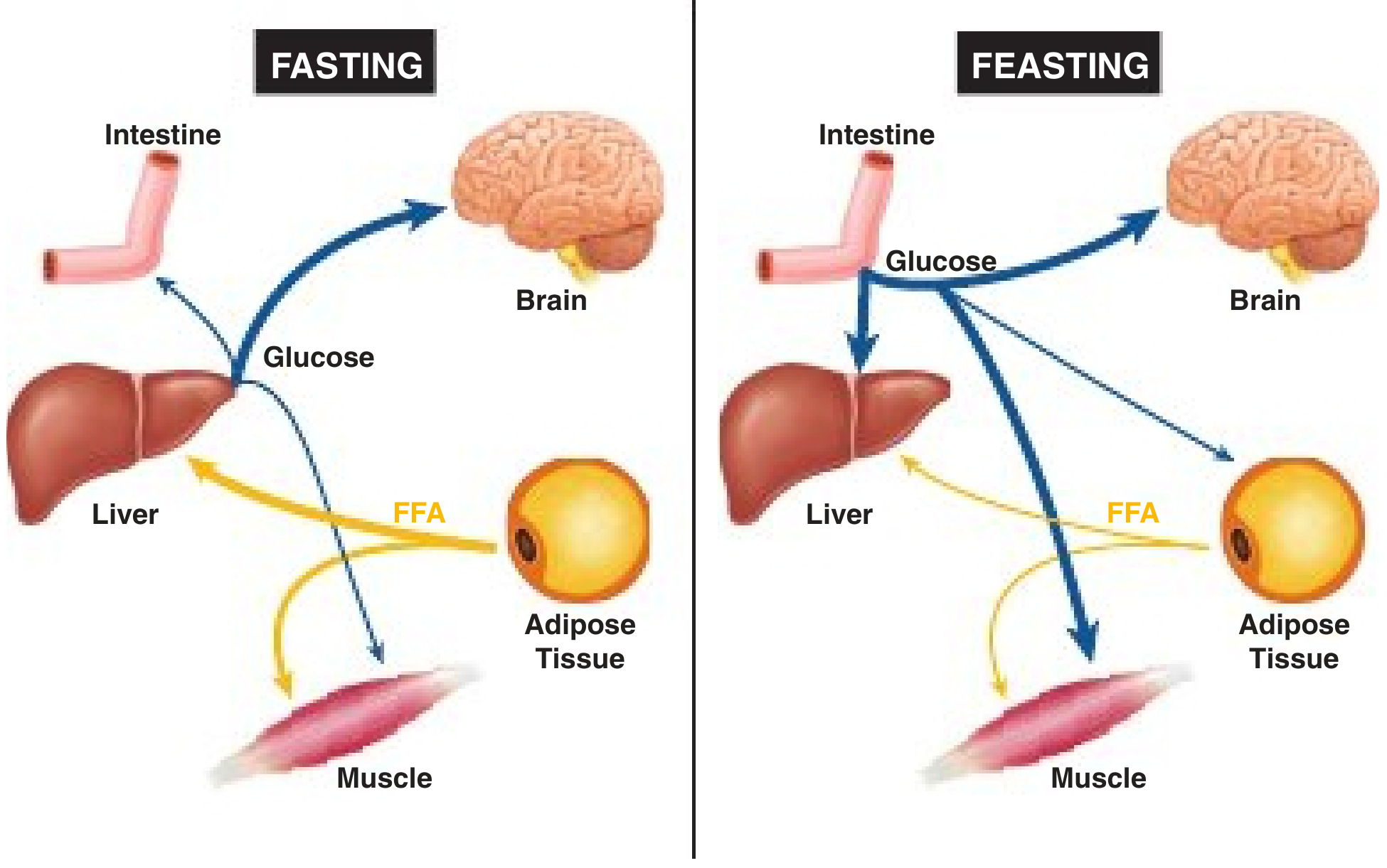
Fasting:
- Liver provides glucose (~9 g/hr) via glycogenolysis and gluconeogenesis
- Brain and RBCs are the priority glucose consumers
- Adipose releases free fatty acids (FFA) as fuel for heart, muscle, liver
- Liver synthesizes ketone bodies from fatty acids for muscle and brain
Fed state:
- Intestine becomes the glucose source (dietary carbohydrate)
- Liver switches from glucose producer to glucose consumer
- Excess glucose stored as glycogen or converted to fat
- Insulin promotes glucose uptake, glycogen synthesis, lipogenesis
Harper's Illustrated Biochemistry, 32nd Ed, p. 145
6. Compartmentalization of Metabolism
| Pathway | Location |
|---|---|
| Glycolysis | Cytosol |
| Fatty acid synthesis (lipogenesis) | Cytosol |
| Citric acid cycle | Mitochondrial matrix |
| Beta-oxidation of fatty acids | Mitochondrial matrix |
| Oxidative phosphorylation (ETC) | Inner mitochondrial membrane |
| Gluconeogenesis | Cytosol + mitochondria |
Substrates freely cross the outer mitochondrial membrane through porins but require specific transporters to cross the inner membrane, driven by concentration gradients or the H+ gradient from the ETC.
Brenner and Rector's The Kidney
7. Key Regulatory Principles
- Enzymes are the gatekeepers - pathways are regulated by controlling either the amount or activity of enzymes
- Allosteric regulation - metabolites act as effectors to modulate enzyme activity (e.g., ATP inhibits phosphofructokinase-1; AMP activates it)
- Hormonal control - insulin promotes anabolism; glucagon and epinephrine promote catabolism
- Energy charge - the ATP/ADP/AMP ratio is a cell-wide signal: high ATP suppresses catabolism, low ATP (high AMP) activates catabolic pathways via AMPK (AMP-activated protein kinase)
Summary Flowchart
FOOD (Carbohydrates, Fats, Proteins)
         |
    [STAGE 1] Glycolysis / Beta-oxidation / Deamination
         |
     Acetyl-CoA  ←→  2 ATP (glycolysis net)
         |
    [STAGE 2] Citric Acid Cycle
         |
     NADH + FADH₂ + GTP
         |
    [STAGE 3] Electron Transport Chain
         |
     ~28-30 ATP + H₂O + CO₂
Metabolism is not just about energy production - it is a tightly regulated network where the balance between building up (anabolism) and breaking down (catabolism) determines growth, maintenance, and survival of every cell.
This is a shared conversation. Sign in to Orris to start your own chat.