
Describe union, delayed union and non unionin terms of orthopaedics
I'll read the medical library skill first, then search for relevant content on fracture union.
Reading File
Now I'll run parallel searches across the library for fracture union topics.
Finding Sources
Finding Sources
Good - I found Campbell's Operative Orthopaedics. Now let me search for the main definitions section and fracture healing content.
Finding Sources
Finding Sources
Excellent! Found content in Rockwood and Green's (primary fractures textbook) and Tintinalli's. Let me now read the key sections.
Reading File
Reading File
Now let me search the main Rockwood & Green's definitions and Campbell's nonunion chapter for detailed clinical content.
Finding Sources
Finding Sources
Now let me read the key sections from Rockwood & Green's and Campbell's on nonunion classification and delayed union definitions.
Reading File
Reading File
Now let me read the actual definition/intro section from Rockwood & Green's nonunion chapter and the detailed nonunion types.
Reading File
Reading File
Excellent content. Let me now read the pseudoarthrosis section and risk factors, and also get content from Miller's Review and Campbell's for additional detail on delayed union.
Reading File
Finding Sources
Now let me read Campbell's DEFINITIONS section which has the clearest definitions.
Reading File
Reading File
I now have very thorough content from multiple authoritative sources. Let me also fetch the X-ray images to include visuals.
Loading Image
Reading File
I now have comprehensive, authoritative content from both Campbell's Operative Orthopaedics (15th Ed 2026) and Rockwood and Green's Fractures in Adults (10th Ed 2025). Here is a thorough, well-cited answer.
Union, Delayed Union, and Nonunion in Orthopaedics
1. Union (Normal Fracture Healing)
Union refers to the complete healing of a fracture - the restoration of bony continuity and structural integrity. It is the expected outcome of most fractures when treated appropriately.
Phases of bone healing:
- Inflammatory phase: Haematoma formation, infiltration of granulation tissue containing osteoprogenitor cells
- Soft callus phase: Collagen, cartilage and woven bone laid down around the fracture site
- Hard callus phase: Progressive mineralisation and bridging callus
- Remodelling phase: The longest phase (can last years); callus is resorbed, trabecular bone formed along lines of stress, restoring original shape
Clinical union is established when there is absence of tenderness at the fracture site and no pain on stressing, along with radiographic evidence of bridging callus on at least three cortices (on two orthogonal views).
Radiographic union is demonstrated by continuous trabeculae crossing the fracture line and obliteration of the fracture gap.
No universally accepted, standardised definition of union exists in the literature. Attempts to define it are hampered by reliance on indirect means (radiographs, clinical signs) rather than direct measurement of fracture site strength. - Rockwood and Green's Fractures in Adults, 10th Ed 2025
Factors governing satisfactory remodelling:
- Young age
- Fracture near the end of the bone (metaphyseal)
- Angulation aligned with the plane of joint motion
- Minimal comminution
2. Delayed Union
Definition: Delayed union occurs when a fracture has not healed in the time frame that would normally be expected, but still retains the biological potential to heal without further intervention.
"The definition of delayed union is arbitrary. Delayed union occurs when a fracture has not healed in the time frame that would be expected." - Campbell's Operative Orthopaedics, 15th Ed 2026
Time frame:
- Generally 3 to 6 months from the time of injury, though this varies by bone and injury severity
- The expected healing time depends on: bone involved, fracture location (metaphyseal heals faster than diaphyseal), energy of injury, soft tissue damage, host factors, and treatment method
- For example, delayed union of a closed tibial shaft fracture has a different threshold than a Gustilo type IIIB open tibial fracture
Key distinction from nonunion:
- In delayed union, healing has slowed but not ceased - the periosteal and endosteal healing response is still active
- On a cellular level, it has been proposed that cessation of the periosteal (but not endosteal) healing response prior to fracture bridging may define delayed union
Radiology:
- Minimal or progressive callus formation, but below what is expected
- No bridging yet, but no signs of healing arrest
Management of delayed union:
- Correction of metabolic/endocrine abnormalities (check vitamin D, thyroid, calcium)
- Optimise host factors: stop smoking, control diabetes, review medications
- Cast or brace immobilisation
- Bone stimulation: pulsed ultrasound (LIPUS), electrical/electromagnetic stimulation, extracorporeal shockwave therapy
- Surgical intervention if conservative measures fail (e.g. bone grafting, revision fixation)
Delayed union can be considered a precursor to nonunion. Timely intervention can prevent progression. - Campbell's Operative Orthopaedics, 15th Ed 2026
3. Nonunion
Definition:
Nonunion is the failure of a fracture to heal, where the healing process has ceased and union will not occur without further intervention.
Two frameworks exist:
-
Temporal (FDA) definition: A nonunion is "established when a minimum of 9 months has elapsed since injury and the fracture shows no visible progressive signs of healing for 3 consecutive months."
-
Physiologic (Brinker) definition - preferred clinically: "A fracture that, in the opinion of the treating physician, has no possibility of healing without further intervention."
The physiologic (Brinker) definition is probably more appropriate, as the FDA definition fails to include many fractures that have minimal or no chance of proceeding to union. - Campbell's Operative Orthopaedics, 15th Ed 2026
The overall rate of nonunion in the literature is approximately 4.9%. Its impact on health-related quality of life is comparable to end-stage hip arthrosis and worse than stroke, diabetes, and AIDS (utility score ~0.68). - Rockwood and Green's, 10th Ed 2025
Classification of Nonunion (Weber-Cech Classification)
Nonunions are classified by:
- Location - epiphyseal, metaphyseal, or diaphyseal
- Infection - septic vs. aseptic
- Biology - hypertrophic, oligotrophic, or atrophic
- Special type - pseudoarthrosis
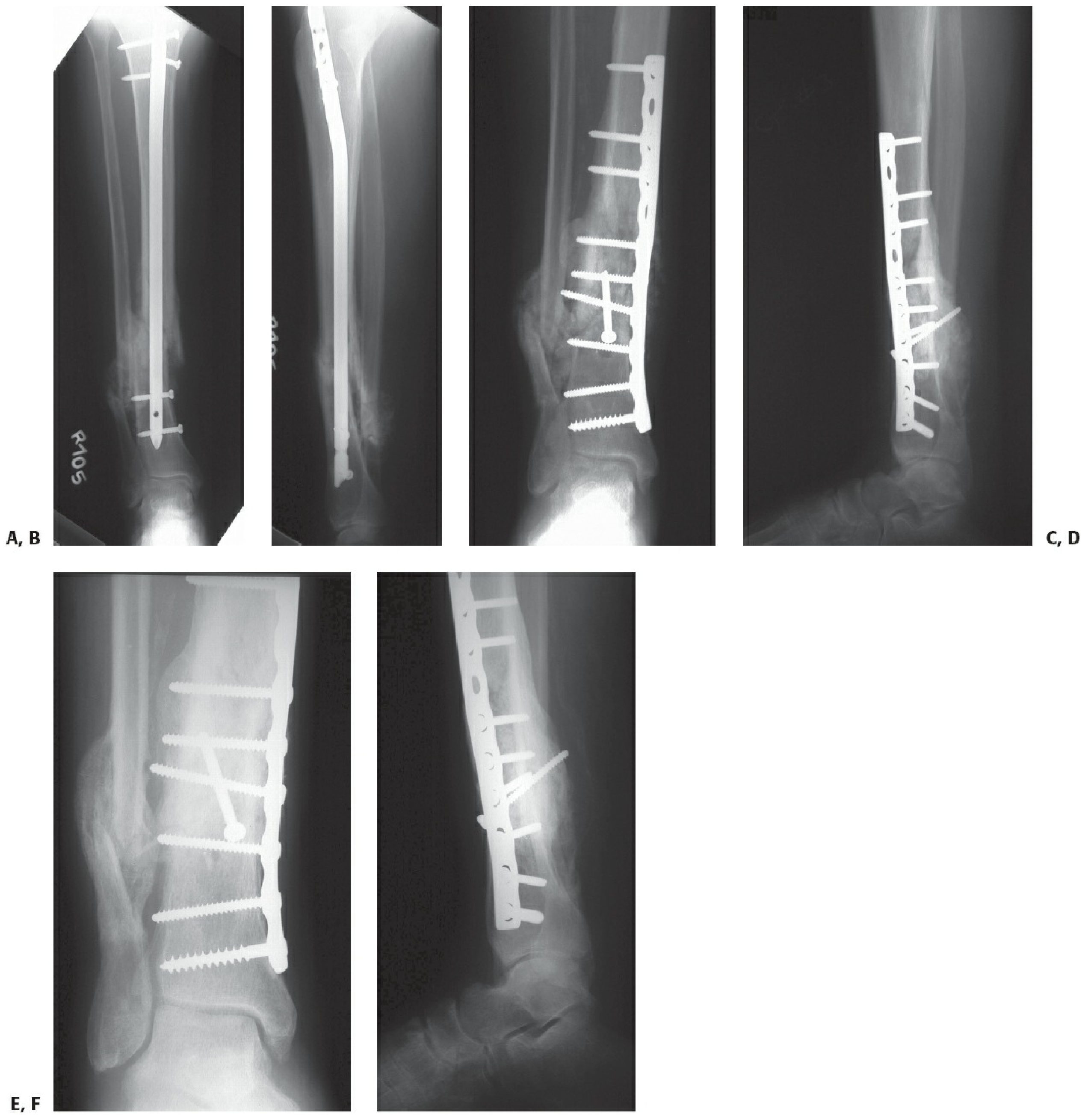
A. Hypertrophic Nonunion ("Elephant Foot")
- Also called: hypervascular, viable, or vital nonunion
- Biology: Adequate vascularity and healing response - the fracture has adequate biology but inadequate stability
- The viable fibrocartilage at the fracture gap cannot mineralise due to excessive interfragmentary motion
- Radiology: Abundant callus on either side of the fracture gap (the classic "elephant foot" appearance), but with a persistent radiolucent gap
- Treatment: Stability alone - rigid fixation (plate/nail). Bone grafting is NOT required. Stabilisation allows the existing fibrocartilage to mineralise (usually by ~8 weeks)
B. Oligotrophic Nonunion
- Intermediate between atrophic and hypertrophic
- Biology: Viable, but with minimal radiographic healing reaction, often due to inadequate fracture approximation (distraction) or poor reduction
- Radiology: Little or no callus, no elephant foot appearance
- Treatment: Stabilisation + improve fracture contact. Bone graft may be considered
C. Atrophic Nonunion
- Also called: avascular, nonviable, or avital nonunion
- Biology: Poor or absent healing response - few or no bone-forming cells active at the fracture site, with poor blood supply
- Often related to: severe open fractures, surgical periosteal stripping, or significant host factors (diabetes, smoking)
- Radiology: No bone reaction, tapered/pointed bone ends (described classically as a "peppermint stick" or "icicle" appearance), no callus whatsoever
- Treatment: Requires a biological stimulus (autogenous bone graft or BMP) AND rigid stabilisation. Debridement of nonviable bone ends is also a key principle
D. Pseudoarthrosis (Synovial Pseudoarthrosis)
- A long-standing nonunion where a synovial-like joint forms at the fracture gap with a fluid-filled cavity and fibrocartilaginous "joint surfaces"
- Represents the end-stage of an untreated nonunion
- Requires surgical excision of the pseudoarthrosis, stabilisation, and bone grafting
Risk Factors for Nonunion
Fracture-specific factors:
- High-energy mechanism with extensive periosteal stripping
- Open fractures (especially Gustilo IIIB/IIIC)
- Diaphyseal fractures (less blood supply than metaphyseal)
- Sites with watershed/limited blood supply: femoral neck, scaphoid waist, talar neck, 5th metatarsal base
- Bone loss/comminution
Host factors:
- Smoking (implicated by 81% of surgeons in one survey)
- Diabetes mellitus (59%)
- Peripheral vascular disease (53%)
- Osteoporosis, advanced age
- Medications: NSAIDs, corticosteroids, bisphosphonates, opioids (chronic opioid use implicated in 14.6% of nonunion cases in one large database study)
- Immunosuppression, malnutrition, vitamin D deficiency
Treatment factors:
- Inadequate stability (excessive interfragmentary motion)
- Excessive rigidity preventing secondary healing
- Distraction at the fracture site
- Infection
- Periosteal stripping during surgery
Summary Comparison Table
| Feature | Union | Delayed Union | Nonunion |
|---|---|---|---|
| Definition | Complete healing | Slow healing, still has potential | Healing has ceased, won't heal without intervention |
| Timeframe | Expected (weeks-months) | 3-6 months | >6-9 months (variable by site) |
| Biology | Active, completing | Slowed but not arrested | Arrested |
| Callus | Progressive, bridging | Below expected | Absent or static |
| X-ray | Bridging callus, obliterated line | Callus without bridging | No progression; gap persists |
| Intervention | None | Stimulation, optimise host | Surgery + biological stimulus |
Sources:
- Campbell's Operative Orthopaedics, 15th Ed 2026 - Definitions (p.3739), Etiology & Classification (p.3740-3743)
- Rockwood and Green's Fractures in Adults, 10th Ed 2025 - Introduction to Nonunions (p.986-996), Classification (Atrophic, Hypertrophic, Oligotrophic, Pseudoarthrosis)
- Tintinalli's Emergency Medicine - Fracture Healing (p. fracture healing section)
This is a shared conversation. Sign in to Orris to start your own chat.