
Treatment for malaria
I'll look up the medical library skill first, then search for malaria treatment information in parallel.
Searching sources...
Reading File
Now I'll search the medical library and PubMed in parallel.
Finding Sources
Searching PubMed
"malaria"[MeSH Terms] AND "antimalarial agents"[MeSH Terms]
Excellent - multiple great sources found. Now I'll read the most comprehensive sections in parallel.
Reading File
Reading File
Reading File
Now let me read the severe malaria and Katzung sections, plus fetch the treatment algorithm image:
Reading File
Reading File
Reading File
I now have comprehensive information from multiple authoritative textbooks. Let me also fetch the treatment algorithm image:
Loading Image
I now have everything needed for a thorough, well-structured answer.
Treatment of Malaria
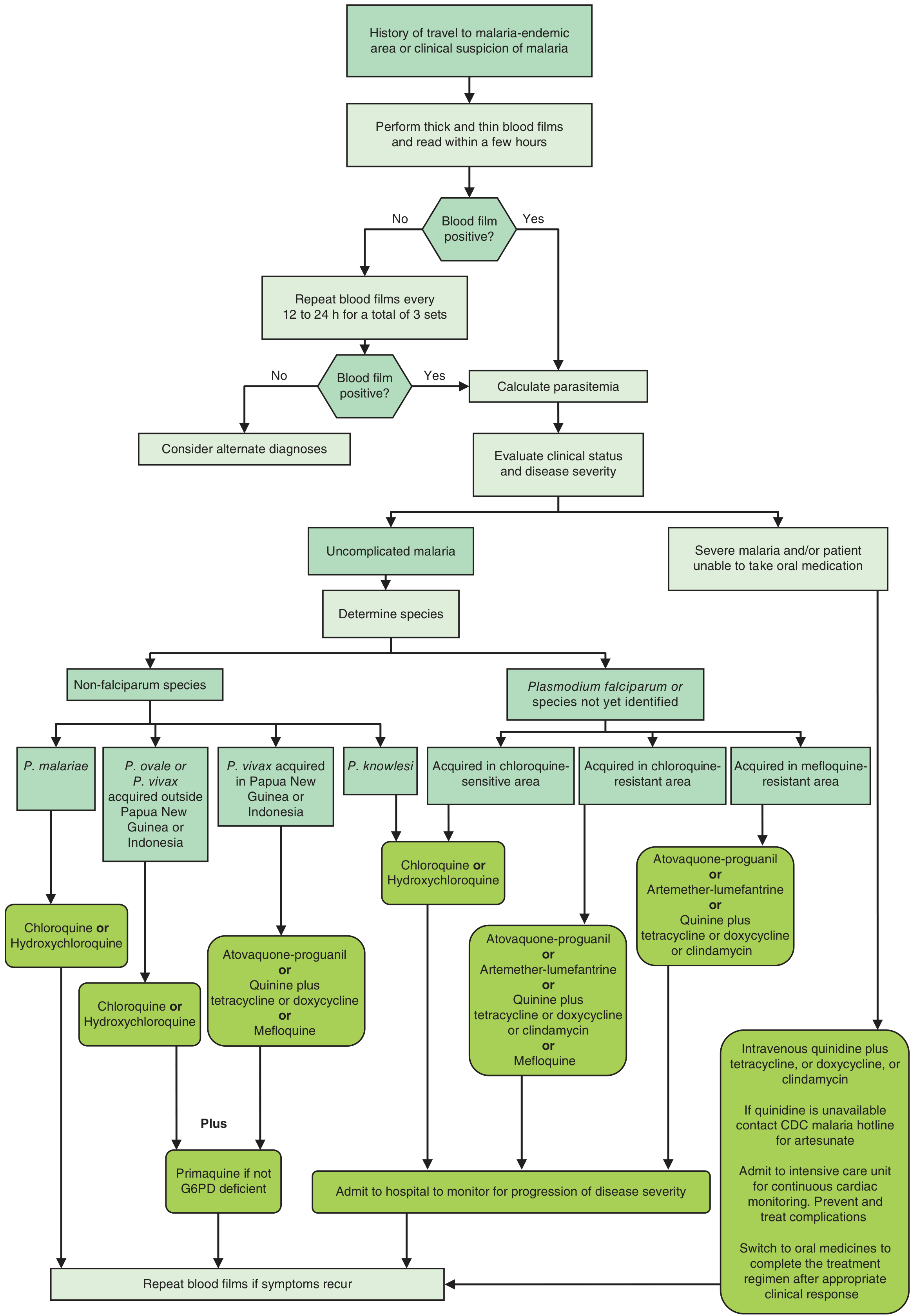
Decision Algorithm (from Goodman & Gilman's Pharmacological Basis of Therapeutics):
Principles of Management
All confirmed malaria cases (by microscopy or RDT) should receive prompt, effective treatment. The choice of agent depends on:
- Plasmodium species (falciparum vs. non-falciparum)
- Severity (uncomplicated vs. severe)
- Geographic resistance patterns (chloroquine-sensitive vs. resistant area)
- Special populations (pregnancy, children, G6PD deficiency)
1. Uncomplicated P. falciparum Malaria
Chloroquine-Resistant Areas (most of the world)
These are the preferred regimens (Goldman-Cecil Medicine):
| Regimen | Dose |
|---|---|
| Artemether-lumefantrine (Coartem) | 4 tablets twice daily x 3 days |
| Atovaquone-proguanil (Malarone) | 4 tablets daily x 3 days |
| Quinine + Doxycycline | Quinine 650 mg TID x 3-7 days + Doxycycline 100 mg BD x 7 days |
| Quinine + Clindamycin | Quinine 650 mg TID + Clindamycin 600 mg BD x 7 days |
| Mefloquine | 750 mg then 500 mg 6-8 hrs later (or 1250 mg single dose) |
In India, the National Programme recommends Artesunate + Sulphadoxine-Pyrimethamine (ACT) for 3 days plus a single dose of Primaquine (0.75 mg/kg) on Day 2 as a gametocidal agent. In North-Eastern states (SP resistance), Artemether + Lumefantrine is used instead. - Park's Textbook of Preventive and Social Medicine
Artemisinin monotherapy is banned - it drives resistance. Always use combination therapy.
Chloroquine-Sensitive Areas
- Chloroquine phosphate: 1 g, then 500 mg at 6, 24, and 48 hours
- Add Primaquine (30 mg base daily x 14 days) only for P. vivax and P. ovale to eliminate hypnozoites
2. Uncomplicated P. vivax / P. ovale / P. malariae
- Chloroquine remains the drug of choice: 25 mg/kg total dose over 3 days
- Add Primaquine 0.25 mg/kg/day x 14 days (P. vivax/P. ovale only) to prevent relapse from liver hypnozoites
- Tafenoquine (300 mg single dose) is an alternative to primaquine for radical cure
Check G6PD status before giving primaquine or tafenoquine - both can cause severe haemolysis in G6PD-deficient patients. These drugs are also contraindicated in pregnancy and infants. - Park's Textbook; Goldman-Cecil Medicine
3. Severe / Complicated Malaria
Features of Severe Malaria (P. falciparum)
- Impaired consciousness/coma (cerebral malaria)
- Repeated convulsions
- Renal failure (creatinine >3 mg/dL)
- Severe anaemia (Hb <5 g/dL)
- Pulmonary oedema / ARDS
- Hypoglycaemia (<40 mg/dL)
- Circulatory collapse / shock
- Haemoglobinuria, jaundice, DIC
- Hyperparasitaemia (>5% in low-endemic, >10% in high-endemic areas)
Treatment (Parenteral - Medical Emergency)
| Drug | Dose |
|---|---|
| IV Artesunate (first-line) | 2.4 mg/kg IV at 0, 12, 24 hrs, then daily |
| IV Quinine dihydrochloride | 20 mg/kg over 4 hrs loading; then 10 mg/kg q8h |
| IM Artemether | 3.2 mg/kg IM loading; then 1.6 mg/kg/day |
After clinical improvement and ability to tolerate oral medications, switch to a full oral regimen (ACT, Malarone, mefloquine, or quinine + doxycycline/clindamycin). - Goldman-Cecil Medicine
Supportive Care for Severe Malaria
- Maintain fluids, electrolytes, and glucose (hypoglycaemia is common and life-threatening)
- Anticonvulsants for seizures
- Mechanical ventilation for respiratory failure
- Haemofiltration/haemodialysis for acute renal failure
- Blood transfusion for severe anaemia (Hb <5 g/dL)
- Presumptive antibiotics if sepsis is suspected
- Cardiac monitoring during IV quinine (QT prolongation risk)
4. Malaria in Pregnancy
| Trimester | P. falciparum | P. vivax |
|---|---|---|
| 1st trimester | Quinine (ACT avoided) | Chloroquine |
| 2nd & 3rd trimester | ACT | Chloroquine |
- Primaquine is contraindicated in pregnancy
- Atovaquone-proguanil, mefloquine, tetracycline, and doxycycline should be avoided in pregnancy
- Severe malaria in pregnancy is treated with IV artesunate per general guidelines, with attention to drug contraindications
5. Malaria in Children
- Dosing is generally the same as adults (paediatric dose should never exceed adult dose)
- Tetracyclines (tetracycline, doxycycline): avoid in children <8 years
- Atovaquone-proguanil: approved only for children >5 kg
- Artemether-lumefantrine: not for children <5 kg
6. Drug Resistance
- Suspect resistance if no clinical or parasitological response within 72 hours of full treatment (with no vomiting or diarrhoea)
- ACT-resistant cases: treat with oral quinine + tetracycline/doxycycline
- P. vivax chloroquine resistance (Papua New Guinea, Indonesia): use atovaquone-proguanil, quinine + tetracycline/doxycycline, or mefloquine
7. Key Drug Notes
| Drug | Key Toxicities / Notes |
|---|---|
| Quinine | Cinchonism (tinnitus, headache, nausea), hypoglycaemia, QT prolongation, haemolysis in G6PD deficiency; "Blackwater fever" (rare) |
| Chloroquine | Well tolerated; retinal toxicity with long-term use |
| Primaquine/Tafenoquine | Haemolytic anaemia in G6PD deficiency; check G6PD before use |
| Artemether-lumefantrine | Avoid in 1st trimester and <5 kg; not monotherapy |
| Mefloquine | Neuropsychiatric effects (anxiety, nightmares, psychosis); avoid with concurrent quinine |
| Atovaquone-proguanil | GI side effects; requires fatty meal for absorption |
| Doxycycline | Phototoxicity; not in pregnancy or children <8 yrs |
8. Chemoprophylaxis (for Travellers)
For travel to endemic regions, options include:
- Atovaquone-proguanil: start 1-2 days before, continue 7 days after travel
- Doxycycline: daily, start 1-2 days before, continue 4 weeks after
- Mefloquine: weekly, start 2-3 weeks before, continue 4 weeks after
- Chloroquine: for chloroquine-sensitive areas only
Sources: Goldman-Cecil Medicine (26th Ed.) | Goodman & Gilman's Pharmacological Basis of Therapeutics (14th Ed.) | Park's Textbook of Preventive and Social Medicine | Katzung's Basic and Clinical Pharmacology (16th Ed.)
This is a shared conversation. Sign in to Orris to start your own chat.