
Uses and side effect of histamine agonist drugs
Reading File
Quick answer: Histamine agonist drugs act on H1, H2, H3, or H4 receptors. Clinical uses include betahistine (H1 agonist/H3 antagonist) for Meniere's disease, betazole and pentagastrin (H2) for gastric acid secretion testing, and investigational H3/H4 agonists for neurological and inflammatory conditions. Side effects vary by receptor subtype - mainly GI upset, headache, flushing, and bronchoconstriction.
Searching sources...
Finding Sources
Finding Sources
Good results. Now let me read the most relevant sections from Katzung and Goodman & Gilman in parallel.
Reading File
Reading File
Excellent content. Let me now read more from Katzung on histamine agonist uses and also fetch the H2 agonist structure image.
Reading File
Reading File
Excellent data. Let me now read the clinical uses section from Katzung and also fetch the H2 agonist structural image.
Reading File
Loading Image
Now let me get the clinical uses section from Katzung and the Goodman & Gilman details on specific agonist drug uses.
Reading File
Reading File
I now have comprehensive data from both Katzung and Goodman & Gilman. Let me compile the full answer.
Histamine Agonist Drugs: Uses and Side Effects
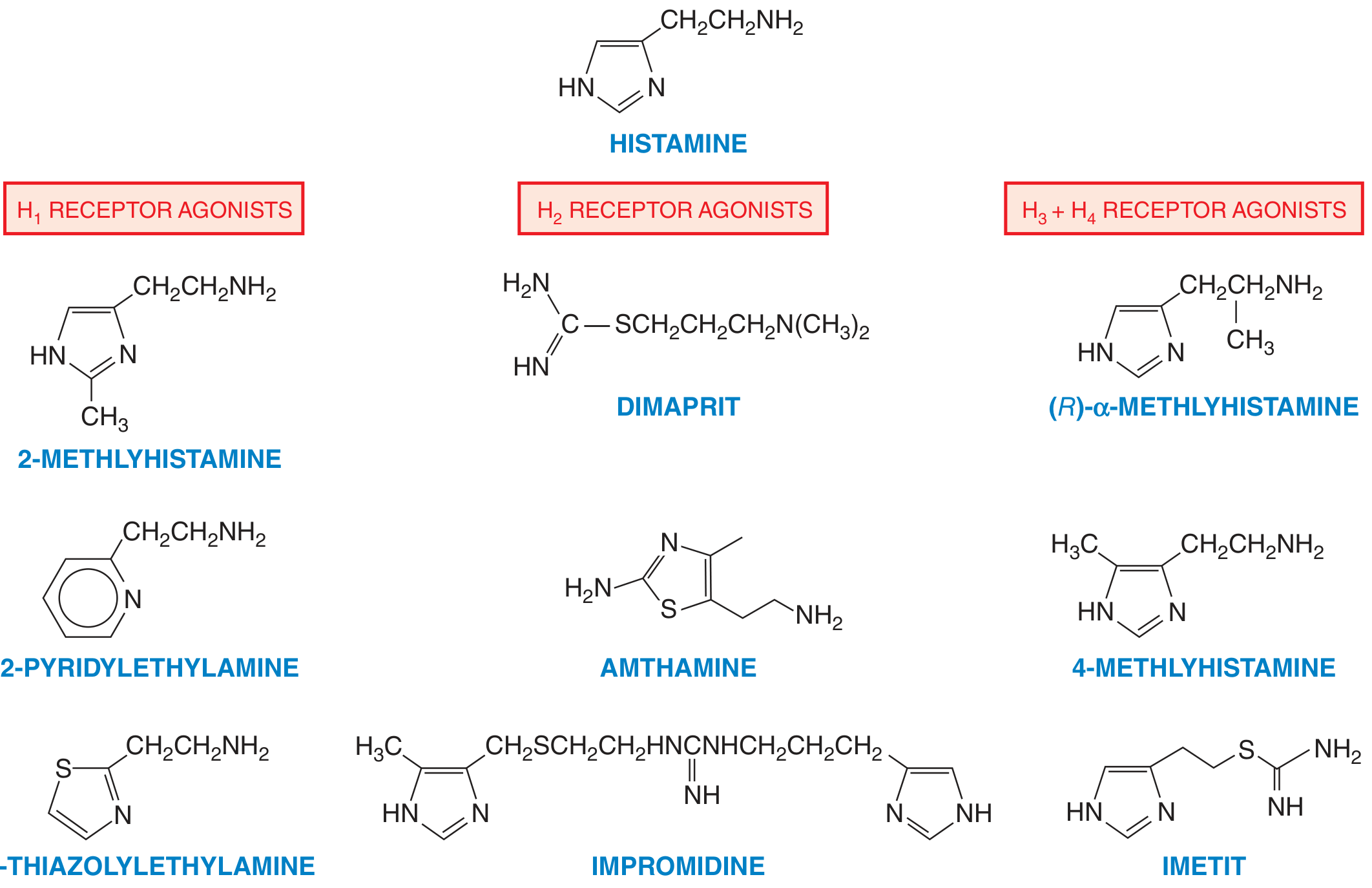
Overview
Histamine itself has broad and largely undesirable peripheral effects, so it has almost no direct clinical use. However, compounds that selectively activate specific receptor subtypes have distinct clinical applications. There are four G protein-coupled histamine receptor subtypes, each with different tissue distribution and signaling mechanisms.
Histamine Receptor Subtypes and Their Agonists
| Receptor | Location | G Protein / Signaling | Selective Agonists |
|---|---|---|---|
| H1 | Smooth muscle, endothelium, brain | Gq/11 -> IP3, DAG -> ↑Ca²⁺ | 2-Methylhistamine, histapridifen, 2-pyridylethylamine |
| H2 | Gastric mucosa, cardiac muscle, mast cells, brain | Gs -> ↑cAMP | Dimaprit, amthamine, impromidine, betazole |
| H3 | Presynaptic autoreceptors - brain, myenteric plexus | Gi/o -> ↓cAMP | R-α-methylhistamine, imetit, imnepip |
| H4 | Eosinophils, neutrophils, mast cells, CD4 T cells | Gi/o -> ↓cAMP | Clobenpropit, imetit, 4-methylhistamine |
(Katzung's Basic and Clinical Pharmacology, 16th Ed.)
Clinical and Experimental Uses
1. Histamine itself
- Bronchial provocation test: Histamine aerosol is rarely used in pulmonary function laboratories as a provocative test of bronchial hyperreactivity to diagnose asthma or airway hyper-responsiveness.
- No other current clinical use - its broad undesirable peripheral effects make it unsuitable for routine therapy.
2. H2 Receptor Agonists (Diagnostic Use)
- Betazole (Histalog) and pentagastrin: Used as gastric acid secretagogues to test maximal acid output from parietal cells. These H2 agonists stimulate copious secretion of gastric acid, pepsin, and intrinsic factor. H2 receptor activation elevates cAMP in parietal cells, driving acid secretion - this forms the basis of the "pentagastrin test" or "betazole stimulation test" for diagnosing conditions like achlorhydria, pernicious anemia, or Zollinger-Ellison syndrome.
- H2 agonists also increase heart rate and act as positive chronotropes in cardiac muscle.
3. Betahistine (H1 partial agonist / H3 antagonist) - Clinically Available
- Meniere's disease: Betahistine is used to reduce frequency and severity of vertigo attacks. It acts as a weak H1 agonist and H3 antagonist, improving microcirculation in the inner ear and modulating vestibular neurotransmission. It is widely available outside the US.
4. H3 Receptor Agonists (Experimental/Research)
- H3 receptors are presynaptic autoreceptors that inhibit release of histamine and other neurotransmitters (acetylcholine, norepinephrine, serotonin, dopamine).
- H3 agonists (R-α-methylhistamine, imetit) are primarily research tools.
- Potential investigational uses: obesity (H3 knockout mice show increased food intake and insulin resistance), nociception modulation, and regulation of arousal.
- H3 selective agonists also inhibit gastric acid secretion stimulated by food or pentagastrin.
5. H4 Receptor Agonists (Investigational)
- H4 receptors are expressed predominantly on immune cells (eosinophils, mast cells, neutrophils, CD4 T cells).
- H4 agonists such as 4-methylhistamine and dimaprit (which is actually more potent at H4 than H2) are used as research tools to study immune cell chemotaxis, allergic inflammation, and itch pathways.
- They have no approved clinical use currently.
Side Effects
Side effects of histamine agonist drugs broadly reflect H1 and H2 receptor activation throughout the body. These are dose-related and replicate the effects of excessive histamine release:
Cardiovascular
- Hypotension (orthostatic and systemic) - due to vasodilation and endothelial NO production via H1
- Tachycardia / reflex tachycardia - both H1 and H2 mediated
- Flushing - widespread vasodilation, especially head, face, neck, and chest
- Headache - from vasodilation of cerebral vessels
Respiratory
- Bronchoconstriction - H1-mediated smooth muscle contraction; risk of severe bronchospasm in asthmatics
- Increased respiratory secretions
Gastrointestinal
- Increased gastric acid secretion - H2 mediated; can trigger or worsen peptic ulceration, gastric bleeding
- Nausea, colic, diarrhea - GI smooth muscle stimulation
- Hypersecretion of pepsin and intrinsic factor
Skin
- Urticaria (hives) - H1-mediated
- Pruritus (itching) - stimulation of peripheral sensory nerve endings
- Triple response - redness, wheal, flare at the site of injection
CNS
- Headache
- At high doses: CNS stimulation or sedation depending on receptor subtype
Special Situations (Histamine Release)
When drugs cause histamine release (e.g., morphine, tubocurarine, succinylcholine, radiocontrast media, some antibiotics), a cascade of effects follows within seconds:
"Burning, itching sensation... most marked in the palms... intense warmth... skin reddens... blood pressure falls, heart rate accelerates, headache. After a few minutes, blood pressure recovers, and crops of hives appear on the skin. Colic, nausea, hypersecretion of acid..." - Goodman & Gilman, p. 878
Contraindications
- Asthma - risk of life-threatening bronchoconstriction (histamine and H1 agonists contraindicated except under monitored pulmonary function testing)
- Active peptic ulcer disease or GI bleeding - H2 agonist activity worsens acid hypersecretion
- Cardiovascular instability - hypotension and tachycardia risk
Key Takeaway
"Because of their broad and largely undesirable peripheral effects, neither histamine nor serotonin has any clinical application in the treatment of disease. However, compounds that selectively activate certain receptor subtypes... are of considerable clinical value." - Katzung's Basic and Clinical Pharmacology, 16th Ed., p. 436
The clinically most relevant histamine agonist in practice is betahistine (Meniere's disease) and betazole/pentagastrin (diagnostic gastric acid testing). H3 and H4 agonists remain largely experimental, with research interest in obesity, neurological disorders, and inflammatory/immune conditions.
This is a shared conversation. Sign in to Orris to start your own chat.