
A patient complains of fever & malaise for 2 days and he is being treated with paracetamol. a. How does paracetamol reduce fever? b. What are the important differences between paracetamol & aspirin?
Reading File
Now let me search the medical library for paracetamol mechanism and paracetamol vs aspirin comparison in parallel.
Finding Sources
Finding Sources
Finding Sources
Finding Sources
I found excellent sources. Let me now read the key sections from Goodman & Gilman's (the gold standard pharmacology reference) and Lippincott Pharmacology for detailed content on both questions.
Reading File
Reading File
Excellent - I have very detailed content from Goodman & Gilman's. Let me now read the Lippincott section on acetaminophen mechanism and the aspirin section for comparison data.
Reading File
Finding Sources
Reading File
Finding Sources
I now have comprehensive data from authoritative pharmacology references. Let me also fetch the Lippincott metabolism diagram for visual clarity.
Loading Image
Finding Sources
I have all the information needed for a thorough answer. Here is the complete, well-referenced response:
a. How Does Paracetamol Reduce Fever?
The Febrile Response (Context)
Fever arises when pyrogens (e.g., bacterial products, cytokines like IL-1, IL-6, TNF) stimulate the synthesis of prostaglandin E₂ (PGE₂) in the hypothalamus. PGE₂ raises the thermoregulatory set-point, triggering heat conservation and production. Paracetamol acts by blocking this process centrally.
Mechanism
Paracetamol (acetaminophen, APAP) is a non-selective COX (cyclooxygenase) inhibitor that works preferentially within the CNS. It inhibits prostaglandin synthesis in the hypothalamus, thereby lowering the elevated set-point back to normal - this causes vasodilation and sweating, dissipating the excess heat.
There is a key nuance here: paracetamol acts at the peroxide tone (peroxide site) of COX enzymes, and its inhibitory activity is markedly reduced in the presence of high concentrations of peroxides - as occurs at peripheral sites of inflammation (e.g., a wound, an abscess). Because peripheral inflammatory sites are rich in peroxides, paracetamol's COX inhibition is neutralized there. The CNS, however, has a low peroxide environment, so COX inhibition is maintained centrally. This is why paracetamol:
- Reduces fever (central COX inhibition → ↓ hypothalamic PGE₂)
- Relieves mild-to-moderate pain (central inhibition of pain sensitization)
- Has weak or no anti-inflammatory effect (peripheral COX activity is not meaningfully blocked)
"Acetaminophen has analgesic and antipyretic effects like those of aspirin, but only weak anti-inflammatory effects at commonly used doses (1000 mg/day). It is a nonselective COX inhibitor, which acts at the peroxide site of the enzyme... The presence of high concentrations of peroxides, as occur at sites of inflammation, reduces its COX-inhibitory activity."
- Goodman & Gilman's The Pharmacological Basis of Therapeutics
"Acetaminophen inhibits prostaglandin synthesis in the CNS, leading to antipyretic and analgesic effects. Acetaminophen has less effect on cyclooxygenase in peripheral tissues (due to peripheral inactivation), which accounts for its weak anti-inflammatory activity."
- Lippincott Illustrated Reviews: Pharmacology
Dose and Pharmacokinetics
- Oral dose: 325-650 mg every 4-6 hours; maximum 4 g/day in healthy adults (2 g/day in those with hepatic disease or alcoholism)
- Onset: plasma peak at 30-60 minutes after oral dosing; half-life ~2 hours
- Metabolism: ~90-95% conjugated with glucuronide or sulfate (inactive, renally excreted); a small fraction is oxidized by CYP2E1/CYP3A4 to the toxic metabolite NAPQI, which is detoxified by hepatic glutathione at therapeutic doses
b. Important Differences Between Paracetamol and Aspirin
| Feature | Paracetamol | Aspirin |
|---|---|---|
| Drug class | Non-NSAID analgesic/antipyretic | NSAID (salicylate) |
| COX inhibition | Non-selective, reversible, site: CNS (peroxide-tone dependent) | Non-selective, irreversible (acetylates serine residue of COX-1 and COX-2) |
| Analgesic | Yes (mild-moderate) | Yes (mild-moderate) |
| Antipyretic | Yes | Yes |
| Anti-inflammatory | Weak/absent at therapeutic doses | Yes - potent anti-inflammatory |
| Antiplatelet effect | None - does not affect platelet function or bleeding time | Yes - irreversibly inhibits platelet TXA₂ synthesis; antiplatelet effect lasts for platelet lifespan (~7-10 days) |
| GI side effects | Minimal - does not irritate gastric mucosa; preferred in patients with GI risk | Significant - causes gastric erosion, ulcers, GI bleeding (inhibits PGE₂-mediated mucosal cytoprotection) |
| Effect on uric acid | None | Dose-dependent: low doses (< 2 g/day) retain uric acid (↓ urate secretion); high doses (> 5 g/day) uricosuric; intermediate doses have unpredictable effect |
| Reye syndrome risk | None - safe in children with viral illness | Yes - contraindicated in children < 12 years with febrile viral illness due to risk of Reye syndrome (hepatic failure + encephalopathy) |
| Hepatotoxicity | Major risk in overdose - NAPQI depletes glutathione → hepatic necrosis; antidote is N-acetylcysteine | Minimal at therapeutic doses |
| Acid-base disturbances | None | Salicylate toxicity: initially respiratory alkalosis (hyperventilation), then metabolic acidosis |
| Pregnancy | Generally considered safe (Category B) | Avoided especially in third trimester (premature closure of ductus arteriosus) |
| Use in peptic ulcer disease | Preferred | Contraindicated |
| Drug interactions | Warfarin (mild potentiation with chronic use); alcohol (↑ hepatotoxicity risk) | Warfarin (significant ↑ bleeding risk); displaces protein-bound drugs; ↑ methotrexate toxicity |
| Cardiovascular risk | Does not increase CV risk | Low-dose aspirin is cardioprotective (antiplatelet); higher doses may have variable effects |
Key Summary Points
- Anti-inflammatory: Aspirin has it; paracetamol does not (at therapeutic doses).
- Platelet effects: Aspirin irreversibly inhibits platelets (used as antiplatelet therapy in cardiovascular disease); paracetamol has no effect on platelets or bleeding time.
- GI safety: Paracetamol is much safer on the gastric mucosa; aspirin causes ulcers and GI bleeding.
- Pediatric use: Paracetamol is the preferred antipyretic in children; aspirin is contraindicated in febrile viral illnesses due to Reye syndrome.
- Hepatotoxicity: Paracetamol is uniquely dangerous in overdose (NAPQI-mediated liver necrosis); aspirin's toxicity profile is primarily renal/GI/hematologic.
- Mechanism: Both inhibit COX, but aspirin does so irreversibly via covalent acetylation, while paracetamol's action is reversible and restricted to the low-peroxide CNS environment.
Acetaminophen metabolism diagram (Lippincott Illustrated Reviews: Pharmacology):
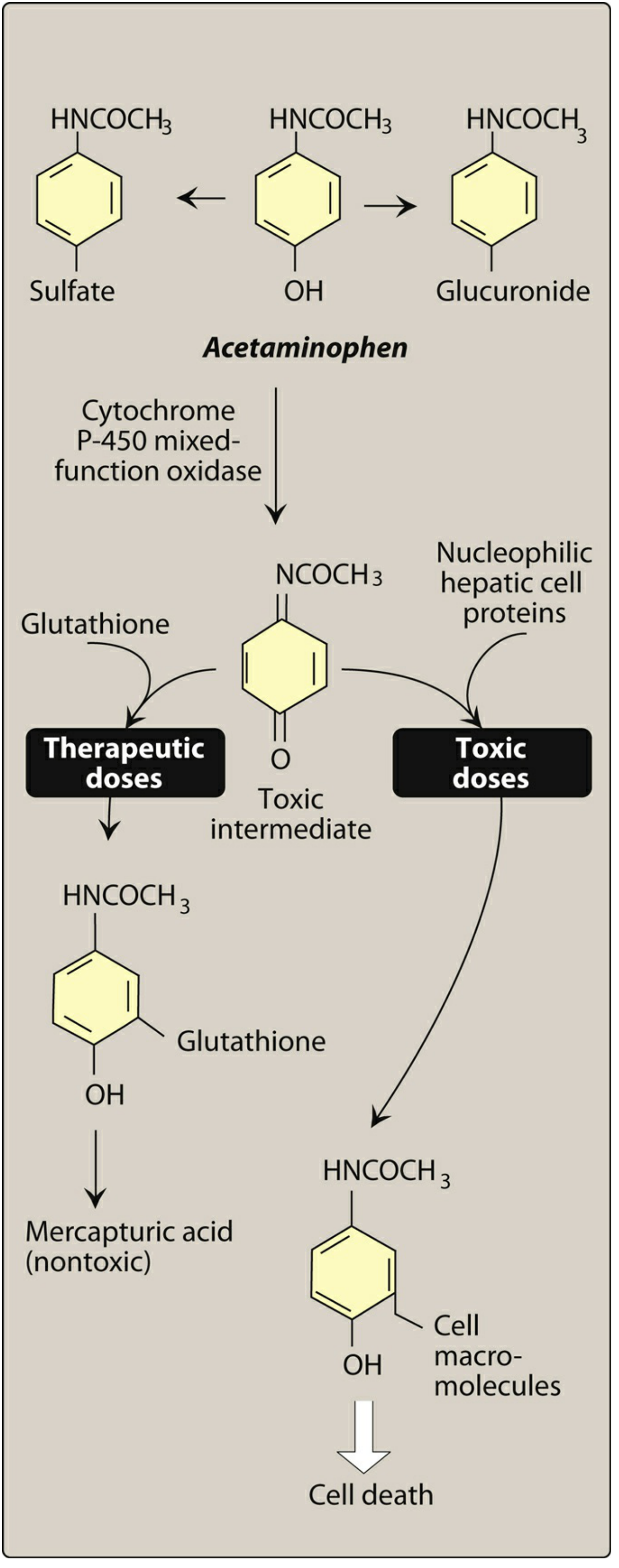
At therapeutic doses, the NAPQI toxic intermediate is safely conjugated with glutathione to form mercapturic acid (nontoxic). At toxic doses, glutathione stores are depleted and NAPQI binds to hepatocyte macromolecules, causing cell death.
Sources: Goodman & Gilman's The Pharmacological Basis of Therapeutics | Lippincott Illustrated Reviews: Pharmacology | Henry's Clinical Diagnosis and Management by Laboratory Methods
This is a shared conversation. Sign in to Orris to start your own chat.