
Evidence of sprinting and growth hormone
Reading File
Reading File
Now I'll run parallel searches — textbook content on GH physiology + sprint-related GH release, and PubMed for the latest evidence.
Finding Sources
Searching PubMed
"growth hormone" AND "sprint" AND exercise
Good. Now let me read the key textbook sections and pull abstracts from the most relevant papers in parallel.
Reading File
Reading File
Reading Article
PMID: 12932743
Reading Article
PMID: 34936049
Reading Article
PMID: 35168036
Now let me get the key specific details — the intensity-dependence of the GH response, the Stokes 2003 mechanisms, and the Sellami sprint+resistance paper.
Reading File
Reading Article
PMID: 28800636
Searching PubMed
"growth hormone" AND "high intensity" AND exercise AND "lactate"
I now have enough to compose a thorough, well-cited answer. Let me also fetch the GH daily secretion graph from Guyton.
Loading Image
Here is a comprehensive synthesis of the evidence on sprinting and growth hormone (GH).
Sprinting and Growth Hormone: The Evidence
1. Exercise as a Fundamental GH Stimulus
Exercise — particularly strenuous exercise — is one of the most potent physiological triggers of GH secretion. The chart below from Guyton & Hall shows that strenuous exercise can drive plasma GH to ~28–30 ng/mL (compared to a resting adult baseline of 1.6–3 ng/mL), rivalling the spike seen in early deep sleep:
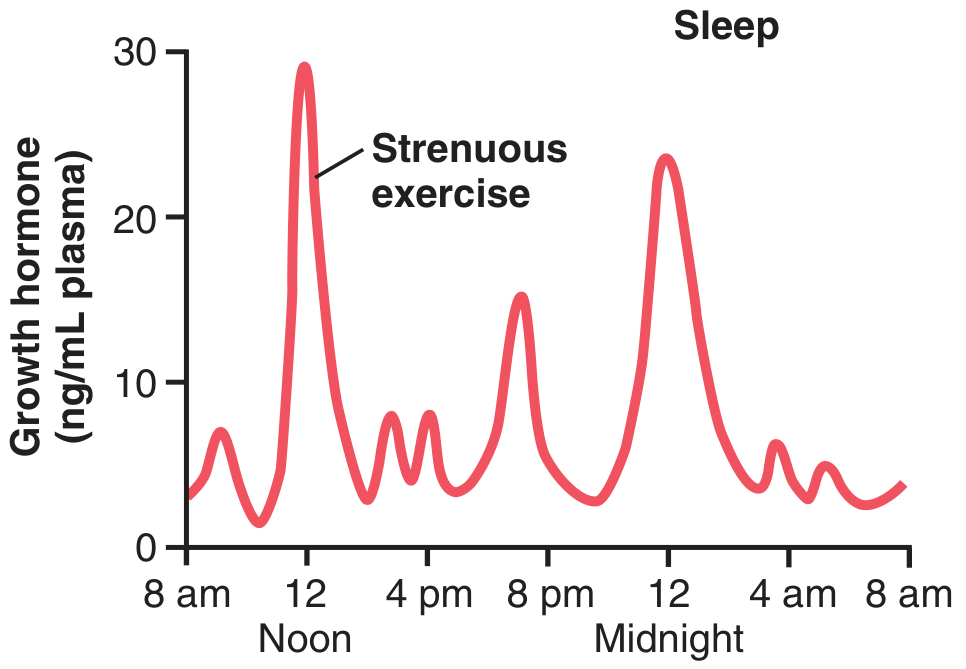
Exercise appears in every major physiology text as a stimulus in the same tier as hypoglycemia, trauma, and deep sleep. — Guyton and Hall Textbook of Medical Physiology, p. 923; Ganong's Review of Medical Physiology, 26th ed., p. 330
2. Intensity is the Key Variable: Why Sprinting is Particularly Effective
Not all exercise elicits equivalent GH responses. The evidence consistently shows a dose-response relationship with intensity:
| Exercise Type | GH Response |
|---|---|
| Low-intensity (<50% VO₂max) | Minimal or negligible |
| Moderate/sub-maximal aerobic | Moderate, variable |
| Sprint / supra-maximal (>90% VO₂max) | Large, reproducible spikes |
A 2003 dedicated review by Stokes (PMID 12932743) specifically examined GH responses to sub-maximal and sprint exercise and concluded: "Exercise is a potent stimulus for GH release and a single bout of exercise can result in marked elevations in circulating GH concentrations. The magnitude of the GH response will vary according to the type, intensity, and duration of exercise." The review also addressed the proposed mechanisms (see below).
A landmark study by Felsing et al. (1992, PMID 1619005) directly compared low vs. high intensity exercise and confirmed that only high-intensity effort substantially elevates circulating GH in men.
3. Proposed Mechanisms of Sprint-Induced GH Release
The exact mechanisms are not fully elucidated, but current evidence points to several mediators:
-
Metabolic acidosis / lactate accumulation: High-intensity sprinting produces substantial lactate. Lactate and/or the associated fall in pH appear to stimulate GHRH release or suppress somatostatin in the hypothalamus. Glucose infusions — which suppress lactate and sustain blood glucose — blunt the GH response to exercise. — Ganong's Review, p. 330
-
GHRH/somatostatin axis: Sprint-induced sympathoadrenal activation increases catecholamines, which act via α-adrenergic pathways in the hypothalamus to stimulate GHRH secretion from arcuate/ventromedial neurons and suppress somatostatin. — Guyton & Hall, p. 924
-
Adrenergic and cholinergic signalling: α-adrenergic agonists that penetrate the CNS stimulate GH; β-adrenergic blockade partially attenuates exercise-induced GH. — Ganong's Review, Table 18-2
-
Ghrelin: Stomach-derived ghrelin, elevated in energy deficit states accompanying intense exercise, is a co-stimulator of GH release. — Guyton & Hall, Table 76.3
-
Nitric oxide: Some evidence suggests NO may mediate a portion of exercise-induced GH secretion, possibly through hypothalamic pathways.
4. RCT Evidence: Sprint Interval Exercise (SIE)
A 2022 RCT (Kon et al., PMID 35168036) in healthy males used a validated Wingate-type sprint protocol (four 30-second all-out bouts with 4 min recovery):
- Both normoxic and hyperoxic conditions significantly increased GH, epinephrine, norepinephrine, lactate, free fatty acids, and angiogenic markers (VEGF, MMP-2/9) (p < 0.01)
- The GH response was not suppressed by supplemental oxygen (FiO₂ = 60%), suggesting that the mechanism is not purely hypoxia-driven but likely metabolic/neural
5. Training Effects: Sprint Training Elevates Basal GH Axis Activity
Beyond acute responses, chronic sprint training modulates the entire GH/IGF-1 axis:
-
Sellami et al. (2017, PMID 28800636): A 13-week combined sprint + resistance training program increased resting GH and GH response to Wingate testing in both young (21 yrs) and middle-aged (40 yrs) men. Critically, post-training, the age-related difference in basal GH was abolished — CSRT "abrogated age differences in somatotropic hormones."
-
Zouhal et al. (2022, Systematic Review, PMID 34936049): 33 studies confirmed that exercise training — including sprint interval training — increases basal testosterone, IGF-1, SHBG, hGH, and DHEA in adults >40 years, with effect sizes ranging from small to very large (d = 0.19–3.37). The effect was independent of training mode, duration, or intensity.
6. Modifying Factors
Several variables modulate the magnitude of the sprint-GH response:
| Factor | Effect on GH Response |
|---|---|
| Female sex | Generally larger acute GH response to sprint than males |
| Oral contraceptives | Attenuate sprint-induced GH (Sunderland et al., 2011; PMID 21848445) |
| Age | Response declines with age; GH falls to ~25% of adolescent levels in old age |
| Obesity | Blunts GH response |
| Sleep deprivation | Reduces exercise-induced GH (Ritsche et al., 2014; PMID 25281616) |
| Glucose infusion | Inhibits exercise-induced GH response |
| Fitness level | Trained individuals show altered GH kinetics (faster response, faster clearance) |
7. Clinical / Applied Relevance
- Anti-doping: Sprinting acutely raises GH to levels that may superficially resemble exogenous GH administration — this complicates detection. The GH isoform test and IGF-1 biomarker panel are used to distinguish endogenous surges from exogenous use. — Birzniece, 2015 (PMID 25369881)
- Children/adolescents: Exercise provocation testing (including sprint-type stimuli) is used clinically as a GH secretion stimulus in the workup for GH deficiency. — Tietz Textbook of Laboratory Medicine, 7th ed.
- Aging: Sprint-type training is increasingly recognized as a non-pharmacological strategy to attenuate the age-related decline in GH/IGF-1 axis activity (somatopause).
Summary
Sprinting is among the most effective physiological stimuli for GH secretion. The response is intensity-dependent, likely mediated via lactate/pH-driven suppression of somatostatin, hypothalamic GHRH/adrenergic signalling, and possibly ghrelin and NO. Acute sprint bouts reliably raise plasma GH 10–20× above baseline. Chronic sprint training elevates basal GH axis activity and can partially reverse age-related decline. These effects are well-established at the textbook level and confirmed by RCTs and systematic reviews.
Key sources:
- Guyton & Hall Medical Physiology, p. 923–924
- Ganong's Review of Medical Physiology 26th ed., p. 330
- Stokes K. Growth hormone responses to sub-maximal and sprint exercise. Growth Horm IGF Res. 2003. [PMID: 12932743]
- Kon et al. Sprint interval exercise under hyperoxia. Growth Horm IGF Res. 2022. [PMID: 35168036]
- Sellami et al. Combined sprint and resistance training. PLoS One. 2017. [PMID: 28800636]
- Zouhal et al. Systematic review: exercise and anabolic hormones with age. Sports Med. 2022. [PMID: 34936049]
This is a shared conversation. Sign in to Orris to start your own chat.