
Breast congenital anomaly in short
Reading File
Now let me search the medical library for breast congenital anomalies.
Finding Sources
Finding Sources
Good leads. Let me read the most relevant sections from the surgery textbook and dermatology textbook.
Finding Sources
Reading File
Reading File
Finding Sources
Finding Sources
Finding Sources
Excellent results. Let me now read the key detailed sections from Bailey & Love's (surgical text), embryology textbook, and Creasy & Resnik's MFM.
Reading File
Reading File
Reading File
I now have comprehensive information. Let me fetch one image and also read the Sabiston text on breast development for the milk-line embryology details.
Loading Image
Reading File
I now have all the information needed for a thorough, concise summary. Let me compile the answer.
Congenital Anomalies of the Breast
Embryological Basis
In utero, an ectodermal thickening forms the mammary ridge (milk line/milk streak) - a bilateral band running from the axilla to the inguinal region. At ~9 weeks, all but the pectoral portion regresses to form one pair of breasts. Aberrant regression (too little or too much) causes the various congenital anomalies.
- Sabiston Textbook of Surgery, p. 1372
Classification
1. Deficiency Anomalies (Absent / Underdeveloped)
| Term | Definition |
|---|---|
| Amastia | Complete congenital absence of the breast and nipple (bilateral or unilateral) |
| Amazia | Nipple present but no underlying breast tissue |
| Athelia | Absence of the nipple only (breast tissue may be present) |
| Hypoplasia | Underdevelopment of breast tissue |
-
Result from failure of the mammary bud to develop or premature disappearance of the mammary crest.
-
May be associated with Turner syndrome (gonadal agenesis), Poland syndrome, or occur in isolation.
-
The Developing Human: Clinically Oriented Embryology, p. 1187
-
Creasy & Resnik's Maternal-Fetal Medicine, Box 11.2
2. Excess / Accessory Anomalies
| Term | Definition |
|---|---|
| Polymastia (Polymazia) | Supernumerary (extra) breast(s) anywhere along the milk line |
| Polythelia (Hyperthelia) | Supernumerary nipple(s) - the most common breast anomaly, seen in 1-6% of the population |
| Hyperadenia | Mammary gland tissue present without a nipple |
Key facts:
-
Both occur due to incomplete regression of the mammary ridge.
-
Most commonly found along the inframammary chest and axilla; rarely in groin, thigh, or buttock.
-
Polythelia: incidence similar in males and females; ~10% of cases are familial.
-
Accessory tissue responds to hormones (enlarges during puberty, pregnancy, lactation) and can develop the same benign and malignant diseases as normal breast tissue.
-
Polythelia is associated with renal and urinary tract anomalies - screening is recommended.
-
Polymazia may also associate with vertebral anomalies, cardiac arrhythmias, and renal anomalies.
-
Bailey & Love's Short Practice of Surgery, p. 947
-
Dermatology 2-Volume Set 5e, p. 1284
-
The Developing Human, p. 1187-1188
3. Poland Syndrome
A predominantly sporadic developmental field defect characterized by:
- Unilateral hypoplasia or complete absence of the breast / nipple
- Absence of the sternal head of pectoralis major (most consistent finding)
- May also involve: pectoralis minor, serratus anterior, costal cartilages of ribs 2-5, subcutaneous chest wall tissue
- Ipsilateral symbrachydactyly (short, webbed fingers) - hallmark associated hand anomaly
- Pathogenesis unclear; prevailing theory involves disruption of subclavian / internal mammary artery blood supply during development
Management: Breast reconstruction with latissimus dorsi muscle flap + silicone implant.
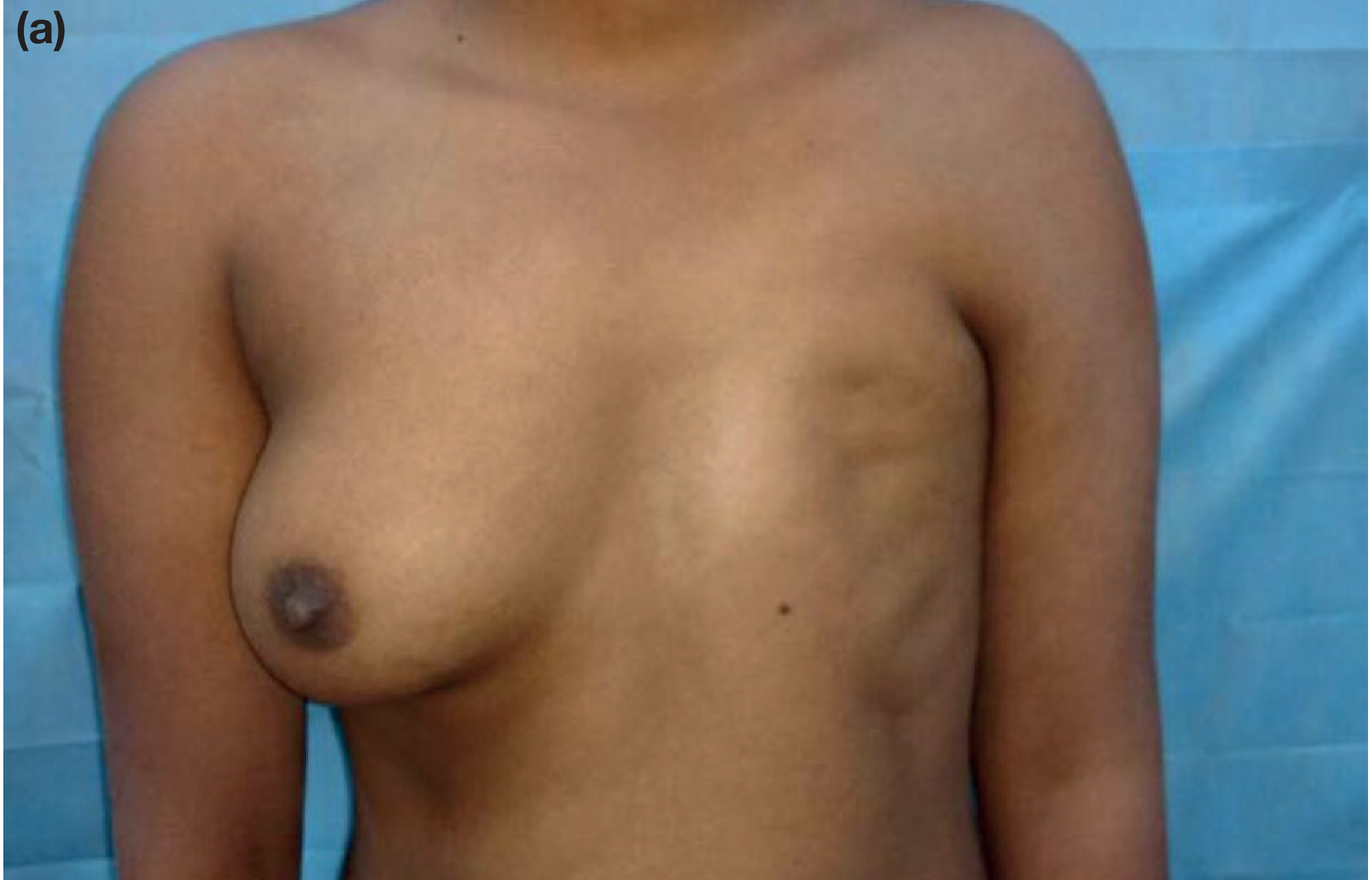
- Bailey & Love's Short Practice of Surgery, p. 947
- Sabiston Textbook of Surgery, p. 1372
- Schwartz's Principles of Surgery, Embryology section
4. Nipple Anomalies
| Term | Definition / Notes |
|---|---|
| Inverted nipples | Nipple fails to evert above the skin surface after birth or puberty; usually autosomal dominant inheritance; can be feature of congenital disorder of glycosylation Ia; may impair breastfeeding |
| Widely spaced nipples | Seen in Turner syndrome, Noonan syndrome |
5. Other / Miscellaneous
| Term | Definition |
|---|---|
| Symastia | Webbing between the two breasts across the midline |
| Gigantomastia | Excessive bilateral breast enlargement (may have congenital predisposition) |
Quick-Reference Summary Table
| Anomaly | Embryological Basis | Key Associations |
|---|---|---|
| Amastia / Athelia | Failure of mammary bud | Turner syndrome, Poland syndrome |
| Polythelia | Incomplete milk-line regression | Renal/urinary tract anomalies (screen!) |
| Polymastia | Incomplete milk-line regression | Cardiac, renal, vertebral anomalies |
| Poland syndrome | Developmental field defect (vascular?) | Ipsilateral symbrachydactyly |
| Inverted nipple | Failure of nipple eversion | Autosomal dominant; breastfeeding difficulty |
| Symastia | Failure of midline separation | Isolated or syndromic |
Sources: Bailey & Love's Short Practice of Surgery 28e, Sabiston Textbook of Surgery, The Developing Human: Clinically Oriented Embryology, Creasy & Resnik's Maternal-Fetal Medicine, Dermatology 2-Volume Set 5e (Bolongia).
This is a shared conversation. Sign in to Orris to start your own chat.