
General bones
Reading File
The query "General bones" is fairly broad. Let me clarify what you need before diving in.
Asking for Preferences
What aspect of bones are you interested in? · What level of detail do you need?
Searching sources...
Finding Sources
Finding Sources
Finding Sources
Finding Sources
The best sources are Gray's Anatomy for Students and Miller's Review of Orthopaedics. Let me read both simultaneously.
Reading File
Reading File
Reading File
Loading Image
Reading File
Loading Image
Reading File
Loading Image
Reading File
I now have comprehensive content from both Gray's Anatomy for Students and Miller's Review of Orthopaedics. Here is the detailed, exam-level overview:
General Bone Anatomy & Structure
1. What Is Bone?
Bone is a calcified, living connective tissue. It is not inert - it contains cells, receives blood supply, and is continuously remodeled. Its functions are:
- Structural support of the body
- Protection of vital organs
- Calcium and phosphorus reservoir
- Lever system for muscle-driven movement
- Container for blood-producing (hematopoietic) cells
- Gray's Anatomy for Students, p. 30
2. Macroscopic Classification
Bones are classified by shape:
| Shape | Description | Example |
|---|---|---|
| Long | Tubular | Humerus, Femur |
| Short | Cuboidal | Carpal, Tarsal bones |
| Flat | Two compact plates + spongy bone sandwich | Skull |
| Irregular | Variable shape | Facial bones, vertebrae |
| Sesamoid | Round/oval bones within tendons | Patella, thumb/toe sesamoids |
Accessory bones are extra bones (normal variants) found especially in the wrist, hands, ankles, and feet. They must not be mistaken for fractures on imaging.
- Gray's Anatomy for Students, p. 30
3. Microscopic Classification
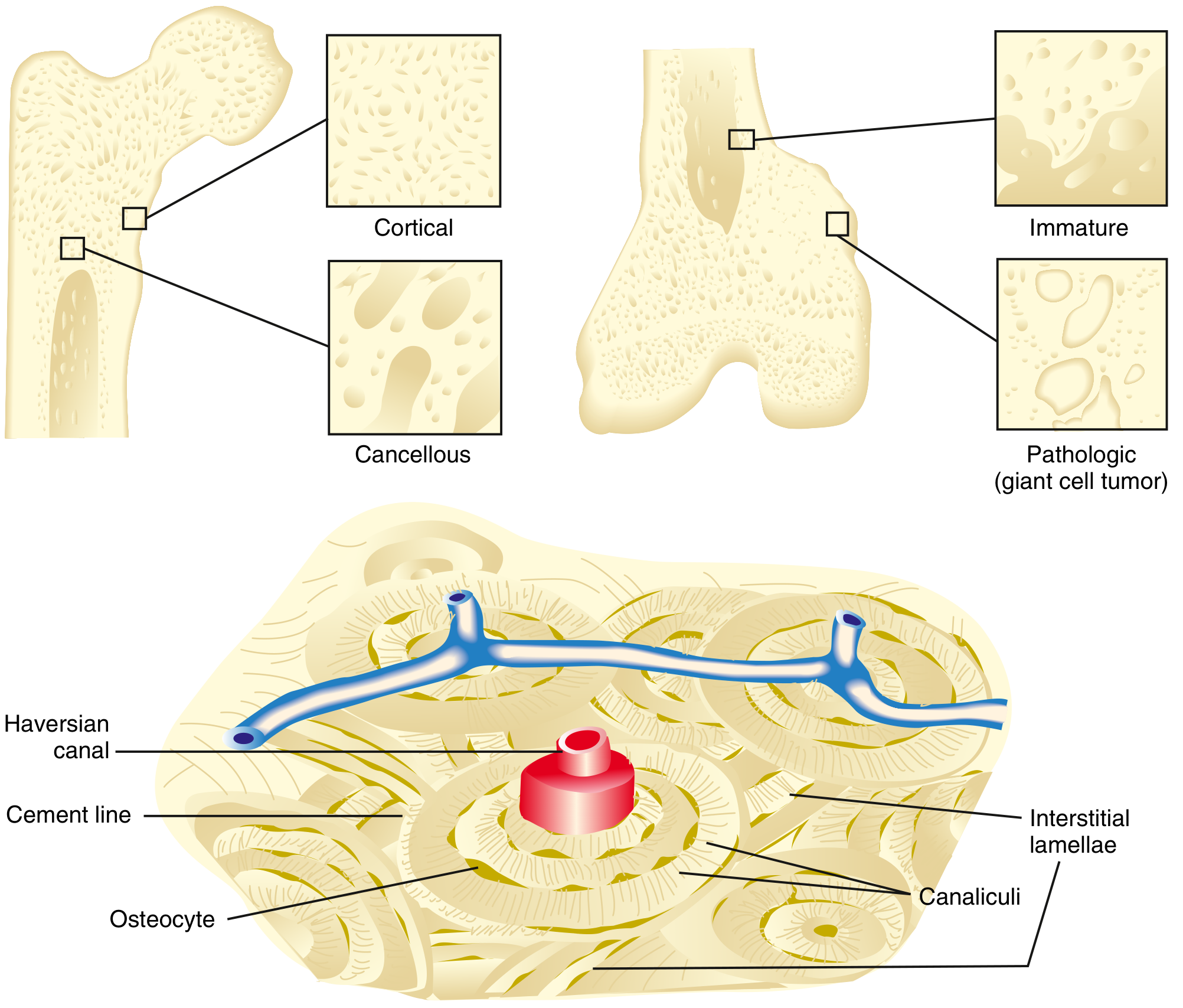
Two microscopic types:
Woven Bone
- Immature or pathologic bone
- Random collagen fiber organization, NOT stress-oriented
- High turnover rate, more osteocytes per unit area
- Weaker and more flexible
- Found in: embryonic skeleton, fracture callus, osteogenic sarcoma, fibrous dysplasia
Lamellar Bone
- Normal, mature bone
- Organized along lines of stress (stress-oriented)
- Less flexible, stronger
- Created by remodeling of woven bone
- Miller's Review of Orthopaedics 9th Ed., p. 20
4. Macroscopic Subtypes: Cortical vs. Cancellous
Cortical (Compact) Bone
- Makes up 80% of the skeleton
- Slow turnover, high Young's modulus (stiff)
- Composed of tightly packed osteons (Haversian systems)
- Each osteon = concentric lamellae around a central Haversian canal
- Haversian canals contain arterioles, venules, capillaries, and nerves
- Haversian canals run longitudinally; Volkmann's canals run transversely, connecting Haversian canals to each other and to the periosteum
- Cement lines define the outer border of each osteon
- Interstitial lamellae fill the spaces between osteons
- Canaliculi are tiny channels containing osteocyte cell processes, providing nutrition
Cancellous (Spongy/Trabecular) Bone
- Makes up 20% of the skeleton
- Higher turnover, smaller Young's modulus (more elastic)
- Loose network of struts and plates called trabeculae
- 30-90% of trabecular bone consists of pores filled with bone marrow
- Miller's Review of Orthopaedics 9th Ed., p. 20-21
5. Bone Cells
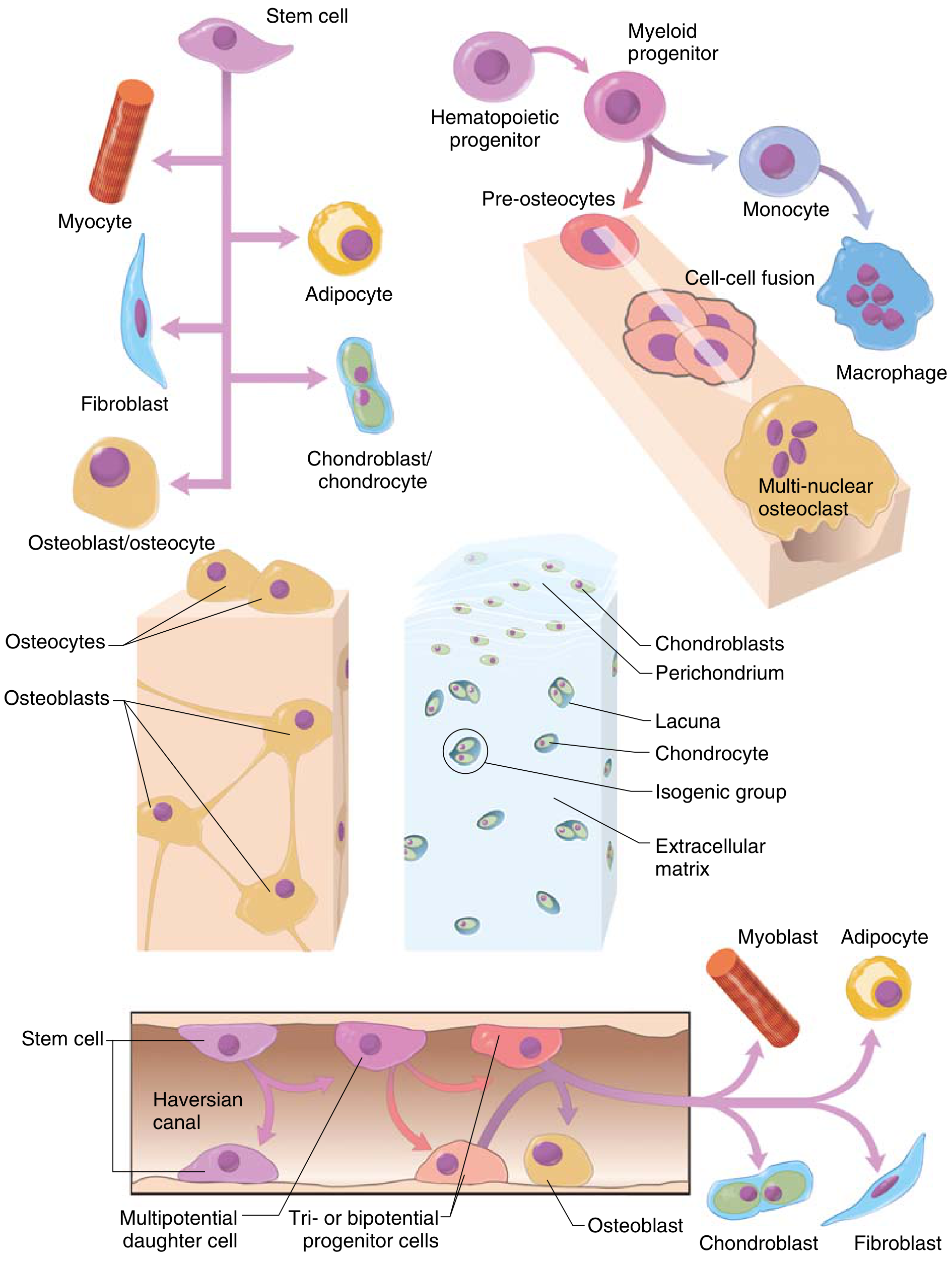
Osteoblasts (Bone-Forming Cells)
- Derived from undifferentiated mesenchymal stem cells (MSCs)
- Cuboid cells aligned along immature osteoid
- Fate depends on environment:
- Low strain + high O2 → osteoblast
- Intermediate strain + low O2 → chondrocyte
- High strain → fibrous tissue
- Directed by transcription factor RUNX2 and BMP (bone morphogenetic protein)
- Rich in endoplasmic reticulum, Golgi, mitochondria (for synthesis/secretion)
Osteoblasts produce:
- Alkaline phosphatase
- Osteocalcin (stimulated by 1,25(OH)₂D₃)
- Type I collagen
- Bone sialoprotein
- RANKL - stimulates osteoclast differentiation
- OPG (osteoprotegerin) - binds RANKL, limits osteoclast activity
Stimulated by: intermittent PTH, Wnt proteins, BMP
Inhibited by: TNF-α, sclerostin, Dkk-1, glucocorticoids
Osteocytes (Maintenance Cells)
- Constitute 90% of all cells in mature skeleton
- Former osteoblasts entrapped by newly formed matrix
- Have high nucleus/cytoplasm ratio
- Long interconnecting cytoplasmic processes project through canaliculi
- Function: maintain bone, regulate extracellular Ca²⁺ and phosphorus
- Secrete sclerostin (Scl) - provides negative feedback on osteoblast bone deposition
- Directly stimulated by calcitonin, inhibited by PTH
Osteoclasts (Bone-Resorbing Cells)
- Multinucleated irregular giant cells
- Derived from hematopoietic cells in the macrophage lineage (monocyte progenitors fuse to form them)
- Primary function: bone resorption
- Activated by RANKL binding to RANK receptor on their surface
- Inhibited by OPG (which sequesters RANKL)
- Inhibited by calcitonin (direct effect)
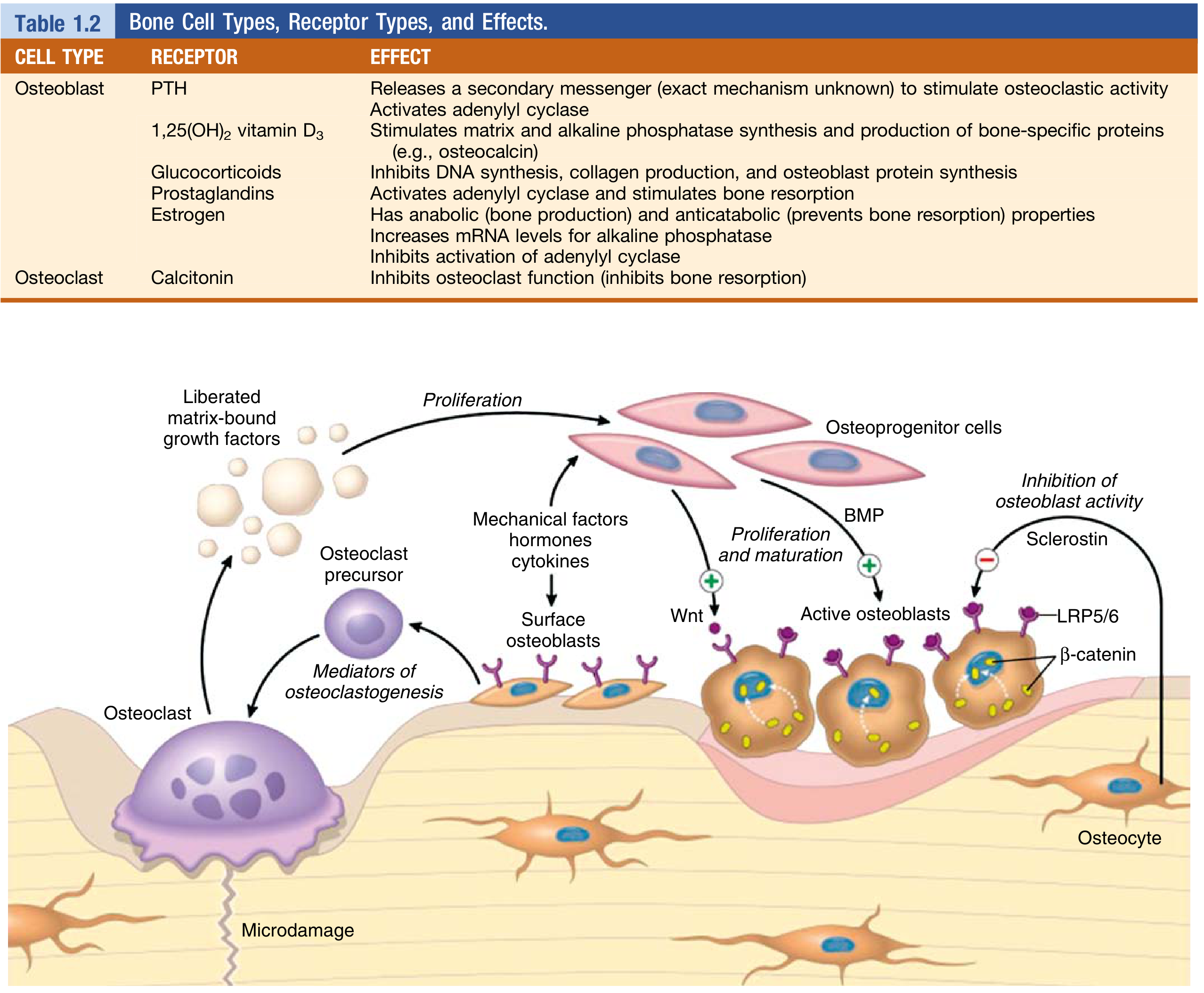
- Miller's Review of Orthopaedics 9th Ed., p. 21-23
6. Bone Matrix Composition
Organic Matrix (~35% of bone by weight)
| Component | Function | Notes |
|---|---|---|
| Type I collagen (90% of organic matrix) | Tensile strength | Triple helix of 2α₁ + 1α₂ chains; mineralization occurs in "hole zones" and "pores" between collagen molecules |
| Proteoglycans | Compressive strength; inhibit mineralization | Glycosaminoglycan-protein complexes |
| Osteocalcin | Most abundant noncollagenous protein (10-20%); marker of bone turnover | Stimulated by 1,25(OH)₂D₃; inhibited by PTH; attracts osteoclasts |
| Osteonectin | Regulates calcium; organizes mineral in matrix | Secreted by platelets and osteoblasts |
| Osteopontin | Cell-binding protein (integrin-like) | |
| Growth factors (TGF-β, IGF, IL-1, IL-6, BMPs) | Differentiation, activation, turnover |
Inorganic Matrix (~65% of bone by weight)
| Component | Function |
|---|---|
| Calcium hydroxyapatite [Ca₁₀(PO₄)₆(OH)₂] | Compressive strength (primary inorganic mineral) |
| Osteocalcium phosphate (brushite) | Secondary inorganic component |
Mineralization occurs first in collagen "holes and pores" (primary) then peripherally (secondary).
- Miller's Review of Orthopaedics 9th Ed., p. 24
7. Periosteum & Endosteum
- Periosteum: fibrous connective tissue membrane covering all external bone surfaces except articular cartilage areas
- Contains blood vessels (supply outer cortical layers) and sensory nerve fibers (very pain-sensitive)
- Unique capability of forming new bone
- A bone stripped of its periosteum will not survive
- Endosteum: thin cellular layer lining the medullary cavity and the surfaces of Haversian canals; contains MSCs that can become osteoblasts
- Gray's Anatomy for Students, p. 30
8. Blood Supply to Bone
Long bones receive blood from three systems:
| System | Pressure | Coverage | Details |
|---|---|---|---|
| Nutrient artery | High | Inner 2/3 of cortex | Enters via nutrient foramen → medullary canal → branches into Haversian system |
| Metaphyseal-epiphyseal | - | Ends of bone | Arises from periarticular vascular plexus (e.g., geniculate arteries) |
| Periosteal | Low | Outer 1/3 of cortex | Mostly capillaries |
Direction of flow:
- In mature bone: arterial flow is centrifugal (inside → outside); venous flow is centripetal
- After fracture or in immature bone: periosteal system dominates → arterial flow becomes centripetal
Clinical exam point: Bone blood flow is the major determinant of fracture healing. Flow peaks at ~2 weeks, returns to normal in 3-5 months. Unreamed intramedullary nails preserve endosteal blood supply; reaming devascularizes inner 50-80% of cortex.
- Miller's Review of Orthopaedics 9th Ed., p. 25-26
9. Innervation
- Most nerves entering the bone cavity via the nutrient artery are vasomotor fibers (regulate blood flow)
- Bone itself has few sensory fibers
- The periosteum is densely supplied with sensory fibers - it is extremely pain-sensitive (explains the deep, localized pain of periosteal injury)
- Gray's Anatomy for Students, p. 30
Key Exam Mnemonics
| Fact | Mnemonic / Quick Rule |
|---|---|
| Bone collagen type | "Bone" contains the word one → Type I collagen |
| Cortical bone fraction | 80% of skeleton; cancellous = 20% |
| Most abundant bone cell | Osteocytes = 90% of cells in mature skeleton |
| Osteoblast origin | Mesenchymal stem cell |
| Osteoclast origin | Hematopoietic / macrophage lineage |
| RANKL effect | Stimulates osteoclast differentiation (bone resorption) |
| OPG effect | Inhibits RANKL → inhibits bone resorption |
| Wnt effect | Promotes osteoblast survival → increases bone mass |
| Sclerostin effect | Inhibits Wnt → inhibits osteoblast activity (produced by osteocytes) |
Make a pdf of this topic
Reading File
Running Command
ls -la /home/daytona/workspace/
Running Command
mkdir -p /home/daytona/workspace/bone-anatomy
Writing File
~/bone-anatomy/generate_pdf.py
from reportlab.lib.pagesizes import A4
from reportlab.lib import colors
from reportlab.lib.styles import getSampleStyleSheet, ParagraphStyle
from reportlab.lib.units import cm
from reportlab.platypus import (
SimpleDocTemplate, Paragraph, Spacer, Table, TableStyle,
HRFlowable, KeepTogether, Image
)
from reportlab.lib.enums import TA_LEFT, TA_CENTER, TA_JUSTIFY
from reportlab.platypus import PageBreak
from urllib.request import urlretrieve
import os
OUTPUT = "/home/daytona/workspace/bone-anatomy/General_Bone_Anatomy_Structure.pdf"
IMG_DIR = "/home/daytona/workspace/bone-anatomy/imgs"
os.makedirs(IMG_DIR, exist_ok=True)
# Download images
IMAGES = {
"bone_types": "https://cdn.orris.care/cdss_images/4c49d5ab68aa34eb0f4dbf737952709e9f9fa998bd1e9d2e1b20571b423cccf4.png",
"cell_origins": "https://cdn.orris.care/cdss_images/ea0816c73f2f0c222947ba3225e694b439ef3306556f87da0a9220dd0d6d2d95.png",
"cell_receptors": "https://cdn.orris.care/cdss_images/4e7dc1ff98dcc72f2bcb7eed4451791669d2f03cadcf41d69b373a7573c2a4be.png",
}
local_imgs = {}
for key, url in IMAGES.items():
path = os.path.join(IMG_DIR, f"{key}.png")
try:
urlretrieve(url, path)
local_imgs[key] = path
print(f"Downloaded {key}")
except Exception as e:
print(f"Failed {key}: {e}")
# --- Styles ---
doc = SimpleDocTemplate(
OUTPUT,
pagesize=A4,
rightMargin=2*cm, leftMargin=2*cm,
topMargin=2.2*cm, bottomMargin=2.2*cm,
title="General Bone Anatomy & Structure",
author="Orris Medical Library"
)
styles = getSampleStyleSheet()
W = A4[0] - 4*cm # usable width
NAVY = colors.HexColor("#1a3a5c")
TEAL = colors.HexColor("#1a7a7a")
LGRAY = colors.HexColor("#f4f6f9")
MGRAY = colors.HexColor("#d0d7e3")
DGRAY = colors.HexColor("#4a4a4a")
WHITE = colors.white
ACCENT = colors.HexColor("#e8f0fe")
title_style = ParagraphStyle("TitleStyle", parent=styles["Title"],
fontSize=22, textColor=WHITE, spaceAfter=4, spaceBefore=0,
fontName="Helvetica-Bold", alignment=TA_CENTER)
h1_style = ParagraphStyle("H1", parent=styles["Heading1"],
fontSize=14, textColor=WHITE, spaceBefore=14, spaceAfter=4,
fontName="Helvetica-Bold", backColor=NAVY,
borderPad=(6, 6, 6, 8), leading=18)
h2_style = ParagraphStyle("H2", parent=styles["Heading2"],
fontSize=11, textColor=NAVY, spaceBefore=10, spaceAfter=3,
fontName="Helvetica-Bold", borderPad=2)
body_style = ParagraphStyle("Body", parent=styles["Normal"],
fontSize=9.5, textColor=DGRAY, spaceAfter=4, spaceBefore=2,
fontName="Helvetica", leading=14, alignment=TA_JUSTIFY)
bullet_style = ParagraphStyle("Bullet", parent=body_style,
leftIndent=14, bulletIndent=4, spaceAfter=2,
bulletFontName="Helvetica", bulletFontSize=9)
sub_bullet_style = ParagraphStyle("SubBullet", parent=bullet_style,
leftIndent=28, bulletIndent=18)
caption_style = ParagraphStyle("Caption", parent=styles["Normal"],
fontSize=8, textColor=colors.HexColor("#666666"), spaceAfter=8,
fontName="Helvetica-Oblique", alignment=TA_CENTER)
source_style = ParagraphStyle("Source", parent=styles["Normal"],
fontSize=7.5, textColor=TEAL, spaceAfter=2,
fontName="Helvetica-Oblique", alignment=TA_RIGHT)
mnemonic_style = ParagraphStyle("Mnemonic", parent=body_style,
backColor=ACCENT, borderPad=6, fontName="Helvetica",
leftIndent=6, rightIndent=6)
def section_header(text):
data = [[Paragraph(f" {text}", h1_style)]]
t = Table(data, colWidths=[W])
t.setStyle(TableStyle([
("BACKGROUND", (0,0), (-1,-1), NAVY),
("ROUNDEDCORNERS", [4,4,4,4]),
("TOPPADDING", (0,0), (-1,-1), 6),
("BOTTOMPADDING", (0,0), (-1,-1), 6),
("LEFTPADDING", (0,0), (-1,-1), 10),
]))
return t
def sub_header(text):
return Paragraph(f"<font color='#{TEAL.hexval()[2:]}'>■</font> <b>{text}</b>", h2_style)
def bullet(text, level=1):
if level == 1:
return Paragraph(f"• {text}", bullet_style)
else:
return Paragraph(f" ◦ {text}", sub_bullet_style)
def body(text):
return Paragraph(text, body_style)
def source(text):
return Paragraph(text, source_style)
def spacer(h=0.2):
return Spacer(1, h*cm)
def make_table(headers, rows, col_widths=None):
if col_widths is None:
col_widths = [W / len(headers)] * len(headers)
header_row = [Paragraph(f"<b>{h}</b>", ParagraphStyle("TH",
parent=body_style, textColor=WHITE, fontSize=9, fontName="Helvetica-Bold")) for h in headers]
data = [header_row]
for row in rows:
data.append([Paragraph(str(c), ParagraphStyle("TD", parent=body_style, fontSize=9)) for c in row])
t = Table(data, colWidths=col_widths, repeatRows=1)
t.setStyle(TableStyle([
("BACKGROUND", (0,0), (-1,0), NAVY),
("BACKGROUND", (0,1), (-1,-1), LGRAY),
("ROWBACKGROUNDS", (0,1), (-1,-1), [WHITE, LGRAY]),
("GRID", (0,0), (-1,-1), 0.4, MGRAY),
("VALIGN", (0,0), (-1,-1), "TOP"),
("TOPPADDING", (0,0), (-1,-1), 4),
("BOTTOMPADDING", (0,0), (-1,-1), 4),
("LEFTPADDING", (0,0), (-1,-1), 6),
("RIGHTPADDING", (0,0), (-1,-1), 6),
]))
return t
# ==============================
# TITLE BLOCK
# ==============================
def title_block():
data = [[
Paragraph("General Bone Anatomy & Structure", ParagraphStyle("TB",
fontSize=22, textColor=WHITE, fontName="Helvetica-Bold",
alignment=TA_CENTER, spaceAfter=0)),
],[
Paragraph("Detailed Exam-Level Review | Sources: Gray's Anatomy for Students & Miller's Review of Orthopaedics 9e",
ParagraphStyle("Sub", fontSize=9.5, textColor=colors.HexColor("#c8ddf5"),
fontName="Helvetica-Oblique", alignment=TA_CENTER)),
]]
t = Table([[row[0]] for row in data], colWidths=[W])
t.setStyle(TableStyle([
("BACKGROUND", (0,0), (-1,-1), NAVY),
("TOPPADDING", (0,0), (-1,-1), 12),
("BOTTOMPADDING", (0,0), (-1,-1), 12),
("LEFTPADDING", (0,0), (-1,-1), 14),
("RIGHTPADDING", (0,0), (-1,-1), 14),
]))
return t
# ==============================
# BUILD STORY
# ==============================
story = []
story.append(title_block())
story.append(spacer(0.5))
# ----- SECTION 1: What Is Bone -----
story.append(section_header("1. What Is Bone?"))
story.append(spacer(0.15))
story.append(body(
"Bone is a <b>calcified, living connective tissue</b> — not inert. It contains cells, "
"receives a dedicated blood supply, and is continuously remodeled throughout life."
))
story.append(spacer(0.1))
story.append(sub_header("Functions of Bone"))
for f in [
"Structural support of the body",
"Protection of vital organs (e.g., skull → brain; ribcage → heart/lungs)",
"Calcium and phosphorus reservoir (mineral homeostasis)",
"Lever system for muscle-driven movement",
"Container for blood-producing (hematopoietic) cells",
]:
story.append(bullet(f))
story.append(source("— Gray's Anatomy for Students, p. 30"))
story.append(spacer(0.3))
# ----- SECTION 2: Classification by Shape -----
story.append(section_header("2. Macroscopic Classification (by Shape)"))
story.append(spacer(0.2))
shape_headers = ["Shape", "Description", "Example"]
shape_rows = [
["Long", "Tubular with a shaft (diaphysis) and two ends (epiphyses)", "Humerus, Femur, Tibia"],
["Short", "Cuboidal — roughly equal dimensions", "Carpal bones, Tarsal bones"],
["Flat", "Two compact bone plates sandwiching spongy bone", "Skull, Sternum, Scapula"],
["Irregular", "Variable, complex shapes", "Vertebrae, Facial bones"],
["Sesamoid", "Round/oval bones embedded within tendons", "Patella, thumb/big-toe sesamoids"],
]
story.append(make_table(shape_headers, shape_rows, [2.5*cm, 7.5*cm, 5.5*cm]))
story.append(spacer(0.1))
story.append(body(
"<b>Accessory bones</b> are normal variants (extra bones) found mainly in the wrist, "
"hands, ankles, and feet. They must not be mistaken for fractures on imaging."
))
story.append(source("— Gray's Anatomy for Students, p. 30"))
story.append(spacer(0.3))
# ----- SECTION 3: Microscopic Classification -----
story.append(section_header("3. Microscopic Classification"))
story.append(spacer(0.2))
if "bone_types" in local_imgs:
img = Image(local_imgs["bone_types"], width=W*0.85, height=W*0.85*0.55)
story.append(img)
story.append(Paragraph(
"FIG. 1 — Types of bone: Cortical (compact), Cancellous (trabecular), Immature (woven), "
"and Pathologic (e.g., giant cell tumor). Lower panel shows Haversian canal microstructure. "
"(Adapted from Miller's Review of Orthopaedics 9e, Fig. 1.1)",
caption_style))
micro_headers = ["Type", "Organization", "Turnover", "Strength", "Examples"]
micro_rows = [
["Woven (Immature / Pathologic)", "Random; NOT stress-oriented", "High", "Weaker, more flexible",
"Embryonic skeleton, fracture callus, osteogenic sarcoma, fibrous dysplasia"],
["Lamellar (Normal)", "Stress-oriented; organized along lines of force", "Low", "Stronger, less flexible",
"Normal adult cortical & cancellous bone"],
]
story.append(make_table(micro_headers, micro_rows, [2.8*cm, 3.5*cm, 1.8*cm, 2.5*cm, 4.9*cm]))
story.append(source("— Miller's Review of Orthopaedics 9e, p. 20"))
story.append(spacer(0.3))
# ----- SECTION 4: Cortical vs Cancellous -----
story.append(section_header("4. Cortical vs. Cancellous Bone"))
story.append(spacer(0.2))
story.append(sub_header("Cortical (Compact) Bone — 80% of skeleton"))
for item in [
"Slow turnover; high Young's modulus (stiff)",
"Composed of tightly packed <b>osteons (Haversian systems)</b>",
"Each osteon = concentric lamellae around a central <b>Haversian canal</b> (contains arterioles, venules, capillaries, nerves)",
"<b>Volkmann's canals</b> run transversely, connecting Haversian canals to each other and to the periosteum",
"<b>Cement lines</b> define the outer border of each osteon",
"<b>Interstitial lamellae</b> fill spaces between osteons",
"<b>Canaliculi</b> are tiny channels containing osteocyte processes — the nutritional highway of cortical bone",
]:
story.append(bullet(item))
story.append(spacer(0.15))
story.append(sub_header("Cancellous (Spongy / Trabecular) Bone — 20% of skeleton"))
for item in [
"Higher turnover; smaller Young's modulus (more elastic)",
"Loose network of struts and plates called <b>trabeculae</b>",
"30–90% of trabecular volume = pores filled with bone marrow",
"MSCs lining endosteum / Haversian canals become osteoblasts (low strain, high O₂)",
]:
story.append(bullet(item))
story.append(source("— Miller's Review of Orthopaedics 9e, p. 20–21"))
story.append(spacer(0.3))
# ----- SECTION 5: Bone Cells -----
story.append(section_header("5. Bone Cells"))
story.append(spacer(0.2))
if "cell_origins" in local_imgs:
img = Image(local_imgs["cell_origins"], width=W*0.82, height=W*0.82*1.1)
story.append(img)
story.append(Paragraph(
"FIG. 2 — Cellular origins of bone and cartilage cells. Osteoblasts/osteocytes "
"arise from mesenchymal stem cells; osteoclasts from hematopoietic progenitors. "
"(From Miller's Review of Orthopaedics 9e, Fig. 1.2)",
caption_style))
story.append(sub_header("Osteoblasts — Bone-Forming Cells"))
for item in [
"Derived from <b>undifferentiated mesenchymal stem cells (MSCs)</b>",
"Appear as cuboid cells aligned along immature osteoid",
"Fate depends on microenvironment: low strain + high O₂ → osteoblast; intermediate strain + low O₂ → chondrocyte; high strain → fibrous tissue",
"Directed by transcription factor <b>RUNX2</b> and <b>BMP</b> (bone morphogenetic protein); also β-catenin / Core-binding factor α-1",
"Rich in ER, Golgi, and mitochondria (synthesis/secretion machinery)",
]:
story.append(bullet(item))
story.append(body("<b>Osteoblasts produce:</b> Alkaline phosphatase, Osteocalcin, Type I collagen, Bone sialoprotein, RANKL, OPG"))
story.append(body("<b>Stimulated by:</b> Intermittent (pulsatile) PTH, Wnt proteins, BMP"))
story.append(body("<b>Inhibited by:</b> TNF-α, Sclerostin, Dkk-1, Glucocorticoids"))
story.append(spacer(0.15))
story.append(sub_header("Osteocytes — Maintenance Cells"))
for item in [
"Constitute <b>90% of all cells</b> in the mature skeleton",
"Former osteoblasts entrapped by newly formed matrix",
"High nucleus/cytoplasm ratio; long cytoplasmic processes through canaliculi",
"Function: maintain bone; regulate extracellular Ca²⁺ and phosphorus",
"Secrete <b>sclerostin (Scl)</b> → negative feedback on osteoblast bone deposition",
"Regulated by mechanical loading: decreased Scl in areas of high strain → increased bone formation",
"Directly stimulated by calcitonin; inhibited by PTH",
]:
story.append(bullet(item))
story.append(spacer(0.15))
story.append(sub_header("Osteoclasts — Bone-Resorbing Cells"))
for item in [
"<b>Multinucleated irregular giant cells</b>",
"Derived from hematopoietic cells in the <b>macrophage lineage</b> (monocyte progenitors fuse)",
"Primary function: <b>bone resorption</b>",
"Activated by <b>RANKL</b> binding to RANK receptor on cell surface",
"Inhibited by <b>OPG</b> (osteoprotegerin) which sequesters RANKL",
"Inhibited directly by <b>calcitonin</b>",
]:
story.append(bullet(item))
story.append(source("— Miller's Review of Orthopaedics 9e, p. 21–23"))
story.append(spacer(0.3))
# Receptor table image
if "cell_receptors" in local_imgs:
story.append(sub_header("Bone Cell Receptor Table & RANKL-OPG-Wnt Crosstalk"))
img = Image(local_imgs["cell_receptors"], width=W, height=W*0.55)
story.append(img)
story.append(Paragraph(
"FIG. 3 — Bone cell receptor types, effects, and paracrine crosstalk between osteoblasts and osteoclasts. "
"(From Miller's Review of Orthopaedics 9e, Table 1.2 & Fig. 1.3)",
caption_style))
story.append(spacer(0.3))
# ----- SECTION 6: Bone Matrix -----
story.append(section_header("6. Bone Matrix Composition"))
story.append(spacer(0.2))
story.append(body(
"Bone matrix = <b>~35% organic</b> (mainly collagen + proteins) + <b>~65% inorganic</b> (mainly calcium hydroxyapatite). "
"The combination gives bone both tensile strength (collagen) and compressive strength (mineral)."
))
story.append(spacer(0.15))
matrix_headers = ["Component", "Type", "Function", "Key Notes"]
matrix_rows = [
["Type I Collagen", "Organic (90% of organic)", "Tensile strength",
"Triple helix (2α₁ + 1α₂); mineralization occurs in 'hole zones' and 'pores'; cross-linking increases strength. Mnemonic: bone contains 'one' → Type I"],
["Proteoglycans", "Organic", "Compressive strength; inhibit mineralization",
"Glycosaminoglycan-protein complexes"],
["Osteocalcin", "Organic (noncollagenous)", "Most abundant noncollagenous protein (10–20%); attracts osteoclasts; marker of bone turnover",
"Stimulated by 1,25(OH)₂D₃; inhibited by PTH"],
["Osteonectin (SPARC)", "Organic (noncollagenous)", "Regulates calcium; organizes mineral in matrix",
"Secreted by platelets & osteoblasts"],
["Osteopontin", "Organic (noncollagenous)", "Cell-binding (integrin-like)", ""],
["Growth factors (TGF-β, IGF, BMPs, IL-1, IL-6)", "Organic", "Differentiation, activation, turnover", "Present in small amounts"],
["Calcium hydroxyapatite [Ca₁₀(PO₄)₆(OH)₂]", "Inorganic (primary)", "Compressive strength",
"Primary: mineralizes in collagen holes/pores; secondary: periphery"],
["Osteocalcium phosphate (brushite)", "Inorganic (secondary)", "Minor inorganic component", ""],
]
story.append(make_table(matrix_headers, matrix_rows, [3.5*cm, 3*cm, 4.5*cm, 4.5*cm]))
story.append(source("— Miller's Review of Orthopaedics 9e, p. 24"))
story.append(spacer(0.3))
# ----- SECTION 7: Periosteum & Endosteum -----
story.append(section_header("7. Periosteum & Endosteum"))
story.append(spacer(0.15))
story.append(sub_header("Periosteum"))
for item in [
"Fibrous connective tissue membrane covering ALL external bone surfaces (except articular cartilage)",
"Contains blood vessels (supply outer cortical layers) and <b>dense sensory nerve fibers</b> → very pain-sensitive",
"Unique capability of <b>forming new bone</b> (critical for fracture repair)",
"A bone stripped of its periosteum will not survive",
]:
story.append(bullet(item))
story.append(spacer(0.1))
story.append(sub_header("Endosteum"))
for item in [
"Thin cellular layer lining the medullary cavity and surfaces of Haversian canals",
"Contains MSCs that differentiate into osteoblasts under appropriate signals",
]:
story.append(bullet(item))
story.append(source("— Gray's Anatomy for Students, p. 30"))
story.append(spacer(0.3))
# ----- SECTION 8: Blood Supply -----
story.append(section_header("8. Blood Supply to Bone"))
story.append(spacer(0.2))
story.append(body("Long bones receive blood from <b>three systems</b>:"))
story.append(spacer(0.15))
blood_headers = ["System", "Pressure", "Coverage", "Details"]
blood_rows = [
["Nutrient Artery", "High", "Inner 2/3 of diaphyseal cortex",
"Enters via nutrient foramen → medullary canal → branches into ascending/descending arteries → Haversian system"],
["Metaphyseal-Epiphyseal", "Intermediate", "Bone ends (epiphyses & metaphyses)",
"Arises from periarticular vascular plexus (e.g., geniculate arteries around knee)"],
["Periosteal", "Low", "Outer 1/3 of cortex", "Mostly capillaries from adjacent soft tissue"],
]
story.append(make_table(blood_headers, blood_rows, [3.5*cm, 2.2*cm, 4.0*cm, 5.8*cm]))
story.append(spacer(0.15))
story.append(sub_header("Direction of Flow"))
for item in [
"<b>Mature bone:</b> arterial flow is <b>centrifugal</b> (inside → outside); venous flow is centripetal",
"<b>After fracture / immature bone:</b> periosteal system dominates → arterial flow becomes <b>centripetal</b>",
]:
story.append(bullet(item))
story.append(spacer(0.1))
story.append(sub_header("Clinical Points"))
for item in [
"Bone blood flow = major determinant of fracture healing quality",
"Flow peaks at ~2 weeks post-fracture; returns to normal in 3–5 months",
"<b>Unreamed intramedullary nails</b> preserve endosteal blood supply",
"<b>Reaming</b> devascularizes the inner 50–80% of cortex and delays endosteal revascularization",
]:
story.append(bullet(item))
story.append(source("— Miller's Review of Orthopaedics 9e, p. 25–26"))
story.append(spacer(0.3))
# ----- SECTION 9: Innervation -----
story.append(section_header("9. Innervation"))
story.append(spacer(0.15))
for item in [
"Most nerves entering the bone cavity (via nutrient artery) are <b>vasomotor fibers</b> regulating blood flow",
"Bone matrix itself has <b>few sensory nerve fibers</b>",
"The <b>periosteum</b> is densely innervated with sensory fibers — extremely pain-sensitive (explains deep periosteal pain with injury or tumors)",
]:
story.append(bullet(item))
story.append(source("— Gray's Anatomy for Students, p. 30"))
story.append(spacer(0.3))
# ----- SECTION 10: Key Exam Mnemonics -----
story.append(section_header("10. Key Exam Facts & Mnemonics"))
story.append(spacer(0.2))
mnemonic_headers = ["Fact", "Mnemonic / Rule"]
mnemonic_rows = [
["Bone collagen type", '"Bone" contains the word one → Type I collagen'],
["Cortical vs. cancellous fraction", "Cortical = 80%; Cancellous = 20% of skeleton"],
["Most abundant bone cell", "Osteocytes = 90% of all cells in mature skeleton"],
["Osteoblast origin", "Mesenchymal stem cell (MSC)"],
["Osteoclast origin", "Hematopoietic / macrophage lineage (monocyte fusion)"],
["RANKL effect", "Stimulates osteoclast differentiation → bone resorption ↑"],
["OPG effect", "Sequesters RANKL → blocks osteoclast activation → bone resorption ↓"],
["Wnt effect", "Promotes osteoblast survival & proliferation → bone mass ↑"],
["Sclerostin effect", "Inhibits Wnt signaling → inhibits osteoblast activity (produced by osteocytes)"],
["Woven vs. lamellar", "Woven = Weak, random, immature/pathologic; Lamellar = organized, strong, normal"],
["Arterial flow in mature bone", "Centrifugal (inside → out); reverses to centripetal after fracture"],
["Periosteum pain sensitivity", "Very sensitive (dense sensory innervation); bone itself has few sensory fibers"],
["PTH on osteoblasts", "Intermittent PTH → stimulates osteoblasts (anabolic); continuous PTH → promotes RANKL → osteoclast activation"],
["Calcitonin target", "Directly inhibits osteoclasts (bone resorption ↓)"],
["1,25(OH)₂D₃ on osteoblasts", "Stimulates matrix synthesis; increases osteocalcin production"],
]
story.append(make_table(mnemonic_headers, mnemonic_rows, [5.5*cm, 10.0*cm]))
story.append(spacer(0.4))
# Footer note
story.append(HRFlowable(width=W, thickness=0.5, color=MGRAY))
story.append(spacer(0.1))
story.append(Paragraph(
"Sources: Gray's Anatomy for Students (p. 30) | Miller's Review of Orthopaedics, 9th Ed. (pp. 20–26) | "
"Generated by Orris Medical AI",
ParagraphStyle("Footer", parent=styles["Normal"], fontSize=7.5,
textColor=colors.HexColor("#888888"), alignment=TA_CENTER)))
# ==============================
# BUILD PDF
# ==============================
doc.build(story)
print(f"PDF saved to: {OUTPUT}")
Running Command
cd /home/daytona/workspace/bone-anatomy && python generate_pdf.py 2>&1
Editing File
~/bone-anatomy/generate_pdf.py
Successfully replaced 1 instance(s) of the string in '/home/daytona/workspace/bone-anatomy/generate_pdf.py'
Running Command
cd /home/daytona/workspace/bone-anatomy && python generate_pdf.py 2>&1
Your PDF is ready. Here is the download link:
General Bone Anatomy Structure
PDF Document · PDF
The PDF includes all 10 sections from the exam-level review:
- Title page with source attribution
- All classification tables (shape, microscopic, cortical vs. cancellous)
- All three textbook diagrams embedded (bone types/Haversian structure, cell origins, receptor crosstalk)
- Complete bone matrix composition table
- Blood supply, innervation, periosteum/endosteum sections
- A full mnemonics/exam facts table at the end
Sources cited throughout: Gray's Anatomy for Students and Miller's Review of Orthopaedics, 9th Ed.
This is a shared conversation. Sign in to Orris to start your own chat.