
Hydrocephalus Pediatrics
Reading File
Now let me search the library for pediatric hydrocephalus content in parallel.
Finding Sources
Searching PubMed
hydrocephalus pediatric management
Now let me search for pediatric-specific hydrocephalus content and read the best sources in parallel.
Finding Sources
Finding Sources
The Harriet Lane Handbook (pediatric reference) and neurology/radiology texts are the best sources. Let me read the key sections in parallel.
Reading File
Reading File
Reading File
Excellent content. Let me now read more from these sources - the Harriet Lane section on hydrocephalus management, and more imaging detail.
Reading File
Reading File
Reading File
Now let me get the Harriet Lane management section properly (I got the wrong offset before) and get the pathology/embryology data.
Reading File
Reading File
Reading File
I also need the Harriet Lane section on etiology and diagnosis (before line 650). Let me get the beginning of the hydrocephalus section and also fetch the CT image.
Finding Sources
Loading Image
Reading File
I now have comprehensive content from multiple authoritative sources. Let me compile the full answer.
Hydrocephalus in Pediatrics
Definition
Hydrocephalus is a pressure-dependent enlargement of the cerebral ventricles resulting from an imbalance between CSF production and absorption - either from obstruction of CSF flow or impaired reabsorption. The result is excess CSF accumulation with progressive ventricular dilation and elevated intracranial pressure (ICP).
- Bradley and Daroff's Neurology in Clinical Practice, p. 1853
- Grainger & Allison's Diagnostic Radiology, p. 2027
Classification
| Type | Description | Alternate Name |
|---|---|---|
| Noncommunicating | Obstruction within the ventricular system (intraventricular) | Obstructive hydrocephalus |
| Communicating | Obstruction outside the ventricles - impaired reabsorption at arachnoid villi/subarachnoid space | Extraventricular obstructive hydrocephalus |
Obstruction can occur at anatomically narrow points: foramina of Monro, cerebral aqueduct (of Sylvius), or the fourth ventricular outflow foramina (Luschka and Magendie).
Etiology by Age Group
Neonates and Infants
- Intraventricular hemorrhage (IVH) of prematurity - most common acquired cause; infants <1500 g have high risk of IVH, and ~25% develop progressive ventricular enlargement; only 5% ultimately require shunting
- Congenital aqueductal stenosis - can be caused by in utero CMV or Toxoplasma gondii infection; rarely X-linked recessive inheritance
- Post-infectious scarring - meningitis causes fibrosis of arachnoid villi or closure of foramina of Luschka/Magendie
- Chiari II malformation - almost always associated with lumbosacral myelomeningocele
- Dandy-Walker malformation - posterior fossa cyst with hypoplasia of the cerebellar vermis and fourth ventricular outflow obstruction
- Vein of Galen malformation - vascular cause
- Choroid plexus adenoma (rare) - excess CSF production
Older Children (post-suture fusion, >2-3 years)
-
Posterior fossa neoplasms - most common cause in this age group (medulloblastoma, ependymoma, astrocytoma); tumors near the midline often compress the cerebral aqueduct
-
Aqueductal stenosis - idiopathic or from prior infection/hemorrhage
-
Tectal plate gliomas - compress the aqueduct from above
-
Colloid cysts of the third ventricle - can cause sudden, life-threatening obstruction via a ball-valve mechanism
-
Meningitis - inflammatory scarring
-
The Developing Human (Moore), Clinically Oriented Embryology, p. 1082
-
Grainger & Allison's Diagnostic Radiology, p. 2027
-
Bradley and Daroff's Neurology, p. 1854
Clinical Features
Infants (open fontanelles and unfused sutures)
The skull can expand, so raised ICP manifests as:
- Macrocephaly with rapidly increasing head circumference (HC) crossing centile lines
- Bulging/tense anterior fontanelle (at rest, upright)
- Sutural diastasis (splaying of cranial sutures)
- Frontal bossing, calvarial thinning, engorged scalp veins
- "Setting-sun" sign - downward deviation of eyes (upward gaze paresis) due to compression of the dorsal midbrain (Parinaud phenomenon)
- Cracked-pot sound on skull percussion (Macewen sign)
- Irritability, poor feeding, vomiting, lethargy
Older Children (fused sutures)
Skull is rigid, so raised ICP dominates:
-
Headache (often early morning)
-
Nausea and vomiting
-
Papilledema
-
Diplopia - CN VI palsy (false localizing sign of raised ICP)
-
Blurred/spotty vision
-
Decreased level of consciousness
-
Cushing's triad - hypertension, bradycardia, irregular respirations (late, ominous sign)
-
Lower limb spasticity - from stretching of corticospinal tracts around dilated ventricles
-
Wide-based ataxic gait
-
Endocrine dysfunction in long-standing cases (short stature, DI, menstrual irregularities) - from third ventricular pressure
-
The Harriet Lane Handbook (23rd ed.), p. 728
-
Bradley and Daroff's Neurology, p. 1854-1855
-
Grainger & Allison's Diagnostic Radiology, p. 2028
Pathophysiology
Acute noncommunicating hydrocephalus reaches 80% of maximal ventricular enlargement within ~6 hours of obstruction, as CSF continues to be produced despite elevated pressure. Continued CSF accumulation forces fluid across the ependymal lining into periventricular white matter, producing transependymal (periventricular interstitial) edema - a key imaging finding.
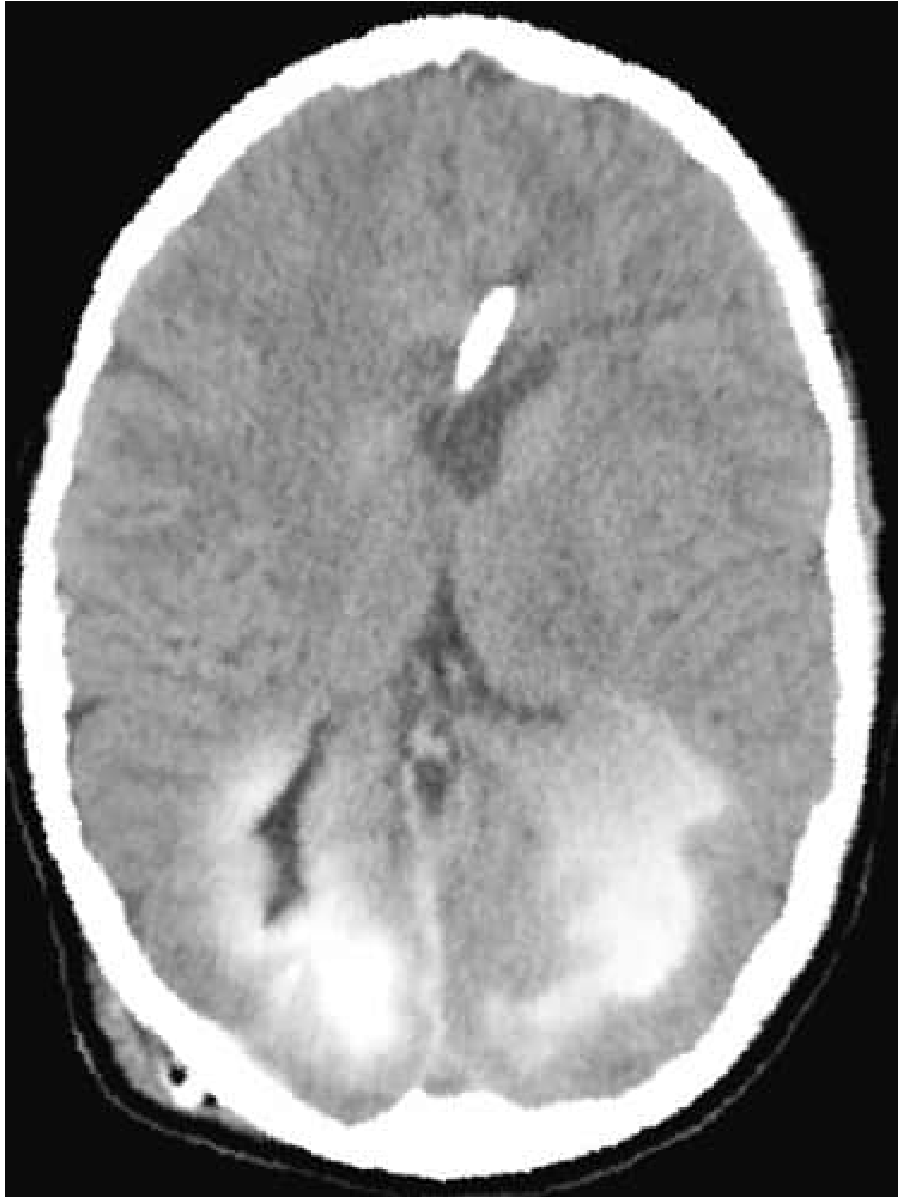
Long-standing hydrocephalus causes white matter atrophy but spares gray matter in most cases.
Diagnosis
Imaging
Ultrasound - first-line in neonates with open fontanelle; can monitor ventricular size serially at bedside
Ultrafast MRI - preferred over CT when available; avoids radiation and provides superior detail
CT - rapid, widely available; acceptable for acute presentations
Key imaging findings:
- Temporal horn dilation disproportionate to lateral ventricles (early noncommunicating sign)
- Enlargement of anterior and posterior recesses of the third ventricle with inferior convexity of its floor
- Periventricular interstitial edema (transependymal flow)
- Effacement of sulci and cisterns
- In communicating hydrocephalus: ventricular and sulcal prominence together
Pitfall: In children under 2 years, ventricles and subarachnoid spaces are normally more prominent - do not over-diagnose. Also distinguish true hydrocephalus from benign enlargement of subarachnoid spaces (BESS) - in BESS, the child is neurologically normal, crossing veins are visible within the subarachnoid space, and the condition self-resolves by age 2.
- Grainger & Allison's Diagnostic Radiology, pp. 2027-2029
Management
Medical (temporary)
- Emergent ICP management for acute presentations (head of bed elevation, osmotherapy, hyperventilation as bridge)
- Acetazolamide + furosemide - decreases CSF production; provides temporary relief in slowly progressive hydrocephalus; not a definitive treatment
Surgical (definitive)
1. CSF Shunting
- Ventriculoperitoneal (VP) shunt - most commonly used; drains CSF from lateral ventricle to peritoneal cavity
- Other sites: ventriculoatrial (VA) shunt, ventriculopleural shunt
- Shunt revisions are frequently needed as the child grows
Shunt complications:
| Complication | Features |
|---|---|
| Obstruction | Clogging, kinking - most common; presents with signs of raised ICP |
| Infection | Fever, meningismus, shunt site erythema; commonest organism: S. epidermidis |
| Disconnection/migration | Proximal or distal tip displacement |
| Valve programming failure | Over- or under-drainage |
| Slit ventricle syndrome | Over-drainage with collapsed ventricles |
2. Endoscopic Third Ventriculostomy (ETV)
- Creates a fenestration in the floor of the third ventricle, bypassing aqueductal obstruction
- Preferred over shunt in noncommunicating hydrocephalus (particularly aqueductal stenosis) in appropriate candidates
- Success rates higher in older children vs. infants
- Avoids hardware and infection risk of shunts
Shunt Dysfunction
Patients with shunt dysfunction typically present with signs of raised ICP. Evaluation includes imaging to assess shunt integrity and ventricular size, neurosurgical consultation.
- The Harriet Lane Handbook (23rd ed.), pp. 728-729
- Bradley and Daroff's Neurology, p. 1855
Prognosis and Complications
- Premature infants with IVH: ~25% develop ventricular enlargement, 5% require shunting; survivors of large germinal matrix hemorrhage often have multiple disabilities
- Early identification and intervention (before optic atrophy develops) prevents the severe cognitive and motor deficits of untreated hydrocephalus
- Long-term shunt dependency with frequent revisions is common
Key Summary Points
- Classify first - communicating vs. noncommunicating; this drives surgical planning
- Age matters - open fontanelles (infants) allow macrocephaly; closed sutures (children >2-3 yr) present with raised ICP symptoms without head enlargement
- Most common causes - IVH of prematurity (neonates), aqueductal stenosis, Chiari II, posterior fossa tumors (older children)
- Definitive treatment - VP shunt (most common) or ETV (for noncommunicating in older children)
- Shunt complications are frequent: always consider shunt malfunction in a known shunt patient presenting with headache, vomiting, or altered consciousness
This is a shared conversation. Sign in to Orris to start your own chat.