
What is fistula
A fistula is an abnormal connection or tunnel between two body parts - such as an organ and the skin surface, or between two organs - that normally do not connect. It forms when tissue is damaged by infection, inflammation, surgery, or injury, and the body creates an unintended channel as part of wound healing.
Searching sources...
Reading File
Searching the Web
fistula types causes treatment overview
Finding Sources
Reading File
Reading File
Here is a thorough explanation of fistulas:
What is a Fistula?
A fistula is an abnormal connection (communication) between two epithelium-lined surfaces that do not normally connect. The tract is usually lined by granulation tissue, but may become fully epithelialized in chronic cases. Think of it as an unintended tunnel or passageway inside the body.
- Bailey and Love's Short Practice of Surgery defines it as: "an abnormal communication between two epithelium-lined surfaces."
How Do Fistulas Form?
Fistulas develop due to:
- Infection / abscess - pus breaks through tissue, creating a channel
- Inflammation (e.g., Crohn's disease, diverticulitis)
- Surgery or trauma - especially in the head/neck, abdomen, or pelvic region
- Radiation therapy - damages tissue integrity
- Childbirth injury - particularly in obstetric fistulas
- Congenital defects - present from birth (e.g., tracheo-oesophageal fistula)
- Malnutrition / poor healing - increases risk especially after surgery
Types of Fistulas
Fistulas are classified by the two structures they abnormally connect:
| Type | Connection | Common Cause |
|---|---|---|
| Anal / anorectal fistula | Anal canal to perianal skin | Abscess, Crohn's disease |
| Enterocutaneous | Intestine to skin | Surgery, Crohn's, radiation |
| Rectovaginal | Rectum to vagina | Childbirth injury, surgery |
| Vesicovaginal | Bladder to vagina | Hysterectomy, childbirth |
| Urethrovaginal | Urethra to vagina | Pelvic surgery |
| Colovaginal | Colon to vagina | Diverticulitis, surgery |
| Tracheo-oesophageal | Trachea to oesophagus | Congenital or post-surgery |
| Pharyngocutaneous | Pharynx to skin of neck | Laryngectomy, radiation |
| Arteriovenous (AV) fistula | Artery to vein | Trauma, or surgically created for dialysis |
| Branchial fistula | Neck structures to skin | Congenital |
Symptoms
Symptoms depend on the location, but generally include:
- Discharge of pus, stool, urine, or gas from an abnormal opening
- Recurrent infections or abscesses
- Pain and swelling in the affected area
- Foul-smelling discharge
- In vaginal fistulas: leakage of stool/urine into the vagina, pain with intercourse
A Special Case: The AV Fistula (Surgically Created)
Not all fistulas are harmful. An arteriovenous (AV) fistula is deliberately created by surgeons to provide reliable vascular access for hemodialysis in patients with kidney failure. In this case, a surgeon connects an artery and a vein (usually in the arm), causing the vein to enlarge and strengthen enough to tolerate repeated needle insertions.
Management
Treatment depends on the cause and location:
-
Conservative (small/uncomplicated fistulas):
- Wound care and dressing changes
- Nutritional support (enteral feeding, nil by mouth)
- Antibiotics for infection control
- Treating the underlying disease (e.g., immunosuppressants for Crohn's)
-
Surgical (large, persistent, or dangerous fistulas):
- Fistulotomy / fistulectomy - laying open or excising the tract (anal fistula)
- Flap repair - using vascularized tissue to close the defect (e.g., pectoralis major flap for pharyngocutaneous fistula)
- Surgical excision and primary repair - for vesicovaginal, rectovaginal fistulas
-
Complications if untreated:
- Chronic infection and abscess formation
- Sepsis
- Carotid artery blowout (pharyngocutaneous fistulas near great vessels)
- Delayed cancer treatment (radiation cannot proceed if active fistula present)
Summary: A fistula is an abnormal tunnel connecting two body surfaces or organs. Most are acquired (from infection, surgery, inflammation, or injury), though some are congenital. Location determines symptoms and treatment, ranging from conservative wound care to complex surgical repair.
Explore anal fistula
Anal fistula is an abnormal tunnel connecting the inside of the anal canal (usually at an infected anal gland) to an opening on the skin around the anus. It is most commonly the result of a previous anorectal abscess. It causes chronic discharge, pain, and recurrent infection, and generally requires surgical treatment.
Searching sources...
Finding Sources
Searching the Web
anal fistula classification Parks types treatment 2024
Reading File
Reading File
Reading File
Reading File
Reading File
Finding Sources
Loading Image
Loading Image
Searching PubMed
anal fistula management sphincter preservation
Here is a thorough, textbook-based exploration of anal fistula:
Anal Fistula - A Complete Overview
Definition
An anal fistula is an abnormal communication (tunnel) that connects the internal opening at the dentate line of the anal canal (arising from an infected anal gland/crypt) to an external opening on the perianal skin. The tract is lined by granulation tissue and, in chronic cases, becomes epithelialized.
- Goldman-Cecil Medicine defines it as: "the chronic form of a perianal abscess in which the tract from the infected anal gland to the abscess cavity does not adequately heal."
Epidemiology
- Incidence: approximately 8.6 per 100,000 population
- 2-3x more common in men than women
- Occurs in 30-50% of patients following a perianal abscess
- Crohn disease-associated fistulas occur in 13-54% of Crohn patients
Pathophysiology (Cryptoglandular Theory)
The widely accepted theory:
- Bacteria enter an anal gland (located in the crypts at the dentate line)
- The gland becomes infected, forming a perianal abscess
- The abscess drains (spontaneously or surgically), but the internal opening at the dentate line remains patent
- This persistent tract = an anal fistula
- Goldman-Cecil Medicine: "After a perianal abscess is drained, the internal opening - the site at the dentate line where the infected gland originated - can remain patent, thereby leaving a source for recurrent infection."
Parks Classification (by relationship to sphincter complex)
This is the standard surgical classification, based on where the tract passes relative to the internal and external anal sphincters:
| Type | Frequency | Description |
|---|---|---|
| Intersphincteric | ~70% (most common) | Tract runs in the plane between internal and external sphincters |
| Transsphincteric | ~20-25% | Tract crosses both internal AND external sphincters |
| - Low | - | Traverses only the distal external sphincter |
| - High | - | Traverses the more proximal external sphincter |
| Suprasphincteric | Rare | Originates at dentate line, loops over the entire sphincter complex |
| Extrasphincteric | Rare | Internal opening is remote from the dentate line (e.g., from pelvic abscess, Crohn's, diverticulitis, ruptured appendix) |
Horseshoe fistula: Has external openings on both sides of the midsagittal plane, most often with a single internal opening in the posterior midline.
Goodsall's Rule
A useful clinical rule for locating the internal opening:
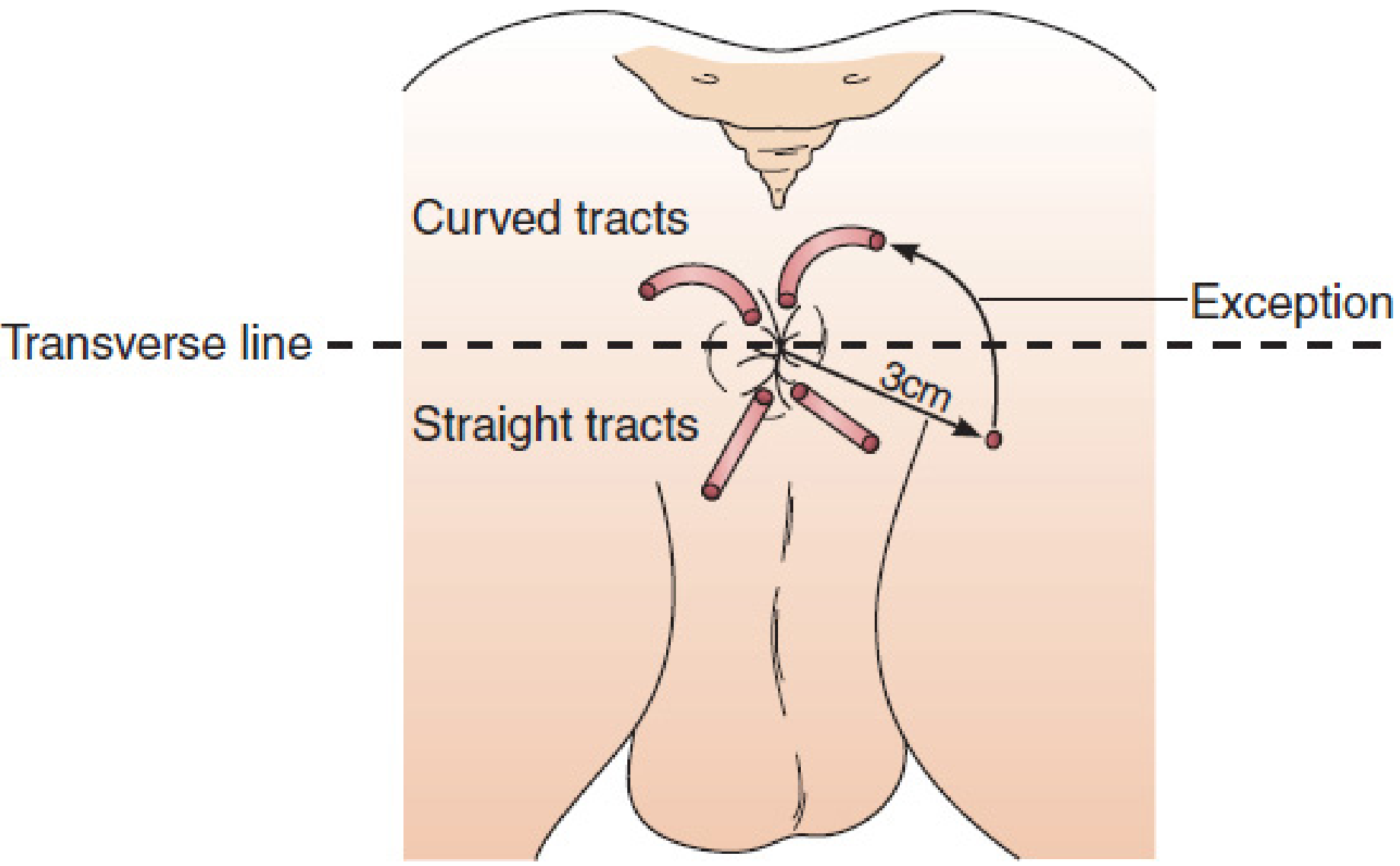
Draw an imaginary transverse line across the anus:
- Posterior external opening (behind the line): tract curves to open in the posterior midline of the anal canal
- Anterior external opening (in front of the line): tract runs in a straight line to the nearest anal crypt
Exception: anterior openings more than 3 cm from the anus may also curve to the posterior midline.
Clinical Features
Symptoms:
- Recurrent perianal abscesses (often same location)
- Persistent or intermittent purulent / bloody discharge from a perianal opening
- Perianal pain, swelling, and itching
- Intermittent healing followed by re-flare ("feels like a boil forming, rupturing, and relieving")
- In Crohn fistulas: may have multiple external openings, more complex anatomy
Examination:
- External opening visible on perianal skin (may have granulation tissue)
- Fibrous tract may be palpable along the course toward the anal canal
- Internal opening sometimes visible on anoscopy (but not always necessary for diagnosis)
Differential Diagnoses
| Condition | How to distinguish |
|---|---|
| Hidradenitis suppurativa | Inflammation of apocrine sweat glands; fistulas are superficial and do NOT enter the anal canal |
| Pilonidal disease | Origin in the gluteal cleft, caused by a hair tuft foreign body reaction |
| Crohn disease | Multiple, complex, or recurrent fistulas; check for bowel symptoms |
Investigations
- Clinical examination (usually sufficient for simple fistulas)
- Examination under anesthesia (EUA) with a probe - identifies tract length and sphincter involvement
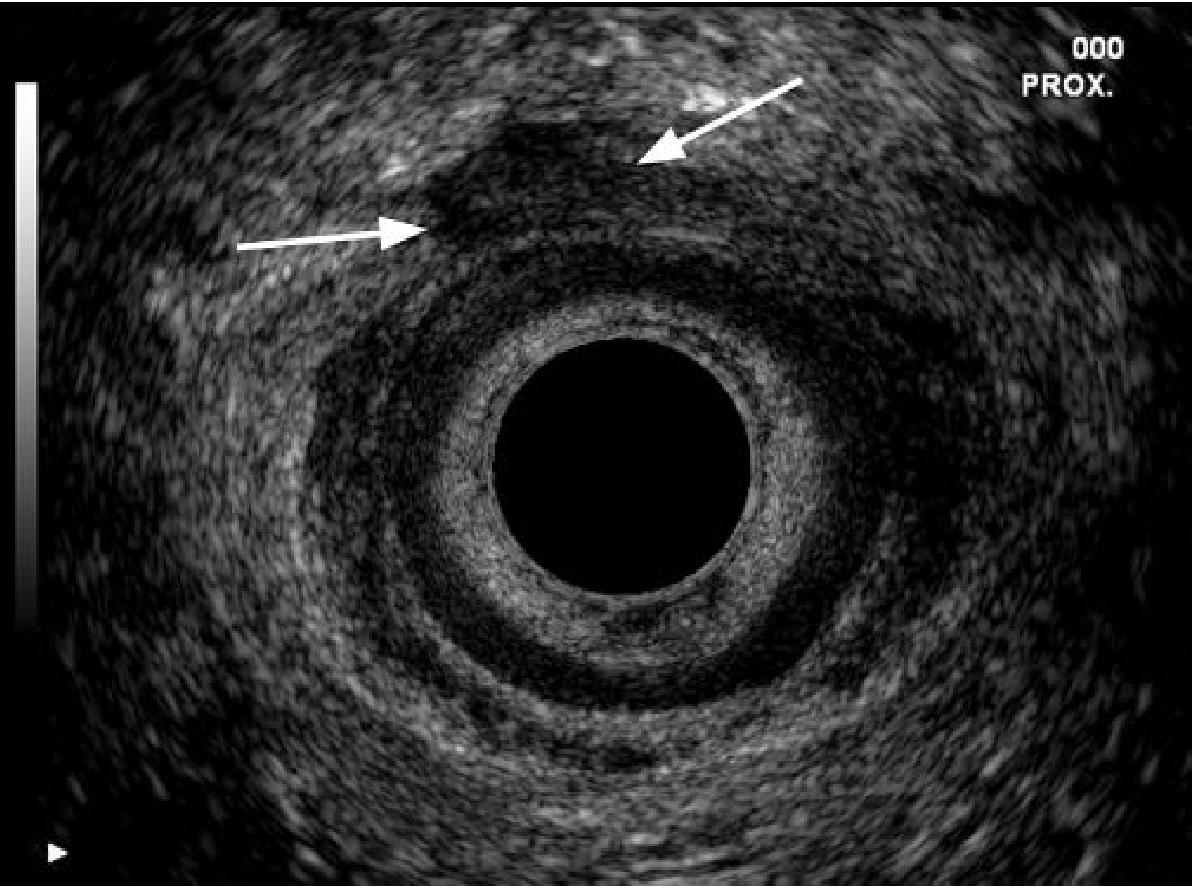
- Endoanal ultrasound - shows tract in relation to sphincters, useful for internal opening identification
- MRI pelvis (modality of choice for complex fistulas) - fat-suppressed T2W sequences show the fistula tract as high signal against the sphincter complex; detects supralevator extensions and abscesses; preoperative MRI reduces recurrence rates
- Hydrogen peroxide injection into external opening (with or without endoanal US) - helps identify smaller fistulas
- Fistulography with water-soluble contrast - for complex, recurrent, or Crohn fistulas
Management
The goal of all treatment is to obliterate the fistula tract while preserving sphincter function to prevent fecal incontinence.
Simple / Low Fistulas
Fistulotomy (laying open the tract):
- Success rate up to 90%
- Safe when < 30% of sphincter is involved and baseline continence is normal
- The unroofed tract heals by secondary intention
- Caution in women: the anterior anal sphincter is shorter; anterior fistulotomy risks incontinence
Complex / High Fistulas
1. Seton placement:
- A suture, Silastic loop, or other material passed through the fistula tract and secured
- Keeps the external opening patent (prevents recurrent abscess)
- Over weeks, the tract scars and becomes fibrotic around the seton
- Can be used as a draining seton (long-term symptom control) or progressively tightened as a cutting seton (gradually erodes through sphincter)
- Cutting seton success: up to 94%, but incontinence risk: 23-22%
2. Endoanal advancement flap:
- A flap of mucosa + internal sphincter muscle is raised over the internal opening
- Tract is curetted, internal opening sutured closed, flap advanced and sutured over it
- Success rate: 66-87%
3. LIFT procedure (Ligation of Intersphincteric Fistula Tract):
- After seton placement allows fibrosis, the intersphincteric tract is exposed, ligated, and divided
- Incision over the intersphincteric groove; both ends of tract ligated
- Success rate: 40-95%
4. Not recommended as primary treatment:
- Fibrin glue instillation - high recurrence
- Fistula plug - high recurrence
Crohn-Associated Fistulas
- Asymptomatic fistulas in Crohn disease do not need treatment
- First step: unroof branching tracts to create a single track
- Anti-TNF therapy (e.g., infliximab) for medical management - can achieve symptomatic control
- Long-term draining setons combined with medical therapy are the mainstay
- Fistulotomy reserved only for most superficial fistulas
- Temporary defunctioning stoma (diversion) may help complex cases heal
- Proctectomy for severe, refractory perianal Crohn disease
Prognosis
After appropriate surgery, approximately 85% of anal fistulas are healed at 6 years.
Recent Evidence
A 2025 systematic review and meta-analysis (PMID 40936062) examined laser-based fistula therapies (FiLaC - Fistula-tract Laser Closure) as an emerging sphincter-preserving option, showing promising results for complex anal fistulas where conventional surgery carries high incontinence risk.
Sources: Goldman-Cecil Medicine, Mulholland and Greenfield's Surgery (7e), Grainger & Allison's Diagnostic Radiology
This is a shared conversation. Sign in to Orris to start your own chat.