
Uh, explain the neonatal care, step number six, maintenance of warm chain. Uh, explain this with a diagram and in which you show me, uh, radiation, convection, evaporation, and conduction, and how does that takes place. Give, explain me with this an example.
neonatal heat loss radiation convection evaporation conduction newborn
newborn baby heat loss mechanisms diagram
neonatal care maintenance of warm chain step 6 radiation convection evaporation conduction heat loss newborn
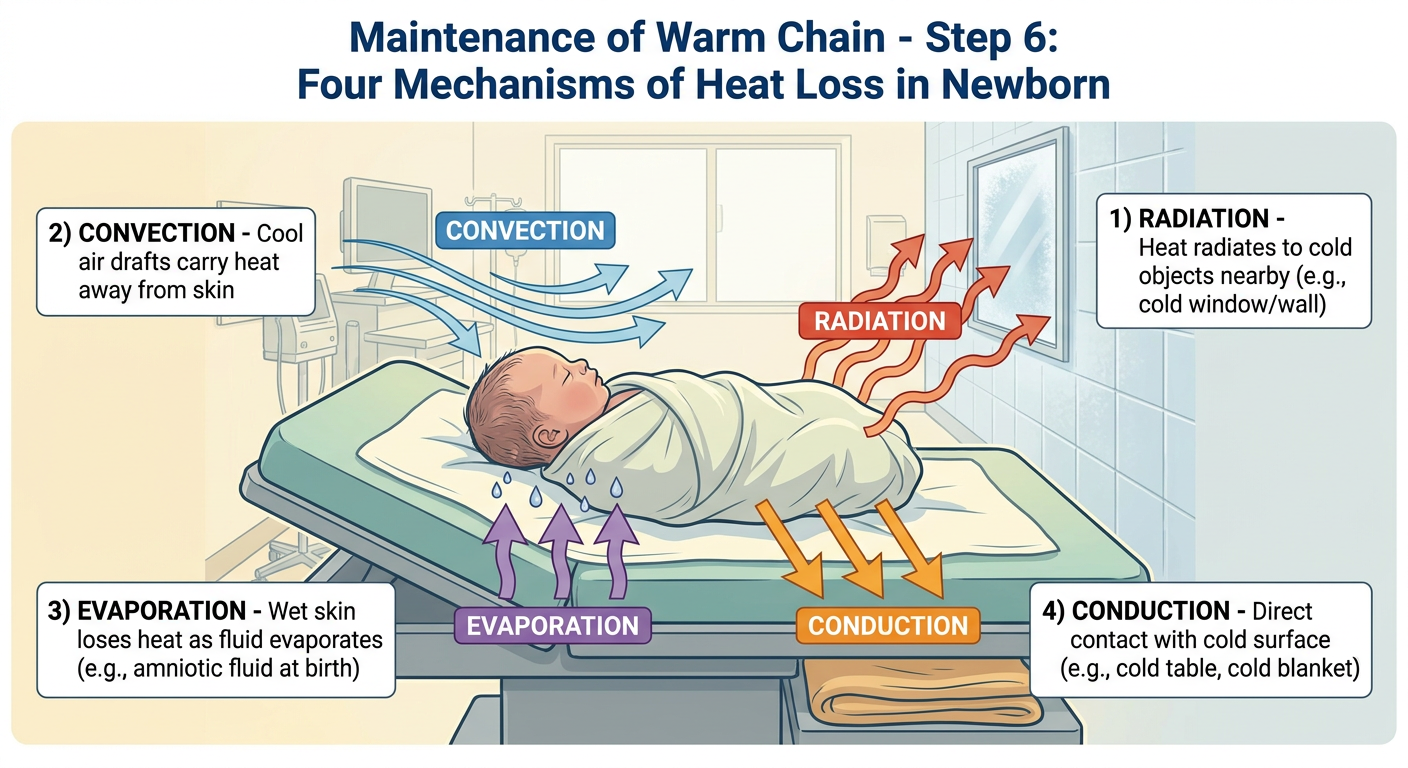
A clear medical educational diagram showing a newborn baby lying on a surface in a delivery room, with four labeled arrows showing the four mechanisms of heat loss: 1) RADIATION - wavy arrows going from the baby outward toward a cold wall/window in the distance (no direct contact), labeled with "Heat radiates to cold objects nearby (e.g., cold window/wall)"; 2) CONVECTION - curved arrows showing cool air currents flowing over the baby's skin surface, labeled "Cool air drafts carry heat away from skin"; 3) EVAPORATION - upward arrows from the wet skin surface showing moisture evaporating into the air, labeled "Wet skin loses heat as fluid evaporates (e.g., amniotic fluid at birth)"; 4) CONDUCTION - downward arrows from baby into the surface below, labeled "Direct contact with cold surface (e.g., cold table, cold blanket)". The diagram should have a warm/clinical style, clean educational layout with clear color coding for each mechanism, title at the top: "Maintenance of Warm Chain - Step 6: Four Mechanisms of Heat Loss in Newborn"
Neonatal Care - Step 6: Maintenance of Warm Chain
The Diagram
Why Newborns Are Especially Vulnerable
- Large skin surface area relative to small body mass (especially the head, which has high blood flow)
- Little subcutaneous fat for insulation
- Cannot shiver effectively to generate heat
- Cannot behaviorally regulate temperature (e.g., cannot put on a blanket or move away from cold air)
- At birth, the baby moves from a warm, wet uterine environment (~37°C) into a cool, dry delivery room
The Four Mechanisms of Heat Loss (with Examples)
1. 🌡️ Radiation
- Heat travels as infrared energy from a warm surface to a cooler one.
- Example: A newborn placed in a crib next to a cold glass window or a cold outer wall. The baby's body heat radiates toward the window even though the baby never touches it.
- Prevention: Keep the baby away from cold walls/windows. Use a radiant warmer. Maintain delivery room temperature at least 25°C (77°F).
2. 💨 Convection
- Moving air currents pick up heat from the skin surface and carry it away.
- Example: A newborn lying uncovered under a fan, near an air-conditioning vent, or in a drafty room. Even opening a door or window creates a draught that steals heat rapidly.
- Prevention: No fans in the delivery room. Close windows and doors. Wrap the baby in warm blankets. Avoid exposing skin unnecessarily.
3. 💧 Evaporation
- Evaporation of water requires heat energy, which is drawn from the baby's body.
- Example: At birth, the baby is covered in amniotic fluid. As this fluid evaporates off the wet skin, it draws enormous amounts of heat away - this is why evaporation is the BIGGEST source of heat loss immediately at birth. Similarly, after a bath or even a wet nappy, heat is lost the same way.
- Prevention: Dry the baby immediately and vigorously after birth with a warm, dry towel. Remove the wet towel and replace with a dry one. Delay baths for at least 6-24 hours after birth.
4. 🧱 Conduction
- Heat flows from the warmer baby into the cooler object by direct touch.
- Example: Placing a naked baby on a cold examination table, a cold weighing scale, or wrapping it in a cold blanket or towel. Even a cold stethoscope placed on a newborn's chest causes conductive heat loss.
- Prevention: Pre-warm all surfaces (radiant warmer, towels, blankets). Use warm (not cold) objects in contact with the baby. Practice skin-to-skin (kangaroo) care - the mother's warm chest is the best conductor of warmth back to the baby.
Quick Summary Table
| Mechanism | How It Happens | Clinical Example | Prevention |
|---|---|---|---|
| Radiation | Heat to distant cold objects (no contact) | Baby near cold window/wall | Radiant warmer, warm room |
| Convection | Heat carried away by moving cool air | Fan, open door, draught | No fans, close doors/windows |
| Evaporation | Heat lost from wet skin as fluid dries | Amniotic fluid at birth, post-bath | Dry immediately, delay bath |
| Conduction | Heat lost to cold surface by direct touch | Cold scale, cold blanket | Pre-warm all surfaces, skin-to-skin |
Key Clinical Takeaway
Explain the APAR scale, which is done to assess the neonatal.
Apgar score table newborn assessment chart
A clean, colorful medical educational poster titled "APGAR Score - Neonatal Assessment". Show a table with 5 rows and 4 columns. Column headers: Sign/Component | Score 0 | Score 1 | Score 2. Rows: 1) Heart Rate: Absent | Less than 100 bpm | Greater than 100 bpm. 2) Respiratory Effort: Absent | Slow, irregular | Good, strong cry. 3) Muscle Tone: Limp (flaccid) | Some flexion of limbs | Active movement. 4) Reflex Irritability: No response | Grimace | Cough, sneeze, cry. 5) Color (Appearance): Blue/Pale all over | Body pink, extremities blue (acrocyanosis) | Completely pink. Below the table, show three interpretation bands: Score 0-3 = Severe depression (red color), Score 4-6 = Mild depression (yellow/orange), Score 7-10 = Normal/No depression (green). Also show the mnemonic APGAR vertically: A=Appearance, P=Pulse, G=Grimace, A=Activity, R=Respiration. Include a small icon of a baby at the top. Bright, clinical, educational style.
APGAR Score - Neonatal Assessment
Note on spelling: You said "APAR" - the correct term is APGAR (with a G). It is named after Dr. Virginia Apgar, an American anesthesiologist who devised this scoring system in 1952. APGAR is also a useful mnemonic - explained below.
What is the APGAR Score?
- Devised by Dr. Virginia Apgar in 1952
- Assessed at 1 minute and 5 minutes after birth
- If the score at 5 minutes is still less than 7, it is repeated every 5 minutes up to 20 minutes while resuscitation continues
The Diagram
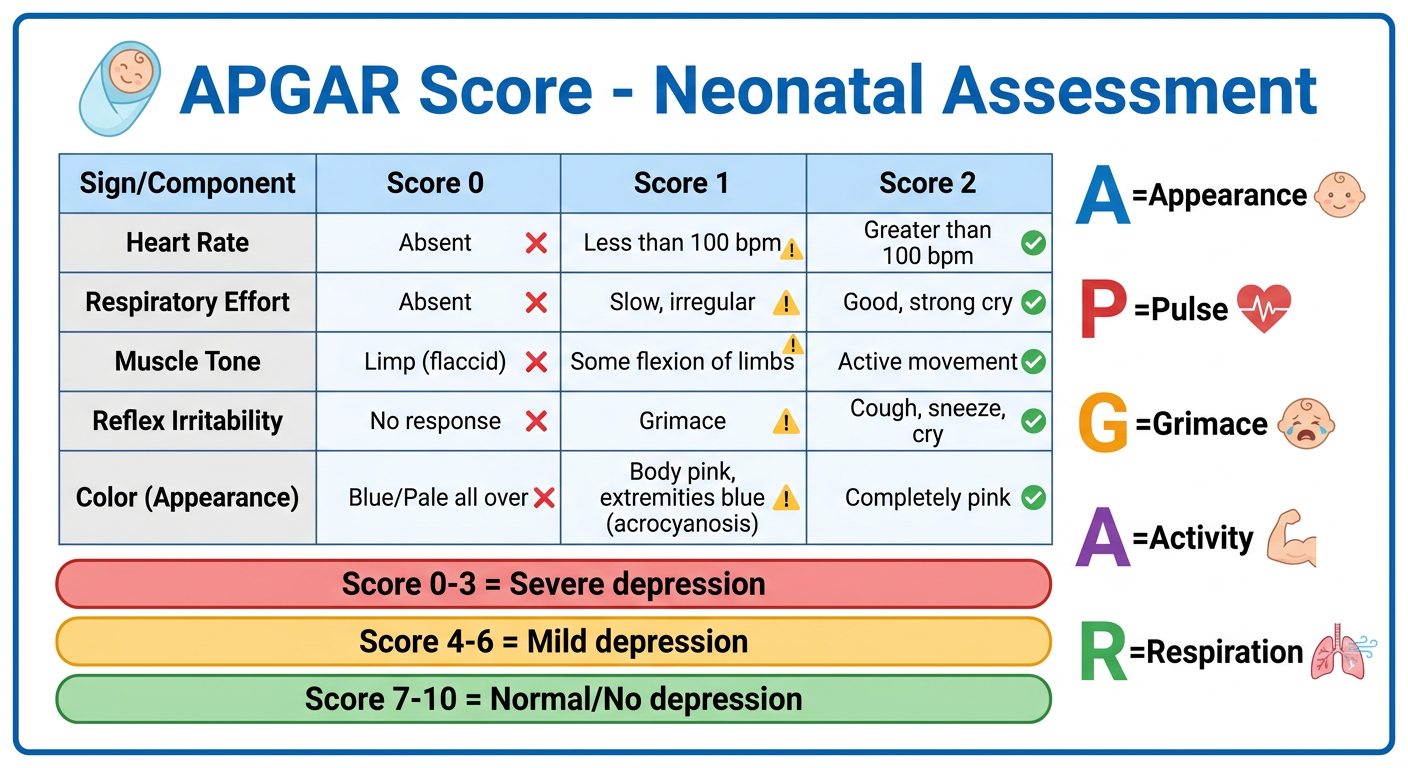
The APGAR Mnemonic
| Letter | Full Name | What It Means |
|---|---|---|
| A | Appearance | Skin color |
| P | Pulse | Heart rate |
| G | Grimace | Reflex irritability |
| A | Activity | Muscle tone |
| R | Respiration | Breathing effort |
The 5 Components - Scored 0, 1, or 2
1. A - Appearance (Skin Color)
| Score | Finding |
|---|---|
| 0 | Completely blue or pale all over the body |
| 1 | Body is pink, but extremities (hands/feet) are blue - called acrocyanosis |
| 2 | Completely pink all over (normal) |
- Example: A baby born pink all over scores 2. A baby with blue hands and pink body scores 1.
2. P - Pulse (Heart Rate)
| Score | Finding |
|---|---|
| 0 | Absent - no heartbeat detected |
| 1 | Slow - less than 100 beats per minute |
| 2 | 100 beats per minute or more (normal) |
- Example: A baby with a heart rate of 130 bpm scores 2. A baby with a rate of 80 bpm scores 1.
- Heart rate is checked by listening with a stethoscope over the chest or feeling the pulse at the umbilical cord.
3. G - Grimace (Reflex Irritability)
| Score | Finding |
|---|---|
| 0 | No response to stimulation |
| 1 | Grimace (frown, wrinkle face) only |
| 2 | Active response - cough, sneeze, or cry |
- Tested by gentle suctioning of the nostril or flicking the sole of the foot.
- Example: A baby who cries vigorously when suctioned scores 2. A baby who just grimaces scores 1.
4. A - Activity (Muscle Tone)
| Score | Finding |
|---|---|
| 0 | Limp / Flaccid - no muscle tone, arms and legs hang loosely |
| 1 | Some flexion of arms and legs |
| 2 | Active movement - good flexion, baby moves limbs actively |
- Example: A baby kicking and moving all four limbs scores 2. A completely limp baby scores 0.
5. R - Respiration (Breathing Effort)
| Score | Finding |
|---|---|
| 0 | Absent - no breathing at all |
| 1 | Slow or irregular breathing |
| 2 | Strong breaths with a good, strong cry |
- Example: A baby crying loudly scores 2. A baby making only weak, irregular gasps scores 1.
Score Interpretation
| Total Score | Interpretation | Clinical Meaning |
|---|---|---|
| 7 - 10 | Normal (No depression) | Baby is in good condition |
| 4 - 6 | Mild depression | Baby needs some stimulation and support |
| 0 - 3 | Severe depression | Baby needs immediate resuscitation |
Timing - When is it Done?
Birth → 1-minute APGAR → 5-minute APGAR → (if <7) → repeat every 5 min up to 20 min
- The 1-minute score reflects the baby's condition at birth and the need for immediate intervention.
- The 5-minute score reflects the baby's response to any resuscitation and is a better predictor of survival.
Important Clinical Points
- Do NOT delay resuscitation to calculate the APGAR score - if the baby needs help, act immediately.
- A low APGAR score (0-3) does NOT alone predict neurological damage or confirm a hypoxic event occurred in the womb.
- APGAR scores can be affected by:
- Prematurity (premature babies score lower physiologically)
- Maternal medications (e.g., sedatives, opioids)
- Infections
- Cardiac or respiratory conditions
- A score of 0-3 at 5 minutes may correlate with risk of neonatal death.
Quick Memory Trick
"Babies APGAR at 1 and 5" - Remember to assess at 1 minute and 5 minutes. Score each of the 5 signs from 0 to 2, maximum total = 10.