
Injury
I need a bit more context to help you well. What's your question about injury?
Asking for Preferences
What would you like to know about injury?
Injuries are broadly classified by mechanism, tissue type, and severity. Let me pull together a thorough overview from the medical library.
Searching sources...
Reading File
Finding Sources
Finding Sources
Finding Sources
Finding Sources
Finding Sources
Searching the Web
types and classification of injuries medical overview
Reading File
Reading File
Finding Sources
Finding Sources
Finding Sources
Finding Sources
Reading File
Reading File
Here is a structured overview of injury types and classification drawn from authoritative surgical and trauma textbooks.
Injury: Types & Classification
1. Classification by Mechanism
| Mechanism | Examples |
|---|---|
| Blunt / Closed | Falls, motor vehicle crashes, direct blows - skin intact |
| Penetrating / Open | Stab wounds, gunshot wounds, impalement - skin breached |
| Thermal | Burns (flame, scalds, contact), frostbite |
| Chemical | Acid/alkali burns, caustic ingestion |
| Electrical | Lightning, electrocution |
| Blast / Barotrauma | Explosions - primary (pressure wave), secondary (fragments), tertiary (thrown), quaternary (burns/inhalation) |
2. Classification by Tissue Type
Soft Tissue Injuries
- Contusion - bruising from blunt force, no skin breach
- Abrasion - superficial skin loss by friction
- Laceration - irregular tear of skin/soft tissue
- Incised wound - clean cut (knife, glass)
- Degloving - avulsion of skin and subcutaneous tissue
- Crush injury - compressive force causing cell necrosis, rhabdomyolysis risk
Bone Injuries
- Closed (simple) fracture - no communication with external environment
- Open (compound) fracture - fracture haematoma communicates with a breach in the epithelial lining (skin, mucosa, rectum, vagina)
The Gustilo-Anderson classification grades open fractures by energy and soft-tissue damage:
| Grade | Description |
|---|---|
| I | Low energy; wound <1 cm, clean |
| II | Wound >1 cm; no extensive soft-tissue damage |
| IIIA | High energy; extensive damage but adequate soft-tissue cover after debridement |
| IIIB | High energy; inadequate cover - flap closure required |
| IIIC | Open fracture with arterial injury requiring repair |
(Bailey and Love's Short Practice of Surgery, 28th ed.)
Nerve Injuries (Seddon Classification)
- Neurapraxia - nerve sheath intact, no Wallerian degeneration; good recovery potential
- Axonotmesis - sheath intact but internal fibres disrupted with Wallerian degeneration; guided regeneration possible
- Neurotmesis - complete nerve division; surgical repair required
(Bailey and Love's Short Practice of Surgery, 28th ed.)
3. Classification by Body Region / System
Trauma consistently crosses junctional zones - anatomical boundaries where injuries to one cavity may affect adjacent structures:
- Neck-thorax junction
- Thorax-upper limb junction
- Thoracico-abdominal junction (diaphragm - penetrating wounds below the nipple may enter the abdomen)
- Abdominopelvic-groin junction
(Bailey and Love's Short Practice of Surgery, 28th ed.)
4. Classification by Severity: Injury Severity Score (ISS)
The ISS is the standard anatomic scoring system correlating with morbidity and mortality. It is calculated from the Abbreviated Injury Scale (AIS):
AIS severity codes:
| Code | Severity |
|---|---|
| 1 | Minor |
| 2 | Moderate |
| 3 | Severe (non-life-threatening) |
| 4 | Severe (life-threatening) |
| 5 | Critical (survival uncertain) |
| 6 | Fatal |
ISS = A² + B² + C² (squares of the AIS scores in the three worst body areas: soft tissue, head/neck, chest, abdomen, extremity/pelvis)
- An AIS of 6 in any area automatically sets ISS = 75 (maximum)
- ISS >15 is associated with ~10% mortality
- The New ISS (NISS) takes the three highest AIS scores regardless of body region, which better accounts for multiple injuries in one area
(Rockwood and Green's Fractures in Adults, 10th ed.)
5. Classification by Acuity (Orthopaedic Framework)
- Acute injuries - sudden onset, high-intensity force, short duration (e.g. fractures, acute ligament tears)
- Chronic / overuse injuries - repetitive low-level stress over time (e.g. stress fractures, tendinopathy)
6. Special Soft-Tissue Classification Systems
| System | Used for |
|---|---|
| Tscherne classification | Closed soft-tissue injuries associated with fractures |
| Gustilo-Anderson | Open fractures (see above) |
| Ganga classification | Severe open injuries with limb salvage decisions |
| AO-ASIF classification | Combines fracture pattern + soft-tissue + neurovascular injury |
This framework covers the major axes along which injuries are classified clinically. If you want to go deeper on any specific type (e.g. fractures, burns, traumatic brain injury, spinal cord injuries, sports injuries), just ask.
Injury forensic medicine
In forensic medicine, injuries are classified by the type of weapon/force, wound morphology, and whether they could be self-inflicted or homicidal. Key wound types include abrasions, contusions, lacerations, incised wounds, stab wounds, and firearm wounds.
Searching sources...
Reading File
Finding Sources
Finding Sources
Multiple forensic medicine textbooks found. Let me pull the dedicated injury sections from the most comprehensive ones.
Finding Sources
Finding Sources
Excellent - rich content found. Now reading the key sections in parallel.
Reading File
Reading File
Reading File
Reading File
Reading File
Reading File
Reading File
Reading File
Reading File
Reading File
Reading File
I now have rich content across all the major wound types. Let me compile the comprehensive answer.
Loading Image
Loading Image
Loading Image
Loading Image
Here is a comprehensive overview of Injury in Forensic Medicine, drawn directly from The Essentials of Forensic Medicine and Toxicology (36th ed., 2026) and P.C. Dikshit's Textbook of Forensic Medicine and Toxicology.
Injury in Forensic Medicine
Classification of Injuries (Forensic Framework)
Injuries are classified along several medico-legal axes:
| Axis | Categories |
|---|---|
| By agent | Mechanical, Thermal, Chemical, Electrical/Lightning/Radiation |
| By weapon type | Blunt, Sharp, Firearm |
| By legal severity | Simple injury vs. Grievous hurt |
| By manner | Suicidal, Homicidal, Accidental |
| By wound type | Defense wounds, Fabricated wounds |
| By timing relative to death | Antemortem vs. Postmortem |
(P.C. Dikshit's Textbook of Forensic Medicine and Toxicology)
Mechanism of Wound Production
Wounds result from energy transfer at impact between a moving weapon and the body (or vice versa). Key physics:
- KE = ½mv² - velocity has far greater influence on wound severity than mass; doubling velocity quadruples kinetic energy
- Blunt objects dissipate force over a large area; sharp objects concentrate force over a small area
- Tissues resist compression but are deformed by displacement, producing traction/shear strains
- Bones fracture; muscles develop hemorrhages; hollow viscera rupture
(P.C. Dikshit)
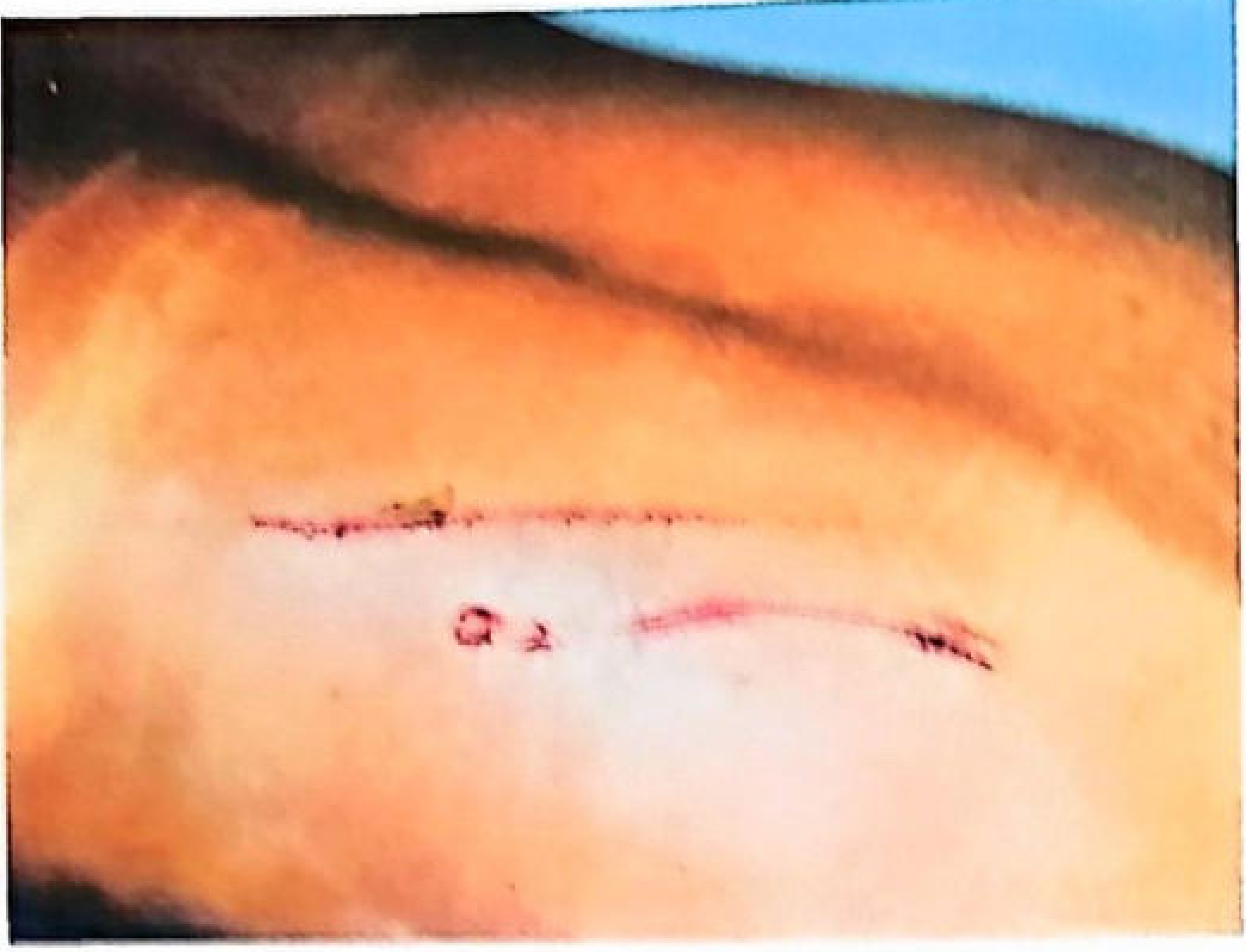
1. Abrasions
An abrasion is a destruction or discontinuity of the superficial epidermis only (skin thickness ~1.6 mm), caused by friction or compression against a rough surface.
Four forensic types:
| Type | Mechanism | Significance |
|---|---|---|
| Graze (sliding/scraping) | Lateral rubbing; skin dragged across surface | Direction of force can be determined from "tailing" of dislodged epithelium |
| Pressure abrasion | Right-angle compression | Best examples: fingernail marks, ligature marks around neck |
| Impact abrasion | Perpendicular blow from a solid object | Abrasion at periphery of impact zone |
| Patterned abrasion | Impact from patterned surface | Reproduces shape of weapon (e.g., tyre tread, shoe sole, rope weave) |
Forensic value: Shape and direction of abrasions indicate the type and direction of force; patterned abrasions can identify the weapon.
2. Contusions (Bruises)
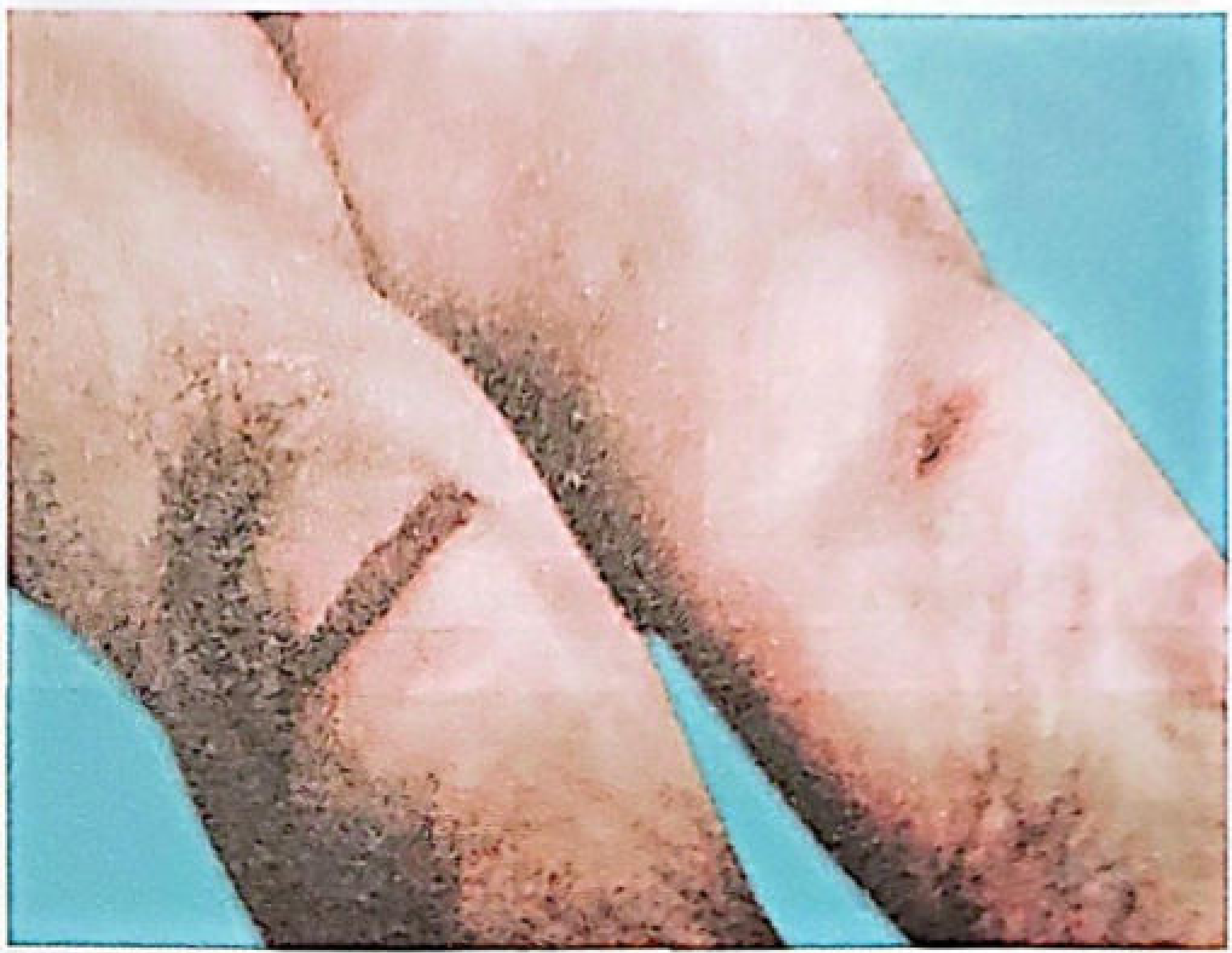
A contusion is an extravasation of blood into the tissues from ruptured veins/venules/arterioles, caused by a blunt object, without skin breach (usually).
Key features:
- Fresh bruise: tender, slightly raised, darker at periphery (center lighter because blood is pushed outward by impact)
- Deep bruises may take hours to 1-2 days to appear at the surface ("delayed bruising")
- Petechiae = pinpoint bruises; ecchymoses = larger, confluent petechiae
Colour changes over time (used to estimate age of injury):
| Time | Colour |
|---|---|
| Fresh | Red/dark red |
| 1-3 days | Blue/purple |
| 3-6 days | Green |
| ~1 week | Yellow |
| Fading | Pale yellow/brown |
Note: This timeline varies with depth, individual, and location; courts should not rely on colour alone for precise dating.
Patterned bruising - forensically important:
- Whip: two parallel lines curving around limbs
- Belt/strap: clear imprint of object
- Muzzle contact: circular bruise around barrel outline
- Tyre tread: alternating red lines (grooves) and pale strips (ridges)
- Suction/biting: elliptical petechial confluences (erotic/sexual assault context)
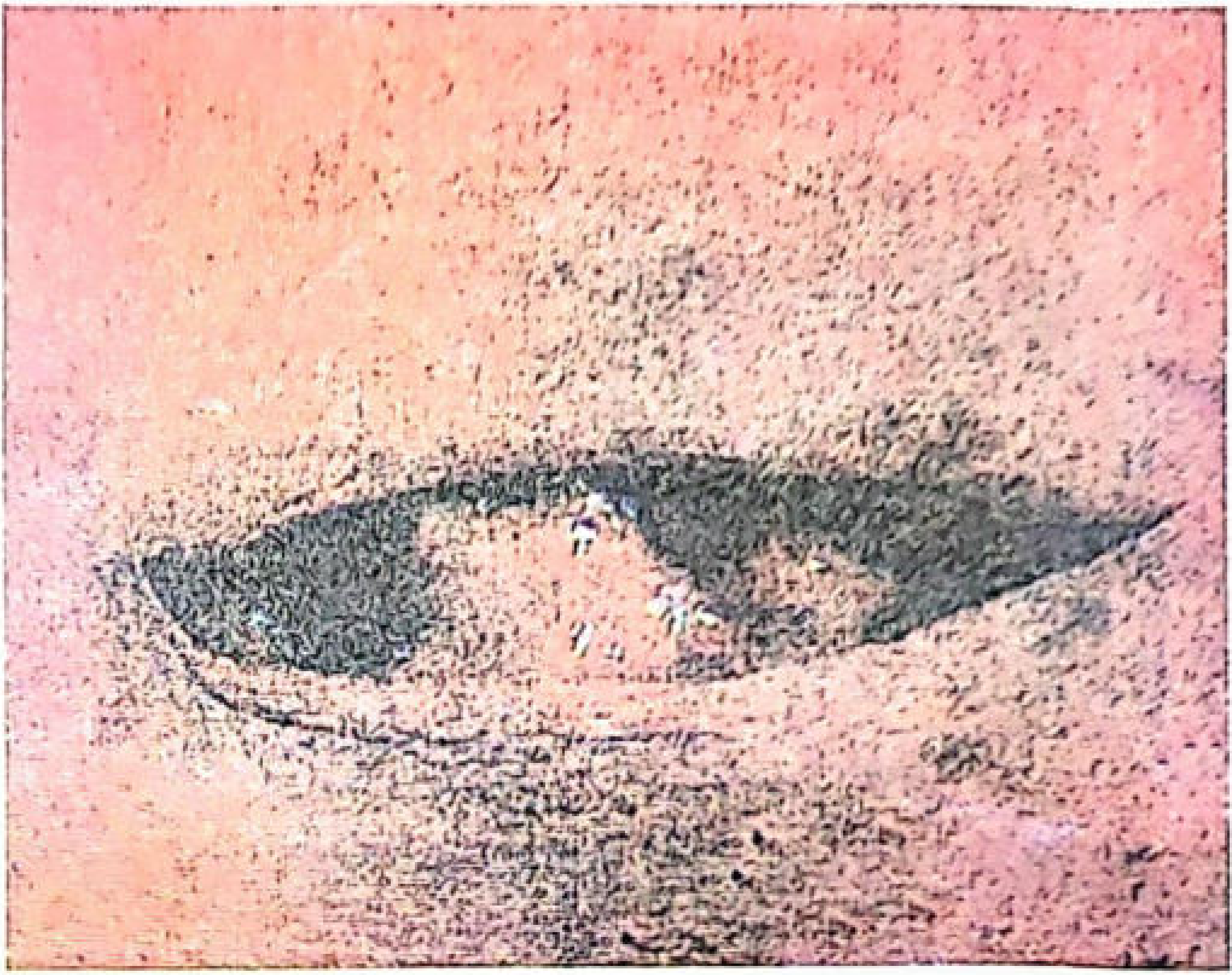
3. Lacerations
Lacerations are tears or splits of skin/mucosa/muscle produced by blunt force crushing or stretching tissue beyond elasticity. They are not the same as incised wounds.
Distinguishing features of lacerations vs. incised wounds:
| Feature | Laceration | Incised wound |
|---|---|---|
| Edges | Irregular, ragged, bruised | Clean, sharp |
| Margins | Contused, sometimes inverted | Not contused |
| Hair/tissue bridges | Present across wound | Absent |
| Bleeding | Moderate | Often profuse |
| Weapon | Blunt | Sharp |
Types of laceration:
- Split laceration - over bony prominences (scalp, eyebrow, shin)
- Stretch laceration - tangential force; skin overstretched
- Avulsion - tissue torn away; degloving
- Cut/penetrating laceration - by blunt irregular edge producing a wound mimicking an incised wound
Medicolegal significance:
- Foreign bodies in wound can indicate circumstances of the crime
- Homicidal lacerations typically on the head
- Suicidal lacerations on exposed, accessible areas
4. Incised Wounds
An incised wound (cut) is produced by a sharp-edged weapon (knife, razor, glass) where the length and width exceed the depth. The wound is clean, with sharp, non-abraded edges.
Forensic features:
- Hesitation marks (tentative/trial cuts) - multiple, parallel, superficial, uniform cuts at the beginning of the wound track; hallmark of self-infliction
- Typically on the front of the neck, wrists, groin - accessible areas
- Tail or "tailing" at one end indicates the direction and manner of withdrawal of the weapon
Homicidal vs. Suicidal incised wounds:
| Feature | Suicidal | Homicidal |
|---|---|---|
| Location | Accessible (wrists, neck, groin) | Any area, often back/non-accessible |
| Hesitation cuts | Present | Absent |
| Clothing cut | Clothing displaced first (often) | Clothing cut through |
| Defense wounds | Absent | Often present on hands/forearms |
5. Stab Wounds
A stab wound is produced by force along the long axis of a pointed/narrow object (knife, dagger, scissors, nail, arrow). The depth exceeds the surface length and width.
Key features for medicolegal analysis:
| Parameter | Detail |
|---|---|
| Depth | Greater than surface dimensions; equals or is less than blade length (may exceed it on soft surfaces - abdomen, buttocks - due to indentation) |
| Shape | Depends on single vs. double-edged blade, skin tension, orientation to Langer's lines |
| Single-edged weapon | One end sharp/acute, other end blunt/wedge-shaped |
| Double-edged weapon | Both ends are acute/pointed |
| Langer's lines | Wounds parallel to Langer's lines appear narrow/slit-like; wounds across them appear oval and wider |
| Tailing | A "tail" on one end indicates direction of blade withdrawal |
Important caution: Never probe a stab wound - may dislodge clot and cause fatal hemorrhage or create false tracks.
6. Defense Wounds
Defense wounds are injuries on the hands, forearms, and sometimes feet sustained while the victim attempts to fend off an attack:
- Incised/stab wounds on the palms and fingers (grabbing the blade)
- Abrasions and contusions on the forearms (blocking blows)
- Absence of defense wounds in a homicidal case may suggest the victim was taken by surprise, incapacitated, or bound
7. Antemortem vs. Postmortem Wounds
Determining whether an injury occurred before or after death is one of the most important forensic questions.
| Feature | Antemortem | Postmortem |
|---|---|---|
| Bleeding | Profuse; clot formation | Minimal; no true clotting |
| Vital reaction | Inflammation, hyperemia | Absent |
| Retraction of wound edges | Present | Absent |
| Histopathology | Neutrophil infiltration, fibroblast activity | None |
| Bruising | Blood infiltrates tissue | Blood settles by gravity (not infiltration) |
Histopathological timeline for wound healing (used to date antemortem injuries):
| Time | Findings |
|---|---|
| Minutes | Capillary dilation, neutrophil margination |
| 12 hours | Monocytes in exudate, leucocytic infiltration |
| 24 hours | Epithelium begins to grow at wound edges |
| 72 hours | Neutrophils replaced by macrophages; granulation tissue forms |
| 4-5 days | New fibrils; epithelial proliferation |
| 1 week | Soft scar in small wounds |
(Essentials of Forensic Medicine and Toxicology, 36th ed.)
8. Fabricated Wounds
Fabricated (self-inflicted for deception) wounds are created to falsely implicate someone or claim victimhood. Features:
- Typically superficial, involving only skin
- Located on accessible areas
- Often parallel and uniform
- No associated bruising unless deliberately induced
- Hesitation marks common
Summary: Wound Types at a Glance
| Wound | Weapon | Edges | Depth vs. Surface | Key ML Point |
|---|---|---|---|---|
| Abrasion | Blunt/rough surface | Superficial, no true edges | Epidermis only | Direction, patterning |
| Contusion | Blunt | No breach | Subcutaneous/deep | Colour dating, patterning |
| Laceration | Blunt | Irregular, bruised | Variable | Tissue bridges, foreign bodies |
| Incised wound | Sharp edge | Clean, sharp | Surface > depth | Hesitation marks = suicidal |
| Stab wound | Pointed/narrow | Clean | Depth > surface | Blade type, Langer's lines |
Sources: The Essentials of Forensic Medicine and Toxicology, 36th ed. (2026) - KS Narayan Reddy; P.C. Dikshit's Textbook of Forensic Medicine and Toxicology
This is a shared conversation. Sign in to Orris to start your own chat.