
Anemia in acute loss
I'll read the medical library skill first, then search for content on anemia in acute blood loss.
Reading File
Now let me search the library for anemia in acute blood loss, running parallel queries:
Finding Sources
Finding Sources
Excellent - found a dedicated section in Harrison's 22E. Let me read it along with other relevant sections:
Reading File
Reading File
Reading File
Now let me read the treatment section from Harrison's and fetch the anemia classification diagram:
Reading File
Loading Image
I now have comprehensive information. Here is the full response:
Anemia Due to Acute Blood Loss (Posthemorrhagic Anemia)
Sources: Harrison's Principles of Internal Medicine 22E (2025), Frameworks for Internal Medicine, Goldman-Cecil Medicine
Classification Context
Acute blood loss anemia is classified as normocytic, hyperproliferative anemia - the bone marrow responds actively to replace lost red cells.
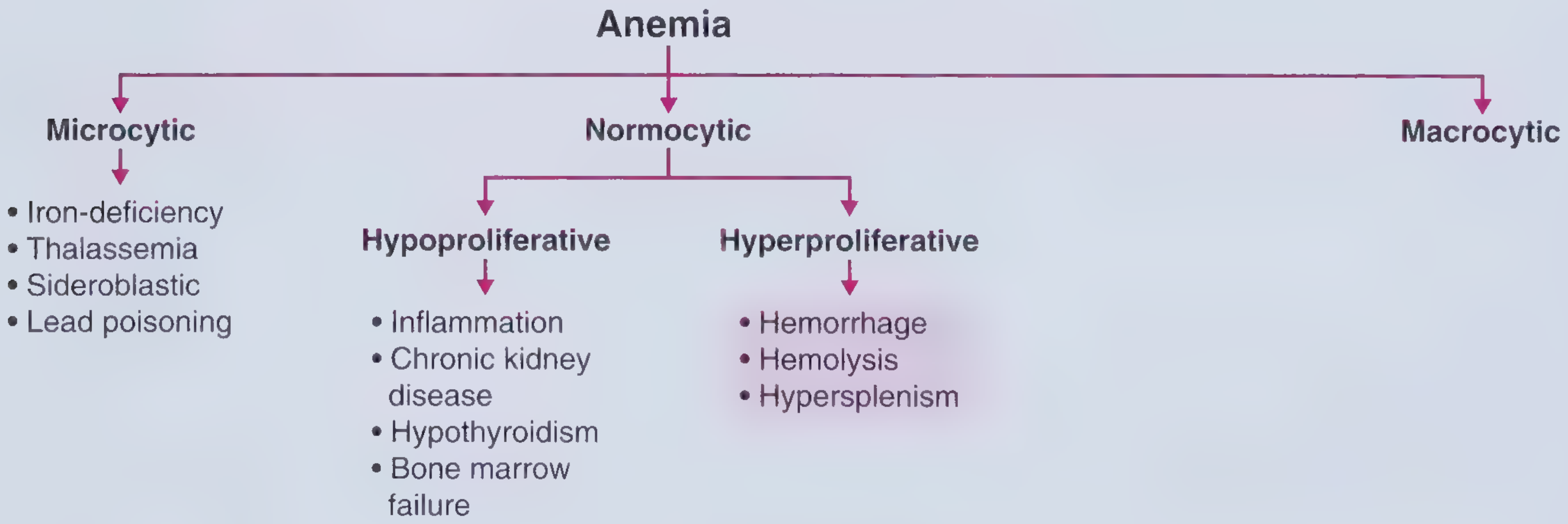
Mechanisms of Anemia
Blood loss causes anemia by two main mechanisms:
- Direct loss of red cells - the acute posthemorrhagic type (covered here)
- Gradual depletion of iron stores - if loss is protracted, leading to iron-deficiency microcytic anemia
Three Clinical/Pathophysiologic Stages
Stage 1 - Hypovolemia (Immediate)
- The dominant feature is hypovolemia, not yet anemia
- Organs with high blood supply (brain, kidneys) are most threatened - loss of consciousness and acute renal failure are major risks
- Key point: A blood count at this stage will NOT show anemia - hemoglobin concentration is unchanged because plasma and red cells are lost proportionally
- Only after IV fluids are given does the Hb begin to fall over several hours
- Physical exam findings reflect sympathetic activation: tachycardia, tachypnea, decreased pulse pressure, cold/pale/mottled skin, decreased urine output
Stage 2 - Hemodilution (Hours later)
- Baroreceptors and stretch receptors trigger release of vasopressin and other peptides
- The body shifts fluid from the extravascular to intravascular compartment, producing hemodilution
- Hypovolemia gradually converts to dilutional anemia
- The hemoglobin now reflects the amount of blood lost. For example: if Hb = 7 g/dL at 3 days, approximately half of total blood volume was lost
Stage 3 - Bone Marrow Response (Days to weeks)
- Provided bleeding stops, the marrow gradually corrects the anemia
- Reticulocyte count and erythropoietin levels become elevated (hyperproliferative response)
- This is physiologically identical to the marrow response seen in hemolysis
Clinical Features by Volume Lost
| Blood Loss | % of Total Volume | Clinical Features |
|---|---|---|
| Mild | < ~15% (1 unit donation) | Usually asymptomatic; enhanced O₂ delivery via Bohr effect (decreased pH / increased CO₂) |
| Moderate | Up to 30% | Tachycardia, tachypnea; blood pressure typically normal or mildly decreased |
| Severe | > 30% | Orthostatic hypotension progressing to hypotensive shock; dyspnea, diaphoresis, cold/clammy skin, decreased urine output, delayed capillary refill |
- Healthy young adult men (~30s): ~6 L total blood volume
- By the 7th decade: ~5 L total blood volume
Symptoms of the Resulting Anemia
Symptoms of the anemia itself (once it develops) depend on how quickly it develops:
- Rapid onset: fatigue, loss of stamina, breathlessness, tachycardia (especially on exertion)
- Gradual onset: young patients may tolerate Hb as low as 7-8 g/dL before symptoms, due to:
- Rightward shift of O₂-Hb dissociation curve (increased 2,3-BPG)
- Increased cardiac output and regional blood flow redistribution
- Blood shunted away from kidney, gut, and skin to protect brain and heart
- Compensatory mechanisms can cover a 2-3 g/dL Hb deficit
Diagnosis
- Usually straightforward with external or obvious bleeding
- Internal bleeding (GI, retroperitoneal, ectopic pregnancy, subarachnoid, aneurysm) may not be immediately obvious
- Never underestimate internal losses - blood loss at the scene is often overestimated visually
- Physical signs to localize:
- Grey Turner sign (flank ecchymosis) - retroperitoneal bleeding
- Cullen sign (umbilical ecchymosis) - intraperitoneal or retroperitoneal bleeding
- Dullness to chest percussion - intrapleural bleeding
- When an abrupt Hb fall occurs, always suspect acute posthemorrhagic anemia (APHA)
- Investigations: sonogram, endoscopy as appropriate
Treatment
Priority order:
- ABCs - Airway, Breathing, Circulation in hemodynamically unstable patients; vasopressors for bleeding-associated hypotension
- Blood transfusion - Unlike chronic anemias, the body is NOT adapted, so transfusion takes priority early
- Stop the hemorrhage - eliminate the source concurrently
Volume replacement:
- Plasma is preferred over saline for volume expansion in acute hemorrhage - crystalloid dilutes clotting factors and can worsen hemostasis
- Trauma also causes vascular and platelet abnormalities that further increase bleeding risk
Surgical blood loss:
- Can be substantial (e.g., up to 2 L in radical prostatectomy)
- Elective surgery: preoperative autologous blood donation may be available
Blood substitutes (experimental):
- Two approaches: fluorocarbon synthetic chemicals and hemoglobin-based oxygen carriers (HBOCs)
- HBOCs have reached phase 2-3 trials but no blood substitute has yet become standard treatment
- Harrison's Principles of Internal Medicine 22E (2025), Chapter 106 - Dan L. Longo
- Frameworks for Internal Medicine, Chapter on Normocytic Hyperproliferative Anemia
- Goldman-Cecil Medicine, Chapter 144 (Normocytic Anemias)
This is a shared conversation. Sign in to Orris to start your own chat.