
CBC detail basic clinical
Reading File
Now let me search the medical library for CBC content in parallel.
Finding Sources
Finding Sources
Let me search more specifically for CBC components and interpretation sections.
Finding Sources
Finding Sources
Finding Sources
Finding Sources
Finding Sources
Excellent sources found. Let me read the key sections from Goldman-Cecil and Histology textbooks.
Reading File
Reading File
Reading File
Reading File
Reading File
Reading File
Finding Sources
I now have comprehensive data from the textbooks. Let me also fetch the hematopoiesis diagram and check for WBC normal ranges.
Finding Sources
I now have all the key content from authoritative textbooks. Let me compile a thorough CBC clinical overview.
Complete Blood Count (CBC) - Clinical Overview
A CBC is one of the most commonly ordered laboratory panels. It uses automated flow cytometry to count and characterize ~10,000 cells per category, providing directly measured and calculated parameters across three cell lines: erythrocytes, leukocytes, and thrombocytes.
- Histology: A Text and Atlas with Correlated Cell and Molecular Biology, p. 728
- Goldman-Cecil Medicine, p. 1670
1. Components of the CBC
A. Red Blood Cell (RBC) Parameters
| Parameter | Normal Range | Clinical Note |
|---|---|---|
| Hemoglobin (Hgb) | 13.5-17.5 g/dL (M); 12-16 g/dL (F) | Primary test for anemia/polycythemia |
| Hematocrit (HCT/PCV) | 40-52% (M); 36-48% (F) | Percentage of RBC volume in blood |
| RBC count | 4.5-6.0 × 10⁶/µL (M); 4.0-5.4 × 10⁶/µL (F) | Used to calculate indices |
| MCV | 81-99 fL | Mean cell volume - classifies anemia type |
| MCH | 30-34 pg | Mean Hgb per cell |
| MCHC | 30-36 g/dL | Mean Hgb concentration per cell |
| RDW-CV | 12-15% | RBC size variation (anisocytosis) |
| RDW-SD | 37-47 fL | Standard deviation of RBC volume |
Goldman-Cecil Medicine, Table 144-2
B. Formulas for RBC Indices
| Formula | Calculation |
|---|---|
| MCV = Hematocrit / RBC count | Directly measured by cell counter |
| MCH = Hemoglobin / RBC count | Derived parameter |
| MCHC = MCH / MCV × 100 (or Hgb/Hct × 100) | Derived parameter |
| Corrected reticulocyte count = Retic% × Hct / 42 | Adjusts for anemia severity |
| RPI (Reticulocyte Production Index) = Corrected retic / maturation factor | Assesses marrow response |
Goldman-Cecil Medicine, Table 144-3
C. Reticulocyte Parameters
| Parameter | Normal Range |
|---|---|
| Reticulocyte % | 0.5-1.5% |
| Absolute reticulocyte count | 20,000-100,000/µL |
| Reticulocyte Production Index (RPI) | 0.5-2.5% |
RPI interpretation:
- RPI < 2 in anemia = hypoproliferative (iron deficiency, B12/folate deficiency, aplastic anemia, anemia of chronic disease)
- RPI > 3 in anemia = hyperproliferative (blood loss, hemolysis)
Maturation factor for RPI:
| Hematocrit | Maturation Factor |
|---|---|
| 36-45% | 1.0 |
| 26-35% | 1.5 |
| 16-25% | 2.0 |
| < 15% | 2.5 |
D. White Blood Cell (WBC) Parameters
| Component | Normal Value |
|---|---|
| Total WBC | 4,500-11,000/µL (4.5-11 × 10³/µL) |
| Neutrophils | 50-70% (2,500-7,500/µL) |
| Lymphocytes | 20-40% (1,500-4,000/µL) |
| Monocytes | 3-8% (200-800/µL) |
| Eosinophils | 1-4% (100-400/µL) |
| Basophils | 0-1% (0-100/µL) |
| Band neutrophils | 0-5% |
Key WBC abnormalities:
| Finding | Term | Common Causes |
|---|---|---|
| WBC > 11,000 | Leukocytosis | Infection, inflammation, burns, fractures, stress, pregnancy, steroids |
| WBC > 100,000 | Hyperleukocytosis | Leukemia |
| WBC < 4,500 | Leukopenia | Chemotherapy, radiation, autoimmune disease, aplastic anemia, HIV, antipsychotics |
| Neutrophils > 7,500 | Neutrophilia | Bacterial infection, corticosteroids, stress |
| Neutrophils < 1,500 | Neutropenia | Viral infections, chemotherapy, autoimmune |
| Lymphocytes > 4,000 | Lymphocytosis | Viral infections (EBV, CMV), CLL |
| Eosinophils > 500 | Eosinophilia | Parasites, allergy, ABPA, drug reactions, Loeffler syndrome |
| "Left shift" | Bands > 5% | Acute bacterial infection, severe physiological stress |
Histology: A Text and Atlas, p. 729
E. Platelet Parameters
| Parameter | Normal Range |
|---|---|
| Platelet count | 150,000-400,000/µL (150-400 × 10³/µL) |
| Mean Platelet Volume (MPV) | 7.5-12.5 fL |
Key platelet abnormalities:
| Finding | Term | Common Causes |
|---|---|---|
| > 400,000 | Thrombocytosis/Thrombocythemia | Reactive (infection, inflammation, post-splenectomy) or myeloproliferative (ET, CML) |
| < 150,000 | Thrombocytopenia | Decreased production (leukemia, aplastic anemia, B12 deficiency), increased destruction (ITP, DIC, TTP, drug-induced), hypersplenism |
2. MCV-Based Classification of Anemia
| MCV | Type | Causes |
|---|---|---|
| < 80 fL | Microcytic | Iron deficiency, thalassemia, lead poisoning, sideroblastic anemia, anemia of chronic disease (sometimes) |
| 80-100 fL | Normocytic | Acute blood loss, anemia of chronic disease, hemolysis, aplastic anemia, CKD |
| > 100 fL | Macrocytic | B12/folate deficiency, hypothyroidism, liver disease, alcohol, drugs (hydroxyurea, methotrexate) |
Note: In early anemia, MCV may change before Hgb and Hct do. MCH and MCHC tend to follow MCV trends and are less individually sensitive.
- Textbook of Family Medicine, 9e
- Symptom to Diagnosis, 4th ed.
3. RDW - Clinical Relevance
- High RDW + low MCV: Iron deficiency (early - mixed cell population)
- High RDW + normal/high MCV: Mixed deficiency (B12/iron), hemolysis
- Normal RDW + low MCV: Thalassemia trait (uniform microcytosis)
- Normal RDW + high MCV: Liver disease, hypothyroidism
4. CBC Analytic Method
Automated counters use electrical impedance (cell size) and light scatter (cell complexity) via a flow cytometry principle. ~10,000 cells are counted per category - highly accurate. Manual peripheral smear review is still performed when:
- Atypical flags are triggered
- Suspected blast cells or dysplasia
- Clinical picture doesn't match CBC data
Histology: A Text and Atlas, p. 728-729
5. Key Clinical Decision Points
- Hgb < 9 g/dL: Pallor visible in conjunctival mucosa
- Hgb 7-8 g/dL: Palmar creases do not become more prominent on extension
- Hgb concentration changes with plasma volume - dehydration can falsely elevate; pregnancy dilutes (physiologic anemia of pregnancy in 2nd trimester)
- Reticulocyte count is essential to classify anemia as hypo- vs. hyperproliferative - always order alongside CBC when evaluating anemia
Goldman-Cecil Medicine, pp. 1669-1670
6. Hematopoiesis Summary (Context for CBC)
All CBC cell lines originate from a common hematopoietic stem cell in red bone marrow. Cytokines and growth factors regulate differentiation along each lineage. Key life spans:
- RBC: 120 days
- Platelets: 10 days
- Neutrophils: 6-12 hours in circulation, days in tissue
- Lymphocytes: hours to years (memory cells)
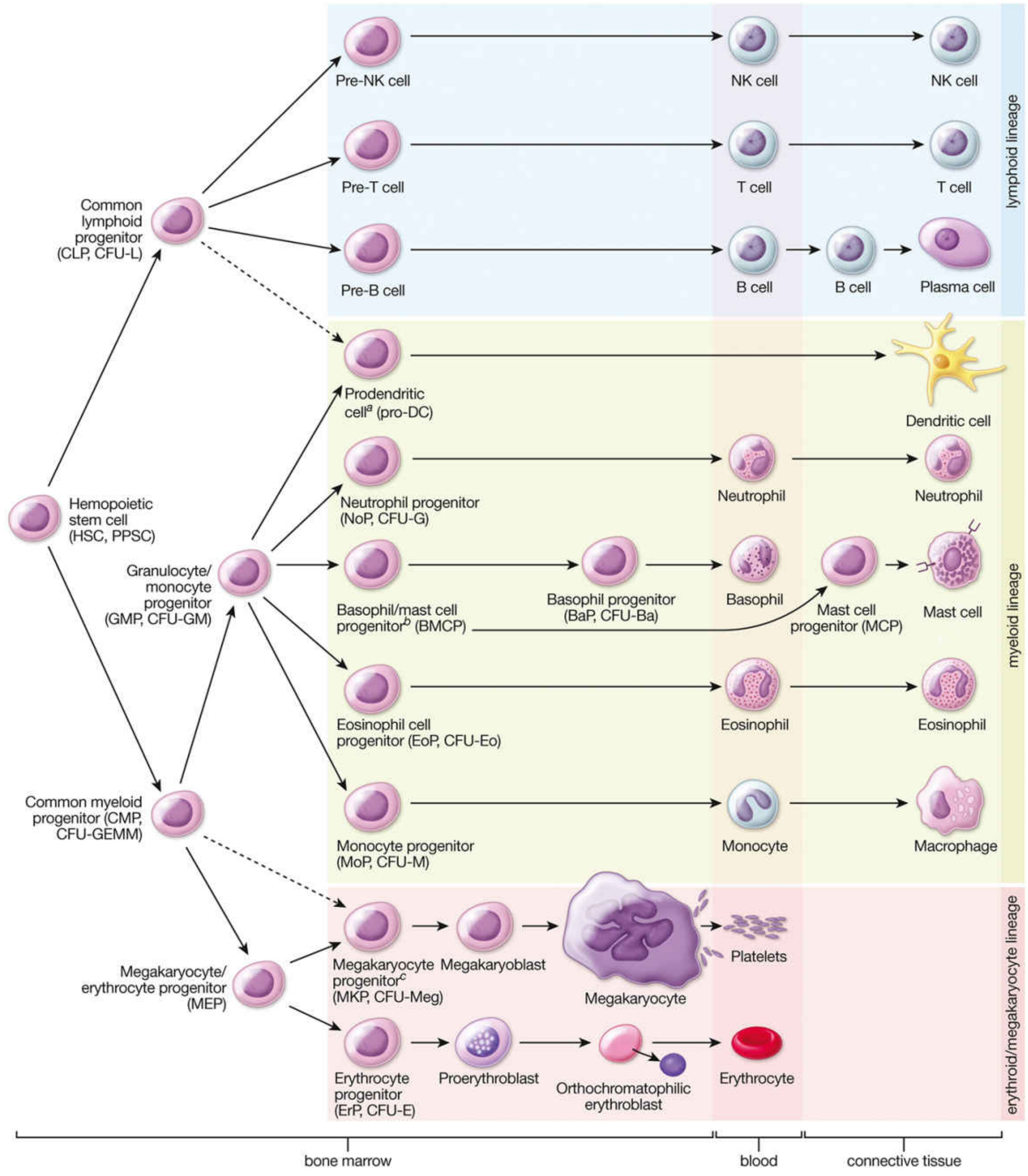
Histology: A Text and Atlas, pp. 730-732
Sources: Goldman-Cecil Medicine (International Ed., 2-volume set) | Histology: A Text and Atlas with Correlated Cell and Molecular Biology | Textbook of Family Medicine, 9e | Symptom to Diagnosis: An Evidence-Based Guide, 4th ed.
This is a shared conversation. Sign in to Orris to start your own chat.