
Respiratory alkalosis full details for md exams 10marks
Reading File
Now let me search the medical library for comprehensive content on respiratory alkalosis.
Finding Sources
Finding Sources
Excellent - multiple authoritative sources found. Let me read from Harrison's, Costanzo Physiology, Brenner & Rector's Kidney, Morgan & Mikhail's Anesthesiology, and Comprehensive Clinical Nephrology simultaneously.
Reading File
Reading File
Reading File
Reading File
Reading File
Now let me get Costanzo renal compensation details and the Harrison's treatment section, plus fetch the flowchart image.
Reading File
Reading File
Loading Image
I now have comprehensive data from Harrison's 22e, Costanzo Physiology, Brenner & Rector's Kidney, Morgan & Mikhail's Anesthesiology, and Comprehensive Clinical Nephrology. Let me compile the full, exam-ready answer.
Respiratory Alkalosis - Complete MD Exam Answer (10 Marks)
Definition
Respiratory alkalosis is a primary acid-base disorder characterized by a decrease in arterial PaCO2 (hypocapnia) below 35 mmHg, resulting in a rise in arterial pH above 7.45 (alkalemia). It is caused by alveolar hyperventilation, where CO2 output by the lungs exceeds its metabolic production by tissues.
- Harrison's Principles of Internal Medicine 22e, Ch. 50
- Brenner & Rector's The Kidney, Ch. 16
Pathophysiology / Mechanism
Alveolar hyperventilation increases CO2 elimination, reducing PaCO2. By the Henderson-Hasselbalch equation:
pH = 6.1 + log [HCO3-] / (0.03 × PaCO2)
As PaCO2 falls, the ratio [HCO3-]/PaCO2 rises, causing alkalemia. The decreased PaCO2 also lowers [HCO3-] slightly by mass action (CO2 + H2O ⇌ H2CO3 ⇌ H+ + HCO3-).
- Costanzo Physiology 7e, Ch. 7
Causes (Etiology)
1. Central Stimulation of Respiratory Center
| Cause | Examples |
|---|---|
| Psychogenic / anxiety | Hysterical hyperventilation, panic attacks |
| Pain | Any acute pain |
| CNS disease | Stroke, tumor, meningitis, encephalitis, head injury |
| Fever / sepsis | Gram-negative septicemia (may precede fever/hypoxemia) |
| Drugs | Salicylates (most common drug cause - direct chemoreceptor stimulation), theophylline, aminophylline, analeptics (doxapram) |
| Hormonal | Progesterone (pregnancy - lowers PaCO2 by 5-10 mmHg) |
| Hepatic failure | Severity correlates with degree of hepatic insufficiency |
2. Peripheral Stimulation (Hypoxemia-mediated)
- High altitude
- Pneumonia, pulmonary embolism
- Congestive heart failure
- Non-cardiogenic pulmonary edema
- Asthma
- Severe anemia
3. Iatrogenic / Miscellaneous
- Mechanical ventilation (ventilator-induced)
- Metabolic encephalopathies
Key: Chronic respiratory alkalosis is the most common acid-base disturbance in critically ill patients and portends a poor prognosis when severe.
- Morgan & Mikhail's Clinical Anesthesiology 7e, Table 50-5
- Harrison's 22e, p. 419
Compensatory Responses
Respiratory alkalosis triggers two phases of compensation:
Phase 1 - Acute: Chemical Buffering (minutes)
- Nonbicarbonate cellular buffers (proteins, phosphates in ICF and RBCs) titrate down HCO3-
- CO2 leaves cells; intracellular pH rises
- Rule: For each 10 mmHg ↓ in PaCO2, [HCO3-] falls by ~2 mEq/L
- pH rises by ~0.08 units per 10 mmHg fall in PaCO2
Phase 2 - Chronic: Renal Compensation (begins 2-6 hours; complete in 3-5 days)
- Decreased renal excretion of H+ as titratable acid and NH4+
- Decreased reabsorption of filtered HCO3-
- Decreased synthesis of new HCO3-
- Rule: For each 10 mmHg ↓ in PaCO2, [HCO3-] falls by 4-5 mEq/L
- pH rises by only ~0.03 units per 10 mmHg fall in PaCO2
Key fact: Respiratory alkalosis is the only acid-base disorder in which physiologic compensation can return pH fully to normal (7.35-7.45). This is unique.
- Brenner & Rector's The Kidney, p. [block10]
- Costanzo Physiology 7e, p. 341
ABG Interpretation Summary Table
| Parameter | Acute R. Alkalosis | Chronic R. Alkalosis |
|---|---|---|
| pH | >7.45 (often >7.55) | Near normal or slightly elevated |
| PaCO2 | ↓ (primary) | ↓ (primary) |
| HCO3- | Slightly ↓ (~2 per 10 mmHg) | More ↓ (~4-5 per 10 mmHg) |
| K+ | Slightly ↓ | Slightly ↓ |
| Cl- | ↑ | ↑ |
| Ca2+ (ionized) | ↓ | ↓ |
HCO3- rarely falls below 12 mmol/L in pure respiratory alkalosis.
Clinical Features
Neurological
- Dizziness, mental confusion, seizures - due to reduced cerebral blood flow (hypocapnia causes cerebral vasoconstriction)
- Paresthesias and circumoral numbness - from decreased ionized Ca2+ (Ca2+ binds more to albumin at alkaline pH)
- Tetany (rare) - same mechanism as above
- Inability to take an adequate breath
Cardiovascular
- Minimal in awake conscious patients
- In anesthetized/ventilated patients: fall in cardiac output and BP (due to anesthesia effects on heart rate, SVR, and venous return)
- Cardiac arrhythmias (especially in pre-existing heart disease) - due to left shift of O2-Hb dissociation curve (Bohr effect), reducing O2 delivery to myocardium
Metabolic/Electrolyte Effects
- Hypokalemia: alkalemia drives K+ intracellularly (exchange with H+); usually minor
- Hypophosphatemia: intracellular shift of PO4²-
- Hypocalcemia (ionized): more Ca2+ binds to albumin at high pH
- Left shift of O2-Hb dissociation curve (Bohr effect): Hb holds O2 more tightly, reducing tissue O2 unloading
- Bronchoconstriction: respiratory alkalosis increases bronchial smooth muscle tone
- Decreased pulmonary vascular resistance: opposite to bronchoconstriction
Hyperventilation Syndrome
-
A clinical entity where anxiety/panic drives hyperventilation, causing PaCO2 15-30 mmHg
-
Symptoms of chest tightness, dizziness, paresthesias can perpetuate the cycle
-
No hypoxemia on ABG
-
Diagnosis by exclusion (rule out PE, CAD, hyperthyroidism)
-
Morgan & Mikhail 7e; Harrison's 22e; Brenner & Rector's
Diagnosis
- ABG: pH >7.45, PaCO2 <35 mmHg, HCO3- appropriately decreased
- Serum electrolytes: ↓K+, ↑Cl-, ↓ionized Ca2+
- Determine if acute vs. chronic using compensation formulas above
- Search for underlying cause
Treatment
Treat the Underlying Cause (most important)
- Treat sepsis, hypoxemia (oxygen therapy), hepatic failure, pain, fever
- Stop/adjust offending drugs (salicylates, theophylline)
- Reassure patients with hyperventilation syndrome; rebreathing from paper bag raises PaCO2
Ventilator-Induced Respiratory Alkalosis
- Increase dead space, reduce tidal volume, or change ventilation mode (e.g., assist-control to mandatory ventilation)
- If persistent: sedation with or without skeletal muscle paralysis
Severe Alkalemia (pH >7.55-7.60)
- IV hydrochloric acid (HCl), arginine chloride, or ammonium chloride may be indicated
- Acetazolamide (carbonic anhydrase inhibitor) to reduce HCO3- reabsorption
- Ultrafiltration with low HCO3- dialysate in renal failure
Hyperventilation Syndrome
- Reassurance, rebreathing from paper bag
- Attention to underlying psychological stress
- Beta-blockers may help peripheral hyperadrenergic symptoms
- Antidepressants and sedatives are NOT routinely recommended
Treatment flowchart from Comprehensive Clinical Nephrology:
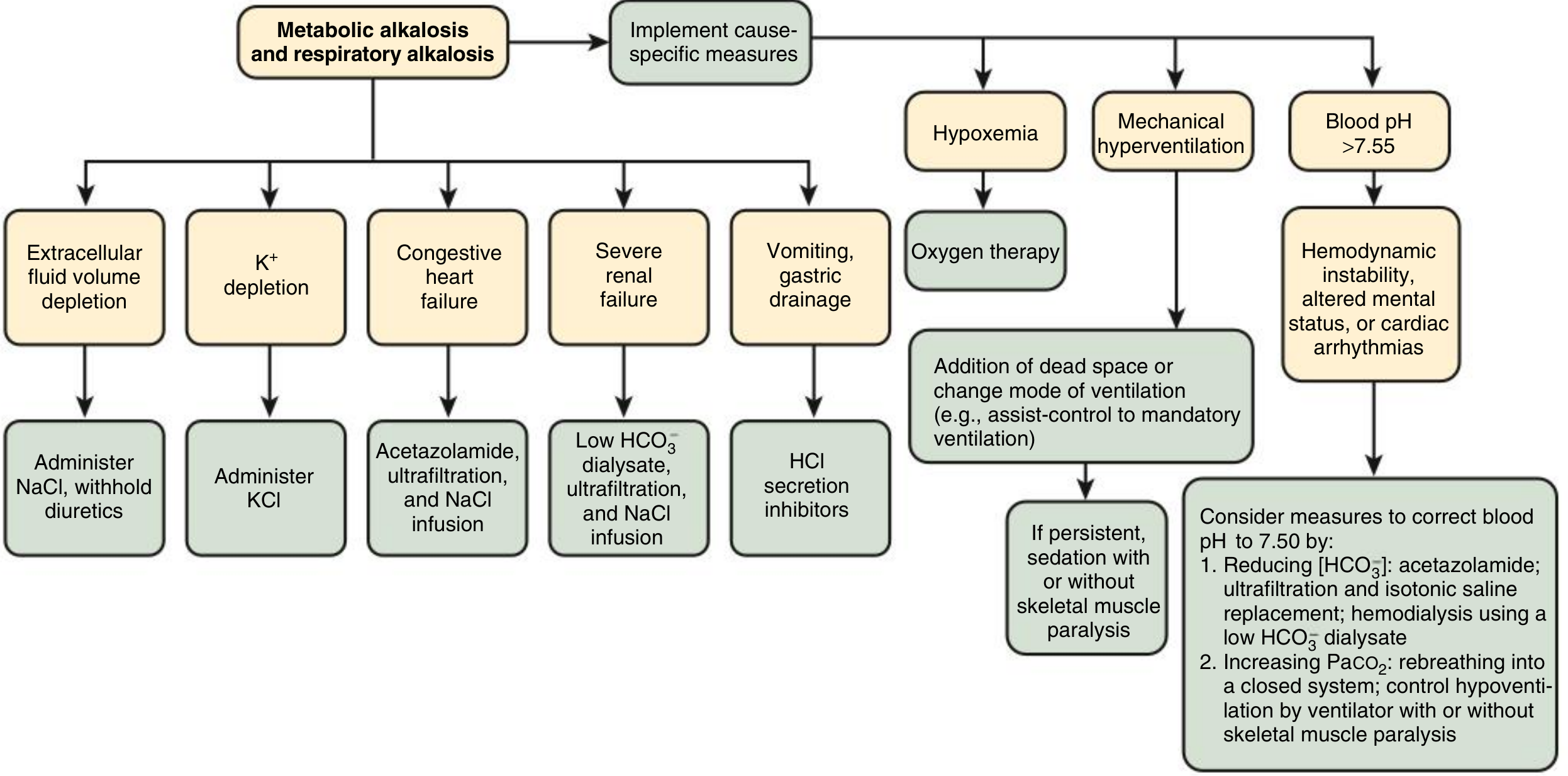
Fig. 15.7 - Treatment of metabolic alkalosis and respiratory alkalosis (Comprehensive Clinical Nephrology 7e)
Mixed Disorders Involving Respiratory Alkalosis
Respiratory alkalosis commonly occurs as part of a mixed disorder:
- Mixed metabolic acidosis + respiratory alkalosis: seen in salicylate poisoning (salicylates cause both metabolic acidosis via organic acid accumulation AND respiratory alkalosis via direct medullary stimulation). pH may be near normal but both disorders are present.
- Mixed respiratory alkalosis + metabolic alkalosis: seen in hepatic failure with vomiting/diuretics
- Approach with caution - correcting one arm alone can create severe imbalance in the other
High-Yield Points for MD Exams
| Point | Detail |
|---|---|
| Only disorder fully compensated | Chronic respiratory alkalosis (pH can normalize) |
| Most common drug cause | Salicylates (direct medullary chemoreceptor stimulation) |
| Most common cause in critically ill | Respiratory alkalosis (worst prognosis when severe) |
| Compensation formula - Acute | HCO3- ↓ 2 mEq/L per 10 mmHg ↓ PaCO2 |
| Compensation formula - Chronic | HCO3- ↓ 4-5 mEq/L per 10 mmHg ↓ PaCO2 |
| Minimum HCO3- in pure respiratory alkalosis | ~12 mmol/L |
| Mechanism of tingling/tetany | ↑ protein-bound Ca2+, ↓ ionized Ca2+ |
| Mechanism of dizziness | Cerebral vasoconstriction from ↓ PaCO2 |
| Earliest sign of gram-negative sepsis | Respiratory alkalosis (before fever, hypoxemia, hypotension) |
| Pregnancy-related | Chronic respiratory alkalosis (progesterone lowers PaCO2 by 5-10 mmHg) |
| O2-Hb curve | Left shift (Bohr effect) - impairs O2 unloading |
Sources:
- Harrison's Principles of Internal Medicine 22e, Ch. 50 (Acid-Base Disturbances)
- Costanzo Physiology 7e, Ch. 7 (Acid-Base Physiology)
- Brenner & Rector's The Kidney (2-Volume Set), Ch. 16
- Morgan & Mikhail's Clinical Anesthesiology 7e, Ch. 50
- Comprehensive Clinical Nephrology 7e, Ch. 15
- Rosen's Emergency Medicine, Ch. 113
This is a shared conversation. Sign in to Orris to start your own chat.