
white substance in urine of 20 year old male
Reading File
Finding Sources
Finding Sources
Searching the Web
white substance in urine 20 year old male causes
Reading File
Reading File
White Substance in Urine (20-year-old male) — Differential
In a young man, "white material" seen in the urine falls into a few well-recognized categories, ranging from entirely benign to conditions needing work-up:
1. Semen (most common, benign)
By far the most frequent cause in this age group. A white, stringy or flocculent substance appearing after ejaculation (or with retrograde ejaculation, where semen passes backward into the bladder rather than out the urethra) is usually just seminal fluid mixed with urine. Bailey & Love's textbook notes: "White urine is a complaint seen in two distinct conditions. One is in young men who may report the presence of a white substance in urine. This substance is usually semen and requires no treatment other than reassurance" (Bailey and Love's Short Practice of Surgery, 28th ed.). No treatment is needed beyond reassurance unless retrograde ejaculation is causing infertility concerns.
2. Pyuria (pus/white blood cells) - infective causes
- Urinary tract infection / cystitis - cloudy, white-tinged urine with dysuria, frequency, urgency.
- Prostatitis - inflammation of the prostate can cause white discharge/pus cells to enter urine, often with perineal pain, dysuria, or fever.
- Sexually transmitted infections (chlamydia, gonorrhea, trichomoniasis) - urethral discharge mixing with urine, causing a cloudy/white appearance, usually with dysuria or visible discharge.
3. Crystalluria / phosphaturia
Excess phosphate or urate crystals, especially in concentrated or alkaline urine, can precipitate as a fine white sediment. This is often benign, related to diet or hydration status, but can occasionally be associated with kidney stone formation (per Comprehensive Clinical Nephrology).
4. Chyluria (needs investigation)
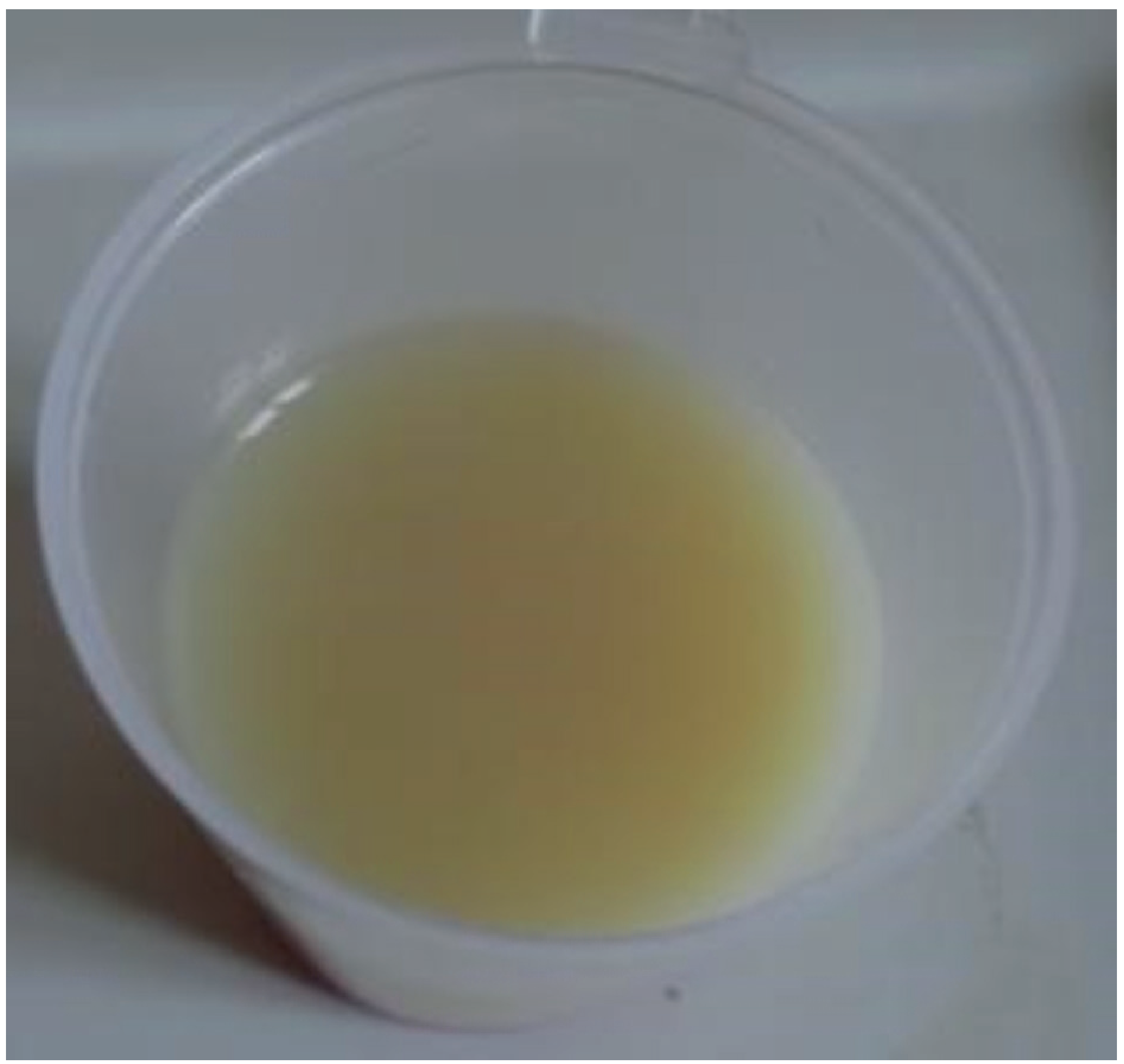
A less common but important cause of true "milky white urine" - lymphatic (chylous) fluid leaking into the renal collecting system due to lymphatic channel obstruction, classically from filarial infection (Wuchereria bancrofti) in endemic regions, though it can also be caused by trauma, malignancy, or congenital lymphatic abnormalities. As multiple sources describe: "chyluria (the passage of milky white urine containing lymphatic fluid)... may mimic nephrotic syndrome by producing nephrotic-range proteinuria" (Brenner and Rector's The Kidney). This condition is diagnosed by observing milky urine that may separate into layers, testing for chylomicrons/fat in urine (Sudan III staining), and imaging (lymphangiography/CT) to identify the fistula - it requires proper urological investigation, unlike simple post-ejaculatory semen.
Below is a clinical photo of chyluria for reference showing the characteristic milky-white appearance:
How to tell them apart clinically
| Feature | Semen/retrograde ejaculation | UTI/Prostatitis/STI | Crystalluria | Chyluria |
|---|---|---|---|---|
| Timing | After sex/masturbation | Any time, with dysuria/fever | Often first morning urine | Persistent, may worsen after fatty meals |
| Associated symptoms | None, or infertility | Burning, urgency, discharge, fever | None usually | Proteinuria, weight loss, lymphedema history |
| Simple test | Resolves with time; urinalysis clear otherwise | Urinalysis shows WBCs/bacteria, urine culture positive | Clears on warming/acidifying urine | Milky, may separate on standing; positive for fat/chylomicrons |
Practical next step
A basic urinalysis and urine culture (plus a post-ejaculation urine sample if retrograde ejaculation is suspected) will differentiate most of these. If the urine is persistently milky (not just an isolated finding after sex) or is associated with proteinuria, travel history to a filariasis-endemic area, or lymphedema, chyluria should be actively investigated with urine fat/chylomicron testing and imaging.
If you can share more details (timing relative to sexual activity, presence of pain/burning, fever, travel history, or whether the urine is consistently milky vs. occasional stringy material), I can narrow this down further.
urine always contains the white substance
Finding Sources
Finding Sources
If it's happening every time you urinate (not just after sex), that changes the likely explanation quite a bit — it makes simple post-ejaculatory semen or retrograde ejaculation less likely, since those are typically intermittent and tied to sexual activity.
Here's how the persistent pattern reshapes the differential:
1. Phosphaturia (most likely benign explanation)
This is the most common cause of consistently cloudy/white urine and is often mistaken for something serious. Excess phosphate crystals precipitate out in alkaline urine — Campbell-Walsh Urology notes: "Cloudy urine is commonly caused by phosphaturia, a benign process in which excess phosphate crystals precipitate in alkaline urine... often intermittent and may occur after meals" (Campbell Walsh Wein Urology, 3-Vol Set). It can look like a persistent white/cloudy haze or fine sediment, especially in well-hydrated or high-dairy/high-vegetable diets. It's harmless — it clears if you acidify the urine (e.g., add a drop of vinegar to a sample) and the cloudiness dissolves, confirming it's crystal-based rather than pus or protein.
2. Chronic/persistent pyuria (infection)
If bacteria are continuously present — chronic bacterial prostatitis, a partially treated UTI, or an STI (chlamydia/gonorrhea urethritis) — white blood cells and discharge can appear in every void, not just intermittently. This usually comes with other clues: dysuria, urgency, perineal/pelvic ache, or urethral discharge noticed separately from urination.
3. Chyluria — less likely but not excluded
Textbook sources consistently describe chyluria as usually intermittent, not constant: "Chyluria is usually intermittent and may spontaneously remit" (Campbell-Walsh Urology); Harrison's adds it's "usually intermittent and most prominent in the morning." So a truly every-single-time white urine pattern argues somewhat against classic filarial chyluria, though severe/chronic cases can become more persistent.
4. Proteinuria mimicking "white" appearance
Heavy, persistent proteinuria can make urine look foamy/cloudy-white rather than clear. This is worth ruling out with a simple urine dipstick, since unlike phosphaturia, protein won't clear with acidification and can signal underlying kidney disease.
What actually distinguishes these — a simple bedside test:
Collect a sample and add a few drops of vinegar or dilute acid:
- Clears completely → phosphaturia (benign, no action needed).
- Stays cloudy/white → suggests pus (infection), fat/chyle, or protein — needs a formal urinalysis, urine culture, and possibly urine protein/fat testing.
Given that yours is happening consistently, I'd recommend getting a urinalysis with microscopy and urine culture as the next concrete step — it will immediately tell you whether this is crystals (phosphaturia, benign), white cells/bacteria (infection), protein, or fat/chyle, and point to the right specific treatment. If you have any burning, urgency, pelvic pain, penile discharge, or if the urine looks milky and separates into layers on standing, mention those specifically to whoever evaluates you, as they help pinpoint infection vs. chyluria.
symptoms of infertility
Finding Sources
Finding Sources
Searching the Web
symptoms of male infertility
Reading File
Reading File
Symptoms of Male Infertility
The key thing to understand first: male infertility itself often has no symptoms at all. As Mayo Clinic and the textbooks note, the main - and sometimes only - sign is simply the inability to conceive a child after 1 year of regular, unprotected intercourse (the clinical definition of infertility). Many men with abnormal sperm counts feel completely normal otherwise, which is why semen analysis is the first diagnostic step rather than symptom-spotting.
That said, when an underlying cause does produce symptoms, they generally fall into these categories:
1. Sexual/reproductive symptoms
- Difficulty with erections or reduced libido
- Problems with ejaculation (reduced volume, retrograde ejaculation - semen going into the bladder instead of out, painful ejaculation)
- Pain, swelling, or a lump in the testicles
- A visible or palpable swelling above the testicle that feels like a "bag of worms" (suggests a varicocele - per Smith & Tanagho's Urology and Family Medicine textbooks, this is the single most common identifiable cause of male infertility, found in 15-35% of infertile men)
- History of undescended testicle(s), testicular trauma, or prior groin/scrotal surgery (hernia repair, vasectomy)
2. Hormonal symptoms (suggesting low testosterone or a pituitary/hormonal problem)
- Fatigue, low energy
- Decreased muscle mass, loss of body/facial hair
- Gynecomastia (breast tissue growth)
- Weight gain
- Mood changes, depression
3. Signs of infection
- Pain, redness, or swelling of the testicle/epididymis (orchitis/epididymitis)
- Fever, urethral discharge, dysuria - relevant given our earlier discussion, since untreated prostatitis, UTIs, or STIs (chlamydia, gonorrhea) can scar the reproductive tract and directly impair fertility
- History of mumps after puberty (mumps orchitis can damage sperm-producing tissue)
4. Genetic/developmental clues
- Small, firm testicles, reduced facial/body hair, tall stature with disproportionately long limbs (suggestive of Klinefelter syndrome, 47,XXY - the most common genetic cause of male infertility due to hypogonadism)
- Chronic sinus/respiratory infections alongside infertility (can suggest primary ciliary dyskinesia/Kartagener syndrome, which immobilizes sperm the same way it immobilizes airway cilia)
5. Red-flag findings that always warrant urologic evaluation
- Absence of one or both testes from the scrotum
- Any testicular lump, asymmetry, or persistent pain
- Semen with no volume at all (possible obstruction or retrograde ejaculation)
Connecting to your earlier questions
Since you'd asked about persistent white material in urine - if that turns out to represent chronic prostatitis, a UTI, or an STI, that is directly relevant here, because ongoing genital tract infection/inflammation is a recognized, reversible cause of male infertility (it can obstruct the epididymis or impair sperm quality). This is one more reason to get that urinalysis/culture done - treating an underlying infection early can prevent it from becoming a fertility issue.
Bottom line - what actually confirms infertility
Symptoms alone can't diagnose infertility. The definitive test is a semen analysis (checking sperm count, motility, and morphology), done after 1 year of trying to conceive without success (or sooner if risk factors like undescended testes, prior infection, varicocele, or chemotherapy exposure are present). If semen analysis is abnormal, follow-up hormone testing (testosterone, LH, FSH, prolactin) helps pinpoint the cause.
is varicocele treatable
Finding Sources
Searching the Web
varicocele treatment options success rate fertility
Yes, varicocele is treatable — and often quite effectively
A varicocele (enlarged/dilated veins in the scrotum, feeling like a "bag of worms" above the testicle) has several established treatment options, ranging from doing nothing to surgery.
Treatment options
1. Observation
If the varicocele isn't causing pain, testicular shrinkage, or infertility, and semen parameters are normal, no treatment is needed - just periodic monitoring.
2. Surgical repair (varicocelectomy) - the most common and effective option
This is the gold-standard treatment. Campbell-Walsh Urology notes it is "by far the most commonly performed operation for the treatment of male infertility." Techniques include:
- Microsurgical varicocelectomy (subinguinal or inguinal) - has the highest success and lowest recurrence rate, considered the current gold standard
- Laparoscopic repair
- Open retroperitoneal/inguinal ligation
3. Percutaneous embolization
A minimally invasive, catheter-based procedure (interventional radiology) that blocks off the dilated veins from inside, done as an outpatient without incisions. It's effective but has a higher recurrence rate than surgery - Bailey & Love notes recurrence in "around 20% after embolisation," at which point surgical ligation becomes the next step.
How well does treatment work?
- Semen quality: Repair reliably improves sperm count, motility, and morphology, especially for larger varicoceles — Campbell-Walsh states "repair of large varicoceles results in significantly greater improvement in semen quality than repair of small [varicoceles]."
- Pregnancy rates: This is genuinely debated in the literature. Some randomized trials show improved natural pregnancy rates after repair, others show no significant benefit — a meta-analysis of six controlled trials found no significant overall effect on pregnancy rates, even though sperm parameters often improve. So repair reliably fixes the semen analysis numbers, but doesn't guarantee conception.
- Severe cases (non-obstructive azoospermia): repair returns some sperm to the ejaculate in roughly 10-50% of these more difficult cases, sometimes avoiding the need for surgical sperm retrieval (TESA/TESE) for IVF.
- Pain relief: For a painful varicocele (rather than an infertility indication), both surgery and embolization relieve symptoms in most patients.
Practical takeaway
- If the varicocele is small, asymptomatic, and semen parameters are normal → often just monitored.
- If there's pain, testicular atrophy, or abnormal semen analysis with a clinically palpable varicocele and no major female-factor infertility → microsurgical varicocelectomy is generally the preferred, most durable treatment.
- If a couple will need IVF/ICSI anyway for female-factor infertility, some specialists argue varicocele repair may not change management and could be skipped or done in parallel.
Given the debate around pregnancy outcomes, the right choice depends on the size of the varicocele, semen analysis results, partner's fertility status, and personal preference — this is best discussed jointly with a urologist and a reproductive endocrinologist, as one of the sources notes.
varicocele can be treated by medication
Finding Sources
No — medication cannot fix a varicocele itself
There is no drug that repairs or eliminates the dilated veins of a varicocele. The structural problem (faulty vein valves causing blood to pool and dilate the veins in the scrotum) is a mechanical/anatomical issue, not one caused by a deficiency or excess of any hormone or chemical that medication could reverse. That's why the actual treatments remain surgery (varicocelectomy) or embolization, as covered earlier.
Where medication does play a role — but it's supportive, not curative
1. Medical therapy targeting infertility, not the varicocele itself
Sabiston's Textbook of Surgery notes: "The most common medical therapies include hormonal stimulation of spermatogenesis, such as gonadotropin agents and antiestrogen agents, which have been met with mixed results." These drugs try to boost sperm production generally — they don't shrink or remove the varicocele, and results are inconsistent.
2. Antioxidants / supplements
Sometimes used to reduce oxidative stress on sperm (varicoceles are thought to raise scrotal temperature and oxidative damage, contributing to sperm DNA fragmentation). These may modestly help semen quality in some men but don't correct the vein abnormality.
3. Pain management
If the varicocele causes dull scrotal ache, NSAIDs or other pain relievers can manage symptoms temporarily, but this doesn't address the underlying varicocele - if pain persists or is significant, surgery/embolization is still the definitive fix.
4. Antibiotic/anti-inflammatory therapy
Sabiston also mentions these are sometimes tried in male infertility generally, but this is for treating a separate/coexisting infection or inflammation, not for treating the varicocele itself.
Bottom line
Medication can support sperm quality or manage symptoms around the edges, but if you actually want the varicocele removed or its effect on fertility/pain corrected, surgery (microsurgical varicocelectomy) or percutaneous embolization are the only treatments that work - this is consistent across every major urology and surgery reference (Campbell-Walsh Urology, Bailey & Love, Sabiston). Anyone claiming a pill can "cure" a varicocele is not describing an evidence-based treatment.
varicocele can be treated by lifestyle changes
No — lifestyle changes cannot cure or eliminate a varicocele either
Same principle as with medication: a varicocele is a structural/mechanical problem — incompetent valves in the veins of the spermatic cord (pampiniform plexus) causing blood to pool and the veins to dilate. No amount of diet, exercise, or habit change will repair a faulty vein valve or shrink the dilated veins back to normal. The only things that physically remove or correct a varicocele are surgery (varicocelectomy) or embolization, as covered earlier.
What lifestyle changes CAN do — support sperm quality, not fix the varicocele
Certain lifestyle measures are genuinely recommended in the fertility literature, but their role is to minimize the varicocele's harmful effects on sperm (heat, oxidative stress) or improve general fertility, not to treat the varicocele itself:
1. Avoid scrotal overheating
- Avoid prolonged sitting, tight underwear/clothing, hot tubs/saunas, and laptop use directly on the lap — a varicocele already raises scrotal temperature, and additional heat further impairs sperm production.
2. Stop smoking and limit alcohol
- Both are independently linked to worse semen parameters and may compound the oxidative stress a varicocele causes on sperm.
3. Reduce/avoid recreational drugs and anabolic steroids
- These directly suppress sperm production and testosterone, worsening fertility outcomes on top of the varicocele.
4. Manage weight and general health
- Obesity, poorly controlled diabetes, and sedentary habits are all associated with reduced sperm quality generally.
5. Antioxidant-rich diet
- Some evidence suggests antioxidants may reduce sperm DNA fragmentation associated with varicocele-driven oxidative stress, though this is adjunctive, not curative.
Bottom line
Lifestyle changes are a reasonable adjunct — they can help protect sperm quality while you decide on definitive treatment, or make sense to combine with surgery/embolization for the best fertility outcome. But they will not make the varicocele go away, shrink it, or fix the underlying vein incompetence. If the varicocele is causing pain, testicular atrophy, or infertility, surgical repair or embolization remains the only effective treatment — lifestyle measures alone are not an evidence-based substitute.
reason of varicocele
Finding Sources
Reading File
Causes (Etiology) of Varicocele
A varicocele forms because of abnormal dilation of the veins of the pampiniform plexus (the network of veins draining the testicle), almost always due to a problem with venous drainage rather than the testicle itself.
Why it happens - the anatomy explains it
The veins draining the testis join into one or two testicular veins that travel up through the retroperitoneum. Critically:
- The left testicular vein drains into the left renal vein (a relatively high-pressure vessel)
- The right testicular vein drains directly into the inferior vena cava, below the right renal vein (a lower-pressure vessel)
This anatomical difference is why about 90% of varicoceles are left-sided - the left testicular vein faces a tougher, higher-pressure drainage route, making it far more prone to backflow and dilation. If a left varicocele is found, there's a 30-40% chance it's actually bilateral.
Three proposed mechanisms
- Absent/incompetent valves - failure of the one-way (antireflux) valve where the testicular vein joins the left renal vein (or IVC on the right), allowing blood to reflux backward down the vein instead of flowing up properly.
- "Nutcracker" effect - the left testicular vein gets compressed between the superior mesenteric artery and the aorta, causing venous obstruction and back-pressure.
- Sharp angulation at the junction of the left testicular vein and the left renal vein, impeding normal drainage.
When it develops
Varicoceles are rare in young boys and typically develop during late childhood and adolescence, when puberty increases testicular blood flow and metabolic demand — this is thought to be a key trigger for revealing the underlying venous weakness. Overall, varicoceles affect 10-20% of adult males, but are found in around 40% of infertile men, reflecting their link to fertility problems.
Important red flag - secondary varicocele
Most varicoceles are idiopathic (no identifiable cause beyond the venous anatomy above). However, a varicocele can occasionally be secondary to obstruction of the testicular vein, for example by:
- A renal tumor (compressing or invading the renal vein)
- Prior nephrectomy
- Rarer causes: deep vein thrombosis, renal arteriovenous malformations, thrombosis of the pampiniform plexus
A key clinical clue for a secondary cause: a varicocele that does not collapse/decompress when the patient lies down (normal idiopathic varicoceles typically shrink in the supine position). Also, an isolated right-sided varicocele is extremely rare and should prompt imaging to rule out a retroperitoneal mass or renal tumor pressing on the venous drainage - this is an important diagnostic red flag that shouldn't be missed, especially in older men or when a varicocele appears suddenly.
This is a shared conversation. Sign in to Orris to start your own chat.