
How is a vaginal delivery handled in case the baby is big sized and there is cord around the neck?
Reading File
Now let me search the medical library for both topics simultaneously.
Finding Sources
Finding Sources
Finding Sources
Finding Sources
Good results. Let me read the most relevant sections now in parallel.
Reading File
Reading File
Reading File
Excellent content. Let me now get the full shoulder dystocia management section and nuchal cord section from Rosen's, plus the Swanson's content.
Reading File
Reading File
Reading File
I now have comprehensive information from multiple authoritative sources. Let me also fetch the McRoberts maneuver illustration to include in the answer.
Loading Image
I have all the information needed. Here is a detailed, well-organized answer:
Vaginal Delivery with a Large Baby and Nuchal Cord
These are two distinct but commonly co-occurring intrapartum challenges. A large baby raises the risk of shoulder dystocia, while a nuchal cord (cord around the neck) occurs in about 20% of all deliveries. Each has its own management protocol, though they can occur together.
Part 1: Nuchal Cord (Cord Around the Neck)
What It Is
A nuchal cord is when the umbilical cord loops around the fetal neck. It occurs in approximately 1 in 5 births (20%) and can be single or multiple loops.
Management at Delivery
As the fetal head is delivered, the clinician reaches around the neck to check for a nuchal cord. There are two scenarios:
1. Loose nuchal cord
- Simply slip the cord loop over the delivered head or over the body as the baby is born.
- This is the most common situation and is easily managed.
2. Tight nuchal cord (cannot be reduced)
- The cord is doubly clamped and cut at the perineum.
- Once cut, the baby must be delivered immediately and without delay because the cord is now transected - the infant's blood supply and oxygenation are interrupted until fully delivered.
- This is a time-critical step and the team must be prepared for rapid delivery the moment the cord is cut.
"During delivery, loose nuchal cords should be reduced at the perineum... On occasion, loops are tight enough to impede delivery and cannot be reduced. The solution is to cut the clamped cord and deliver the infant rapidly. The high frequency of nuchal loops (one in five births) means that the emergency clinician should expect to encounter this problem." - Rosen's Emergency Medicine, p. 3421
Part 2: Large Baby - Shoulder Dystocia
A large fetus (macrosomia, EFW >4000 g) significantly raises the risk of shoulder dystocia - where the fetal head delivers but the anterior shoulder becomes impacted behind the pubic symphysis. The hallmark sign is the "turtle sign" - the head retracts back against the perineum after delivery.
Risk Factors
- Fetal macrosomia
- Diabetes (gestational or pregestational) - asymmetric fat deposition increases risk
- Previous shoulder dystocia
- Postdates delivery
- Operative vaginal delivery
- Obesity, multiparity
Step-by-Step Management: HELPERR Mnemonic
The ALSO (Advanced Life Support in Obstetrics) course recommends the HELPERR sequence:
| Letter | Action |
|---|---|
| H | Help - Call for obstetrics, neonatology, and anesthesia assistance immediately |
| E | Episiotomy - A generous episiotomy (possibly episioproctotomy) creates room for internal maneuvers |
| L | Legs - McRoberts maneuver (see below) |
| P | Pressure - Suprapubic pressure |
| E | Enter - Internal rotational maneuvers (Rubin, Wood screw) |
| R | Remove posterior arm |
| R | Roll - Place mother on all-fours and repeat |
The Maneuvers in Detail
1. McRoberts Maneuver (First-line)
The maternal legs are removed from stirrups and flexed sharply against the abdomen (knee-to-chest position). This "walks" the pubic symphysis over the impacted anterior shoulder and flattens the sacrum, allowing the shoulders to pass through one at a time. This is the most important first step and, when combined with suprapubic pressure, resolves the majority of cases.
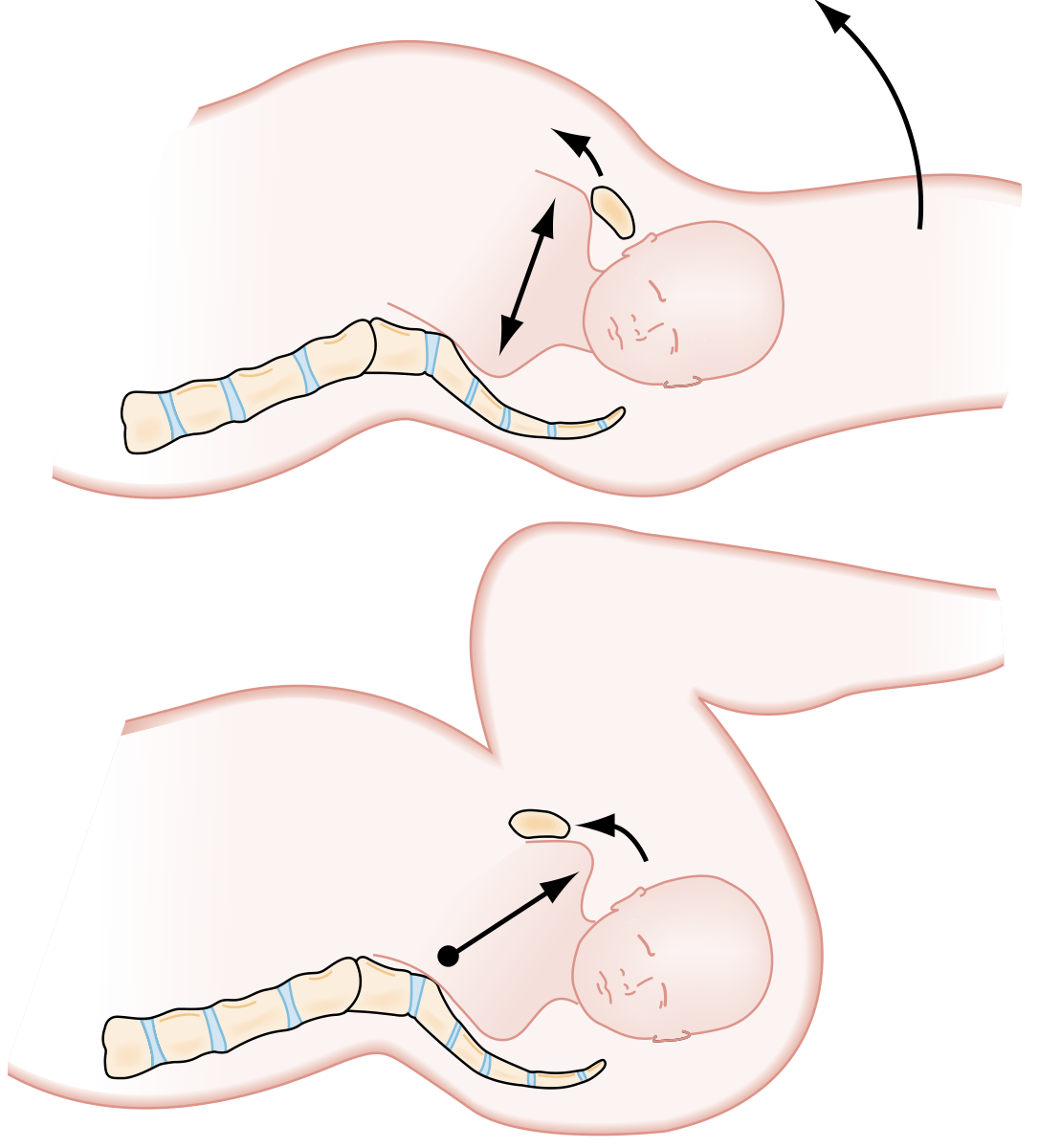
2. Suprapubic Pressure
An assistant applies firm downward pressure just above the pubic symphysis (not fundal pressure) to push the anterior shoulder under the pubis or rotate it into an oblique diameter. This combined with McRoberts resolves most cases.
3. Rubin Maneuver
The clinician's hand is inserted vaginally and pushes the most accessible shoulder toward the fetal chest to decrease the bisacromial diameter. This can be done transabdominally, through the introitus (anterior shoulder), or through the episiotomy (posterior shoulder).
4. Wood Corkscrew Maneuver
The impacted shoulders are released by rotating the fetus 180 degrees. The fetal axilla can be hooked with a digit, or a hand slid along the fetal spine to sweep the hips. This is technically difficult.
5. Removal of the Posterior Arm
The posterior arm is swept across the fetal chest (splint, sweep, grasp, and pull to extension), reducing the effective shoulder width and allowing delivery.
6. Roll to All-Fours (Gaskin Maneuver)
The mother is rolled to the all-fours position, which can dislodge the impacted shoulder by gravity and change pelvic dimensions.
7. Last Resort Maneuvers
- Deliberate clavicle fracture or humeral fracture to reduce shoulder width
- Zavanelli maneuver - replacing the infant's head back into the uterus and proceeding to emergency cesarean section
Complications to Anticipate
| Maternal | Neonatal |
|---|---|
| Postpartum hemorrhage | Brachial plexus injury (Erb's palsy) |
| Perineal/vaginal trauma | Clavicular or humeral fracture |
| Psychological distress | Hypoxic-ischemic encephalopathy |
| Death (rare) |
Combined Scenario: Large Baby + Nuchal Cord
When both occur together:
- Deliver the head in a controlled manner, preventing rapid extension.
- Check for and address the nuchal cord first - slip it over the head if loose, or double-clamp and cut if tight, then proceed immediately.
- Assess for shoulder dystocia - if the "turtle sign" appears or the shoulders do not deliver with gentle traction, activate the HELPERR protocol at once.
- Call for extra help early - the combination of macrosomia and cord complications requires obstetric, neonatal, and anesthesia support at the bedside.
A majority of shoulder dystocias will be relieved with the McRoberts maneuver and suprapubic pressure. - Swanson's Family Medicine Review
Sources: Rosen's Emergency Medicine, p. 3416-3421 | Pfenninger and Fowler's Procedures for Primary Care, p. 7058 | Swanson's Family Medicine Review, p. 1048-1079 | Creasy & Resnik's Maternal-Fetal Medicine
This is a shared conversation. Sign in to Orris to start your own chat.