
Liposarcoma
Reading File
Liposarcoma is a malignant tumor of adipose tissue, one of the most common soft tissue sarcomas in adults. Let me pull comprehensive information from the medical library.
Searching sources...
Finding Sources
Finding Sources
Searching PubMed
liposarcoma
Good results. Now let me read the key textbook sections in parallel - Robbins Pathology (most authoritative for pathology), Campbell's Orthopaedics (surgical perspective), and Sabiston Surgery (clinical management).
Reading File
Reading File
Reading File
Reading File
Excellent - rich data from multiple authoritative sources. Let me also fetch the histopathology images to include visuals.
Loading Image
Reading File
Finding Sources
I now have comprehensive data from multiple authoritative textbooks. Let me compose the full answer.
Liposarcoma
Overview
Liposarcoma is a malignant tumor of adipose tissue and the most common soft tissue sarcoma (STS) of adulthood. It typically affects individuals in their 50s and 60s, presenting as a large, deep-seated, painless mass. It accounts for 45% of all retroperitoneal sarcomas. - Robbins & Kumar Pathologic Basis of Disease; Sabiston Textbook of Surgery
Subtypes and Pathogenesis
There are three major histologic subtypes, each with distinct genetics and behavior:
1. Well-Differentiated Liposarcoma (WDL) / Atypical Lipomatous Tumor (ALT)
- Most common subtype, listed in order of decreasing frequency (WDL/dedifferentiated > myxoid > pleomorphic).
- Genetics: Amplification of chromosome region 12q13-q15, including the MDM2 gene and CDK4. MDM2 acts as an oncoprotein by promoting p53 proteasomal degradation.
- The terms ALT (extremity/superficial trunk) and WDL (retroperitoneum, mediastinum, paratesticular) describe histologically identical tumors in different anatomic locations - the distinction exists because retroperitoneal tumors are harder to resect and more prone to recurrence.
- Dedifferentiated liposarcoma is a progression variant of WDL; it carries a higher risk of distant metastasis.
- IHC: MDM2 and CDK4 positivity helps distinguish from lipoma and other sarcomas.
2. Myxoid Liposarcoma
- Second most common subtype; ~5% of all soft tissue sarcomas in adults.
- More common in the extremities; tends to affect younger to middle-aged adults.
- Genetics: Translocation t(12;16)(q13;p11) → FUS::DDIT3 fusion gene (rarely EWSR1-DDIT3 from t(12;22)). This arrests adipocyte differentiation → proliferation of primitive mesenchymal cells. Activates MET, RET, and PI3K/Akt pathways.
- Intermediate local recurrence (~20%) and metastatic risk (~50%).
- Unique metastatic pattern: metastasizes to bone and retroperitoneum (unusual for soft tissue sarcomas; other STS metastasize mainly to lung).
- Myxoid liposarcoma is notably radiosensitive and chemosensitive; 10-year disease-specific survival ~87%.
- Round cell liposarcoma = poorly differentiated variant of myxoid liposarcoma; worse prognosis with distant metastasis rates up to 21%.
3. Pleomorphic Liposarcoma
- Least common but most aggressive subtype.
- Genetics: Complex karyotype without consistent/reproducible genetic abnormalities; no known targetable mutations.
- Sheets of anaplastic cells with bizarre nuclei admixed with lipoblasts.
- Predilection for the extremities of adults.
- Frequently metastasizes; poor prognosis.
- Robbins, Cotran & Kumar Pathologic Basis of Disease; Sabiston Textbook of Surgery; Campbell's Operative Orthopaedics 15th Ed 2026
Histopathology
The sine qua non of liposarcoma is the presence of lipoblasts - immature fat cells with a hyperchromatic nucleus indented or scalloped by lipid vacuoles. - Dermatology 2-Volume Set 5e
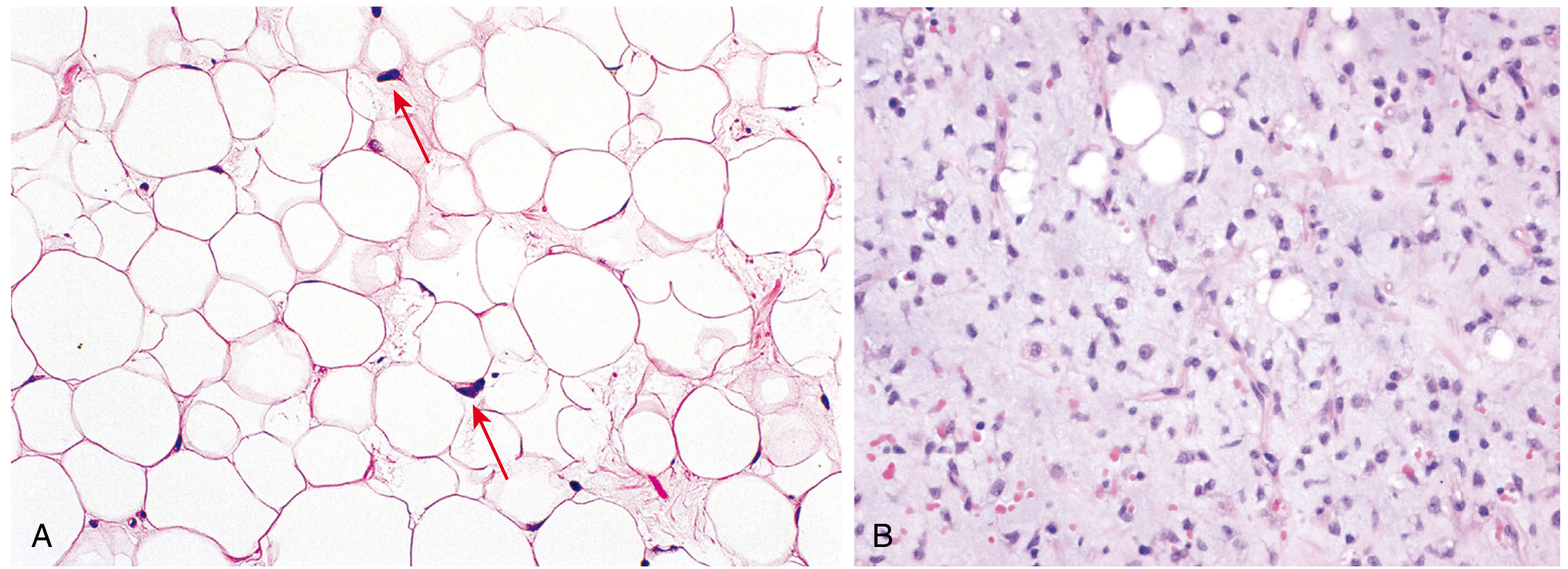
Fig. 26.42 Liposarcoma - Robbins & Kumar Pathologic Basis of Disease. (A) Well-differentiated: mature adipocytes + scattered atypical spindle cells with hyperchromatic nuclei. (B) Myxoid: abundant basophilic matrix, arborizing ("chicken-wire") capillaries, primitive cells resembling fetal fat.
| Subtype | Histology |
|---|---|
| Well-differentiated | Mature adipocytes + scattered atypical stromal cells |
| Myxoid | Basophilic matrix + arborizing capillaries + primitive adipocytes |
| Round cell | Hypercellular myxoid areas with round overlapping nuclei |
| Pleomorphic | Sheets of anaplastic cells + bizarre nuclei + lipoblasts |
| Dedifferentiated | Abrupt transition from WDL to high-grade non-lipogenic sarcoma |
Clinical Features and Location
| Feature | Well-Differentiated/Dedifferentiated | Myxoid/Round Cell | Pleomorphic |
|---|---|---|---|
| Common location | Retroperitoneum, mediastinum | Extremities (thigh) | Extremities |
| Typical age | 50s-60s | Younger adults | Adults |
| Local recurrence | Common (especially retroperitoneal) | Intermediate (~20%) | High |
| Metastatic risk | Low (WDL); higher (dediff.) | ~50%; to bone/retroperitoneum | Frequent |
| Prognosis | Good (extremity); guarded (retroperitoneal) | Intermediate (87% 10-yr DSS) | Poor |
Imaging
- Plain radiographs: Usually normal.
- MRI: Best modality. Well-differentiated tumors show characteristic fat signal. Features suggesting malignancy over lipoma: tumor >10 cm, thick septa (>2 mm), non-adipose areas, <75% adipose tissue.
- CT: Used for retroperitoneal tumors. Features suggesting dedifferentiation: hypervascularity, necrosis/cystic change, adjacent organ invasion, focal nodular or water-density areas.
- MRI/CT can distinguish WDL from dedifferentiated tumors but can be difficult in large, heterogeneous lesions.
- Sabiston Textbook of Surgery; Campbell's Operative Orthopaedics 15th Ed
Treatment
Surgery (Mainstay)
- Extremity tumors (ALT/WDL): Limb-sparing resection with negative margins. Limited resection is appropriate given low metastatic risk. Neoadjuvant/perioperative radiation reduces local recurrence risk.
- Retroperitoneal liposarcoma: Gross complete resection is the principal goal - incomplete resection increases mortality. Traditionally involves resection of contiguous organs. Some advocate complete compartmental resection (spleen, pancreas, diaphragm, adrenal, kidney resected in >50% of cases), though this remains debated. Out-of-compartment recurrences (~15%) would not be prevented by this approach.
- Recurrent retroperitoneal disease: Resection is favored when tumor growth rate is <0.9 cm/month.
Radiation Therapy
- Reduces local recurrence, especially for extremity tumors.
- Preferably given in the neoadjuvant (preoperative) setting.
- Myxoid liposarcoma is particularly radiosensitive.
Chemotherapy
- Role is controversial for most subtypes.
- Myxoid liposarcoma is uniquely chemosensitive (anthracycline-based regimens).
- High-grade tumors: standard first-line is anthracycline-based (doxorubicin ± ifosfamide).
- A 2025 systematic review (PMID: 40257618) evaluated immune checkpoint inhibitors + anthracyclines as a potential first-line regimen for dedifferentiated liposarcoma - emerging evidence for immunotherapy combinations.
- Sabiston Textbook of Surgery; Campbell's Operative Orthopaedics; Fischer's Mastery of Surgery
Poor Prognostic Indicators
- High histologic grade
- Large tumor size
- Proximal or deep location
- Presence of metastases
- Retroperitoneal location (vs. extremity)
- Dedifferentiated or pleomorphic histology
- Campbell's Operative Orthopaedics 15th Ed 2026
Key Genetic Summary Table
| Subtype | Genetic Abnormality | Key Oncogene |
|---|---|---|
| Well-differentiated / Dedifferentiated | Amplification 12q13-q15 | MDM2, CDK4 |
| Myxoid / Round cell | t(12;16) → FUS::DDIT3; rarely t(12;22) → EWSR1-DDIT3 | DDIT3 (CHOP) |
| Pleomorphic | Complex karyotype | No consistent target |
This is a shared conversation. Sign in to Orris to start your own chat.