
Endoscopic thyroidectomy In detail according to standard ENT textbook
Reading File
Now let me search the medical library for endoscopic thyroidectomy content.
Finding Sources
Finding Sources
Excellent! Found the key sources. Let me read the main sections from Scott-Brown's and Cummings simultaneously.
Reading File
Reading File
Finding Sources
I found the main chapter in Scott-Brown's (Chapter 69). Let me read the full content of this section.
Reading File
Reading File
Let me continue reading the Scott-Brown's chapter which is the main ENT textbook content:
Reading File
I now have enough rich content from Scott-Brown's (Chapter 69) to provide a comprehensive, detailed answer. Let me also quickly check for the Scarless/TOETVA section and images.
Reading File
I now have comprehensive content from Scott-Brown's Chapter 69. Let me compile the full, detailed response.
Loading Image
Loading Image
Now I have all the material needed for a thorough, textbook-based answer. Here is the comprehensive response:
Endoscopic Thyroidectomy
Source: Scott-Brown's Otorhinolaryngology Head & Neck Surgery, Chapter 69 (Neil S. Tolley); supplemented by Scott-Brown's Vol 2 and Cummings Otolaryngology
1. Introduction and Historical Context
The principles of safe thyroid surgery were established by Kocher at the beginning of the 20th century, earning him the Nobel Prize in 1909. His cervical collar incision remained virtually unchanged for nearly a century. The impetus for change came from patient preference - studies reveal that 71% of patients attending thyroid clinics would prefer to avoid a neck scar, independent of sex or skin colour. Furthermore, validated scar assessment tools consistently show that professionals rate scar aesthetics more favourably than patients themselves do.
Two key technological prerequisites enabled endoscopic thyroid surgery:
- The development of high-definition miniaturized endoscopes
- Energy-sealing devices capable of working in a confined operative space
Advances in minimally invasive thyroid surgery date back to 1996, when Gagner performed the first endoscopic parathyroidectomy using CO2 insufflation and 5 mm laparoscopic instruments placed between the platysma and strap muscles.
- Scott-Brown's Otorhinolaryngology HNS, Chapter 69, p. 858
2. Classification / Nomenclature
These techniques are referred to by several terms:
| Acronym | Full Name |
|---|---|
| MIVAT | Minimally Invasive Video-Assisted Thyroidectomy (Miccoli technique) |
| MIT | Minimally Invasive Thyroidectomy |
| EAT | Endoscopic-Assisted Thyroidectomy |
| Henry technique | CO2 insufflation lateral port technique |
| RAT | Robotic-Assisted Thyroidectomy |
| TOETVA | Transoral Endoscopic Thyroidectomy Vestibular Approach |
"Endoscopic-assisted thyroidectomy" is considered the most accurate descriptor of these procedures in practice.
3. Minimally Invasive Thyroidectomy - Techniques
3a. The Miccoli Technique (MIVAT / Gas-less Method)
Pioneered by: Paolo Miccoli (Pisa, Italy)
Technique:
- A 2-3 cm midline incision is made in the neck
- Endoscopic dissection of the superior pole is performed under direct visualization
- The superior pole is delivered into the neck
- Dissection of the lower pole and completion thyroidectomy is then carried out in a conventional (open) manner once the thyroid is delivered through the incision
Instrumentation:
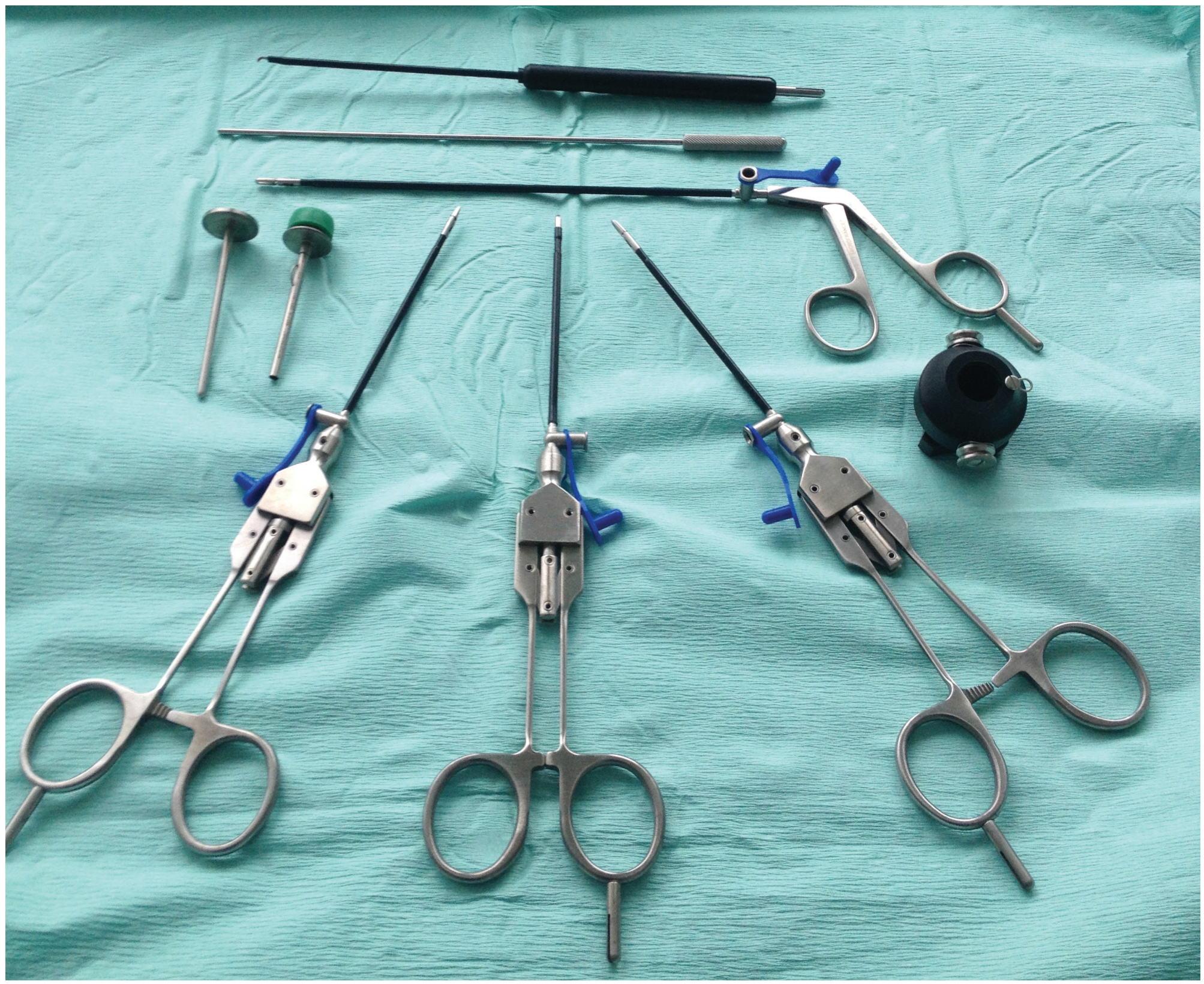
- A 30-degree, 4 mm endoscope
- Specially designed suction dissectors, spatulas, and retractors (see Figure 69.1)
- Requires two competent assistants and video stacks
Advantages:
- Excellent visualization of the recurrent laryngeal nerve (RLN), external laryngeal nerve (ELN), and parathyroid glands
- Avoids complications of gas insufflation
- Total thyroidectomy is possible through a single incision
Indications:
- Solitary nodules up to 3 cm in diameter
- Total thyroid lobe volume should not exceed 20 mL (nodule volume up to 14 mL)
- Selected Graves' disease and thyroid cancer (in highly experienced hands)
Contraindications:
- History of thyroiditis
- Prior thyroid surgery
- Known thyroid cancer (relative, in general practice)
Limitations:
- Suitable for only approximately 8% of a UK surgeon's thyroid practice
- Steep learning curve: >50 cases required before achieving expert status
- 86% of BAETS (British Association of Endocrine and Thyroid Surgeons) members perform fewer than 50 thyroidectomies per year, limiting adoption
- Excessive traction through the small incision may cause hyperpigmentation or hypertrophy of the scar - the opposite of the cosmetic goal
3b. The Henry Technique (Insufflation / CO2 Gas Method)
Pioneered by: Jean-François Henry (Marseille, France) - virtually synchronous with the Miccoli technique
Technique:
- Creates three lateral ports along the anterior border of the sternocleidomastoid muscle:
- Two 3 mm ports for instrumentation
- One 1 cm port for introduction of the insufflator-endoscope
- CO2 insufflation at a pressure of 8 mmHg creates the working space and achieves a bloodless operative field
Operative steps:
- Dissection takes place entirely within the neck
- Delivery of the thyroid lobe (once dissection is complete) is through the endoscope port
- An assistant holds and manipulates the endoscope while dissection proceeds via the other ports
Indications: Same as Miccoli technique
Limitations:
- Total thyroidectomy is not possible by this method
- Technically more challenging than the Miccoli method
- Potential complication of hypercarbia from CO2 insufflation, which can be serious
- While excellent for parathyroidectomy, it has not been widely adopted for thyroid surgery
4. Scarless in the Neck Techniques
Despite the cosmetic improvement offered by MIVAT/Henry techniques, they still leave a cervical scar. The desire to avoid any visible neck scar has led to development of "remote access" approaches.
4a. Transaxillary Approach
- Multiple Asian studies report on endoscopic transaxillary thyroidectomy
- Entry through the axilla avoids any neck incision
- Both gasless and CO2 insufflation variants are used
- Hypercarbia is a recognized serious potential complication of insufflation in this approach
- Korean surgeons (notably Chung at Yonsei University, Seoul) pioneered the transaxillary route - by 2013 they had experience exceeding 3,000 patients
4b. Facelift Approach
- Described by Terris et al.
- The incision is placed within the facelift crease, completely hiding the scar
- Feasibility compared favorably against transaxillary approach in a series of 15 patients
- Demonstrated decreased operative time and potential for outpatient thyroidectomy without drain placement
4c. Transoral Endoscopic Thyroidectomy Vestibular Approach (TOETVA)
- Access via oral vestibular incisions - truly scarless
- A shorter and less expensive operation compared to robotic transoral approaches
- Avoids any cutaneous scar entirely
- Indications, safety, and long-term outcomes continue to be defined in the literature
5. Evidence Base for Minimally Invasive Thyroidectomy
A meta-analysis by Radford (though limited to 5 studies, low degrees of freedom, and study heterogeneity) analyzed 318 patients and found:
- Complications were no higher than conventional thyroidectomy
- Superior cosmetic outcomes were supported
- Operating time was longer
- Scar cosmesis was assessed only in the early post-operative period; validated scar assessment methods were not used
Caveat noted in the literature: Personal communication from Henry (JFH) suggests there may be little or no difference in scar satisfaction after 18 months, once full healing has taken place. Long-term prospective cohort studies comparing conventional and MIT are lacking.
6. Robotic-Assisted Thyroidectomy (RAT)
Background and Technology
The concept of telerobotics originated in NASA research and Ministry of Defence interest in battlefield surgery. Patents were acquired and the da Vinci Surgical System (Intuitive Surgical, Sunnyvale, California) was developed for commercial use. Marescaux published the feasibility of transatlantic surgery in 2001.
Technical advantages of da Vinci:
- Three-dimensional display with 30-degree optics
- 540-degree wristed instrumentation - surpasses human wrist range of motion
- Improved operative dexterity, field exposure, and visualization
- Motion scaling and tremor filtration
Surgical Approaches for Robotic Thyroidectomy
- Transaxillary - the dominant approach, pioneered by Chung and Korean surgeons
- Facelift - demonstrated by Terris (2012)
- Combined endoscopic-robotic transaxillary - reported by Chang et al.
- Transoral robotic - emerging approach via oral vestibule
Clinical Evidence
- A recent meta-analysis of 5,200 patients showed an equivalent adverse event and complication rate for robotic thyroidectomy compared to conventional approaches
- Rates of cord palsy and hypocalcaemia were not significantly different from conventional thyroidectomy
- Chung's Korean series reported superior cosmetic outcomes and better post-operative swallowing function
- Safety in papillary thyroid cancer has been studied; however, mean tumour size was only 8 mm (microcarcinoma category), limiting generalizability
- Studies are heavily weighted toward pioneering Korean units, with significant publication bias (complications of RAT tend not to be published)
Caution
Despite meta-analytic support, many surgeons remain skeptical of RAT given that:
- Conventional open thyroidectomy remains safe and effective
- The technique adds cost and operative time
- The learning curve is significant
- Prospective cohort data are limited outside high-volume Korean centres
7. Indications Summary
| Indication | MIVAT/MIT | RAT/Transaxillary |
|---|---|---|
| Benign nodule ≤3 cm | Yes | Yes |
| Lobe volume ≤20 mL | Yes | Yes |
| Selected Graves' disease | Experienced centres | Experienced centres |
| Microcarcinoma (papillary) | Selected cases | Korean data supports |
| Previous neck surgery | No | Relative contraindication |
| Thyroiditis | No | Relative contraindication |
| Large goitre | No | No |
| Substernal extension | No | No |
8. Complications Specific to Endoscopic/Robotic Approaches
In addition to standard thyroidectomy risks (RLN injury, hypocalcaemia, haematoma), endoscopic approaches carry unique risks:
- Hypercarbia - from CO2 insufflation, potentially serious; monitored with end-tidal CO2
- Hypertrophic scarring / hyperpigmentation - paradoxically caused by excessive traction through a small cervical incision
- Brachial plexus injury - with transaxillary approach (arm positioning)
- Skin flap injury - with remote access approaches creating subcutaneous tunnels
- Longer operative time - consistent finding across all minimally invasive techniques
- Higher cost - particularly for robotic systems
9. Practical Considerations and Training
- Both Miccoli and Henry techniques require a large volume thyroid practice to maintain competency
- Volume-outcome data indicate only surgeons with high-volume practices should adopt these techniques
- Steep learning curve requiring >50 cases for MIVAT expert status
- With 86% of UK thyroid surgeons performing <50 cases/year, few centres in the UK perform truly minimally invasive thyroidectomy
- These techniques are best suited to centres with dedicated endocrine surgery units
10. Conclusion
Endoscopic thyroidectomy encompasses a spectrum of techniques from gas-less video-assisted cervical approaches (Miccoli) to remote access robotic transaxillary and transoral routes. The primary driver is patient preference to avoid a visible neck scar. Evidence supports comparable safety to conventional thyroidectomy in selected patients, but the techniques are demanding, require significant case volume to maintain, and are only applicable to a small proportion of patients presenting for thyroid surgery. Long-term prospective data and standardized outcome reporting remain needed areas of research.
References:
- Scott-Brown's Otorhinolaryngology Head & Neck Surgery (7th ed.), Chapter 69 - Minimally Invasive and Robotic-Assisted Thyroidectomy, Neil S. Tolley, pp. 858-817
- Scott-Brown's Otorhinolaryngology Head & Neck Surgery, Vol 2, Chapter 29 - Robotic Thyroidectomy
- Cummings Otolaryngology Head and Neck Surgery, Chapter on Thyroid Surgery
This is a shared conversation. Sign in to Orris to start your own chat.