
Why in pregnancy multiple sclerosis improve n sle worsen
Reading File
The core answer: pregnancy shifts the immune system toward Th2 dominance (tolerogenic state) to protect the fetus. MS is a Th1-driven disease, so it improves. SLE is a Th2/B-cell driven disease, so it worsens. Let me get the full textbook detail now.
Searching sources...
Finding Sources
Finding Sources
Finding Sources
Good results. Now let me read the key sections in detail.
Reading File
Reading File
Reading File
Now let me get the immunological mechanism from MS textbook and the SLE flare mechanisms.
Reading File
Finding Sources
Finding Sources
Finding Sources
Finding Sources
Finding Sources
Reading File
Reading File
I now have all the information needed for a comprehensive answer. Let me compile it.
Here is a detailed explanation of why MS improves and SLE worsens during pregnancy:
The Core Mechanism: Pregnancy Shifts Immunity from Th1 to Th2
Pregnancy creates a state of immunological tolerance to prevent rejection of the fetus (which is semi-allogeneic). To achieve this, the immune system undergoes a fundamental shift:
- Th1 responses are suppressed - reduced production of IL-12, IFN-gamma, and TNF-beta
- Th2 responses are enhanced - increased IL-4, IL-5, IL-10, IL-13
- Regulatory T cells (Tregs) are induced to further suppress maternal cell-mediated immunity
- Progesterone and high-dose estrogens drive this Th2-dominant state
As stated in Dermatology 2-Volume Set: "To prevent fetal rejection, a normal pregnancy is characterized by a lack of strong maternal cell-mediated immune function and reduced Th1 cytokine production (e.g. IL-12, interferon-gamma) as well as a dominant humoral immune response with increased Th2 cytokine production (e.g. IL-4, IL-10)."
Why MS Improves in Pregnancy
MS is a Th1 / Th17-driven autoimmune disease. The pathogenic mechanism involves:
- Autoreactive CD4+ T cells (Th1 and Th17) that attack CNS myelin
- IL-12, IFN-gamma, and IL-17 as key drivers of demyelination
When pregnancy suppresses Th1/Th17 activity and shifts to Th2 dominance, the inflammatory attack on myelin is dampened. This is why:
- Relapse rate falls by ~2/3 in the third trimester (when Th2 shift is maximal and estrogen/progesterone levels are highest)
- Postpartum rebound occurs in the first 6 months - when the Th1/Th17 response rebounds (Th1 cytokines like IFN-gamma surge back in the early postpartum period), leading to increased relapses
- The same mechanism explains why other Th1-driven diseases like rheumatoid arthritis and psoriasis also commonly improve in pregnancy
As stated in Goldman-Cecil Medicine: "The activity of disease typically lessens during the course of pregnancy, especially by the third trimester, when the frequency of exacerbations is reduced by approximately two thirds."
Murray & Nadel's Respiratory Medicine directly confirms: "Inappropriately developed and activated Th1 cells have been implicated in the pathogenesis of certain autoimmune diseases, such as type 1 diabetes, multiple sclerosis, and rheumatoid arthritis."
Why SLE Worsens in Pregnancy
SLE is a Th2 / B-cell / antibody-driven autoimmune disease. Its pathogenic mechanism involves:
- B-cell hyperactivity with production of pathogenic autoantibodies (anti-dsDNA, anti-Sm, etc.)
- Immune complex deposition causing tissue damage
- Complement activation
- Th2 cytokines (IL-4, IL-10) that drive B-cell activity
The Th2 shift of pregnancy directly amplifies the disease mechanism:
- Enhanced B-cell help and antibody production
- IL-10 drives further B-cell activation and autoantibody production
- Elevated estrogens (which peak in pregnancy) are known lupus flare triggers - estrogen directly promotes B-cell activation and prolongs B-cell survival, reduces apoptosis of autoreactive B cells
- Complement consumption increases, worsening the immune complex burden
The elevated estrogen effect is confirmed in Firestein & Kelley's Rheumatology: "Important ovarian stimulation risks for rheumatic disease patients relate to elevated estrogen levels and include lupus flare and thrombosis."
The flare risk quantified:
- Patients with active disease in the 6 months before conception - flare rate ~60%
- Patients with quiescent disease at conception - flare rate as low as 10%
- In the PROMISSE study (prospective multicenter study of stable SLE pregnancies), mild-to-moderate lupus flare occurred in 15%, severe flare in 5%
SLE also brings additional pregnancy complications: pre-eclampsia (up to 25%), which is further compounded by antiphospholipid antibody syndrome in many patients.
Summary Table
| Feature | MS | SLE |
|---|---|---|
| Immunopathology | Th1/Th17 mediated (cell-mediated) | Th2/B-cell mediated (humoral) |
| Key cytokines | IFN-gamma, IL-12, IL-17 | IL-4, IL-10 - drive B cells |
| Pregnancy immune shift | Th1 suppressed - disease improves | Th2 enhanced - disease worsens |
| Estrogen effect | Neutral/protective | Promotes B-cell activation - flare |
| Course in pregnancy | Relapses fall ~67% in 3rd trimester | Flare risk 10-60% depending on activity |
| Postpartum course | Rebound - increased relapses (6 months) | May remain active or flare postpartum |
This same principle explains other diseases in pregnancy: psoriasis improves (Th1-driven), atopic dermatitis worsens (Th2-driven), and Sjogren's syndrome is relatively unchanged (mixed pathology).
Th1 vs th2
Th1 cells drive cell-mediated immunity against intracellular pathogens and are implicated in organ-specific autoimmune diseases. Th2 cells drive humoral/antibody immunity, fight parasites, and are implicated in allergy and systemic autoimmune diseases. They mutually inhibit each other.
Searching sources...
Finding Sources
Reading File
Reading File
Reading File
Let me also fetch the diagram from Katzung that illustrates this beautifully.
Loading Image
Finding Sources
Reading File
Reading File
Excellent - I have comprehensive textbook content. Here is the full comparison:
Th1 vs Th2 - Complete Comparison
Both are subsets of CD4+ T helper cells that arise from the same naive CD4+ precursor. Which path a naive T cell takes depends on the cytokine environment at the time of antigen presentation.
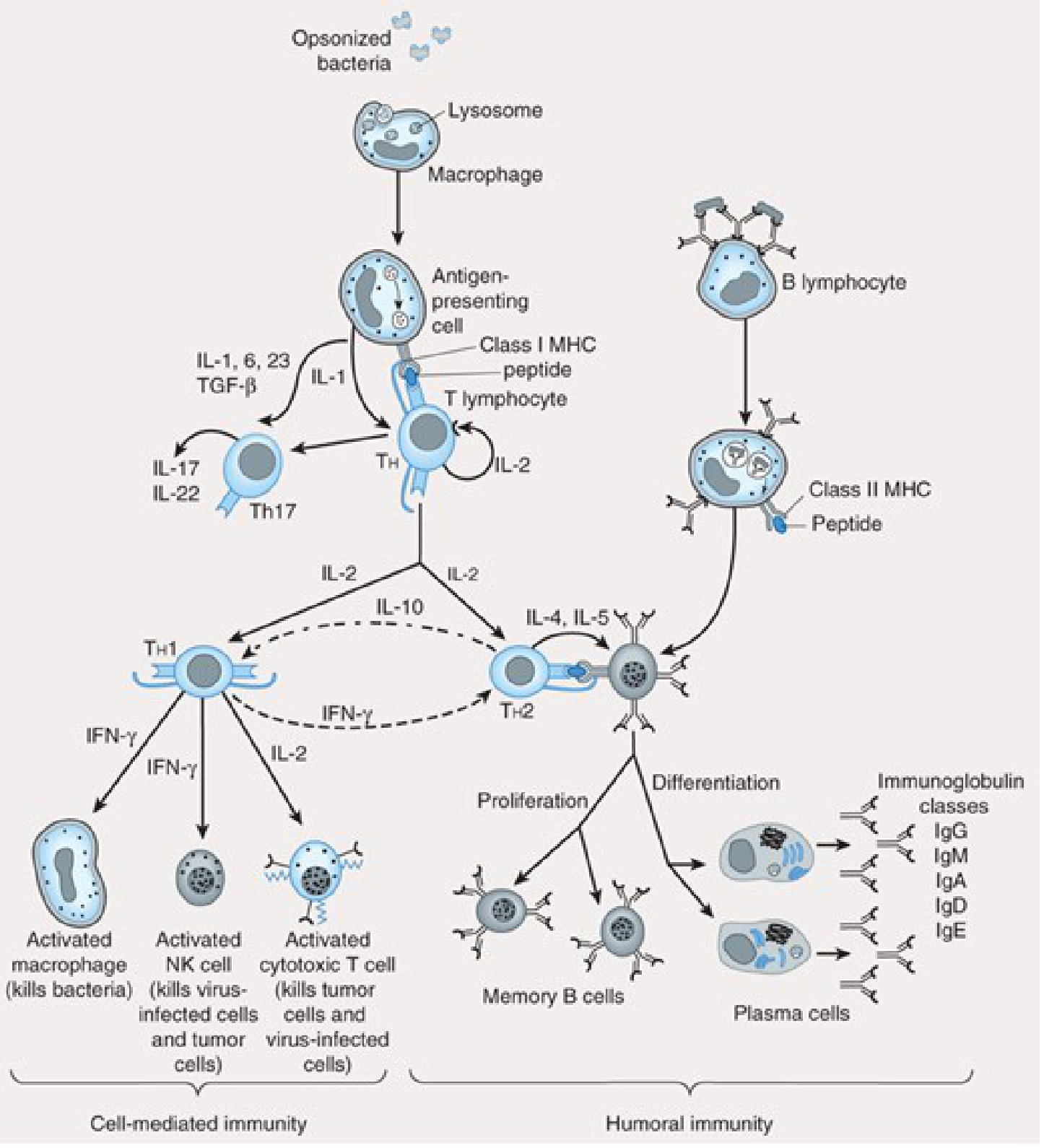
Differentiation
| Feature | Th1 | Th2 |
|---|---|---|
| Inducing cytokine | IL-12 (from macrophages/DCs) + IL-18 | IL-4 (from existing Th2, mast cells, NK-T cells) |
| Master transcription factor | T-bet | GATA-3 |
| Signal transducer | STAT-4 | STAT-6 |
| When it predominates | Intracellular infection, innate IL-12/IFN-gamma signal | Default pathway; extracellular/parasitic antigen; no innate IL-12 signal |
Cytokines Produced
| Th1 Cytokines | Function |
|---|---|
| IFN-gamma | Activates macrophages (M1), activates CD8+ T cells, inhibits Th2 |
| IL-2 | Drives T cell, B cell, NK cell proliferation |
| TNF-alpha / TNF-beta (lymphotoxin) | Promotes inflammation, cytotoxicity |
| IL-12 (amplification loop) | Further drives Th1 commitment |
| Th2 Cytokines | Function |
|---|---|
| IL-4 | Drives Th2 differentiation, Ig class switching (IgG, IgE), M2 macrophage activation, inhibits Th1 |
| IL-5 | Eosinophil growth factor, IgA/IgG class switching |
| IL-10 | B-cell growth factor, inhibits Th1 and all inflammation |
| IL-13 | Promotes mucus production, airway hyperresponsiveness, fibrosis |
| IL-6 (also Th17 driver) | B-cell differentiation |
Immune Function
| Th1 | Th2 | |
|---|---|---|
| Type of immunity | Cell-mediated | Humoral (antibody-mediated) |
| Effector cells activated | Macrophages (M1), CD8+ CTLs, NK cells | B cells --> plasma cells + antibodies (IgG, IgE, IgA, IgM) |
| Targets | Intracellular pathogens (viruses, mycobacteria, fungi, intracellular parasites) | Extracellular bacteria, helminths, allergens |
| Characteristic reaction | Delayed-type hypersensitivity (DTH) - induration at 24-48h (e.g. PPD/tuberculin test) | Immediate hypersensitivity - IgE-mediated mast cell degranulation |
Mutual Inhibition (The Th1/Th2 Seesaw)
This is a critical concept. They suppress each other:
- IFN-gamma (Th1 product) inhibits Th2 cell proliferation
- IL-4 and IL-10 (Th2 products) suppress Th1 responses and downregulate MHC on APCs
- TGF-beta (from Tregs) inhibits both Th1 and Th2
This means that conditions promoting one arm tend to suppress the other, which is the basis for the pregnancy effect described earlier (Th2 rise suppresses Th1-driven MS).
Disease Associations
| Th1-driven diseases | Th2-driven diseases |
|---|---|
| Multiple sclerosis | SLE (systemic) |
| Type 1 diabetes | Allergic diseases (asthma, atopic dermatitis, allergic rhinitis) |
| Rheumatoid arthritis | Parasitic hypersensitivity |
| Crohn's disease | IgE-mediated anaphylaxis |
| Psoriasis (Th1/Th17 mixed) | Helminth immunity |
| Granulomatous diseases (TB, sarcoid) | Omenn syndrome |
| Contact dermatitis | Hypereosinophilic syndromes |
Plus Th17 (the "third player")
Th17 is distinct from both but worth noting in context:
- Induced by TGF-beta + IL-6, stabilized by IL-23
- Transcription factor: ROR-gamma-t
- Produces: IL-17A, IL-17F, IL-22
- Function: recruits neutrophils, defends against extracellular bacteria and fungi
- Both IFN-gamma (Th1) and IL-4 (Th2) inhibit Th17 development
- Pathological role in: psoriasis, MS (alongside Th1), inflammatory bowel disease, RA
Quick Memory Aid
- Th1 = "T for Tissue killing" - kills intracellular bugs via macrophages and CTLs
- Th2 = "2 antibodies" - drives B cells and antibody production
- Th17 = "17 neutrophils" - neutrophil recruitment via IL-17
Sources: - Katzung's Basic & Clinical Pharmacology 16e - Medical Microbiology 9e - Murray & Nadel's Respiratory Medicine - Cummings Otolaryngology
This is a shared conversation. Sign in to Orris to start your own chat.