
Apoptosis
Reading File
Now let me search the medical library for apoptosis content in parallel.
Finding Sources
Searching PubMed
apoptosis mechanisms pathways
Good results. Now let me read the best sources - Robbins (most authoritative for pathology) and Braunwald's Heart Disease for cardiovascular aspects, plus the immunology text. Let me read them in parallel.
Reading File
Reading File
Reading File
Excellent content. Now let me read more of the Robbins pathology section for detailed mechanisms (caspases, BCL-2 family, pathways) and fetch the apoptosis diagram.
Reading File
Loading Image
Now let me fetch the Robbins mechanism diagram and read more of the detailed mechanisms section.
Loading Image
Reading File
I now have comprehensive content from Robbins & Kumar Basic Pathology and Sleisenger & Fordtran's GI textbook, along with two excellent diagrams. Let me compose a thorough, well-illustrated answer.
Apoptosis
Apoptosis (from Greek, "falling off") is a form of programmed cell death in which cells activate intrinsic enzymes that systematically degrade their own nuclear DNA, nuclear proteins, and cytoplasmic proteins - without triggering inflammation. It is distinct from necrosis in that the plasma membrane remains intact until the very end, the cell is tidily packaged into fragments ("apoptotic bodies"), and those fragments are silently cleared by phagocytes.
Definition and Key Features
Apoptosis is executed by caspases - cysteine proteases that cleave proteins after aspartic acid residues. Like the coagulation cascade, caspases exist as inactive zymogens (pro-caspases) that are activated by cleavage, typically by another caspase or by focal accumulation of inactive caspases.
Morphological hallmarks (visible on H&E staining):
-
Chromatin condensation and aggregation → karyorrhexis (nuclear fragmentation)
-
Cytoplasmic shrinkage and budding
-
Fragmentation into membrane-bound apoptotic bodies
-
Rapid phagocytosis by macrophages - no inflammatory response
-
DNA laddering: fragmentation into nucleosome-sized pieces
-
Robbins & Kumar Basic Pathology, p. 24-25
Physiologic vs. Pathologic Apoptosis
| Setting | Examples | Mechanism |
|---|---|---|
| Embryogenesis | Digit formation, organ sculpting | Loss of growth factor signaling |
| Tissue turnover | Intestinal epithelium, lymphocytes | Loss of survival signals |
| Hormonal involution | Endometrium after menstruation | Reduced survival signals from falling hormone levels |
| Immune regulation | Decline of leukocytes post-infection; deletion of self-reactive lymphocytes | Elimination of survival signal as stimulus is removed |
| Pathologic - DNA damage | After radiation, cytotoxic drugs | Activation of proapoptotic BH3-only proteins |
| Pathologic - Misfolded proteins | ER stress | Activation of BH3-only proteins; direct caspase activation |
| Pathologic - Viral infections | Cytotoxic T lymphocyte (CTL) killing | CTLs activate caspases in infected cells |
- Robbins & Kumar Basic Pathology, p. 24
Two Main Pathways
Both pathways converge on executioner caspases (caspase-3 and caspase-7):
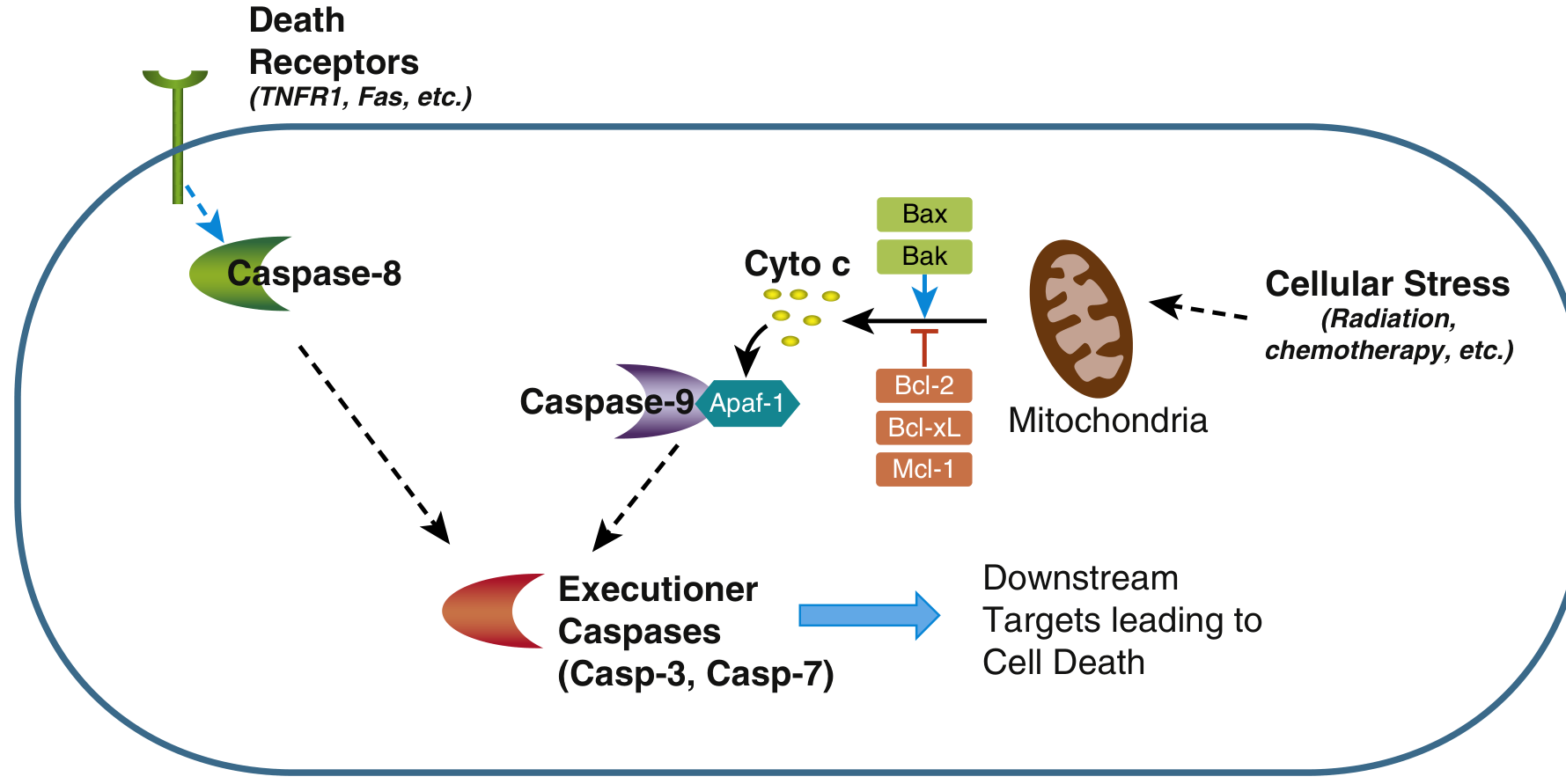
1. Mitochondrial (Intrinsic) Pathway
This is responsible for the majority of physiologic and pathologic apoptosis.
Key players - the BCL-2 family (>20 proteins):
| Group | Members | Role |
|---|---|---|
| Antiapoptotic | BCL-2, BCL-X | Maintain mitochondrial membrane integrity; inhibit BAX/BAK |
| Proapoptotic effectors | BAX, BAK | Dimerize and form pores in the outer mitochondrial membrane |
| BH3-only sensors | BIM, BID, PUMA, NOXA | Sense stress; shift balance toward BAX/BAK |
Sequence of events:
- Cellular stress (growth factor withdrawal, DNA damage, protein misfolding, radiation) activates BH3-only proteins
- BH3-only proteins neutralize BCL-2/BCL-X
Land directly activate BAX and BAK - BAX/BAK dimerize and insert into the outer mitochondrial membrane, forming channels
- Cytochrome c leaks from the intermembrane space into the cytosol
- Cytochrome c + Apaf-1 (apoptosis-activating factor-1) + pro-caspase-9 assemble into the apoptosome
- Caspase-9 is activated → activates caspase-3 and caspase-7 (executioners)
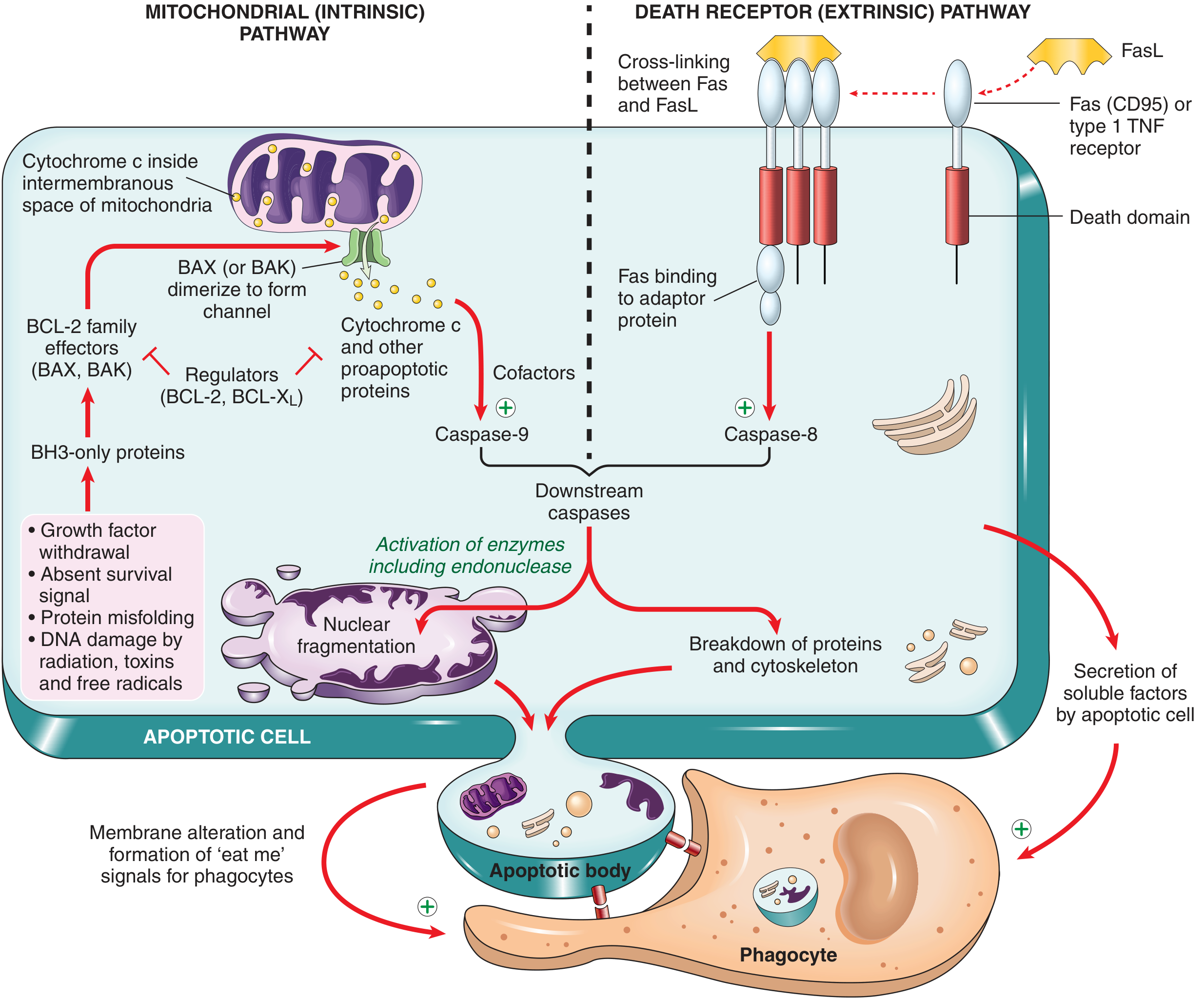
2. Death Receptor (Extrinsic) Pathway
Many cells express death receptors - members of the TNF receptor family with a conserved cytoplasmic "death domain."
Key receptors and ligands:
- Fas (CD95) + FasL (expressed on activated T lymphocytes)
- Type I TNF receptor (TNFR1) + TNF
Sequence of events:
- FasL (on cytotoxic T cells) cross-links Fas on the target cell
- Fas recruits adaptor proteins via the death domain
- Adaptor proteins recruit and activate caspase-8 (initiator caspase)
- Caspase-8 directly activates executioner caspases-3 and -7
Role: Eliminates self-reactive lymphocytes and infected cells killed by CTLs.
- Robbins & Kumar Basic Pathology, p. 25
Clearance of Apoptotic Cells
Apoptotic cells and fragments produce "eat-me" signals for phagocytes:
-
Phosphatidylserine flip: In normal cells, phosphatidylserine is on the inner leaflet of the plasma membrane. During apoptosis it flips to the outer leaflet, where macrophage receptors recognize it.
-
Soluble recruitment factors: Apoptotic cells secrete chemotactic signals to draw in phagocytes.
-
Engulfment is so efficient that no cellular contents spill, and no inflammation occurs.
-
Robbins & Kumar Basic Pathology, p. 25
Other Related Cell Death Mechanisms
Beyond classical apoptosis and necrosis, several hybrid forms have been described:
| Form | Trigger | Features |
|---|---|---|
| Necroptosis | TNF (and other signals) | Features of both necrosis and apoptosis; caspase-independent |
| Pyroptosis | Inflammasome activation (IL-1β release) | Inflammatory; causes fever |
| Ferroptosis | Iron-dependent lipid peroxidation | Distinct from caspase-mediated death |
- Robbins & Kumar Basic Pathology, p. 25
Clinical Relevance
Insufficient apoptosis:
- Cancer: Overexpression of BCL-2 (e.g., follicular lymphoma from t(14;18) translocation) prevents apoptosis of malignant cells. BCL-2 inhibitors (e.g., venetoclax) are now used therapeutically.
- Autoimmunity: Failure of self-reactive lymphocyte deletion (Fas/FasL defects → autoimmune lymphoproliferative syndrome, ALPS)
Excessive apoptosis:
- Neurodegeneration: Alzheimer's, Parkinson's, ALS - excessive neuronal apoptosis
- Myocardial ischemia: Cardiomyocyte loss following ischemia/reperfusion
- HIV: CTL-mediated killing of CD4+ T cells
Recent reviews confirm these pathways remain active therapeutic targets - a 2025 Annual Review of Pathology review (PMID 39854189) and a 2024 Journal of Clinical Investigation review (PMID 39007268) both highlight the growing role of apoptosis-targeting agents in oncology.
Summary: Apoptosis vs. Necrosis
| Feature | Apoptosis | Necrosis |
|---|---|---|
| Mechanism | Programmed; caspase-mediated | Uncontrolled cell injury |
| Membrane integrity | Maintained until phagocytosis | Early disruption |
| Inflammation | None (silent) | Yes (leakage of contents) |
| DNA fragmentation | Orderly (nucleosome-sized "ladder") | Random degradation |
| Morphology | Cell shrinkage, apoptotic bodies | Cell swelling, lysis |
| Energy requirement | ATP-dependent | Passive |
- Robbins & Kumar Basic Pathology, p. 24-25
- Sleisenger and Fordtran's Gastrointestinal and Liver Disease, p. 23-24
This is a shared conversation. Sign in to Orris to start your own chat.