
Ecg
I can help with ECG! To give you the most useful response, could you clarify what you need?
Asking for Preferences
What would you like to know about ECG?
Reading File
Finding Sources
Searching Images
ECG basic interpretation waveform P QRS T intervals
Finding Sources
Finding Sources
Reading File
Finding Sources
Finding Sources
Reading File
Reading File
Reading File
Reading File
I now have comprehensive information to provide a thorough ECG interpretation guide. Let me fetch a key waveform image to include.
Loading Image
Loading Image
Here is a comprehensive guide to basic ECG interpretation, drawn from Braunwald's Heart Disease, Medical Physiology (Boron & Boulpaep), and the Harriet Lane Handbook.
How to Read an ECG — Systematic Approach
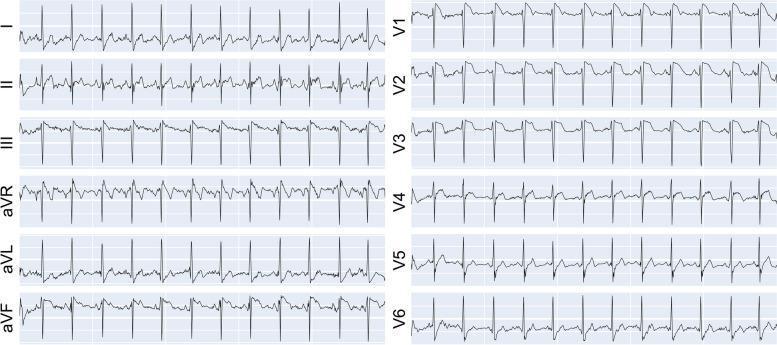
The 12-Lead ECG Layout
A standard 12-lead ECG uses:
- Limb leads: I, II, III, aVR, aVL, aVF (frontal plane)
- Precordial leads: V1–V6 (horizontal plane)
ECG Paper & Calibration
| Measurement | Value |
|---|---|
| Paper speed | 25 mm/sec |
| 1 small box (1 mm) | 0.04 sec horizontally / 0.1 mV vertically |
| 1 large box (5 mm) | 0.20 sec |
| 5 large boxes | 1.0 second |
| Standard voltage | 10 mm = 1 mV |
Step-by-Step Interpretation
1. Rate
Quick method: Count the large boxes between two R waves, then use:
Rate = 300 ÷ (number of large boxes between R peaks)
| Large boxes between R waves | Heart rate |
|---|---|
| 1 | 300 bpm |
| 2 | 150 bpm |
| 3 | 100 bpm |
| 4 | 75 bpm |
| 5 | 60 bpm |
| 6 | 50 bpm |
Normal: 60–100 bpm. <60 = bradycardia. >100 = tachycardia.
2. Rhythm
Ask three questions:
- Where is the pacemaker? — Normal = SA node
- What is the conduction path? — Normal: SA node → AV node → Bundle of His → Purkinje fibers
- Is it regular and at the right rate?
Normal sinus rhythm (NSR) criteria:
- Every QRS is preceded by a P wave
- P wave is upright in leads I and aVF (normal P-wave axis)
- Regular R-R intervals with normal respiratory variation
3. Axis (QRS Axis)
The normal QRS axis in the frontal plane is −30° to +90°.
| Axis | Value |
|---|---|
| Normal | −30° to +90° |
| Left axis deviation (LAD) | More negative than −30° |
| Right axis deviation (RAD) | More positive than +90° |
Quick method: Look at leads I and aVF:
- Both positive → Normal axis
- I positive, aVF negative → Left axis deviation
- I negative, aVF positive → Right axis deviation
- Both negative → Extreme axis deviation
4. Intervals & Waveforms
Waveforms and what they represent
| Waveform | Represents |
|---|---|
| P wave | Atrial depolarization |
| QRS complex | Ventricular depolarization |
| T wave | Ventricular repolarization |
| U wave | Possibly Purkinje repolarization (small, follows T) |
Normal interval values
| Interval | Normal Duration | Clinical Significance |
|---|---|---|
| PR interval | 0.12–0.20 sec (3–5 small boxes) | AV node conduction time |
| QRS duration | <0.12 sec (<3 small boxes) | Ventricular conduction time |
| QT interval | <0.44 sec (rate-corrected) | Ventricular action potential duration |
| QTc (Bazett formula) | ≤0.44 s (males), ≤0.46 s (females) | QT corrected for heart rate |
Bazett formula for QTc:
QTc = QT (sec) ÷ √R-R interval (sec)
5. P-Wave Morphology
- Duration: <0.12 sec in adults
- Amplitude: <2.5 mm (0.25 mV)
- Bifid or broad P → Left atrial enlargement (P mitrale)
- Tall, peaked P >2.5 mm → Right atrial enlargement (P pulmonale)
6. QRS Complex
- Normal duration: <0.12 sec
- R-wave progression (precordial leads): R wave should increase from V1 to V5/V6
- Pathological Q waves: >0.04 sec wide or >1/4 the height of the R wave → suggests prior infarction
- Wide QRS (≥0.12 sec) → Bundle branch block or ventricular origin
7. ST Segment
The ST segment lies between the end of the QRS (J point) and the start of the T wave. Normally it sits at the isoelectric baseline.
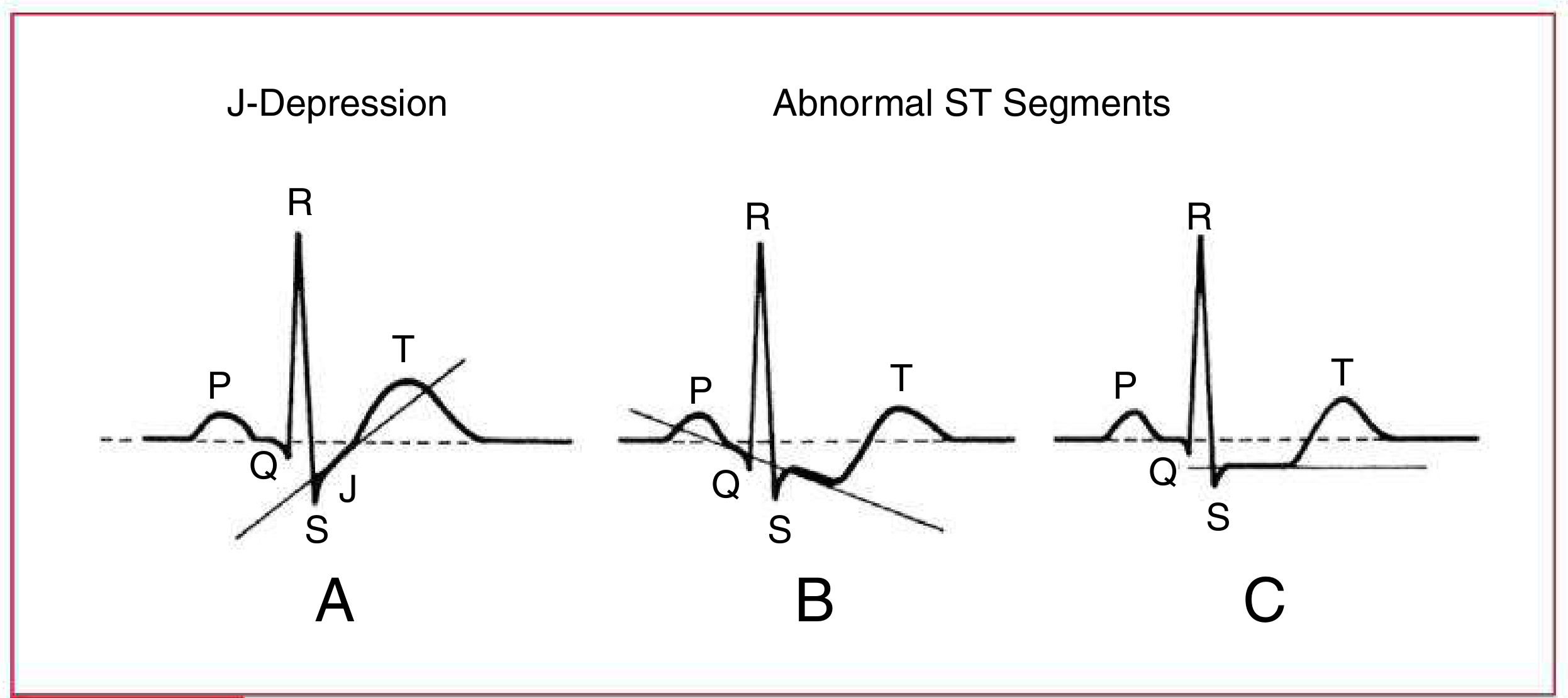
- ST elevation (≥1 mm in limb leads, ≥2 mm in precordial leads) → STEMI until proven otherwise
- ST depression (horizontal or downsloping) → Ischemia or NSTEMI
- J-depression with upsloping ST → Non-ischemic, benign variant
8. T-Wave
- Normally upright in leads I, II, V4–V6
- Normally inverted in aVR (always)
- T inversion in V1–V4 → Right heart strain, RBBB, or ischemia
- Tall, peaked T waves → Hyperkalemia or hyperacute MI
Summary: The 8-Step Checklist
| Step | What to assess |
|---|---|
| 1 | Rate — tachycardia / bradycardia? |
| 2 | Rhythm — sinus? Regular? |
| 3 | Axis — normal / LAD / RAD? |
| 4 | PR interval — prolonged (heart block)? Short (WPW)? |
| 5 | QRS duration — wide (BBB) or narrow? |
| 6 | ST segment — elevation or depression? |
| 7 | T waves — inverted, peaked, or flat? |
| 8 | QTc — prolonged (risk of torsades)? |
Sources: Medical Physiology (Boron & Boulpaep), Box 21-2 | Braunwald's Heart Disease, Ch. 61 | Harriet Lane Handbook, Ch. 7
This is a shared conversation. Sign in to Orris to start your own chat.