
Stents types and moa
Stents - Types and Mechanism of Action
What Is a Stent?
- Prevent elastic recoil - the plaque and vessel wall would spring back inward without scaffolding
- Tack up dissection flaps - balloon inflation creates small intimal tears; the stent holds these against the vessel wall, preventing acute thrombotic closure
- Scaffold the lumen - provides a rigid, permanent conduit
Types of Coronary Stents
1. Bare Metal Stent (BMS)
- Plain metallic mesh; no drug coating
- Material: stainless steel or cobalt-chromium alloys
- MOA: Pure mechanical scaffolding - prevents recoil and seals dissection planes
- Limitation: In-stent restenosis (ISR) in 20-30% of patients within 6-9 months, due to neointimal smooth muscle cell proliferation stimulated by the injury of balloon/stent deployment
- Requires DAPT for minimum 1 month post-implantation
- Now rarely used; largely superseded by DES
2. Drug-Eluting Stent (DES) - First Generation
- Metal scaffold coated with a permanent polymer that releases antiproliferative drugs over 1-3 months
- Drugs used:
- Sirolimus (rapamycin) - a hydrophobic macrolide; binds the cytosolic immunophilin FKBP12; the FKBP12-sirolimus complex inhibits mTOR (mammalian target of rapamycin), blocking the G1-to-S cell cycle progression in smooth muscle cells, thereby inhibiting neointimal proliferation
- Paclitaxel - a tricyclic diterpene; inhibits cellular proliferation by binding to and stabilizing polymerized microtubules, preventing mitotic spindle disassembly and thus arresting cell division
- Result: DES reduces clinical restenosis by 50% vs BMS, bringing symptomatic ISR down to 5-10% in uncomplicated lesions
- Limitation of first-generation DES: Permanent polymers associated with chronic inflammation, delayed endothelialization, and increased risk of late/very late stent thrombosis
- Requires DAPT for minimum 6-12 months
3. Drug-Eluting Stent (DES) - Second Generation
- Uses newer antiproliferative agents on improved polymer platforms
- Drugs used:
- Everolimus - sirolimus derivative; same mTOR inhibition mechanism
- Zotarolimus - another sirolimus derivative; same mechanism
- Biolimus - highly lipophilic sirolimus analogue
- Advantages over first generation: More effective restenosis prevention + fewer complications (especially reduced early and late stent thrombosis)
- Some use biodegradable polymers that dissolve after drug elution is complete, theoretically reducing late inflammation and thrombosis risk
- Nearly 100% of stents placed today are second-generation DES
4. Bioresorbable Vascular Scaffold (BVS) / Biodegradable Stent
- Made of polylactic acid or similar biodegradable material; designed to dissolve over 2-3 years
- First-generation everolimus-eluting BVS showed reasonable short-term safety
- Theoretical advantage: After scaffold resorbs, the vessel can regain vasomotion and normal physiology; eliminates the permanent foreign body
- Clinical setback: Concerns about late and very late stent thrombosis prevented widespread adoption in the US
- Additional next-generation bioresorbable stents are still under investigation
5. Drug-Coated Balloon (DCB)
- Not a stent per se, but a balloon catheter coated with an antiproliferative drug (usually paclitaxel)
- Mechanism: Drug transfers from balloon surface to vessel wall during brief inflation (30-60 seconds); achieves local drug delivery without leaving a permanent implant
- Primary use: Treatment of in-stent restenosis (ISR) within a previously placed stent; also used in small vessels or bifurcations where stent placement is difficult
- No permanent scaffold remains; no DAPT requirement beyond the short healing period
MOA Summary Table
| Stent Type | Scaffold | Drug | Drug Target | MOA |
|---|---|---|---|---|
| BMS | Metal (SS/CoCr) | None | - | Mechanical only |
| 1st-gen DES | Metal + permanent polymer | Sirolimus / Paclitaxel | mTOR / Microtubules | Antiproliferative |
| 2nd-gen DES | Metal + biod. polymer | Everolimus / Zotarolimus / Biolimus | mTOR | Antiproliferative; less thrombogenic |
| BVS | Biodegradable scaffold | Everolimus | mTOR | Antiproliferative + dissolves over time |
| DCB | No stent - balloon only | Paclitaxel | Microtubules | Local drug delivery, no implant |
Key Complications
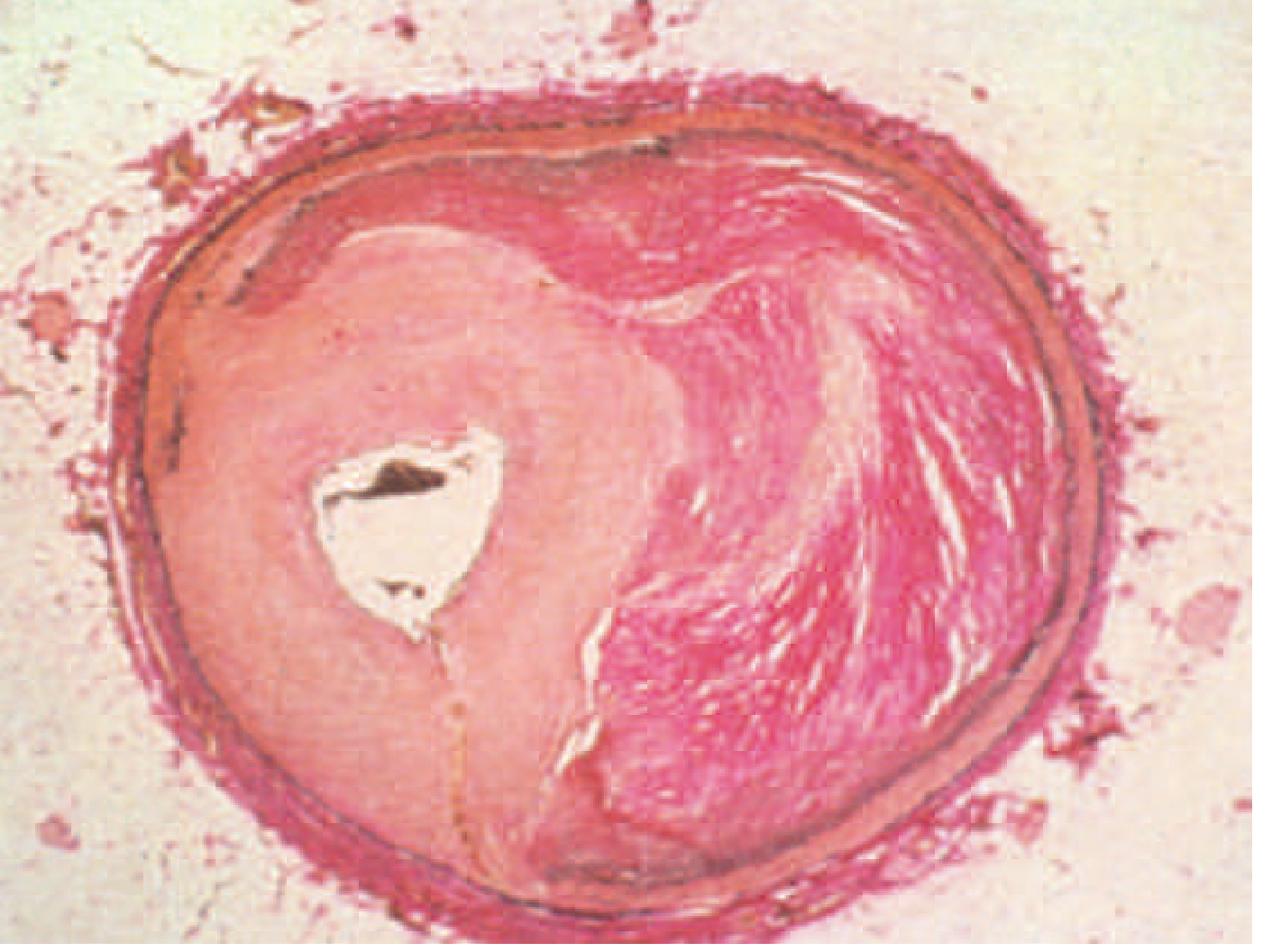
- Result of neointimal hyperplasia (SMC proliferation + matrix deposition in response to injury)
- Occurs more in BMS, diabetics, long stented segments, small arteries
- Presents as recurrence of angina within 12 months
- Histology: fibrocellular occlusion narrowing the lumen (see image below)
- Acute (<24 h): mechanical/procedural complications + inadequate anticoagulation
- Subacute (24 h - 30 days): inadequate platelet inhibition; stopping P2Y12 inhibitor in this window causes 30-100x increased risk
- Late (30 days - 1 year) / Very late (>1 year): principally with DES; associated with delayed endothelialization, neoatherosclerosis
Non-Coronary Stent Contexts (Brief)
- Biliary/GI stents: Self-expanding metal stents (SEMS) or plastic stents to relieve obstructive jaundice, esophageal strictures, or colonic obstruction - purely mechanical
- Ureteral stents: Double-J (pigtail) design; maintains ureteral patency after ureteroscopy or in obstruction
- Airway stents: Silicon or metal; used for tracheal/bronchial stenosis; biodegradable steroid-eluting stents (e.g., mometasone-releasing) available for post-FESS sinonasal surgery
- Vascular/Aortic stents: Nitinol or stainless steel self-expanding or balloon-expandable; used in carotid, renal, iliac, and aortic disease - ISR pattern similar to coronary stents
Stent trails
coronary stent landmark clinical trials
SIRIUS sirolimus stent trial
ABSORB bioresorbable scaffold trial coronary
ISCHEMIA trial percutaneous coronary intervention stable coronary artery disease
TAXUS paclitaxel stent randomized trial
COURAGE trial PCI medical therapy stable angina
SPIRIT XIENCE everolimus stent trial
SYNTAX trial PCI CABG three vessel disease left main
BENESTENT stent balloon angioplasty coronary restenosis
Landmark Stent Trials
ERA 1 - BMS vs Balloon Angioplasty (1990s)
BENESTENT-I (1994) [PMID: 8041413]
- Journal: NEJM | Authors: Serruys PW et al.
- Design: RCT, 520 patients, stable angina with single de novo lesion
- Intervention: Palmaz-Schatz BMS vs balloon angioplasty (PTCA)
- Key Result: Stent reduced angiographic restenosis (22% vs 32%) and event-free survival was better at 7 months
- Significance: One of the two landmark trials (alongside STRESS) that established BMS as superior to PTCA alone and led to routine stent use. 5-year follow-up confirmed continued benefit [PMID: 11345371]
STRESS Trial (1994) - Parallel to BENESTENT
- Stent Restenosis Study; similar design to BENESTENT
- Showed BMS reduced restenosis rate vs balloon angioplasty (31.6% vs 42.1%)
- Together with BENESTENT, changed practice to routine stenting in coronary interventions
ERA 2 - First-Generation DES (2000s)
SIRIUS Trial (2003) [PMID: 14769686]
- Journal: Circulation (1-yr outcomes), JACC (5-yr follow-up PMID: 19389558)
- Design: RCT, 1058 patients, complex de novo native coronary lesions
- Intervention: Sirolimus-eluting stent (Cypher) vs BMS
- Key Results:
- Target lesion revascularization (TLR): 4.1% vs 16.6% at 9 months
- In-stent restenosis: 3.2% vs 35.4%
- No difference in death/MI at 1 year
- 5-year follow-up: Durable benefit in TLR maintained; no excess late mortality
- Significance: Established first-generation sirolimus-eluting DES; FDA approval for Cypher stent followed
TAXUS-IV Trial (2004)
- Design: RCT, 1314 patients
- Intervention: Paclitaxel-eluting stent (TAXUS Express) vs BMS
- Key Results: TLR 3% vs 11.3%; restenosis 5.5% vs 24.4% at 9 months
- Significance: Established paclitaxel-eluting stent; FDA approval for TAXUS stent. Concern later emerged about higher very late stent thrombosis vs sirolimus stent
ERA 3 - Second-Generation DES (2007-2013)
SPIRIT III Trial [PMID: 24239202]
- Design: RCT, XIENCE V everolimus-eluting stent (EES) vs TAXUS paclitaxel stent
- Key Results (5-year): EES showed significantly lower MACE (major adverse cardiac events) and stent thrombosis vs paclitaxel stent
- Significance: Demonstrated second-gen DES superiority over first-gen; everolimus-eluting stents (XIENCE/PROMUS) became global standard
RESOLUTE All-Comers / RESOLUTE China [PMID: 23523240]
- Intervention: Zotarolimus-eluting stent (Resolute Integrity) vs paclitaxel stent
- Key Result: Non-inferior outcomes; established zotarolimus DES as another safe second-generation platform
DES vs BMS Meta-Analysis (Lancet 2019) [PMID: 31056295]
- Individual patient data meta-analysis, 26 RCTs, ~20,000 patients
- Key Finding: DES reduced repeat revascularization and MI vs BMS with no increase in mortality or stent thrombosis at 5-10 years
- Significance: Definitively settled DES vs BMS debate; confirmed DES superiority across all patient subgroups
ERA 4 - PCI vs Surgery / Medical Therapy
COURAGE Trial (2007) [PMID: 17387127]
- Journal: NEJM | Design: RCT, 2287 patients, stable coronary artery disease
- Intervention: PCI + optimal medical therapy (OMT) vs OMT alone
- Key Result: No significant difference in death or non-fatal MI at median 4.6 years (19.0% vs 18.5%)
- Significance: Showed PCI does not reduce hard cardiac events over OMT in stable CAD; however, PCI did improve angina relief and quality of life
ISCHEMIA Trial (2020) [PMID: 32227755]
- Journal: NEJM | Design: RCT, 5179 patients, stable CAD with moderate-severe ischemia
- Intervention: Invasive strategy (PCI/CABG) + OMT vs OMT alone
- Key Result: No significant difference in primary composite outcome (CV death, MI, hospitalization for unstable angina/heart failure/resuscitated cardiac arrest) at median 3.2 years
- Caveat: Invasive strategy showed early hazard (periprocedural MI) but late benefit; superior for angina relief
- Significance: Confirmed COURAGE - routine revascularization for stable CAD does not reduce mortality; OMT is the cornerstone
REVIVED-BCIS2 Trial (2022) [PMID: 36027563]
- Journal: NEJM | Design: RCT, 700 patients, ischemic LV dysfunction (EF ≤35%)
- Intervention: PCI + OMT vs OMT alone
- Key Result: No difference in death or hospitalization for heart failure at 3.4 years
- Significance: Even in patients with viable myocardium and reduced EF, PCI provided no mortality benefit
SYNTAX Trial (2009-2019) [PMIDs: 19228612, 23439102, 31488373]
- Journal: NEJM (initial), Lancet (5-yr and 10-yr follow-up)
- Design: RCT, 1800 patients, 3-vessel or left main CAD
- Intervention: PCI (paclitaxel DES) vs CABG
- Key Results:
- At 1 year: CABG better for MACCE (12.4% vs 17.8%)
- At 5 years: CABG better for repeat revascularization and MI; similar mortality in left main subgroup
- At 10 years: CABG superior in 3-vessel disease (death, MI, stroke); left main outcomes similar
- SYNTAX Score: Angiographic complexity score developed from this trial; high SYNTAX score (>33) = favor CABG
- Significance: Defined role of PCI vs CABG; established that complex 3-vessel disease benefits from surgical revascularization
ERA 5 - Bioresorbable Scaffolds and Novel Devices
ABSORB III Trial (2015) and Meta-Analysis [PMID: 28408454]
- Design: RCT + subsequent meta-analysis, everolimus-eluting BVS (Absorb) vs XIENCE EES
- Key Result: Non-inferior at 1 year, but at 2-3 years BVS showed significantly higher device-oriented failure and stent thrombosis (2-3x higher)
- Significance: Led to withdrawal of Absorb BVS from the US market in 2017; set back the bioresorbable stent field
REC-CAGEFREE I Trial (2026) [PMID: 41194754]
- Journal: JACC | Design: RCT, drug-coated balloon (DCB) vs upfront DES stenting for de novo CAD
- Key Result (3-year follow-up): DCB non-inferior to DES for MACE in de novo lesions
- Significance: First major RCT supporting DCB as an alternative to stenting in de novo lesions (not just ISR) - potentially allowing "leave nothing behind" strategy
INFINITY-SWEDEHEART Trial (2024) [PMID: 39481425]
- Journal: Lancet | Design: Registry-based RCT, bioadaptor stent vs contemporary DES
- Intervention: DynamX bioadaptor (uncages after 4 months to restore vessel motion) vs DES
- Key Result: Non-inferior at 12 months; promising safety profile
- Significance: Emerging evidence for next-generation "adaptive" stent technology
Summary Table
| Trial | Year | Comparison | Key Finding |
|---|---|---|---|
| BENESTENT-I | 1994 | BMS vs PTCA | BMS reduces restenosis |
| STRESS | 1994 | BMS vs PTCA | BMS reduces restenosis |
| SIRIUS | 2003 | Sirolimus DES vs BMS | DES reduces TLR by 75% |
| TAXUS-IV | 2004 | Paclitaxel DES vs BMS | DES reduces restenosis |
| SPIRIT III | 2007-13 | EES (everolimus) vs TAXUS | 2nd-gen DES superior to 1st-gen |
| COURAGE | 2007 | PCI+OMT vs OMT | No mortality benefit of PCI in stable CAD |
| SYNTAX | 2009-19 | PCI vs CABG (3VD/LM) | CABG better for complex 3VD; similar LM |
| DES vs BMS meta | 2019 | DES vs BMS | DES superior; no late thrombosis risk |
| ISCHEMIA | 2020 | Invasive vs OMT | No mortality benefit of routine revascularization |
| ABSORB III | 2015 | BVS vs EES | BVS: higher late stent thrombosis |
| REVIVED-BCIS2 | 2022 | PCI vs OMT (LV dysfunction) | No benefit of PCI in ischemic cardiomyopathy |
| REC-CAGEFREE I | 2026 | DCB vs DES (de novo) | DCB non-inferior to DES |
How do dual antiplatelet therapy (DAPT) guidelines differ by stent type and clinical scenario?
"dual antiplatelet therapy" duration stent guidelines
DAPT antiplatelet ACS coronary ACC AHA ESC guideline 2023 2024
short DAPT 1 month 3 month drug eluting stent ACS high bleeding risk
PMID: 39382876
PMID: 40963197
extended DAPT beyond 12 months stent high ischemic risk benefit bleeding
DAPT Guidelines: By Stent Type and Clinical Scenario
The Purpose of DAPT After Stenting
The P2Y12 Inhibitors Used in DAPT
| Drug | Class | Mechanism | Key Points |
|---|---|---|---|
| Clopidogrel 75 mg/day | Thienopyridine (prodrug) | Irreversible P2Y12 blockade after CYP2C19 conversion | Variable response due to CYP2C19 polymorphisms; preferred in elderly, low-weight, prior stroke/TIA |
| Prasugrel 10 mg/day (5 mg if >75yr or <60 kg) | Thienopyridine (prodrug) | Faster, stronger, more uniform P2Y12 blockade | Contraindicated if prior stroke/TIA; superior to clopidogrel in ACS-PCI (TRITON-TIMI 38); only after coronary anatomy known |
| Ticagrelor 90 mg BD | Non-thienopyridine (direct) | Reversible direct P2Y12 blockade; no prodrug activation needed | Preferred in ACS (mortality advantage over clopidogrel; PLATO); ASA maintenance dose must be <100 mg; caution in bradycardia/severe reactive airways |
| Cangrelor IV | Non-thienopyridine (direct) | IV, ultra-rapid onset (<2 min), short offset (~1 hr) | Bridge strategy perioperatively; FDA-approved only for PCI patients |
DAPT Duration by Stent Type
Bare Metal Stent (BMS)
- Minimum DAPT: 1 month (ACC/AHA 2016)
- After 1 month, aspirin monotherapy indefinitely
- ESC 2022 guidelines make no specific BMS recommendations (largely obsolete)
- Rationale: BMS re-endothelializes faster than DES; 1 month is sufficient to bridge the thrombotic risk window
First-Generation DES (Cypher/TAXUS)
- DAPT: 12 months minimum
- Permanent polymer causes delayed endothelialization and chronic inflammation, extending the vulnerable period for late/very late stent thrombosis
- Largely replaced; rarely implanted today
Second-Generation DES (Current Standard)
- Stable CAD (elective PCI): 6 months (ACC/AHA 2016; ESC 2022)
- ACS (STEMI or NSTEMI/UA): 12 months from index event
- Evidence suggests extended DAPT (up to 30 months) provides additional anti-ischemic benefit but at the cost of more bleeding - the trade-off must be individualized
- High bleeding risk with second-gen DES: As short as 1 month DAPT is acceptable based on accumulating evidence, because stent thrombosis is now much less common with modern polymer-free or biodegradable polymer platforms
DAPT by Clinical Scenario
1. Stable CAD / Elective PCI
- Standard: Aspirin + clopidogrel for 6 months, then aspirin alone indefinitely
- Preferred P2Y12: clopidogrel (ticagrelor/prasugrel offer no proven mortality benefit in stable CAD)
- Evidence from COURAGE: OMT is primary; PCI does not reduce death/MI in stable CAD but does relieve angina
2. NSTEMI / Unstable Angina (UA)
- DAPT for 12 months regardless of whether PCI performed or managed medically
- Loading dose of ASA 162-325 mg immediately, then 81 mg/day
- Preferred P2Y12: ticagrelor (mortality advantage; Washington Manual: "preferred P2Y12 inhibitor of choice") or prasugrel (only after coronary anatomy known and PCI planned)
- Clopidogrel: used when ticagrelor/prasugrel are contraindicated or unavailable
- Prasugrel: NOT for pre-treatment before knowing coronary anatomy; contraindicated if prior stroke/TIA; only use after PCI decision is made
3. STEMI (Primary PCI)
- DAPT for 12 months minimum
- Loading doses at first medical contact: ASA 162-325 mg + P2Y12 (ticagrelor 180 mg OR prasugrel 60 mg preferred; clopidogrel 600 mg if others unavailable)
- Anticoagulation during procedure: UFH, enoxaparin, or bivalirudin (direct thrombin inhibitor)
- GpIIb/IIIa inhibitors (eptifibatide, tirofiban) reserved for large thrombus burden or bailout; not routine
- ESC 2022: Ideal interval before non-cardiac surgery after PCI for ACS = 12 months on DAPT; can be reduced to 3 months with newer-gen DES if time-sensitive surgery is needed
4. High Bleeding Risk (HBR)
- Shortened DAPT: 1-3 months
- ARC-HBR criteria define high bleeding risk (e.g., recent major bleeding, anticoagulation need, severe CKD, thrombocytopenia, advanced age)
- After short DAPT, transition to P2Y12 inhibitor monotherapy (preferably high-potency: ticagrelor) rather than aspirin alone
- JAMA Cardiology 2024 network meta-analysis [PMID: 39382876] (35,326 ACS patients, 15 RCTs):
- 1 month DAPT followed by P2Y12 monotherapy reduced major bleeding by 53% (RR 0.47) vs 12-month DAPT with no difference in MACCE
- 3-month DAPT followed by P2Y12 monotherapy ranked best for reducing MACCE (RR 0.85)
- Note: evidence mainly applies when potent P2Y12 (ticagrelor) is used for monotherapy phase
- Catheter Cardiovasc Interv 2025 meta-analysis [PMID: 40963197] (53,421 patients, 13 RCTs):
- Short DAPT (≤3 months) significantly decreased net adverse clinical events (NACE) (RR 0.80) without impacting MACE
- 3-month duration outperformed 1-month; monotherapy with high-potency P2Y12 preferred over aspirin
5. High Ischemic Risk / Extended DAPT (>12 months)
- Patients with prior MI + complex anatomy (multivessel, bifurcation, left main, long stents, diabetes, CKD)
- DAPT Score (calculates benefit vs bleeding of extended therapy): score ≥2 = benefit from extended DAPT; score <2 = excess bleeding harm
- Extended DAPT up to 30 months: additional reduction in MI and stent thrombosis but increased major bleeding - individualize based on bleeding and ischemic risk profile
- DAPT Trial (2014): 30 months vs 12 months - MI reduction but more bleeding and all-cause mortality (mainly non-cardiac)
6. Concurrent Oral Anticoagulation (AF + PCI) - "Triple Therapy"
- Patients with AF on OAC who need DAPT post-stent present the highest bleeding risk
- Triple therapy (OAC + aspirin + P2Y12): Recommended for only 1 month regardless of stent type
- ESC recommendation (Class IIa): After 1 month, transition to dual therapy: OAC + clopidogrel (drop aspirin) for up to 12 months
- After 12 months: OAC monotherapy
- Prefer NOAC over VKA (lower bleeding risk in AF-PCI setting; PIONEER-AF, RE-DUAL PCI, AUGUSTUS trials)
- Prefer clopidogrel over ticagrelor/prasugrel during dual/triple therapy (lower bleeding)
7. Perioperative / Surgery After PCI
| Scenario | Minimum Wait Before Surgery | DAPT Action |
|---|---|---|
| BMS | ≥30 days | Continue aspirin; restart P2Y12 ASAP post-op |
| DES - Elective PCI | ≥3-6 months (ideally 6 mo) | Continue aspirin; restart P2Y12 ASAP |
| DES - ACS indication | ≥12 months (can reduce to 3 mo with new-gen DES if urgent) | Continue aspirin; restart P2Y12 ASAP |
| Emergency surgery | Bridge with IV cangrelor (if needed); continue aspirin | Do NOT use heparin bridge - paradoxically increases platelet aggregation |
Key Algorithmic Framework
Post-PCI Stent
       |
       ├── Stable CAD + DES → DAPT 6 months → Aspirin indefinitely
       |
       ├── ACS + DES → DAPT 12 months → Aspirin indefinitely
       |        |
       |        └── High ischemic risk → Consider extended DAPT (up to 30 months)
       |
       ├── High Bleeding Risk → Shorten DAPT to 1-3 months → P2Y12 monotherapy (ticagrelor preferred)
       |
       ├── AF + Anticoagulation → Triple therapy 1 month → OAC + clopidogrel up to 12 months → OAC alone
       |
       └── BMS → DAPT 1 month minimum → Aspirin indefinitely
De-escalation Strategies (Emerging Evidence)
- Early aspirin dropout - Drop aspirin after 1-3 months; continue P2Y12 inhibitor alone (TWILIGHT, TICO, STOPDAPT-2 trials)
- P2Y12 de-escalation - Switch from potent P2Y12 (ticagrelor/prasugrel) to clopidogrel after 1 month; validated by TROPICAL-ACS (PFT-guided) and TALOS-AMI trials (Class IIb, LOE A in ESC guidelines)
- Dual pathway inhibition - Replace DAPT with antiplatelet (aspirin) + low-dose DOAC (rivaroxaban 2.5 mg BD; from COMPASS trial); for post-ACS patients at low bleeding risk