
Give me the notes of migraine medicine topic, detailed notes.
Reading File
Finding Sources
Finding Sources
Good. Now let me read the most relevant pharmacology sources in parallel — Goodman & Gilman, Katzung, Lippincott, Harrison's, and Adams & Victor's Neurology.
Reading File
Reading File
Reading File
Reading File
Excellent — good content from all sources. Let me now read more from Harrison's (acute attack therapies + preventive) and Lippincott (more on triptans + ergots + CGRP + prophylaxis), plus read the Adams & Victor section.
Reading File
Reading File
Reading File
Excellent content from Harrison's (acute + preventive treatments) and Adams & Victor's. Let me now grab more detail on:
- Ergotamine/DHE (Goodman & Gilman / Katzung)
- CGRP gepants & lasmiditan (Katzung continuation)
- Prophylaxis agents detail (Harrison's continuation)
Reading File
Reading File
Reading File
I have very rich content now. Let me read the final part of the Lippincott migraine section (gepants + CGRP monoclonal antibodies + prophylaxis) and Harrison's preventive treatments section.
Reading File
Reading File
I now have comprehensive content to compile detailed notes. Let me also fetch the Lippincott migraine drug flowchart image that was referenced.
Loading Image
I now have all the material needed to write comprehensive notes. Here are the detailed migraine medicine notes:
🧠 Migraine Medicine — Detailed Notes
1. Overview & Classification
Migraine is a prevalent, largely familial neurological disorder affecting 10–20% of the population. It is characterized by periodic, commonly unilateral, pulsatile headaches that begin in childhood, adolescence, or early adult life. Women are 3× more likely than men to be affected.
Two main clinical types (IHS classification):
| Type | Features |
|---|---|
| Migraine without aura (Common migraine) | Unheralded onset; severe, unilateral, throbbing; lasts 4–72 h; accompanied by nausea, photophobia, phonophobia, aggravated by movement |
| Migraine with aura (Classic migraine) | Preceded by neurological symptoms (aura), usually visual (flashes, zigzag lines, glare); aura lasts ~20–40 min before headache |
Diagnostic criteria (IHS):
Repeated attacks lasting 4–72 h with ≥2 of: unilateral pain, throbbing, aggravated by movement, moderate/severe intensity — PLUS ≥1 of: nausea/vomiting, photophobia & phonophobia.
2. Pathophysiology
2a. Vascular & Neural Mechanisms
- Migraine with aura: begins as cortical spreading depression — hypoperfusion spreading forward over the cortex, persisting through the aura and into the headache phase
- Migraine without aura: no hypoperfusion, but pain arises from extracranial and intracranial arterial vasodilation
- Vasodilation leads to release of neuroactive molecules: substance P, neurokinin A, and CGRP (calcitonin gene-related peptide)
2b. Serotonin (5-HT) Hypothesis
Evidence implicating 5-HT:
- Plasma/platelet 5-HT concentrations vary with migraine phases
- Urinary 5-HT and metabolites are elevated during most attacks
- Migraine can be precipitated by agents that release 5-HT (e.g., reserpine, fenfluramine)
- 5-HT1B/1D receptor agonists (triptans) are highly effective acutely
2c. CGRP Role
- CGRP is a potent vasodilatory and proinflammatory neuropeptide
- Plasma CGRP levels are elevated during acute migraine attacks
- Successful triptan treatment correlates with decreased blood levels of CGRP
- CGRP blockade is now a central therapeutic strategy
2d. Brainstem Involvement
- PET studies show hypothalamic, dorsal midbrain, and dorsolateral pontine activation during migraine (including the noradrenergic locus coeruleus)
- Lateralization of pontine changes correlates with side of head pain in hemicranial migraine
3. Acute Treatment of Migraine
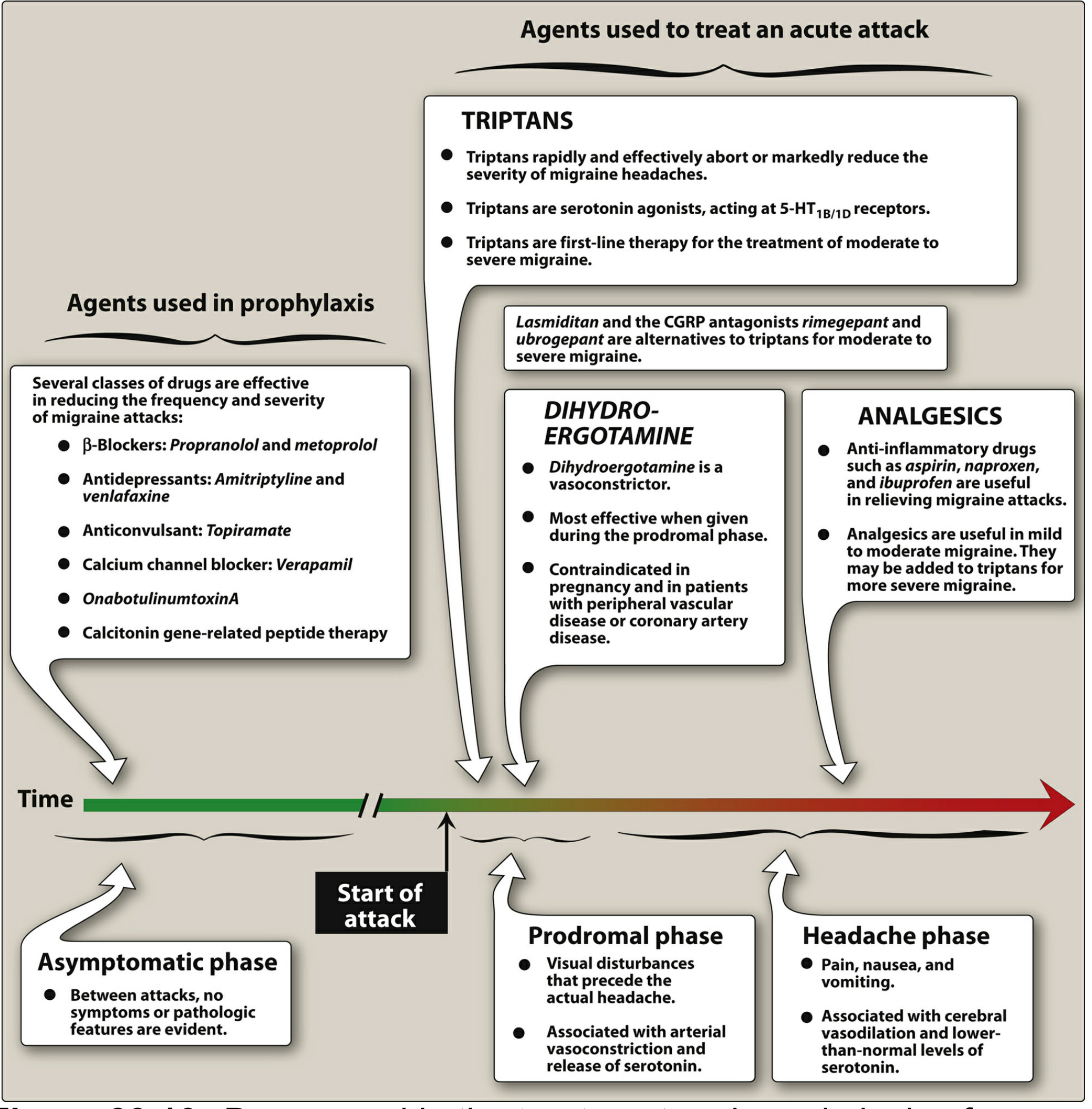
Strategy
- Nonspecific (symptomatic): NSAIDs, analgesics, antiemetics
- Migraine-specific: Triptans, ergot alkaloids, ditans (lasmiditan), CGRP receptor antagonists (gepants)
3.1 Triptans (5-HT1B/1D Receptor Agonists) — First-Line
Agents: Sumatriptan (prototype), almotriptan, eletriptan, frovatriptan, naratriptan, rizatriptan, zolmitriptan
Mechanism:
- Potent agonists at 5-HT1B and 5-HT1D receptors
- Two proposed mechanisms:
- Vasoconstriction of intracranial blood vessels (including AV anastomoses), restoring normal blood flow
- Presynaptic inhibition — block release of proinflammatory neuropeptides (substance P, CGRP) at trigeminal perivascular nerve terminals
Clinical use:
- Effective for acute treatment of migraine with or without aura
- NOT for prophylaxis
- Start treatment as soon as possible after headache onset
- Effective in ~70% of patients
- Sumatriptan 6 mg SC: onset ~20 min; oral: 1–2 h
- Frovatriptan has the longest half-life (>24 h) — useful for menstrual migraine
- Headache may recur within 24–48 h; a second dose is usually effective
Available formulations:
- Sumatriptan: SC injection (fastest), intranasal, oral, oral + naproxen combination
- Zolmitriptan: oral tablet or nasal spray
- All others: oral only
Adverse effects:
- Chest, neck, throat, jaw pressure/pain sensations
- Dizziness, malaise
- Elevated blood pressure
Contraindications:
- Coronary artery disease (or significant risk factors without prior cardiac evaluation) — due to coronary vasospasm risk
- Do not use within 24 h of ergot alkaloids — risk of coronary ischemia
3.2 Ergot Alkaloids
Agents: Ergotamine, Dihydroergotamine (DHE)
Mechanism:
- Complex action at 5-HT1 receptors, α-adrenergic receptors, and dopamine receptors
- 5-HT1 agonism on intracranial blood vessels → vasoconstriction
Ergotamine:
- Available sublingually, orally (+ caffeine), suppository
- Most effective in early stages of migraine
- Strict daily and weekly dosage limits due to risk of dependence and rebound headaches
Dihydroergotamine (DHE):
- IV or intranasal
- Efficacy similar to sumatriptan
- Reserved for severe migraine
- Common adverse effect: nausea
- IV protocol for severe migraine in ED: prochlorperazine 5 mg + DHE 0.5 mg over 2 min
Contraindications:
- Angina and peripheral vascular disease (significant vasoconstrictors)
- Pregnancy
- Do not combine with strong CYP3A4 inhibitors — risk of life-threatening peripheral ischemia
3.3 Ditans — Lasmiditan (5-HT1F Agonist)
Mechanism:
- Selective 5-HT1F receptor agonist
- Reduces activation of trigeminal nerve system pain pathways
- Does NOT cause vasoconstriction — unlike triptans and ergots
Clinical use:
- Oral agent for acute migraine
- Indicated for patients with contraindications or intolerance to triptans (e.g., cardiovascular disease)
Adverse effects / Special considerations:
- Potential for abuse — classified as a controlled substance
- Can cause significant driving impairment — patients must avoid hazardous activities
3.4 CGRP Receptor Antagonists (Gepants)
Agents:
- Ubrogepant — acute treatment only
- Rimegepant — acute treatment AND prevention
- Atogepant — prevention only
- Vazgepant (intranasal) — investigational for acute treatment
Mechanism:
- Block CGRP receptor signaling, reducing vasodilation and neuroinflammation in the trigeminal system
Clinical use:
- Oral agents indicated for acute migraine in patients with contraindications or intolerance to triptans
- Rimegepant and atogepant also used for prevention
Adverse effects:
- Nausea, somnolence (incidence is low)
Drug interaction:
- Ubrogepant: contraindicated with strong CYP3A4 inhibitors
3.5 NSAIDs and Analgesics
- Both the severity and duration of a migraine attack can be reduced significantly by NSAIDs
- Agents: ibuprofen, naproxen, aspirin, indomethacin, ketorolac, diclofenac
- Naproxen combined with sumatriptan (Treximet) is FDA-approved
- For mild to moderate migraine: combination of acetaminophen + aspirin + caffeine is FDA-approved
- Useful adjunct with triptans for more severe migraine
3.6 Antiemetics / Dopamine Receptor Antagonists
- Drug absorption is impaired during migraine (reduced gastric motility), even without overt nausea
- Oral dopamine antagonists (metoclopramide 10 mg, prochlorperazine 10 mg, domperidone 10 mg) enhance gastric absorption of co-administered drugs AND reduce nausea
- Parenteral forms (chlorpromazine, prochlorperazine, metoclopramide IV/IM) can provide significant acute migraine relief; can be combined with parenteral triptans/DHE
- RCT evidence shows prochlorperazine is superior to hydromorphone in ED setting
3.7 Opioids
- Modestly effective; IV meperidine 50–100 mg used in ED
- Not recommended for recurrent headache:
- Do not address underlying headache mechanism
- May decrease future triptan response
- Opioid craving/withdrawal can worsen migraine
- Reserve for: severe but infrequent headaches unresponsive to other approaches, or when other therapies are contraindicated
3.8 Neuromodulation (Acute)
- Single-pulse transcranial magnetic stimulation (sTMS): FDA cleared; 2 pulses at attack onset
- Non-invasive vagus nerve stimulator (nVNS): FDA cleared; 1–2 doses of 120 s each
- Remote electrical neuromodulation: smartphone-app-controlled stimulation of upper arm, 30–45 min
- Transcutaneous supraorbital nerve stimulation: 60 min
- These offer non-pharmaceutical options
4. Preventive (Prophylactic) Treatment of Migraine
When to Initiate Prophylaxis
- ≥4 migraine days/month
- Attacks unresponsive or poorly responsive to acute treatments
- Attacks causing significant disability or neurologic compromise
General principles
- Most agents must be taken daily
- Lag of 2–12 weeks before effect is seen
- Once effective, continue for 6–12 months, then slowly taper
- Probability of success with any one drug: ~40–50%
- Topiramate and valproate are now less attractive in females of reproductive age (fetal developmental concerns)
Harrison's Table: Preventive Treatments in Migraine
| Drug | Dose | Selected Side Effects |
|---|---|---|
| Propranolol (β-blocker) | 40–120 mg bid | Reduced energy, tiredness, postural hypotension; contraindicated in asthma |
| Metoprolol (β-blocker) | 25–100 mg bid | Same as above |
| Amitriptyline (TCA) | 10–75 mg at night | Drowsiness |
| Nortriptyline (TCA) | 25–75 mg at night | Drowsiness |
| Venlafaxine (SNRI) | 75–150 mg/d | — |
| Topiramate (anticonvulsant) | 25–200 mg/d | Paresthesias, cognitive symptoms, weight loss, glaucoma |
| Valproate (anticonvulsant) | — | Weight gain, teratogenic |
| Verapamil (CCB) | — | — |
| Erenumab (anti-CGRP mAb) | SC monthly | — |
| Fremanezumab (anti-CGRP mAb) | SC monthly or quarterly | — |
| Galcanezumab (anti-CGRP mAb) | SC monthly | — |
| Eptinezumab (anti-CGRP mAb) | IV quarterly | — |
| Rimegepant (gepant) | Oral | Nausea |
| Atogepant (gepant) | Oral | Nausea |
| OnabotulinumtoxinA (Botox) | — | Approved for chronic migraine only (negative in episodic migraine trials) |
4.1 Beta-Blockers — Drugs of Choice for Prophylaxis
- Propranolol and metoprolol are the first-line agents
- Mechanism in migraine prophylaxis is not entirely clear (likely not serotonin-related)
- Contraindicated in asthma, heart block, severe depression
4.2 Antidepressants
- Amitriptyline (TCA): most studied; effective regardless of comorbid depression
- Nortriptyline, venlafaxine: alternatives
- Low doses used; benefit unrelated to antidepressant effect
4.3 Anticonvulsants
- Topiramate and Divalproex/valproate: FDA-approved for migraine prevention
- Topiramate: paresthesias, cognitive slowing ("cognitive fog"), weight loss, angle-closure glaucoma
- Valproate: weight gain, teratogenicity — avoid in pregnancy and reproductive-age women
4.4 Calcium Channel Blockers
- Verapamil — used especially when other agents fail or are contraindicated
4.5 CGRP Monoclonal Antibodies (Anti-CGRP mAbs)
- Erenumab (targets CGRP receptor), fremanezumab, galcanezumab, eptinezumab (target CGRP ligand)
- Subcutaneous (monthly or quarterly) except eptinezumab (IV quarterly)
- Highly effective; often work within the first month
- Excellent tolerability profile
- Have significantly changed the landscape of preventive treatment
4.6 OnabotulinumtoxinA (Botox)
- FDA-approved for chronic migraine only (≥15 headache days/month)
- Placebo-controlled trials in episodic migraine were negative
- Injected into pericranial and neck muscles every 12 weeks
4.7 Other Agents
- Candesartan (ARB): shows preventive efficacy; well-tolerated
- Cyproheptadine: significant 5-HT antagonism; used especially in children
- Melatonin: controlled trial evidence; not FDA-approved for this indication
- Phenelzine (MAOI): reserved for very refractory cases; tyramine-containing foods contraindicated
5. Medication-Overuse Headache (MOH)
- Acute medications, especially opioids and barbiturate-containing analgesics, can aggravate headache frequency
- Results in refractory daily or near-daily headache (transformation of migraine)
- Patients with ≥2 headache days/week should be counseled about frequent analgesic use
- MOH is not a separate entity — it reflects migraine biology's reaction to certain medications
6. Special Situations
Menstrual Migraine (Catamenial Migraine)
- In ~15% of female migraineurs, attacks are exclusively perimenstrual
- Related to estrogen withdrawal (though hormonal influence is complex)
- Frovatriptan (longest-acting triptan, t½ >24 h) is particularly useful for perimenstrual prophylaxis
Migraine in Pregnancy
- Migraine tends to improve in 2nd and 3rd trimester in 75–80% of women
- Topiramate and valproate are contraindicated in pregnancy
- DHE is contraindicated in pregnancy
- NSAIDs generally avoided in 3rd trimester
Migraine with Cardiovascular Risk Factors
- Triptans require cardiac evaluation before use in patients with CAD risk
- Lasmiditan is preferred as it causes no vasoconstriction
- Gepants are also an option (no vasoconstriction)
7. Summary Table: Acute Treatment
| Drug Class | Mechanism | Use Case | Key Caution |
|---|---|---|---|
| Triptans | 5-HT1B/1D agonist | First-line, moderate–severe | CVD contraindication; no ergots within 24 h |
| Ergotamine/DHE | 5-HT1/α/DA agonist | Severe/refractory | CVD, pregnancy, CYP3A4 inhibitors |
| Lasmiditan | 5-HT1F agonist | Triptan-intolerant/CVD | Controlled substance; driving impairment |
| Gepants (ubrogepant, rimegepant) | CGRP receptor antagonist | Triptan-intolerant; also prevention | CYP3A4 interaction |
| NSAIDs | COX inhibition | Mild–moderate; adjunct | GI side effects |
| Antiemetics (metoclopramide, prochlorperazine) | DA antagonist | Adjunct; restore GI motility | Extrapyramidal effects |
| Opioids | μ-receptor agonist | Last resort | Dependency; MOH risk |
8. Summary Table: Prophylactic Treatment
| Drug Class | Examples | Notes |
|---|---|---|
| β-Blockers (1st line) | Propranolol, metoprolol | Avoid in asthma |
| Tricyclics | Amitriptyline, nortriptyline | Helpful with comorbid insomnia/depression |
| SNRI | Venlafaxine | Alternative antidepressant |
| Anticonvulsants | Topiramate, valproate | Avoid valproate in reproductive-age women |
| CCB | Verapamil | Second-line |
| CGRP mAbs | Erenumab, fremanezumab, galcanezumab, eptinezumab | Rapid onset, excellent tolerance; game-changer |
| Gepants | Rimegepant, atogepant | Oral; dual acute + prophylactic (rimegepant) |
| Botulinum toxin A | OnabotulinumtoxinA | Chronic migraine only |
| Others | Candesartan, cyproheptadine, melatonin | Off-label but evidence-based |
Sources:
- Lippincott Illustrated Reviews: Pharmacology — Ch. 39
- Goodman & Gilman's Pharmacological Basis of Therapeutics — Ch. 5 (5-HT drugs)
- Harrison's Principles of Internal Medicine 22e — Ch. 441
- Adams and Victor's Principles of Neurology, 12e — Ch. on Headache
- Katzung's Basic and Clinical Pharmacology, 16e — CGRP section
This is a shared conversation. Sign in to Orris to start your own chat.